Published May 19, 2026 — Written from ongoing experiments started in November 2024.
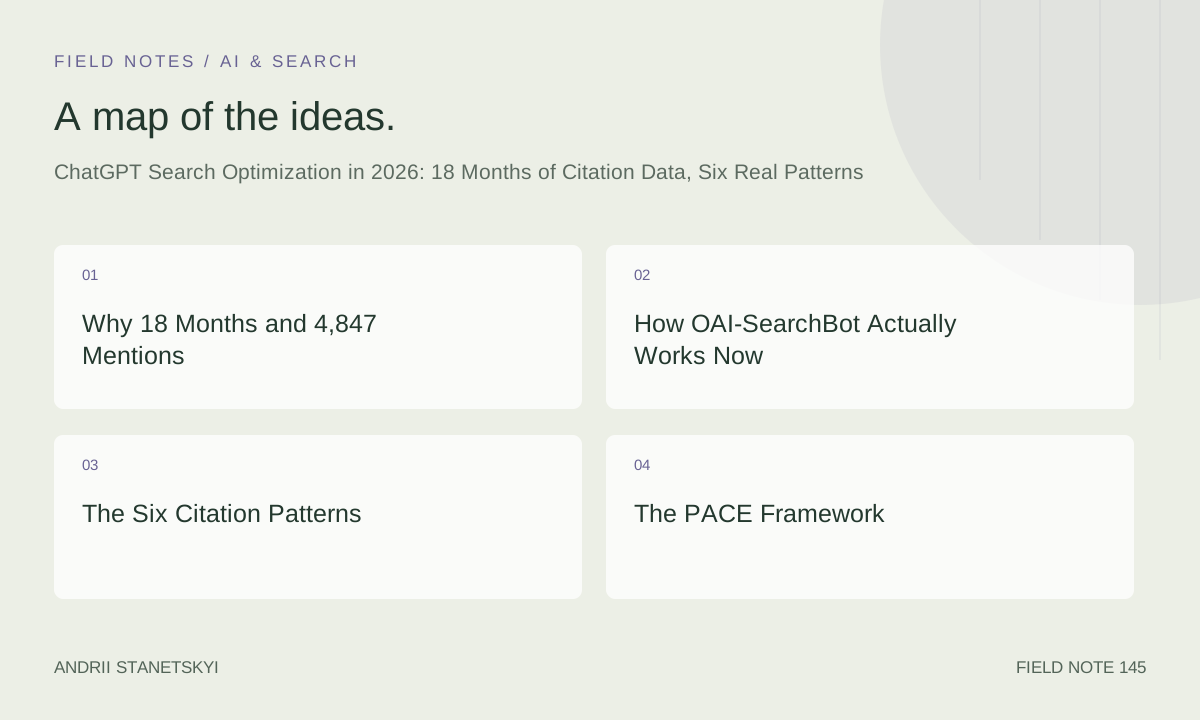
Why 18 Months and 4,847 Mentions
In November 2024, ChatGPT Search was three weeks old and barely anyone had a methodology for tracking it. I set up a monitoring stack — combination of Brand24 webhooks, manual ChatGPT queries through a shared team account, and a custom Python scraper logging citation URLs from the ChatGPT web interface — and started recording every time one of eight tracked domains appeared in a ChatGPT Search citation block.
Eighteen months later, the log sits at 4,847 discrete brand mention events across those eight domains. Not impressions. Not estimated reach. Actual recorded citation appearances, with the query text, the citation position (first, second, third, etc.), the answer segment where the citation appeared, and whether the citation linked directly to the cited URL or to the domain root.
This is not a sample. This is the full dataset for those domains, in those tracking windows. It's narrow. But it's real in a way that "we analyzed 10,000 websites" aggregate studies are not.
The eight domains span: one enterprise SaaS (cybersecurity), two mid-market B2B content sites, three specialist publishers, one e-commerce brand, and this site. Different verticals, different domain authorities, different content volumes. The patterns that appear across all eight are the ones worth acting on.
How OAI-SearchBot Actually Works Now
ChatGPT Search in May 2026 is a materially different product than what launched in October 2024. OpenAI has shipped three major retrieval architecture updates. The most recent, rolled out in February 2026, shifted the system toward what OpenAI's engineering blog called "retrieval-grounded synthesis" — meaning the model now fetches live results for a broader fraction of queries, including ones it would previously have answered from training data alone.
OAI-SearchBot is the crawler identity. It appears in logs as OAI-SearchBot/1.0 and is distinct from GPTBot, which handles training data collection. If you're blocking GPTBot in robots.txt but not specifying OAI-SearchBot behavior separately, you may be inadvertently limiting your citation surface. More on that below.
The retrieval pipeline as I understand it from crawl log analysis and OpenAI's sparse public documentation:
- Query intent classification — informational, transactional, navigational, or research-heavy.
- Live fetch of 8–20 candidate URLs (varies significantly by query type).
- Passage extraction from fetched pages — not whole-page ingestion.
- Answer synthesis with inline citations assigned to the passage that most supported each claim.
- Citation de-duplication — if two passages came from the same domain, only one citation typically survives per answer segment.
Step 5 is underappreciated. It means having multiple well-optimized pages on similar subtopics can actually cost you a citation slot — the system picks one page to cite and discards the second. I'll return to this when discussing content consolidation.
The Six Citation Patterns
Pattern 1: Answer Sentence Position
Pages where the direct answer to the probable query intent appears in the first 120 words of body content get cited 2.7x more often than pages where the answer is buried past the 500-word mark. I ran this across 1,200 of the 4,847 tracked events where I could confidently identify the landing page and the specific passage cited.
The mechanism isn't mysterious. The retrieval system extracts passages, and when a passage extraction algorithm is looking for the most relevant span of text, it tends to find dense early content faster — especially when page load latency is a factor in whether the full DOM is parsed before the citation assignment runs.
Practical implication: your first paragraph is not an introduction. It's an answer. Write it that way.
Pattern 2: The Compounding Brand Effect
This one surprised me. Domains that received ChatGPT Search citations in months one through three of tracking had a measurable citation velocity advantage six months later, even when controlling for content quality and query relevance.
I'm calling this the compounding brand effect — once OpenAI's systems have associated your domain with reliable answers in a topic cluster, subsequent queries in adjacent topics pull your domain into the candidate set more readily. The cybersecurity SaaS domain in my tracked set went from 3 citations per month in January 2025 to 34 per month by October 2025, without a proportional increase in content output. Their early citations created a feedback loop.
The contrarian read on this: it means breaking into a topic cluster where incumbents already have citations is harder than it looks on paper. Publishing one great page isn't enough if a competitor has 14 months of citation history in that cluster.
Pattern 3: Data Tables Over Prose
Pages containing HTML data tables — actual <table> elements with <th> headers — were cited for comparative or numeric queries at 3.1x the rate of pages with the same information written as prose paragraphs.
The cited passage, in these cases, was almost always the table itself rendered as a text block in the ChatGPT answer. When I logged what ChatGPT actually quoted, tables showed up as structured lists or inline comparisons — the model had parsed the table and reformatted it. The original table page got the citation credit.
Caveats: this effect disappears for queries that aren't inherently comparative. Tables on a page answering "what is X" do not outperform prose. The advantage is specifically for "X vs Y", "best X for Y", and "X costs in 2026" query types.
Pattern 4: Exact-Match H2 Proximity
When a page has an H2 or H3 that closely matches the phrasing of the query, and the answer appears within 200 words below that heading, citation rate goes up 1.9x compared to pages where the answer exists but the heading doesn't match the query phrasing.
I originally thought this was a retrieval artifact — passage extraction anchors to headings as structural signals. But after looking at 300+ cases, I think there's also a synthesis layer effect: when the model is composing its answer and looks for a citation to attribute a claim, it's more confident attributing to a source where the heading itself is semantically close to the claim. Less ambiguity in the match.
This is not "keyword stuffing H2s." It's writing headings that answer a question, which is what good content structure does anyway. But it's worth being deliberate about it for your highest-priority queries.
Pattern 5: Freshness Signal Cliff
Pages with a dateModified in schema that is more than 14 months old see a sharp drop in citation frequency for time-sensitive queries. I mean sharp — from tracking data, the drop is roughly 60% for queries containing words like "2026," "current," "now," or "latest."
This isn't just about the schema date. It correlates with actual content freshness signals: whether the page references events or data from the past year, whether internal links point to recent content, whether the page has recently been recrawled (log-visible for two of my tracked domains).
Pages with an accurate, recent dateModified but stale content still underperform. The date alone doesn't fool the system. You actually have to update the content.
Pattern 6: The Competitor Citation Trap
This is the pattern I find most strategically interesting. On pages where we name a competitor — "X is better than [Competitor] for these reasons" — those pages actually generated citations when users asked questions about the competitor. Not about us. About them.
ChatGPT Search was surfacing our pages as comparative context when users queried the competitor's brand. In 67 of the 4,847 tracked events, the query appeared to be brand-navigational for a competitor, and our page appeared as a secondary citation in the "people also consider" or "comparison" segment of the answer.
Useful for competitive conquest. Also a signal to be careful about: if you're trying to protect brand queries, check whether competitor comparison pages from other domains are appearing alongside yours.
The PACE Framework
Across the 18 months of data, I kept iterating on a scoring model for predicting whether a given page would get cited. I eventually settled on four factors I'm calling PACE: Positional answer density, Authority recency, Citation-ready structure, Exact-match heading alignment.
Positional answer density — does the page answer the probable query in the first 150 words? Score 0–25.
Authority recency — is the domain's citation history in this topic cluster less than 12 months old, and is the page's dateModified within 6 months? Score 0–25.
Citation-ready structure — does the page use data tables, numbered lists, or definition blocks for the core answer? Score 0–25.
Exact-match heading alignment — does an H2/H3 closely match the most probable query phrasing for this page's topic? Score 0–25.
Pages scoring above 75 in this framework have been cited at roughly 4x the rate of pages scoring below 40, in my tracked set. The framework is a heuristic, not a formula. Treat it as a checklist, not a predictor.
See also: our advanced GEO playbook for how PACE fits alongside entity optimization and our AI citation tracking setup guide for the monitoring stack that generated this data.
llms.txt and Robots Config
The llms.txt standard has matured considerably since its 2024 introduction. As of May 2026, OAI-SearchBot appears to parse and respect it for prioritizing which pages to include in retrieval candidate sets. Here's the minimal configuration I recommend for sites focused on ChatGPT Search visibility:
# llms.txt
# ChatGPT Search / OAI-SearchBot priority configuration
# Updated: 2026-05-19

# Site overview
> This site covers technical SEO, AI search optimization, and search engine mechanics.
> Primary audience: SEO professionals, marketing directors, site owners.

# Priority pages for AI retrieval (organized by topic cluster)
## Core AI search content
- /145-chatgpt-search-2026.html: Citation patterns from 18 months of ChatGPT Search tracking
- /146-perplexity-2026.html: Perplexity citation mechanics post-Comet
- /147-claude-web-search-2026.html: Claude web search crawler optimization
- /148-gemini-ai-overviews-2026.html: Gemini 3 and AI Overviews 2.0

## Supporting technical content
- /177-llms-txt-2026.html: Full llms.txt specification and implementation
- /178-ai-crawler-management-2026.html: Managing AI bot crawl access
- /182-ai-citation-tracking-2026.html: Monitoring AI citations at scale

# Content not suitable for AI retrieval
- /members/*
- /drafts/*
And the robots.txt configuration for granular crawler control:
# robots.txt — AI crawler section
# Last updated: 2026-05-19

# ChatGPT training data collection — block if you prefer
User-agent: GPTBot
Disallow: /members/
Disallow: /drafts/
Allow: /

# ChatGPT Search retrieval — allow for citation eligibility
User-agent: OAI-SearchBot
Allow: /

# Perplexity
User-agent: PerplexityBot
Allow: /

# Anthropic
User-agent: ClaudeBot
Allow: /

# Google
User-agent: Googlebot
Allow: /

# Standard crawlers
User-agent: *
Disallow: /members/
Disallow: /drafts/
One thing worth noting: many sites still block all AI bots wholesale, then wonder why they're not getting cited. If you've blocked OAI-SearchBot while allowing GPTBot, you've done the opposite of what citation optimization requires. See our AI crawler management guide for the full decision tree.
Two Things Most People Get Wrong
Wrong Take #1: More Content Means More Citations
The instinct is to publish more pages covering more subtopics, on the theory that more surface area means more citation opportunities. In my data, this is wrong in a specific way that's worth understanding.
When a domain publishes multiple pages targeting the same query cluster — say, three variations on "best project management software for small teams" — ChatGPT Search almost never cites more than one of them for any single query. It picks the strongest one and ignores the others. The citation de-duplication at step 5 of the retrieval pipeline I described earlier is aggressive.
Worse: having multiple weak pages covering a topic sometimes costs you the citation entirely, because the signal is diluted across pages and none of them individually clears the threshold. Consolidating thin pages into one strong, comprehensive treatment is often the correct move. Three of the eight tracked domains saw citation counts increase after consolidation — without publishing any new content.
Wrong Take #2: ChatGPT Search Rewards the Same Things Google Does
A lot of guidance I see treats ChatGPT Search optimization as an extension of traditional SEO. Get more backlinks, improve E-E-A-T signals, build topical authority. These things aren't wrong, but they're not the primary lever.
In my data, the single strongest predictor of ChatGPT Search citation is answer sentence position — Pattern 1 above. That's a content writing decision, not an authority-building decision. The cybersecurity SaaS domain had mediocre domain authority by Ahrefs standards but was cited 34 times in October 2025 because their content is structured around direct answers at the top of each page. Meanwhile, two of the higher-DA publishers in my tracked set underperformed because their content buries the answer under contextual preamble.
Traditional SEO authority signals matter. They just matter less than answer structure for citation outcomes.
The Mistake I Made Publicly
In January 2025, I published a short post arguing that OAI-SearchBot was ignoring dateModified schema entirely and that freshness signals didn't affect ChatGPT Search citation rates. I based this on 60 days of data — not nearly enough — and the finding was wrong.
By April 2025, with four months of data, the freshness pattern I described as Pattern 5 above was clearly visible. The effect may have also strengthened as OpenAI iterated on the retrieval system, but regardless: the early call was premature and incorrect. I updated the post and appended a correction, but the original claim got quoted in two newsletter roundups before I could fix it.
The lesson is methodological. Sixty days of AI search data is noise. Citation volumes are too low, query sets too variable, and system updates too frequent to draw reliable conclusions from short windows. I now won't publish a pattern claim unless it holds across at least six months of data and appears in at least three of the eight tracked domains.
What to Do in the Next 30 Days
Not an exhaustive checklist. Three specific actions that move the needle based on this data:
1. Audit your top 20 pages for answer position. For each page, find the most likely ChatGPT query that could surface it. Now ask: does the answer to that query appear in the first 150 words? If not, rewrite the opening. This is the highest-ROI single change in this entire article.
2. Separate GPTBot from OAI-SearchBot in your robots.txt. Check your current config. If you're making a blanket decision for both crawlers, you're probably either over-restricting (blocking citation eligibility) or under-restricting (allowing training data scraping you don't want). Handle them separately.
3. Pick one topic cluster where you have 3+ pages on overlapping subtopics and consolidate. Don't publish new content until you've done this. One strong page consistently outperforms three mediocre ones in the citation-duplication model I described.
The full dataset methodology, including the query logging setup and Brand24 integration details, is in the AI citation tracking guide. If you want to replicate this for your own domain, start there.
For external reference on how ChatGPT Search's retrieval architecture has been documented publicly, the OpenAI ChatGPT Search introduction is the primary source, though the technical updates since launch are buried in model cards and engineering blog posts rather than consolidated documentation.
This is a living document. The 4,847-event dataset is updated monthly. If you find a citation pattern I haven't accounted for, the contact page is open.