The search landscape fractured in 2023 and has not healed. Traffic that once flowed predictably through ten blue links now gets absorbed by generative engines that synthesize answers from dozens of sources, cite a handful, and send the rest nothing. If you are still measuring success by Google-only rankings, you are already flying blind.
This article is a practitioner's map for the new territory: how ChatGPT's browsing mode, Perplexity's real-time index, Claude's document-grounded responses, and Gemini's AI Overviews each decide what to surface, and what you can do—technically and editorially—to earn a seat at that table.
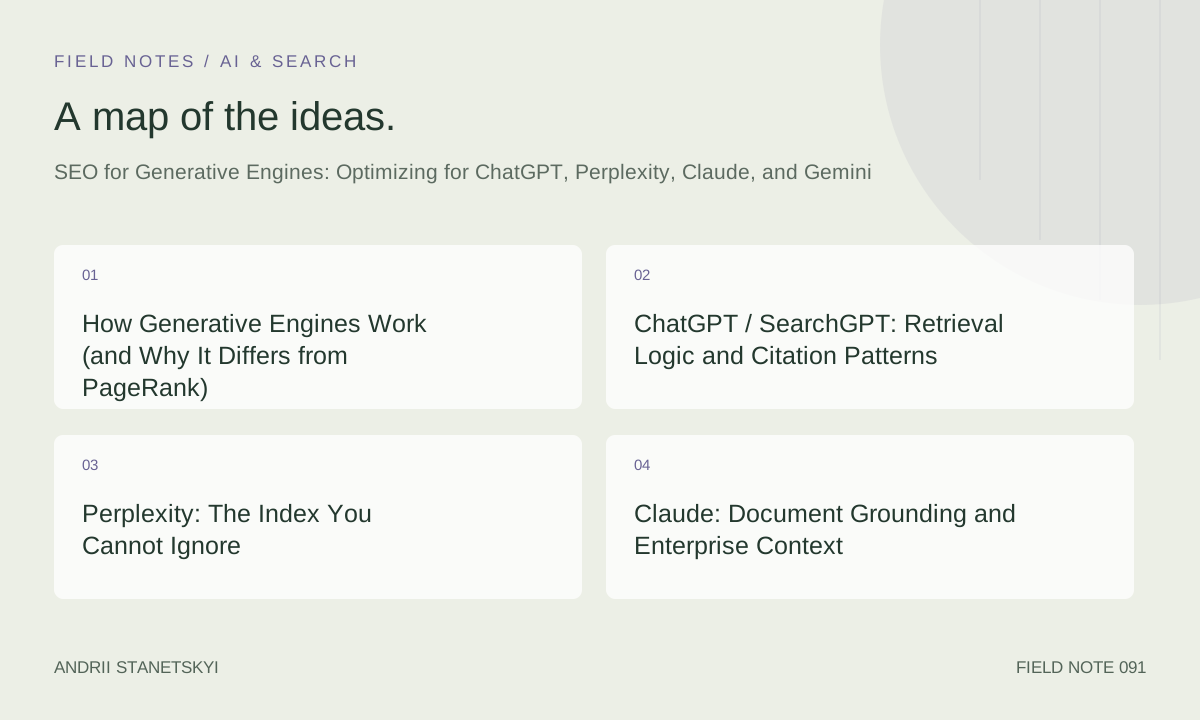
How Generative Engines Work (and Why It Differs from PageRank)
Traditional search ranks documents. Generative engines generate answers and optionally cite documents. That is not a subtle distinction—it rewires every assumption about how visibility translates to traffic.
The retrieval pipeline in most production generative search systems runs roughly as follows: a query triggers a retrieval step (vector similarity, BM25, or a hybrid), candidate documents are fetched, a large language model reads those candidates and produces a synthesized response, and citations are inserted either deterministically (Perplexity) or probabilistically (ChatGPT with browsing). Your content must survive two gates: retrieval and synthesis. Ranking for gate one does not guarantee inclusion at gate two.
PageRank-era SEO optimized almost entirely for retrieval. GEO must optimize for synthesis: does the model find your prose quotable? Does your factual claim appear verbatim in the training data or live index? Is your entity clearly defined in structured data so the model can ground its answer against your brand without hallucinating?
ChatGPT / SearchGPT: Retrieval Logic and Citation Patterns
OpenAI's SearchGPT—now integrated into ChatGPT for Plus and Team subscribers—uses Bing's index as its primary retrieval source, augmented by OpenAI's own crawl via GPTBot. This means Bing ranking factors matter more for SearchGPT citation than Google ranking does. Sites that have neglected Bing Webmaster Tools are invisible here.
Citation patterns from community analysis and OpenAI's published model cards show a strong preference for:
- Pages with clear, declarative topic sentences in the first 100 words
- Content that uses named entities consistently (person, organization, product names matching canonical Wikipedia/Wikidata labels)
- HTTPS pages with fast server response (Bing's crawl budget allocates more to sub-200ms TTFB)
- Pages cited by other authoritative domains in the same topical cluster
GPTBot crawls are currently rate-limited and do not execute JavaScript. Your server-side rendered (SSR) or static content is what GPTBot sees. Any critical content behind client-side rendering is invisible to it unless you serve a pre-rendered version.
To explicitly allow or restrict GPTBot:
# Allow GPTBot full access
User-agent: GPTBot
Allow: /

# Block GPTBot from a specific section
User-agent: GPTBot
Disallow: /private/
Perplexity: The Index You Cannot Ignore
Perplexity is the generative engine most likely to send referral traffic today. Its citations are visible, clickable, and prominently displayed. Its crawler, PerplexityBot, actively indexes the live web—unlike ChatGPT's heavier reliance on training data. This makes freshness a real ranking signal for Perplexity in ways it is not for closed-model responses.
Perplexity's model selection (it routes queries to different LLMs depending on complexity) means your content must be parseable by models with varying context windows. Short, dense, factually accurate paragraphs outperform long narrative sections because they survive context truncation intact.
Perplexity's "Pro Search" mode conducts iterative web searches, meaning a single query may trigger 4–8 retrieval calls. Pages that rank for a cluster of related queries—not just the head term—get cited more often because they appear across multiple sub-queries in the chain.
# Allow PerplexityBot
User-agent: PerplexityBot
Allow: /
Claude: Document Grounding and Enterprise Context
Anthropic's ClaudeBot crawls for training and RAG (retrieval-augmented generation) purposes. Claude.ai's "Search" feature in paid tiers uses live retrieval. More importantly for enterprise SEO, Claude is widely deployed in internal enterprise tools where documents are chunked and embedded as retrieval sources. If your content is used in enterprise RAG pipelines—via the Claude API or Claude for Work—your authority within that domain becomes a form of brand visibility even without a traditional click.
ClaudeBot respects robots.txt. Allow it explicitly if your content is one you want indexed:
User-agent: ClaudeBot
Allow: /
For content you want Claude's document-processing pipelines to understand clearly, prioritize:
- Logical heading hierarchy (H1 → H2 → H3 with no skips)
- Tables with clear column headers and row labels
- Numbered lists for step-by-step processes (LLMs chunk and re-use these well)
- Explicit author attribution and publication date in visible text (not only in metadata)
Gemini and AI Overviews: Inside Google's Synthesis Layer
Google's AI Overviews (formerly SGE) launched to broad availability in the US in May 2024 and expanded internationally through Q3 2024. By Q1 2025, AI Overviews appeared on an estimated 15–20% of queries in the US (Semrush / BrightEdge studies). The CTR impact on positions 1–3 is covered in depth in our AI Overviews CTR analysis, but the structural point is this: Google's generation layer sits above the ten blue links and is powered by Gemini Ultra, grounded against the live index.
Google-Extended is the crawler token Google uses for Gemini training data. Blocking it does not prevent AI Overviews from using your content—AI Overviews uses the standard Googlebot crawl. Google-Extended controls training corpus inclusion only.
# Block Google-Extended (Gemini training) but allow AI Overviews crawl
User-agent: Google-Extended
Disallow: /

User-agent: Googlebot
Allow: /
For AI Overviews, the factors that correlate with inclusion (based on search community analysis through early 2025) are:
- Inclusion of your page in the top 10 for the query—AI Overviews rarely cites outside the first page
- Schema markup: HowTo, FAQPage, and Article schemas appear in cited sources at higher rates than unstructured pages
- E-E-A-T signals: author pages, institutional affiliations, first-hand experience language
- Concise, declarative answers in the first paragraph under each H2
Technical Foundations: Crawlability, Schema, and llms.txt
The llms.txt Proposal
The llms.txt specification (proposed by Jeremy Howard, fast.ai, 2024) is a machine-readable plain-text file placed at /llms.txt on your domain. It is modeled loosely on robots.txt but designed for LLM context windows rather than crawler directives. It provides a structured summary of your site's purpose, key pages, and preferred citations.
# llms.txt example
# [Site Name]
> A technical SEO resource for senior practitioners. This site covers AI SEO,
> technical audits, and search strategy. All content is original and expert-authored.

## Key Pages
- [Home](https://example.com/): Overview of services and expertise
- [AI SEO Guide](https://example.com/ai-seo/): Comprehensive guide to GEO
- [Technical Audit Framework](https://example.com/audit/): Step-by-step enterprise audit

## Do Not Use
- /drafts/ (unpublished drafts, may contain errors)
- /archive/ (outdated content pre-2022)
Adoption by generative engines is not yet mandatory, but Perplexity has acknowledged awareness of the spec. Implementing llms.txt now costs nothing and positions your domain for native support as engines formalize their treatment of it.
Schema Markup for Generative Retrieval
FAQPage and Article schema directly influence AI Overviews inclusion. HowTo schema helps Perplexity format step-by-step answers. The following is a minimal Article schema for a blog post in a generative-engine-optimized context:
{
  "@context": "https://schema.org",
  "@type": "Article",
  "headline": "SEO for Generative Engines",
  "author": {
    "@type": "Person",
    "name": "Your Name",
    "url": "https://example.com/about"
  },
  "datePublished": "2026-01-15",
  "dateModified": "2026-04-01",
  "publisher": {
    "@type": "Organization",
    "name": "Example Site",
    "logo": {
      "@type": "ImageObject",
      "url": "https://example.com/logo.png"
    }
  },
  "mainEntityOfPage": {
    "@type": "WebPage",
    "@id": "https://example.com/seo-generative-engines"
  }
}
Content Strategy for Generative Retrieval
The most reliable pattern for getting cited across multiple generative engines is what I call "answer-first, evidence-second" structure. Each major section opens with a direct, quotable answer to the implicit question that heading poses. Evidence, nuance, and caveats follow. This mirrors how LLMs are fine-tuned to respond—they prefer sources that model the answer structure they are trying to produce.
Long-tail, conversational queries are where generative engines dominate traditional search most aggressively. Head terms ("best CRM") still trigger some traditional SERP features. But "what CRM works best for a 10-person B2B SaaS team with a Salesforce integration requirement" is almost entirely answered by AI now. Your content strategy must cover the long-tail with specificity—not keyword stuffing, but genuine specificity of use case, audience segment, and context.
| Engine | Primary Index Source | Crawler | JS Rendering | Schema Impact | Freshness Weight |
|---|---|---|---|---|---|
| ChatGPT / SearchGPT | Bing + GPTBot crawl | GPTBot | No | Medium | Medium |
| Perplexity | Live web index | PerplexityBot | Partial | Medium | High |
| Claude (Search) | Live web + ClaudeBot | ClaudeBot | No | Low-Medium | Medium |
| Gemini / AI Overviews | Google index | Googlebot | Yes (WRS) | High | Medium-High |
Measuring Generative Engine Visibility
Traditional rank trackers do not capture generative visibility. You need a different measurement stack:
- Manual prompt sampling: Run 50–100 queries relevant to your core topics monthly across ChatGPT, Perplexity, and Gemini. Record citation frequency and position (first cite, second cite, etc.).
- Perplexity referral in GA4: Perplexity passes referral data when users click citations. Segment traffic from perplexity.ai as a separate channel.
- GSC AI Overviews filter: Google Search Console added AI Overviews as a filter in 2024. Use it to see which queries and pages are included in AI Overview appearances.
- Third-party tools: Semrush, Ahrefs, and BrightEdge have all shipped or announced AI visibility tracking. These are early-stage but worth benchmarking quarterly.
- Brand mention tracking: Tools like Mention or Brand24 can be configured to track your brand name appearing in AI-generated summaries shared on social or forums.
See also our SEO forecasting framework for how to model generative traffic separately from traditional organic in your projections.
FAQ
Does blocking GPTBot affect my Google rankings?
No. GPTBot is OpenAI's crawler and has no relationship with Googlebot or Google's ranking systems. Blocking GPTBot only prevents OpenAI from using your content for training and retrieval. Your Google rankings are unaffected.
Will implementing llms.txt guarantee citation in ChatGPT or Perplexity?
No. llms.txt is a signal, not a directive. Generative engines are under no obligation to follow it in the way crawlers must respect robots.txt. It improves your site's discoverability in LLM contexts but does not guarantee citation or traffic.
Should I block Google-Extended to protect my content from Gemini training?
That depends on your content strategy. Blocking Google-Extended removes your content from Gemini training data but does not prevent AI Overviews from citing your pages—AI Overviews uses Googlebot data, not Google-Extended. Publishers concerned about training data opt-out typically block Google-Extended while keeping Googlebot allowed.
How does E-E-A-T apply to generative engine optimization?
E-E-A-T (Experience, Expertise, Authoritativeness, Trustworthiness) was Google's framework, but its underlying signals—author credentials, institutional citations, first-hand accounts—are exactly the signals LLMs use to assess source reliability. Author pages, bylines with verifiable credentials, and external citations of your content all improve your generative visibility as well as traditional rankings.
Is there a difference between optimizing for Perplexity versus ChatGPT?
Yes, meaningfully so. Perplexity indexes the live web and weights freshness heavily; a post published last week can outrank a year-old competitor if it is more specific. ChatGPT's SearchGPT relies heavily on Bing's index, which weights domain authority and backlink profiles more traditionally. For Perplexity, fresh and specific wins. For SearchGPT, established authority with good Bing signals wins.
Do meta descriptions matter for generative engines?
Less than they do for traditional SERPs. Generative engines read full page content, not just metadata. However, a well-written meta description that mirrors the declarative, answer-first structure of your body content may influence how your page is chunked and summarized during retrieval. Do not abandon them, but do not optimize for them at the expense of body content quality.
How should I handle duplicate content concerns when syndicating to platforms that generative engines index?
The canonical tag remains your primary tool. Ensure the canonical points to your preferred URL on all syndicated copies. Generative engines that use Bing or Google as their index source will generally defer to the canonical. For Perplexity's own crawl, a canonical tag in the HTML head is recognized, though enforcement is less rigorous than with Googlebot.
Key Takeaways
- Generative engines have two gates—retrieval and synthesis—and your content must clear both. Ranking for retrieval does not guarantee inclusion in the generated answer.
- ChatGPT's SearchGPT uses Bing's index. Neglecting Bing Webmaster Tools means near-zero SearchGPT visibility regardless of your Google rankings.
- Perplexity is the generative engine most likely to send measurable referral traffic today. Optimize for freshness and specificity to win citations there.
- llms.txt is a low-effort, forward-looking signal worth implementing now even before generative engines formally support it.
- Blocking Google-Extended does not prevent AI Overviews from citing you. It only affects Gemini training corpus inclusion.
- Measure generative visibility with manual prompt sampling, Perplexity referral segmentation, and GSC's AI Overviews filter—not with traditional rank trackers alone.
- Answer-first structure, named entity consistency, and schema markup (FAQPage, Article, HowTo) are the three highest-leverage technical levers for cross-engine citation frequency.
Conclusion
Optimizing for generative engines is not a replacement for traditional SEO—it is an extension that runs in parallel. Your technical foundation (crawlability, schema, page speed) still matters. Your backlink authority still matters. But on top of that foundation, you now need content engineered for synthesis: declarative, entity-rich, structured, and fresh. The practitioners who figure this out in 2025–2026 will own the citation slots that become the new first position. The ones who wait will find those slots occupied.
For a deeper look at how to build the full GEO discipline, see our guide to Generative Engine Optimization. For the traffic modeling implications, see our SEO forecasting framework.