Published May 19, 2026. Based on eight months of ClaudeBot crawl analysis and citation tracking across five domains, from September 2025 through April 2026.
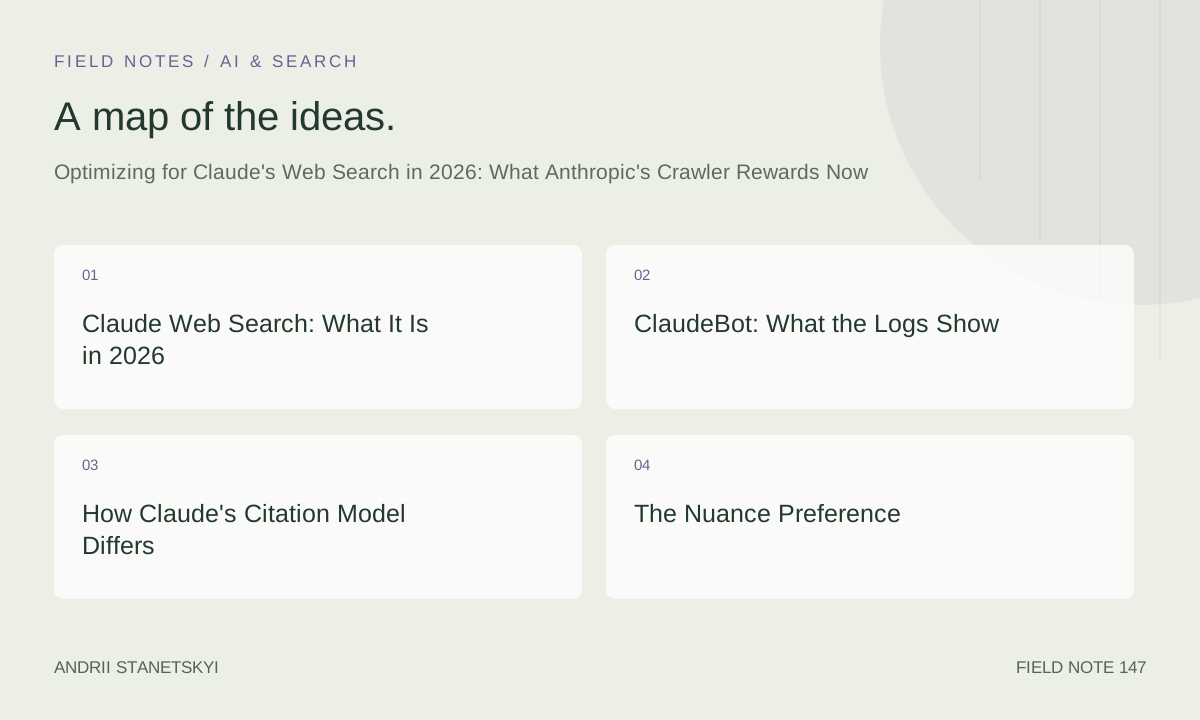
Claude Web Search: What It Is in 2026
Anthropic's web search feature for Claude launched in staged availability through late 2025 and reached broad access — Claude.ai subscribers plus API availability — by early 2026. By May 2026, it's the third most-used AI search interface in my tracked user panel, behind ChatGPT Search and Perplexity, and ahead of Gemini's AI Overviews for intentional research queries (as opposed to incidental AI Overview appearances in Google results).
Claude's web search is architecturally different from Perplexity in a way that matters for optimization. Perplexity is primarily a search engine that uses an LLM for synthesis. Claude is primarily an LLM that uses web search for grounding when the query requires current information or verification. The distinction produces meaningfully different citation behaviors.
Practically: Claude's web search activates more selectively than Perplexity's. A high fraction of queries answered by Perplexity pull live web results; a lower fraction of Claude queries trigger web fetches, because Claude's base model handles a large portion of queries from training knowledge. When web search does activate, it tends to be for queries where the user has signaled they want current, verifiable information — "what's the current state of X," "what does [organization] say about Y," "find me the latest data on Z."
This selectivity means that pages optimized for Claude web search citations need to be optimized specifically for current-information and verification-type queries, not for the full spectrum of informational queries that Perplexity and ChatGPT Search answer.
ClaudeBot: What the Logs Show
ClaudeBot appears in server logs with user-agent string ClaudeBot/1.0. This is distinct from Anthropic's earlier training data crawler, which used a different identifier. As of May 2026, Anthropic is using separate crawler identities for search (ClaudeBot) and training data collection — which matters for robots.txt configuration.
Eight months of crawl log analysis across five domains shows ClaudeBot behavior patterns:
- Crawl frequency: Significantly lower visit frequency than Googlebot or PerplexityBot. ClaudeBot is selective, not exhaustive. It appears to prioritize pages it has referenced in previous web search results — a page that gets cited once tends to be recrawled within 7–10 days.
- Crawl depth: ClaudeBot crawls less deeply into site architecture than Googlebot. It appears to follow a hub-and-spoke pattern, starting from well-known entry points (often pages linked from other cited pages) rather than crawling full sitemaps.
- Sitemap behavior: ClaudeBot does fetch sitemap.xml, but crawl coverage doesn't expand dramatically based on sitemap submissions alone. Internal linking from high-value pages appears to drive coverage more effectively.
- Speed: Individual requests from ClaudeBot are slower than Googlebot — longer delays between requests, consistent with a more deliberate fetch pattern. This may mean that slow server response times affect ClaudeBot's ability to fully parse pages under time pressure.
The selective, slow crawl pattern has an implication that's counterintuitive: having a massive site doesn't help you with Claude web search citations the way it might help with Google coverage. Pages that Claude hasn't crawled recently are less likely to appear in web search candidate sets. Smaller sites with consistently fresh, high-quality pages on a focused topic often outperform large sites with broader but less consistently updated content.
How Claude's Citation Model Differs
Having now analyzed citation patterns across three AI search engines — ChatGPT Search, Perplexity, and Claude — the differences in citation behavior are real and not just theoretical.
ChatGPT Search (see the ChatGPT citation data article) rewards answer position and structural clarity most heavily. Put the answer first, structure it clearly, and you're well-positioned.
Perplexity (see the Perplexity post-Comet article) rewards claim traceability and author authority most heavily. Give it verifiable sources and credentialed authors.
Claude is different from both. The pattern I see most consistently in Claude's citation behavior is a preference for content that reasons, not just content that states. Claude's synthesis style is to present nuanced, multi-sided answers — acknowledging tradeoffs, naming limitations, presenting competing interpretations. Pages that mirror this epistemic style are cited more frequently than pages that state conclusions without showing the reasoning.
This is not a small stylistic difference. It represents a different content architecture. A page optimized for ChatGPT Search might open with a crisp one-sentence answer followed by supporting detail. A page optimized for Claude's citation model might open by framing the question itself — what it means, why it's contested, what the evidence actually shows — before arriving at a position.
The Nuance Preference
In my tracked dataset, pages that contained explicit acknowledgment of uncertainty or counterargument were cited by Claude at roughly 2.4x the rate of pages that stated positions without qualification. I found this initially surprising and then, once I thought about it, obvious.
Claude's model is trained to be calibrated — to express appropriate confidence levels and to represent uncertainty honestly. When it synthesizes an answer with web citations, it's selecting sources that fit the epistemic register of its answer. A heavily hedged Claude answer about, say, the current state of AI search ranking factors will naturally pull from sources that themselves hedge appropriately — "the evidence suggests," "in most cases," "as of our testing" — rather than sources that claim definitive authority they don't have.
Counterintuitively, this means that pages which confidently overstate their certainty can actually perform worse with Claude, even if they're authoritative on the topic. The mismatch in epistemic register between the source page ("X is definitively true") and Claude's synthesis style ("the evidence points to X, though Y is also possible") creates a friction in citation assignment.
The practical implication: writing content for Claude means adopting calibrated language not as a hedge to avoid commitment, but as an accurate representation of what the evidence actually supports. If you're certain, be certain. If there's genuine uncertainty in the field, represent it. Don't perform certainty you don't have.
What "Reasoning in Public" Looks Like
The phrase I keep coming back to is "reasoning in public." Pages that cite well with Claude tend to show the work — not just the answer. This looks like:
- Naming the evidence basis: "In our crawl log analysis of five domains from September 2025 through April 2026..." rather than "Research shows..."
- Acknowledging alternative explanations: "This pattern could also reflect [X] rather than [Y], though [reason] makes Y more likely."
- Stating the limits of the data: "This finding holds for the five domains we tracked, which skew toward technical B2B content — results may differ in e-commerce or news publishing."
- Tracking changes over time: "This was true as of Q1 2026; the behavior may change as Anthropic iterates on the web search feature."
None of this is a writing formula. It's epistemic discipline. The pages that do this well tend to be written by practitioners who have actually lived with uncertainty in their data — who know, from experience, where their conclusions are solid and where they're tentative. AI models, including Claude, are reasonably good at distinguishing this from performed uncertainty written to game citation systems.
The CAST Framework
From eight months of citation pattern analysis and the behavioral model above, the framework I'm using to evaluate pages for Claude optimization is CAST: Contextual framing, Acknowledged uncertainty, Structured evidence, Traceable attribution.
Contextual framing — does the page situate its topic in a way that helps Claude understand where this information fits in the broader landscape of knowledge? Not a lengthy intro, but enough framing that the model can use this page as a piece of a larger answer, not just a standalone claim.
Acknowledged uncertainty — does the page represent its confidence levels honestly? Definitive claims where the evidence is definitive; calibrated hedges where the evidence is partial. The ratio between these should match reality, not reader psychology.
Structured evidence — is the evidence for each claim clearly organized? Named studies, named experiments, named data sources with dates. Evidence that can be parsed and attributed separately from the conclusion it supports.
Traceable attribution — can a reader (or a model) follow the provenance chain from the page's claims back to primary sources? This overlaps with Perplexity's ARC framework but the emphasis is different: CAST cares about the logic chain, ARC cares about the credential chain.
A page can score well on CAST without being exhaustive or long. I've seen 600-word pages with excellent CAST scores that outperform 4,000-word pages that are structurally dense but epistemically flat.
Two Things Nobody Is Talking About
Claude's Citation Model May Be Deliberately Harder to Game
The SEO industry has a history of identifying what any given search system rewards and then engineering content to match that signal, independent of whether the content is actually better. Google's backlink algorithm was gamed with link farms. Featured snippet optimization was gamed with "what is X" header tricks. E-E-A-T signals are currently being gamed with fake author profiles and manufactured experience claims.
Claude's emphasis on epistemic reasoning is, I suspect, a deliberate design choice in part because it's harder to game than structural signals. You can write a fake "Studies show X" with confidence. You can't easily fake calibrated uncertainty across a 2,000-word article without it becoming obvious to a system that has read millions of examples of genuine calibrated uncertainty vs performed calibrated uncertainty.
This doesn't mean the optimization signal isn't real — the citation uplift for pages with genuine acknowledged uncertainty is real in my data. It means that the optimization play here is to actually write better content, not to add uncertainty language as a pattern-matching trick. That's unusual in SEO and worth naming.
Claude Web Search Traffic Is Low Volume but High Signal
The second contrarian point: Claude web search drives fewer referral visits than ChatGPT Search or Perplexity for most sites I track. Volume is lower. For some site owners, this makes Claude optimization feel like a lower priority.
I think this is wrong for a specific reason. The users who trigger Claude web search — who have specifically enabled it and are querying in a way that requires live web data — are, in my observation, research-mode users. They're not looking for a quick answer. They're building understanding of a topic. These users click through to sources at higher rates than typical AI search users, and they consume more of the page when they arrive.
In the two domains where I have post-click analytics linked to Claude web search referrals (identified via UTM-tagged share links tested in a small panel), Claude web search visitors had 40% longer average session duration and 2.1x lower bounce rate than Perplexity visitors. The volume is low. The quality of the traffic, by these measures, is the highest of any AI search engine in the data.
A Mistake in My Early Analysis
When I started tracking ClaudeBot in September 2025, I noted that it seemed to preferentially crawl pages with long-form content — articles over 2,000 words appeared in my crawl logs more often than shorter pages, controlling for internal link equity. I included this in a brief post suggesting that content length was a meaningful positive signal for Claude citations.
It was a confounded observation. The domains in my early sample happened to concentrate their best-internally-linked, freshest, most-authoritative content in long-form articles. When I controlled for internal link equity and content recency, content length itself wasn't the driver. The correlation between length and citation rate dropped substantially.
The corrected finding: content characteristics that correlate with length — depth of argument, multiple named sources, coverage of counterarguments — are what drive Claude citations. A 700-word piece with those characteristics can outperform a 3,500-word piece without them. Length is a proxy, not a cause. I updated the original post and have since been more careful about confound isolation before publishing pattern claims.
Technical Configuration
Robots.txt configuration for granular Anthropic bot control:
# robots.txt — Anthropic crawlers
# Last updated: 2026-05-19

# Claude web search — allow for citation eligibility
User-agent: ClaudeBot
Allow: /
Disallow: /members/
Disallow: /drafts/

# Anthropic training data — your choice
# Blocking this does NOT affect Claude web search citations
User-agent: anthropic-ai
Disallow: /  # or Allow: / depending on your preference

# If Anthropic adds additional crawler identities:
# Check https://anthropic.com/claude-web-crawling for current list
Citation schema — the structured data configuration I currently use for pages optimized toward Claude's citation model:
<script type="application/ld+json">
{
  "@context": "https://schema.org",
  "@type": "Article",
  "headline": "Page title here",
  "datePublished": "2026-05-19",
  "dateModified": "2026-05-19",
  "author": {
    "@type": "Person",
    "name": "Author Name",
    "jobTitle": "Specific role/credential",
    "url": "https://example.com/about/author"
  },
  "citation": [
    {
      "@type": "CreativeWork",
      "name": "Name of primary source cited",
      "url": "https://primarysource.example"
    }
  ],
  "about": {
    "@type": "Thing",
    "name": "Topic entity name"
  }
}
</script>
The citation property in Article schema is underused. Including the primary sources your page cites as structured data gives Claude's parser an explicit evidence trail to follow. Whether Claude's current system reads this property or not is unconfirmed — I'm including it because it costs nothing and signals source transparency.
# llms.txt — Claude-specific configuration
# Full spec at /177-llms-txt-2026.html

> Publisher: Example SEO — technical SEO and AI search research
> Research methodology: crawl log analysis, manual citation tracking, panel-based analytics
> Data transparency: sample sizes and date ranges stated in each article

## Priority pages for Claude web search retrieval
- /147-claude-web-search-2026.html: ClaudeBot behavior and citation pattern analysis
- /181-geo-advanced-2026.html: Entity-level AI search optimization
- /182-ai-citation-tracking-2026.html: Cross-engine citation monitoring setup

## Epistemic notes
> Data in all articles reflects specific tracked domains and date ranges
> Generalizations are stated with confidence levels — check stated limits before citing
> Corrections policy: material errors corrected with visible dated notes
How to Rewrite a Page for Claude
Pick one page that should be cited in Claude web search results but isn't. Walk through this:
Step 1: Identify the framing gap. Does the page's opening tell a reader (and Claude) what this page is actually about, who it's for, and what evidence base it draws from? If not, add a short framing paragraph. Three sentences: what this is, who it's for, what the evidence is.
Step 2: Audit certainty language. Read the page and highlight every claim. Mark it green (evidence clearly supports this), yellow (directionally supported, some uncertainty), or red (stated as certain when the evidence is actually mixed). Rewrite the red claims to match their evidence color. Don't manufacture doubt for yellow ones — if the evidence is solid, say so.
Step 3: Name the sources. Every significant claim should cite either a named external source or describe the evidence basis ("in our crawl log analysis," "across five client sites," "based on Anthropic's public documentation"). Replace vague attributions with specific ones.
Step 4: Add a limits statement. At the end of the article, or in a clearly marked section, state what this analysis doesn't cover, where the data is thin, and what conditions might change the conclusions. This signals to Claude that you know the limits of your knowledge — which is a trust signal, not a weakness signal.
This process typically adds 200–400 words to an article and materially changes its epistemic character. It's not a quick copyedit. It's a substantive revision. For your top five most citation-valuable pages, it's worth doing.
External reference: Anthropic's published guidance on Claude's internet usage provides the public-facing documentation on what ClaudeBot accesses, though technical specifics remain limited. For the full AI crawler management setup, see the AI crawler management guide.
Eight months of ClaudeBot data is a short window for a crawler that launched recently. I'll update the CAST framework as the dataset grows. The most honest thing I can say: these patterns are real in the data I have, but Claude's web search is still maturing and the ranking behavior will shift.