Generative Engine Optimization is not a rebrand of SEO. It is a structurally different discipline that emerged from a structurally different information retrieval paradigm. When a user asks ChatGPT or Perplexity a question, no rank position is assigned. No click-through rate is tracked by a search engine. No impression is logged in a Search Console equivalent. The content either shapes the answer or it does not exist.
This guide defines GEO as a standalone discipline, maps its methods, and gives senior practitioners the frameworks they need to build a GEO practice alongside—not instead of—traditional SEO.
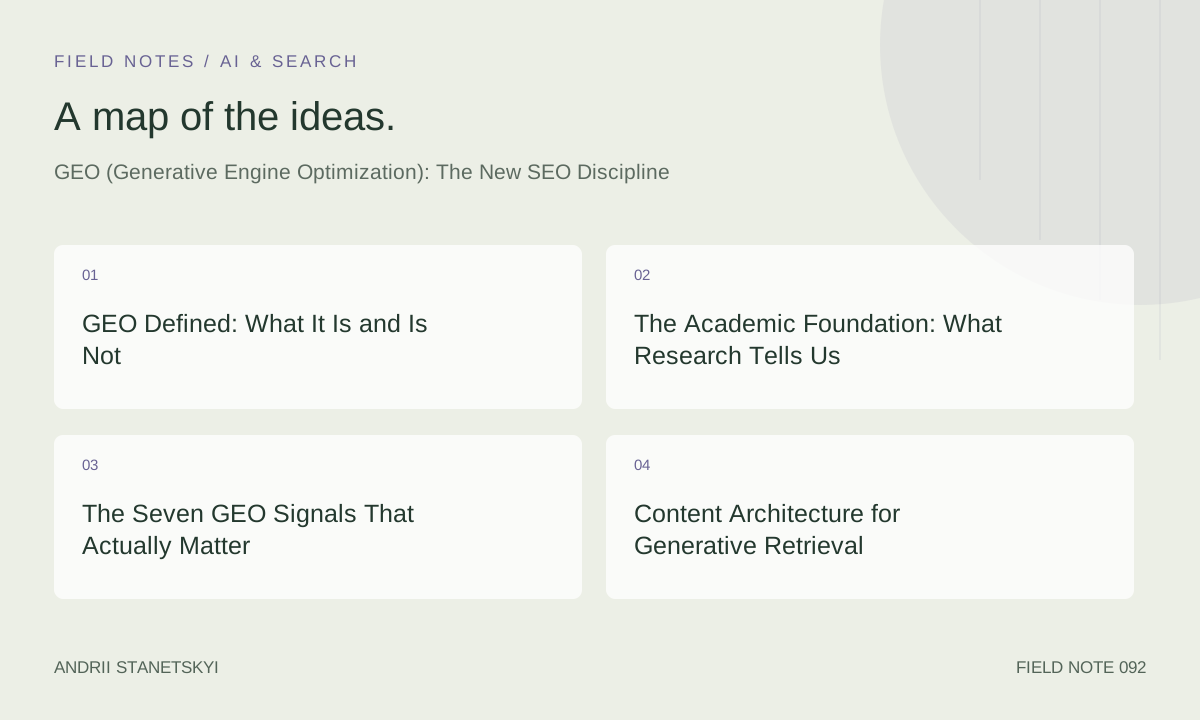
GEO Defined: What It Is and Is Not
GEO is the practice of structuring, publishing, and promoting content so that generative AI systems—including conversational search engines, LLM-powered assistants, and AI-augmented search features—surface it in their synthesized responses and cite it as a source.
GEO is not:
- Keyword stuffing with AI-sounding phrases
- Generating content with LLMs and expecting LLMs to prefer it (this is circular and empirically false)
- A replacement for technical SEO fundamentals
- A single tactics list—it is a measurement + content + technical + entity discipline
The formal research term "GEO" was popularized by a Princeton / Georgia Tech / IIT Delhi paper ("GEO: Generative Engine Optimization," 2024) that studied how different content interventions affected citation frequency across AI engines. Their core finding: citing authoritative sources, adding statistics, and using fluent, quotable language increased AI citation rates by 40%+ in controlled experiments. This is the empirical baseline the discipline now builds on.
The Academic Foundation: What Research Tells Us
The Princeton GEO paper tested nine content interventions across 10,000 queries on multiple generative engines. The interventions and their measured citation impact:
| Intervention | Avg. Citation Increase | Best-Performing Engine |
|---|---|---|
| Adding statistics and data | +40% | Perplexity |
| Citing authoritative external sources | +37% | ChatGPT |
| Fluent, quotable sentence structure | +33% | All engines |
| Adding keyword density (traditional SEO) | +6% | Google AI Overviews |
| Simplifying language (readability) | +14% | Perplexity |
| Adding expert quotes | +29% | ChatGPT |
| Authoritative tone | +18% | Claude |
The keyword density intervention—the backbone of on-page SEO for 20 years—was the weakest GEO signal by a wide margin. This finding should recalibrate how practitioners allocate content optimization time.
A second key study from Columbia Journalism Review (2024) found that generative engines overwhelmingly cite a narrow set of high-authority domains: Wikipedia, major newspapers, government sites, and established trade publications. This "rich get richer" dynamic means new entrants must compete on niche specificity rather than broad authority, a point we return to in the entity strategy section.
The Seven GEO Signals That Actually Matter
1. Statistical Density
Pages that contain specific, citable statistics—with attribution—are cited more frequently than pages that make the same points in qualitative language. "Conversion rates improved" is not citable. "Conversion rates improved 23% after implementing structured data, per BrightEdge's 2024 study" is citable. Every major claim should have a number and a source.
2. Named Entity Clarity
Generative engines are entity-resolution systems at their core. They match concepts in queries to entities in their training data. If your brand, your product, or your author entity is ambiguous—same name as something else, missing from Wikidata, inconsistently named across your site—your content will be mis-attributed or skipped. Entity disambiguation is GEO's equivalent of technical SEO's crawlability.
3. Quotability
LLMs prefer to include text that can be inserted into their output with minimal editing. Sentences that are grammatically self-contained, factually precise, and short enough to drop into a paragraph without context are preferred over long, dependent-clause-heavy prose. Write for quotation, not for narrative flow.
4. Structural Predictability
Content with predictable heading → answer → evidence structure is easier for retrieval systems to chunk correctly. Unpredictable structure (FAQ hidden in a table, answers split across multiple H3s, key claim buried in a sidebar) is more likely to be chunked mid-thought, producing a truncated citation that misrepresents your position.
5. External Credibility Signals
Citing peer-reviewed sources, government data, or industry standards within your content signals credibility to LLMs in a way that internally circular citation does not. Link out to authoritative sources from within your body content, not just in a bibliography footnote.
6. Author Entity Establishment
Author identity matters in GEO more than in traditional SEO because LLMs assign reliability to sources partly based on author reputation derived from training data. An author with a Wikipedia page, published books, conference talks indexed by Google Scholar, or a strong LinkedIn presence is more likely to be treated as an authoritative source than an anonymous page.
7. Schema Completeness
FAQPage, Article, HowTo, and Person schemas give retrieval systems structured hooks that bypass the ambiguity of free text parsing. They are especially important for Google AI Overviews, which has shown strong preference for schema-marked content in independent studies by Semrush and BrightEdge.
Content Architecture for Generative Retrieval
The ideal GEO content unit is what I call a "citable module": a heading that poses a question or names a concept, followed by 2–4 sentences that answer it completely without requiring surrounding context, followed by supporting evidence. Each module is independently parseable.
Traditional long-form SEO content is often structured as a continuous narrative: setup → argument → evidence → conclusion, with meaning that depends on reading sequentially. This structure is difficult for generative retrieval. The model reads a chunk of your page, needs it to make sense in isolation, and embeds it. If your key insight appears only in the conclusion after 1,500 words of setup, it rarely makes it into the retrieval pool.
Rewrite your long-form articles with the following structure test: can any 3-sentence block in this article be read in isolation and still make a coherent, accurate claim? If not, restructure.
For how-to content, numbered steps with explicit verbs ("Navigate to Settings → Privacy → Data Export") survive chunking far better than narrative descriptions of the same process. Generative engines are specifically trained to reproduce step-by-step formats—they actively prefer sourcing from structured step content.
Entity Strategy: The Core of GEO
If GEO has one foundational concept, it is entity-first thinking. The knowledge graphs that underpin Google's Gemini, the entity linking in Perplexity's retrieval, the entity disambiguation in ChatGPT's named entity recognition—all of these are downstream of how well your brand, your product, and your key concepts are defined as entities in the linked open data ecosystem.
Practical entity strategy for GEO:
- Claim your Wikidata entity. If your organization does not have a Wikidata entry, create one following Wikidata's notability guidelines. Link it from your website's About page using
sameAsin your Organization schema. - Establish consistent naming. Your brand name should appear identically across your website, Google Business Profile, LinkedIn, Crunchbase, and any industry directories. Inconsistency creates entity disambiguation failures.
- Use sameAs markup liberally. Schema.org's
sameAsproperty connects your entity to authoritative identifiers (Wikipedia URL, Wikidata QID, LinkedIn URL). This gives generative engines a disambiguated entity graph to ground against. - Author entities matter separately from organizational entities. Create Person schema for each author with links to their professional profiles. Google's E-E-A-T guidelines and the underlying LLM training both treat author and organization entities as distinct signals.
{
  "@context": "https://schema.org",
  "@type": "Organization",
  "name": "Example Company",
  "url": "https://example.com",
  "sameAs": [
    "https://en.wikipedia.org/wiki/Example_Company",
    "https://www.wikidata.org/wiki/Q12345678",
    "https://www.linkedin.com/company/example-company",
    "https://www.crunchbase.com/organization/example-company"
  ]
}
Technical GEO: Crawl, Schema, and llms.txt
Technical GEO inherits all of traditional technical SEO's requirements and adds two layers: AI crawler management and LLM-readable metadata.
The robots.txt file is now a multi-audience document. You are writing rules for Googlebot, Bingbot, and at least five AI-specific crawlers. A production robots.txt for a publisher that wants maximum generative visibility:
User-agent: *
Allow: /
Disallow: /wp-admin/
Disallow: /cart/
Disallow: /checkout/

# AI Crawlers - explicitly allowed for maximum GEO visibility
User-agent: GPTBot
Allow: /

User-agent: PerplexityBot
Allow: /

User-agent: ClaudeBot
Allow: /

User-agent: CCBot
Allow: /

# Block Gemini training (optional - does not affect AI Overviews)
User-agent: Google-Extended
Disallow: /

Sitemap: https://example.com/sitemap.xml
The llms.txt file at your domain root provides a structured, human-readable document that LLMs can process when loaded directly. Unlike robots.txt, it is not a directive—it is a context document. Structure it to answer the questions an LLM would ask when deciding whether to cite your site:
# Example Company — Technical SEO Resource

> This site publishes senior-level technical SEO analysis, with a focus on
> generative engine optimization, enterprise auditing, and search forecasting.
> All content is written by practitioners with 10+ years of hands-on experience.
> Content is updated quarterly or when significant industry changes occur.

## Canonical Pages (cite these)
- [GEO Guide](https://example.com/geo/): Complete guide to generative engine optimization
- [Audit Framework](https://example.com/audit/): Enterprise site audit methodology
- [AI SEO Overview](https://example.com/ai-seo/): AI search landscape analysis

## Author
- [Author Name](https://example.com/about): Senior Technical SEO, 12 years experience

## Do Not Cite
- /drafts/ — unpublished work
- /archive/ — content published before 2022, may be outdated
See also our technical audit framework for how to incorporate GEO checks into your regular site audit process.
Measuring GEO Performance
GEO metrics do not yet have a standard taxonomy. Here is the framework I use with clients:
- Citation Frequency Rate (CFR): Of 100 target queries sampled monthly, what percentage result in your site being cited? Track by engine separately.
- Citation Position: When cited, are you the first, second, or fifth source? First-position citations drive substantially more traffic and credibility.
- Brand Mention Rate: What percentage of sampled queries reference your brand name or product in the generated answer, even without a formal citation link?
- Generative Referral Traffic: Track in GA4 as a separate channel. Perplexity, you.com, and some Bing AI features pass referrer data.
- Prompt → Page Match Rate: For your key landing pages, what percentage of conceptually relevant prompts do you appear in? This requires manual sampling.
For details on building a tracking dashboard for these metrics, see our SEO forecasting and measurement guide.
GEO vs. SEO: Where They Overlap, Where They Diverge
| Signal | Traditional SEO Impact | GEO Impact | Direction |
|---|---|---|---|
| Backlink authority | Very high | Medium (indirect) | Overlaps |
| Keyword density | Medium | Low | Diverges |
| Schema markup | Medium | High | GEO weights more |
| Page speed / CWV | High | Low (crawl only) | Diverges |
| Statistical density | Low | Very high | GEO weights more |
| Author entity | Medium (E-E-A-T) | High | GEO weights more |
| Freshness | Query-dependent | High (Perplexity) | GEO weights more |
| Mobile usability | High | Negligible | Diverges |
| Internal linking | High | Low | Diverges |
| Canonical / dedup | High | Medium | Overlaps |
FAQ
Is GEO a recognized industry term or just a buzzword?
It was coined in a peer-reviewed academic paper (Princeton / GT / IIT Delhi, 2024) and has since been adopted by major publications including Search Engine Journal, Moz, and Semrush. It is not yet a term with universal industry consensus, but it is the most precise label for a real and distinct set of optimization practices. Use it with definition when presenting to clients.
How much should I invest in GEO versus traditional SEO in 2026?
This depends heavily on your query mix. If your target queries are informational and conversational (how-to, what-is, comparison), generative engines now intercept a significant share—10–30% of those clicks depending on niche. If your queries are transactional or local, traditional search features still dominate. A practical starting allocation: 20–25% of content optimization effort toward GEO-specific practices, growing as your measurement shows returns.
Does AI-generated content perform well in GEO?
The empirical answer is: not significantly better or worse than human-written content of equivalent quality, as of current research. The Princeton GEO paper found no statistical difference in citation rates based on whether content was AI-generated. What matters is structure, statistical density, and entity clarity—not authorship method. However, E-E-A-T requirements mean that first-person experience content (which LLMs cannot genuinely produce) has an edge for certain query types.
Can small publishers compete in GEO against major media brands?
More effectively than in traditional SEO, in one specific way: niche specificity beats broad authority for generative queries. When Perplexity answers "what is the best accounting software for a solo-practice immigration attorney in Texas," the New York Times is not going to outrank a highly specific, authoritative page from a niche publication. The long-tail specificity advantage is larger in GEO than in Google search. This is where small publishers should invest.
How do I start a GEO audit for an existing site?
Start with three quick diagnostics: (1) Run your top 20 target queries through Perplexity and ChatGPT—are you cited? (2) Check that all your key pages have FAQPage or Article schema. (3) Review your robots.txt for AI crawler directives. Those three steps take two hours and will tell you your current baseline.
Does GEO apply to e-commerce sites?
Yes, but the signal mix is different. For product pages, structured data (Product, Review, Offer schemas) is the primary GEO lever. For category and buying-guide content, statistical density and quotability matter. The biggest e-commerce GEO opportunity is in product comparison and specification content—generative engines actively source these for product queries.
Key Takeaways
- GEO is empirically distinct from traditional SEO. The Princeton research showed keyword density is the weakest GEO signal; statistical density and source citation are the strongest.
- Entity strategy is the foundation. Brand, author, and product entities must be unambiguous and connected to the linked open data graph (Wikidata, Wikipedia, sameAs).
- Content architecture must support independent chunk parsing. Every 3-sentence block should be coherent in isolation.
- llms.txt and AI-crawler-specific robots.txt directives are low-effort infrastructure investments with forward-looking value.
- GEO measurement requires new metrics (Citation Frequency Rate, Citation Position) that do not yet have standard tooling—manual sampling is necessary today.
- Small publishers can compete more effectively in GEO than in traditional SEO by targeting long-tail specificity that major media does not cover.
Conclusion
GEO is the practice that defines this moment in search. It requires practitioners to internalize a fundamentally different model of how information moves from publisher to reader—not through ranked positions and click decisions, but through synthesis and citation. The core skills transfer from traditional SEO: understand how systems work, structure content to match system preferences, measure what changes. The specific techniques are new enough that there is no definitive playbook yet, which means the practitioners who experiment and measure rigorously now will set the norms others follow in two years.
Build a GEO practice today. Start small, measure everything, and connect it to the traditional SEO program you already run. They are not competitors—they are complementary disciplines that share a content quality foundation. See our guide to optimizing for individual generative engines for the engine-specific tactics layer.