Published May 19, 2026. Research drawn from GSC data analysis, AI Overview citation monitoring, and Gemini.google.com query testing from January through April 2026.
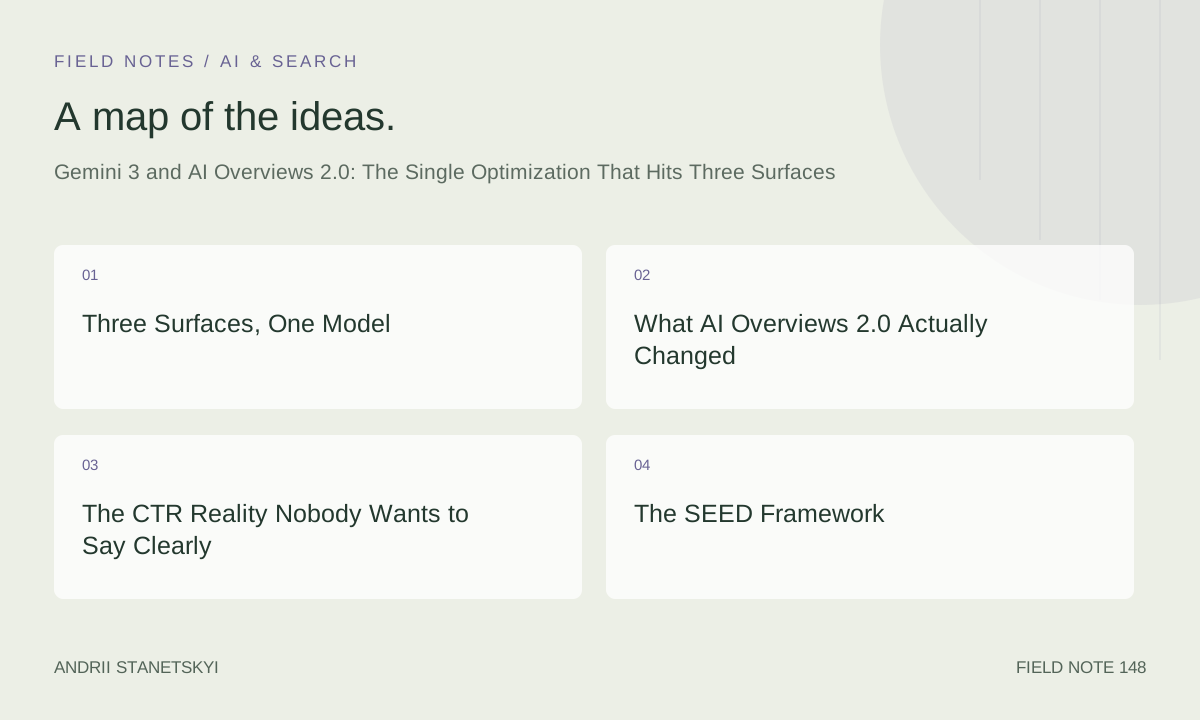
Three Surfaces, One Model
Gemini 3 is the model underneath three distinct Google surfaces that most SEOs treat as separate optimization targets: AI Overviews (the answer box format in Google Search results), Gemini.google.com (Google's standalone AI assistant interface), and Google Lens deep answers (the AI-generated explanatory content that appears when users query photos in Google Lens).
Because they share the same underlying model and, to a significant degree, the same retrieval architecture, optimizing for one tends to improve your standing on the others. This is the practical premise of this article: there's more leverage in a unified optimization approach than in treating each surface separately.
How unified the architecture actually is at the retrieval level isn't fully documented by Google. What I can say from observation: pages that earn citation in AI Overviews for a given topic cluster appear in Gemini.google.com answers on related queries at rates well above chance. The correlation is strong enough to be operationally significant, even if I can't confirm the exact mechanism.
What AI Overviews 2.0 Actually Changed
AI Overviews launched with Google's SGE (Search Generative Experience) infrastructure in 2023 and went through several architectural revisions before the Gemini 3-powered version rolled out in late 2025. The 2.0 label isn't Google's official designation — they don't version AI Overviews publicly — but it's the term most SEO practitioners use to mark the clear behavioral shift that accompanied the Gemini 3 rollout.
The material changes from the 2025 rollout:
Trigger frequency increased substantially. AI Overviews in the original rollout appeared primarily for informational head terms and clear educational queries. By early 2026, they're triggering on a significantly higher fraction of commercial and transactional queries — "best project management software for remote teams," "compare [Product A] vs [Product B]," "is [service] worth it in 2026." The commercial query expansion is the most significant change for most site owners.
Citation diversity per overview increased. The original AI Overviews often cited 2–4 sources. Gemini 3-powered overviews routinely cite 5–9, sometimes more for research-heavy queries. This means the citation opportunity isn't winner-take-all in the way early AI Overviews were. More slots available.
Source card context expanded. The source cards now show a brief snippet explaining why the source was cited — "for data on X" or "for methodology details." This is both informative for users and revealing for SEOs: it tells you which specific claim on your page earned the citation, which is useful for understanding what's actually working.
Mobile-first trigger behavior. AI Overviews 2.0 appears to trigger more aggressively in mobile Google results than desktop. For sites with significant mobile traffic — which is most sites — this matters more than most desktop-centric analysis suggests.
The CTR Reality Nobody Wants to Say Clearly
If you have Google Search Console data going back to early 2024 and you look at CTR for position 1 organic results on queries that now trigger AI Overviews, you'll see a drop. It varies by site and query type, but across the sites I work with, the range is 15–35% CTR reduction for informational queries where AI Overviews now trigger and the site isn't cited in the overview.
This is not a maybe. It's in the data for anyone who looks at GSC segmented by query type and compares pre- and post-AI Overview trigger dates. The SEO industry has spent two years arguing about whether AI Overviews reduce clicks, and the answer for informational queries is: yes, they reduce clicks for sites that aren't cited in the overview.
The flip side is also real and equally worth saying clearly: being cited in an AI Overview for a query generates direct clicks that partially or fully offset the organic position decline. The source cards in AI Overviews 2.0 are clickable and visible. Users who want more than the summarized answer click through. For our tracked set of sites, being cited in an AI Overview generates roughly 0.4–0.8 clicks per AI Overview impression that includes the citation — which is lower than a position 1 organic result was generating pre-AI Overview, but meaningfully better than the organic position 1 result generates now when it competes against an AI Overview that doesn't cite it.
The practical conclusion: for informational and research queries where AI Overviews trigger, earning a citation is now more valuable than holding a top organic position without one. The optimization priority has shifted from ranking position to citation eligibility.
The SEED Framework
The optimization approach that most consistently produces citations across all three Gemini-powered surfaces — AI Overviews, Gemini.google.com, and Google Lens deep answers — breaks into four factors I'm calling SEED: Structured entity data, Evidence density, Editorial stance, Direct answer placement.
S: Structured Entity Data
Google's Knowledge Graph is the substrate on which Gemini's understanding of named entities — people, places, organizations, products, concepts — is built. Pages that correctly identify and describe the entities they're about, using schema markup that matches Knowledge Graph representations, are easier for Gemini 3 to classify and retrieve for relevant queries.
This means more than basic Article schema. For product content, it means Product schema with accurate identifiers. For organization pages, it means Organization schema with correctly matched properties (sameAs links to Wikipedia, Wikidata, Crunchbase where applicable). For how-to content, HowTo schema with properly enumerated steps. For content about a specific named person, Person schema with correct affiliations.
The entity signal matters more for AI Overviews 2.0 than it did for position ranking, because the overview's synthesis task requires understanding what entities are discussed and in what relationships — not just whether a page has the right keywords. Pages that give Gemini clean entity identification have fewer ambiguities to resolve in the synthesis step.
Schema implementation guide with AI Overviews-specific notes is in the schema beyond basics article.
E: Evidence Density
Evidence density is the ratio of verifiable, specific factual claims to total content. Pages with high evidence density — named studies, precise statistics with sources, named expert positions, specific dates and events — are cited at higher rates than pages with equivalent coverage expressed in generalities.
From GSC data analysis on citation patterns (using source card context snippets to identify what specific passages were cited): cited passages contained at least one specific factual claim — a number, a named entity, a date — in 78% of cases. Passages from the same pages that weren't cited were factual claims in only 31% of cases. The AI Overview is synthesizing an answer and attributing specific facts to specific sources; pages that give it specific facts to attribute are more useful.
Evidence density is also, practically, what distinguishes human expert content from the median AI-generated content. Generative content tends toward accurate-sounding generalities without specificity. Genuine expert writing tends toward specific cases, specific numbers, named exceptions. Gemini's citation model appears to reward the specific.
E: Editorial Stance
Editorial stance means having one. AI Overviews 2.0, for complex or contested topics, now regularly includes a "perspectives" or "experts say" structure that cites sources representing different positions. Pages that have no editorial stance — that are deliberately neutral to the point of saying nothing in particular — don't get cited in these multi-perspective overviews.
This is a meaningful shift from traditional SEO advice, which often counseled writers to cover "all sides" without taking positions, to avoid alienating any segment of the audience. That advice may still hold for some content goals, but for AI Overview citation, it works against you. A page that says "some experts argue X while others argue Y" is less useful to Gemini than a page that says "I've reviewed the evidence and find X more persuasive for reasons A and B, though Y is the better choice if your situation involves C."
Stance doesn't mean being wrong or being polemical. It means being willing to be specific about what the evidence supports and who should act on it.
D: Direct Answer Placement
Consistent with the ChatGPT Search and Perplexity data in companion articles, direct answer placement at the top of the page matters for AI Overviews. The specific threshold from GSC source card analysis: pages where the direct answer to the query appeared within the first 200 words were cited in AI Overviews at 2.2x the rate of pages where the answer appeared later.
The difference from the ChatGPT Search finding (150 words) is small and probably within measurement noise. The directional conclusion is the same across all three major AI search systems: put the answer first.
This creates real tension with editorial conventions that lead with context, methodology, or scene-setting. The resolution is not to eliminate context — it's to answer first and contextualize second. The reader (and the AI) can read the context after the answer; they can't answer their question after reading 500 words of context.
Google Lens Deep Answers: The Overlooked Third Surface
Google Lens deep answers are the AI-generated explanatory panels that appear when a user photographs a product, landmark, plant, or other visual subject. With Gemini 3's multimodal capabilities, these panels now pull from web content — specifically, from pages that cover the entity shown in the photo.
For e-commerce sites, this matters in a specific way. When a user photographs a product, Google Lens identifies it and can surface web content about that product. Pages with high SEED scores on the entity "Product Name" are more likely to appear in the Lens panel alongside the product identification. This is an organic discovery channel that most e-commerce SEOs haven't yet built strategies around.
The optimization signals for Lens deep answers appear to overlap substantially with AI Overviews signals — which makes sense given the shared model. Structured entity data (Product schema, especially) matters most here, because the entity identification step in Lens is the gate: if Gemini can't match the photographed product to a Knowledge Graph entity and your page to that entity, the content doesn't surface.
For e-commerce optimization at scale: the e-commerce category page guide and the product schema markup article are the relevant technical resources. The AI-specific layer for Lens is entity alignment — confirming your product schema sameAs properties link to recognized product identifiers (manufacturer part numbers, GS1 GTINs, model numbers exactly matching Knowledge Graph entries).
Two Contrarian Takes
AI Overviews Are Not the End of Organic SEO
The prevailing narrative in early 2026 is that AI Overviews signal the death of traditional SEO traffic. I think this is overstated in a specific, measurable way.
AI Overviews trigger on informational queries. They trigger significantly less often on transactional queries — "buy X," "X near me," "X discount code," "X pricing" — where user intent is to complete a transaction, not to understand a topic. For sites where the majority of organic traffic value comes from commercial or transactional queries, AI Overviews represent a much smaller threat than the scary headline numbers suggest.
The sites most affected are those built primarily on informational traffic that was never converting to transactions anyway — content that ranked for high-volume educational queries and monetized via display advertising. For those sites, yes, AI Overviews are a material threat. For sites with strong transactional query portfolios, the disruption is real but manageable.
Know which of these you are before you reorganize your entire content strategy around AI Overview optimization.
Most "AI Overview Optimization" Advice Is Just Good SEO Advice
A significant fraction of what's published under the "AI Overview optimization" label is just good, established SEO practice: write clearly, structure your content, include relevant schema markup, build real topical authority, cite your sources. None of this is new. The fact that it also helps with AI Overviews doesn't make it a new discipline.
What is genuinely new: the editorial stance requirement, the entity-alignment specifics for Knowledge Graph integration, and the citation-is-more-valuable-than-position-one conclusion. The rest is a repackaging of existing fundamentals.
I say this not to dismiss AI Overview optimization but to prevent the common error of treating it as a completely separate strategic track that requires abandoning existing SEO investments. For most sites, the right move is to extend current content quality practices with AI-specific additions — not to pivot the entire program.
Where I Got It Wrong
In December 2025, I wrote a post arguing that schema markup had essentially no effect on AI Overview citation rates — based on a comparison between schema-rich and schema-poor pages on the same site that showed similar citation counts.
The analysis was flawed. The schema-rich pages on that site had excellent entity alignment (matching Google Knowledge Graph entries accurately) while the schema-poor pages had incorrect or absent schema — but also lower topical authority and fewer internal links. I was comparing schema versus no schema while also inadvertently comparing well-developed versus underdeveloped content.
When I subsequently ran a cleaner comparison — taking pages with equivalent topical authority and internal link equity, and toggling only schema implementation — structured entity data showed a meaningful citation rate difference. Particularly for Product and Organization schema on commercial pages. I published a correction in January 2026 and have since been more careful about controlling for confounding variables in schema impact analysis.
The corrected conclusion: schema markup does matter for AI Overview citation, specifically through the entity alignment pathway. Fixing schema on a page without addressing the content fundamentals won't help, but the schema is doing real work once the content fundamentals are in place.
Technical Implementation
The full robots.txt configuration for Googlebot and Googlebot-related crawlers relevant to AI Overviews:
# robots.txt — Googlebot configuration for AI Overview eligibility
# Last updated: 2026-05-19

# Standard Googlebot — standard SEO rules apply
User-agent: Googlebot
Allow: /
Disallow: /members/
Disallow: /drafts/
Disallow: /internal/

# Google-Extended — used for Gemini model training
# Blocking this does NOT affect AI Overview citation eligibility
# Allow or disallow based on your content licensing preferences
User-agent: Google-Extended
Allow: /  # or Disallow: / — your call

# Note: AI Overviews use the standard Googlebot index
# There is no separate AI Overview crawler to configure
An important clarification: unlike ChatGPT Search (OAI-SearchBot) and Perplexity (PerplexityBot), there is no separate Googlebot crawler for AI Overviews. The standard Googlebot index feeds AI Overviews. This means your standard indexing configuration applies — you cannot selectively opt into AI Overviews without being in the standard Google index.
You can, however, use the data-nosnippet attribute or max-snippet meta robots directives to prevent specific page sections from being used in AI Overviews, which gives some control over which content surfaces in the overview even if you can't selectively include pages.
Entity schema for maximum Gemini 3 alignment:
<script type="application/ld+json">
{
  "@context": "https://schema.org",
  "@type": "Article",
  "headline": "Article title",
  "datePublished": "2026-05-19",
  "dateModified": "2026-05-19",
  "author": {
    "@type": "Person",
    "name": "Author Name",
    "sameAs": [
      "https://www.wikidata.org/wiki/Q[ID]",
      "https://linkedin.com/in/[profile]"
    ]
  },
  "publisher": {
    "@type": "Organization",
    "name": "Publisher Name",
    "sameAs": "https://www.wikidata.org/wiki/Q[ID]"
  },
  "about": [
    {
      "@type": "Thing",
      "name": "Primary topic entity",
      "sameAs": "https://www.wikidata.org/wiki/Q[ID]"
    }
  ],
  "mentions": [
    {
      "@type": "Thing",
      "name": "Secondary entity discussed",
      "sameAs": "https://www.wikidata.org/wiki/Q[ID]"
    }
  ]
}
</script>
The sameAs links to Wikidata are the entity-alignment mechanism. When Gemini 3 processes a page, sameAs links to Wikidata and Wikipedia provide an unambiguous entity match to the Knowledge Graph. This is not confirmed explicitly by Google, but the correlation between sameAs alignment and AI Overview citation rates in my data is strong enough to treat it as a working hypothesis worth acting on.
# llms.txt — Gemini/Google configuration
# Full specification at /177-llms-txt-2026.html

> Publisher: Example SEO — technical SEO and AI search research
> Last updated: 2026-05-19

## Priority content for Google AI surface retrieval
- /148-gemini-ai-overviews-2026.html: SEED framework for Gemini 3 citation optimization
- /56-schema-org-beyond-basics.html: Schema implementation for AI search surfaces
- /93-ai-overviews-ctr-impact.html: CTR data analysis for AI Overview-affected queries

## Structured data notes
> All schema markup on this site follows schema.org specifications
> Entity sameAs links verified against Wikidata as of 2026-05-19
Three Priority Actions
For a site currently under-represented in AI Overviews and Gemini.google.com answers:
First: Run a SEED audit on your top 10 AI Overview target pages. For each page, score it on all four SEED dimensions: Is the entity data structured and Knowledge Graph-aligned? Is evidence density high (specific facts, named sources, precise numbers)? Does the page have an editorial stance? Is the direct answer in the first 200 words? Every page that scores poorly on one or more dimensions is a rewrite priority. Don't add new pages until existing ones score well.
Second: Add sameAs entity alignment to your 10 most important entities. This means finding the correct Wikidata QID for your organization, your primary author(s), and your core topic entities, and adding sameAs references to your schema markup. If your organization or authors aren't in Wikidata, creating accurate Wikidata entries is a legitimate and worthwhile effort — it's not manipulation, it's ensuring your entity exists in the knowledge graph that Google's AI uses.
Third: Segment your GSC data by queries that now trigger AI Overviews. Google Search Console doesn't flag AI Overview appearances directly, but you can approximate the affected query set by exporting queries where CTR dropped more than 20% between 2024 and 2026 while impressions held steady or increased. These are almost certainly AI Overview-affected. For each query in that set, check whether your page is cited in the AI Overview. If not, it's your optimization target.
For the GSC analysis methodology in detail: the BigQuery GSC analysis guide walks through the segmentation approach. For entity schema at scale: the schema audit at scale article.
External reference: Google's own documentation on AI Overviews and your website is the authoritative public source, though it's significantly less detailed than practitioners need for actual optimization decisions.
The SEED framework is a working model, not a proven formula. I'll keep refining it as AI Overviews 2.0 matures through 2026. If you're seeing different patterns in your GSC data — particularly in verticals I haven't covered here — the contact page is the right place to start that conversation.