Category pages are the highest-value, most under-optimized pages in most e-commerce sites. Product pages fight for long-tail traffic on individual SKUs. Category pages compete for the high-volume, high-converting mid-funnel queries — "women's running shoes," "4K televisions under $500," "leather sofas" — where purchase intent is strong and competition is fierce. Getting category SEO right is where enterprise e-commerce SEO teams earn their keep.
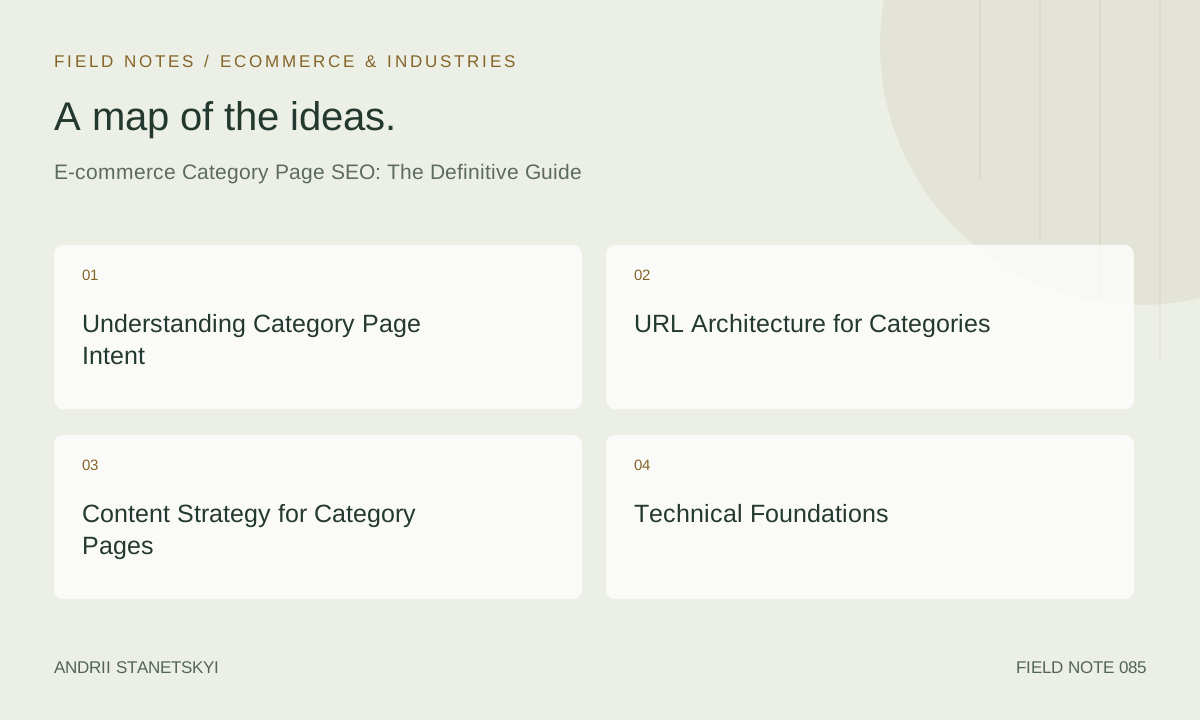
Understanding Category Page Intent
Category pages serve commercial investigation intent — users who know what type of product they want but are still evaluating options. This places them at a specific point in the purchase funnel: past the awareness stage but not yet at the decision stage of a product page. The SEO strategy must match this intent precisely.
Search queries that land on category pages typically follow these patterns:
- Generic product type: "running shoes for women"
- Attribute-filtered: "wireless headphones under $200"
- Brand + category: "Nike running shoes"
- Use-case: "hiking boots for wide feet"
- Comparison: "best DSLR cameras 2026"
The critical mistake most e-commerce teams make: optimizing category pages for the same informational content strategy as blog posts. Category pages should prioritize product discovery, filtering efficiency, and conversion triggers — informational content is supplemental, not central. Every word of category content must serve either the user's evaluation process or Google's understanding of page topic.
URL Architecture for Categories
| Structure | Example | Pros | Cons | Recommended? |
|---|---|---|---|---|
| Flat /category/ | /womens-running-shoes/ | Short URL, keyword-rich, easy crawling | No hierarchy signal, poor for large taxonomies | Yes, for small catalogs |
| Hierarchical | /shoes/womens/running/ | Clear hierarchy, breadcrumb-friendly, scalable | Longer URLs, keyword dilution in deep paths | Yes, for large catalogs |
| With /c/ or /category/ prefix | /c/womens-running-shoes/ | Technical simplicity | Wastes URL real estate, no SEO benefit | No |
| Query string | /products?cat=womens-shoes | Easy to generate dynamically | Poor canonicalization, crawl issues, not keyword-rich | No |
The recommended URL structure for most large e-commerce sites: /{parent-category}/{subcategory}/ with no URL stop words (/the/, /a/, /of/) and hyphens between words. Keep URLs to 3 hierarchical levels maximum — deeper paths dilute the category authority that passes to product pages below them.
Category URL Rules
- Use the primary keyword as the URL slug:
/womens-running-shoes/not/category-23/ - Avoid date-stamping category URLs — categories are evergreen, dates imply obsolescence
- Permanent redirect (301) any URL structure changes — category URL changes are catastrophic for traffic if not properly redirected
- For brand + category pages:
/nike/running-shoes/is cleaner and more crawlable than/brand_nike_running_shoes/
Content Strategy for Category Pages
Category page content has a specific job: help Google understand what products are on this page and help users decide which products to evaluate. It is not a blog post. The content architecture should follow this pattern:
Above-the-Fold Elements
- H1: Primary keyword, singular or plural as naturally searched. "Women's Running Shoes" not "Women's Running Shoes - Buy Online".
- Brief intro text (50-150 words): What types of products are on this page, key selection criteria, notable brands or features. This is the content most category pages get wrong — either missing entirely or copied from a brand description that doesn't serve user intent.
- Filtering/sorting controls: Prominent above the product grid. Users expect to filter immediately.
- Product count display: "243 products" — sets expectations and reduces bounce from users expecting a larger selection.
Below-the-Fold or Tabbed Content
For categories targeting competitive high-volume queries, additional content below the product grid can dramatically improve topical authority:
- Buying guide section: 300-600 words addressing the key selection criteria for this product category (materials, sizing, use cases, price brackets). This directly matches the informational component of commercial investigation queries.
- Featured brands or collections: Internal links to brand-specific subcategories.
- FAQ section: Addresses common questions about the product category. Qualifies for FAQ rich results in SERPs.
- Recently viewed / trending products: Behavioral personalization that also creates a unique content signal per user session.
Title Tag and Meta Description Templates
<!-- Category Page Title Tag Template -->
[Primary Keyword] | [Count] Styles | [Brand Name]

<!-- Examples -->
Women's Running Shoes | 243 Styles | Fleet Feet
4K Televisions | Shop 89 Models | BestTech Electronics
Leather Sofas | 127 Options | Modern Home Furnishings

<!-- Meta Description Template -->
Shop [count] [keyword] at [Brand]. [Key differentiator — free shipping, price match, expert advice].
Filter by [key attributes]. [CTA].

<!-- Example -->
Shop 243 women's running shoes at Fleet Feet. Free shipping on orders over $75.
Filter by brand, width, terrain, and cushion level. Find your perfect fit today.
Note the product count in the title tag — this is a CTR optimization that signals depth of selection to users scanning SERPs. Update it dynamically as catalog size changes. A stale "243 styles" tag on a page that now has 18 products (due to seasonal depletion) destroys trust when users arrive.
Technical Foundations
Canonicalization
Category pages generate a proliferation of near-duplicate URLs through sort orders, page numbers, and filter combinations. The canonical strategy:
- Self-referencing canonical on the base category URL:
/womens-running-shoes/ - Canonical all sort-order variations to the base:
/womens-running-shoes/?sort=price-asc→ canonical to/womens-running-shoes/ - Paginated pages: see pagination section below
- Filtered pages: canonical to base unless the filter generates a SEO-valuable URL worth indexing (see faceted navigation guide)
Page Speed
Category pages typically have the worst Core Web Vitals scores on e-commerce sites due to product image grids. Priority optimizations:
- Lazy load all product images below the fold
- Serve WebP/AVIF format product thumbnails at the exact display size
- Use a CDN for all product images — category page image requests are the single largest performance bottleneck
- Defer non-critical JavaScript (filter panel initialization, review summary widgets) until after page load
- Target LCP under 2.5s — on category pages, the LCP element is almost always the first product image or the hero banner
Structured Data
See the schema section below for full implementation details.
Pagination: The Right Implementation
Google removed rel=prev/next support in 2019. The current recommended approach for paginated category pages:
- Each paginated page (
/womens-running-shoes/page/2/) should be indexable with its own canonical pointing to itself (not to page 1). - Include a "View All" page if catalog size permits (under ~200 products) — a single page showing all products often outranks individual paginated pages.
- For large catalogs, implement infinite scroll with URL updates (pushState) so that individual sections can be shared/linked and Googlebot can crawl each section by following scroll-triggered URL changes.
- Internal links within the pagination: link to all page numbers, not just next/previous. This distributes crawl equity across the full paginated set.
Faceted Navigation (Brief Overview)
Faceted navigation creates thousands of filtered URL combinations. The SEO-safe implementation requires identifying which filter combinations generate sufficient search volume to warrant indexing, and blocking all others. See our comprehensive guide to faceted filtering for e-commerce SEO for the full implementation.
The quick rules: use noindex + follow on low-value filter combinations, allow indexing for high-value filter combinations (brand + category, price range + category), and never block filter pages that receive organic traffic — audit before blocking.
Schema Markup for Category Pages
Category pages benefit primarily from BreadcrumbList schema (which generates breadcrumb rich results) and, where applicable, ItemList schema for the product grid. FAQPage schema can be added to the FAQ section if present.
{
  "@context": "https://schema.org",
  "@graph": [
    {
      "@type": "BreadcrumbList",
      "itemListElement": [
        {
          "@type": "ListItem",
          "position": 1,
          "name": "Home",
          "item": "https://www.fleetfeet.com"
        },
        {
          "@type": "ListItem",
          "position": 2,
          "name": "Shoes",
          "item": "https://www.fleetfeet.com/shoes/"
        },
        {
          "@type": "ListItem",
          "position": 3,
          "name": "Women's Running Shoes",
          "item": "https://www.fleetfeet.com/shoes/womens/running/"
        }
      ]
    },
    {
      "@type": "ItemList",
      "name": "Women's Running Shoes",
      "description": "Shop 243 women's running shoes from top brands. Filter by brand, terrain, and cushion level.",
      "numberOfItems": 243,
      "itemListElement": [
        {
          "@type": "ListItem",
          "position": 1,
          "url": "https://www.fleetfeet.com/p/nike-pegasus-41-womens/"
        },
        {
          "@type": "ListItem",
          "position": 2,
          "url": "https://www.fleetfeet.com/p/brooks-ghost-16-womens/"
        },
        {
          "@type": "ListItem",
          "position": 3,
          "url": "https://www.fleetfeet.com/p/hoka-clifton-9-womens/"
        }
      ]
    }
  ]
}
Note: ItemList schema for categories does not require all products to be listed — include the top-featured products (first 5-10 in the default sort order). The numberOfItems property should reflect the total catalog count for that category.
Platform Implementations: Shopify, Magento, WooCommerce
Shopify
Shopify collections are the category equivalent. Key limitations and solutions:
- URL structure: Shopify forces
/collections/{handle}/— you cannot change this prefix without a proxy or custom domain routing. Accept it and optimize the handle slug. - Duplicate URLs: Shopify generates
/collections/{collection}/products/{product}URLs in addition to/products/{product}. Both are accessible. Shopify applies canonical to the/products/URL, but confirm this is working correctly in your theme. - Schema: Shopify's default themes do not output BreadcrumbList or ItemList schema for collections. Add this to your collection template via Liquid or a schema app.
- Pagination: Shopify uses
?page=2query parameters for collection pagination. These are indexable by default — confirm they have self-referencing canonicals.
Magento
Magento 2's category system is the most flexible but generates the most canonical complexity:
- Layer navigation (Magento's faceted filtering) creates parameter URLs by default — configure robots.txt and canonical tags for all filtered pages via the Category Permissions and URL Rewrites modules.
- Magento's "Use Categories Path for Product URLs" setting creates hierarchical product URLs (
/shoes/womens/running/nike-pegasus-41.html) — consider disabling this to avoid canonical conflicts between hierarchical and flat product URLs. - Implement category-level meta robots control to efficiently noindex/nofollow thin generated category combinations.
WooCommerce
- WooCommerce product categories use
/product-category/{slug}/by default. The/product-category/prefix is removable via permalink settings or a plugin like Yoast's WooCommerce SEO. - WooCommerce generates tag and attribute archive pages that often duplicate category content — ensure these are either noindexed or have unique content if they target distinct queries.
- The Yoast WooCommerce SEO plugin adds category-level schema output including BreadcrumbList, which is worth the additional cost for WooCommerce implementations.
Internal Linking from Categories
Category pages are link hubs — they pass authority down to product pages. Every product listed on a category page receives an internal link. The internal linking strategy for categories:
- Featured products: Products promoted to the top of the category grid (via merchandising rules) receive the most link equity — use this to boost strategically important products.
- Subcategory links: Link to relevant subcategories from within the category page content, not just in the navigation. In-content links carry more weight than navigation links.
- Cross-category links: "Frequently bought with" or "You might also like" sections that link to complementary categories distribute authority cross-category and serve user intent.
- Homepage → Category: Ensure your most important categories have direct homepage links in the main navigation — these receive the highest internal link equity on the site.
See our guide to e-commerce internal linking strategy for a complete category-to-product link equity model.
FAQ
Should category pages target a single keyword or multiple keyword variants?
Target a primary keyword in the URL, H1, and title tag. Use natural keyword variants throughout the page content and meta description. Category pages naturally rank for many related terms — your optimization should anchor on the highest-volume target and let semantic relevance handle the variants. Do not create separate category pages for close keyword synonyms — consolidate them under one URL.
How much text content does a category page need?
The minimum to establish topical relevance is 150-250 words above the fold (intro + key attributes/buying criteria). For highly competitive queries, 400-800 words of substantive buying guide content below the product grid improves topical authority. More than 1000 words on a category page typically signals content stuffing unless it's genuinely useful buying guide content.
Should I noindex category pages with no products?
Yes. Empty category pages with no products provide zero value to users and dilute crawl budget. Use a combination of noindex meta robots tag and a server-side check that applies noindex automatically to any category with 0 products. Consider adding a redirect rule to send users to the parent category when a subcategory is empty.
How do I handle seasonal categories (e.g., "Christmas Gifts")?
Keep the URL live year-round. During off-season, update the page to redirect users to a relevant evergreen category or display a "Check back in October" message while keeping the page indexable. Deleting and recreating seasonal category URLs annually destroys accumulated link equity. See our out-of-stock and seasonal product SEO guide for more detail.
Can a single page rank for both category and brand queries?
Yes, if the page combines both signals — brand logo, brand-specific products, and content that mentions the brand prominently. Create dedicated brand + category pages (/nike/running-shoes/) for high-volume brand + category queries rather than relying on the generic category page to capture brand-filtered traffic.
Key Takeaways
- Category pages target commercial investigation intent — optimize for product discovery and evaluation, not informational content depth.
- Hierarchical URL structure (
/{parent}/{subcategory}/) is recommended for large catalogs; flat structure works for small catalogs. - Dynamic product count in title tags improves CTR but must be kept current — stale counts hurt trust.
- BreadcrumbList and ItemList schema are the primary schema types for category pages.
- Platform-specific limitations (Shopify's
/collections/prefix, Magento's layer navigation URLs) require platform-aware implementation decisions. - Category pages are link hubs — merchandising decisions (which products appear first) have direct SEO implications for product page authority.
- Seasonal and empty categories should be kept live with noindex or updated content rather than deleted to preserve accumulated link equity.
Conclusion
E-commerce category page SEO is a discipline of precision: precise URL architecture, precise content-to-intent alignment, precise canonical configuration, and precise schema implementation. The teams that get this right compound their investment — a well-optimized category page that ranks for dozens of related queries drives more revenue than any individual product page. The teams that treat category pages as auto-generated template outputs leave significant organic revenue on the table.