Internal linking is PageRank sculpting — and most SEO teams are doing it by feel rather than by data. A rigorous internal linking strategy combines crawl depth analysis, PageRank flow modeling, anchor text distribution, and content architecture to move equity where your business needs it most. This guide covers the full framework: from site structure principles to automated audits that scale across millions of pages.
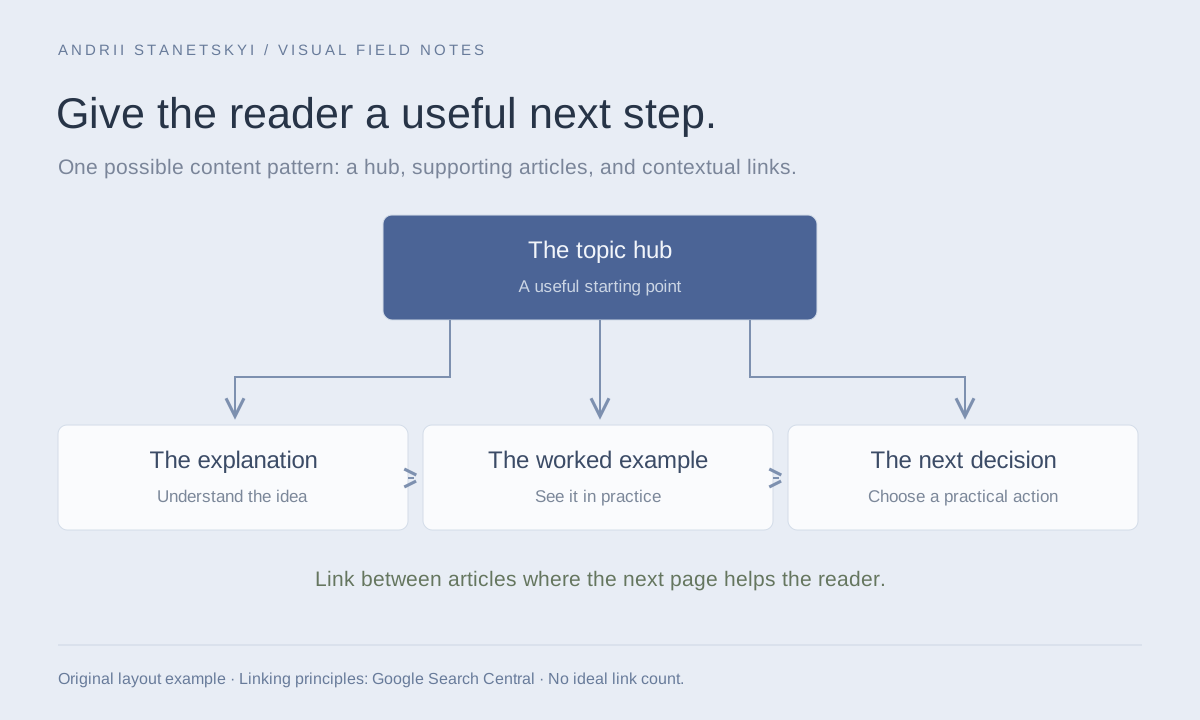
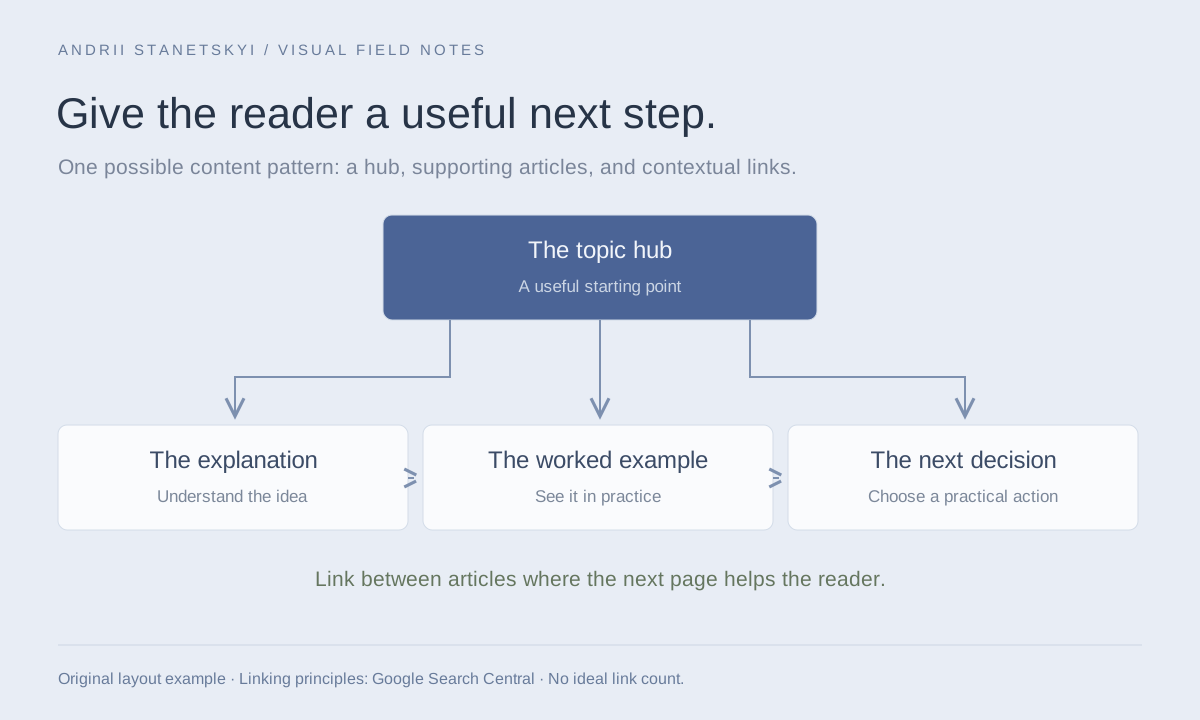
A topic hub connects an explanation, a worked example, and a next decision. Supporting articles link to each other where relevant.
Why Internal Links Matter More Than Ever
Google confirmed in a 2024 documentation update that internal links are used to understand page importance within a site. Couple that with the expanded role of passage ranking — where individual content sections can rank independently — and internal links become the distribution mechanism for authority from high-PageRank pages to content that needs ranking lift.
In practical terms: a blog post with zero external backlinks but strong internal link equity from a high-traffic, high-authority resource hub page can rank competitively for mid-tail keywords. The inverse is equally true — a page with strong external backlinks but poor internal link structure wastes much of that earned equity in dead ends.
The 2025 Google antitrust documents released during the DOJ case provided further evidence that internal link signals influence ranking. While Google's specific implementation details remain opaque, the principle holds: internal links are PageRank conduits, and building them deliberately is one of the highest-leverage technical SEO activities available without acquiring a single new backlink.
PageRank Flow: The Mental Model
Think of your site as a water distribution system. External backlinks are the water supply entering from outside. Your homepage and top-level landing pages are the main reservoir — they receive the most inbound links and accumulate the highest internal PageRank. Every outgoing internal link is a pipe that distributes that water to downstream pages. Pages with no incoming internal links are dry — they get no distributed authority regardless of their content quality.
The mathematics: in the classic PageRank formulation, a page's rank is divided equally among all its outgoing links. A page with 100 units of PageRank and 10 outgoing links passes 10 units per link. A page with 100 units and 2 outgoing links passes 50 units per link. This is why footers and navigation bars with 50+ links dilute link equity significantly — the PageRank passed through each one approaches zero.
"The internal link structure is one of the most controllable ranking factors available to technical SEOs — unlike backlinks, you can add, remove, and redirect internal links without third-party cooperation."
See how internal linking fits into the broader technical SEO audit framework.
Site Architecture and Link Depth
The 3-Click Rule (Revised)
The old "everything within 3 clicks" rule was directionally correct but mechanically insufficient. The real metric is crawl depth — how many links from the homepage does Googlebot have to follow to reach a given URL. Pages at crawl depth 1 (directly linked from homepage) receive maximum authority. Pages at crawl depth 5+ receive meaningfully diminished equity and may be crawled infrequently or not at all on large sites.
Run a Screaming Frog crawl and segment pages by crawl depth. Any page with commercial importance (category pages, money pages, priority landing pages) sitting at depth 4+ is a structural problem requiring architectural intervention, not just link-building.
Flat vs. Silo Architecture
| Architecture Type | Link Distribution | Best For | Risk |
|---|---|---|---|
| Flat (all pages 1–2 clicks from homepage) | Maximum authority per page | Small sites, brand sites | Navigation complexity at scale |
| Silo (strict topical clusters) | Concentrated within clusters | Topical authority sites | Cross-silo equity isolation |
| Hub-and-Spoke (pillar + cluster) | Balanced via hub pages | Content-heavy sites | Hub pages need backlink support |
| E-commerce Category Tree | Category → subcategory → product | Large product catalogs | Deep product pages starved of equity |
Hub-and-Spoke: The Recommended Model for Most Sites
A pillar page (hub) covers a broad topic comprehensively and links out to cluster pages covering specific sub-topics. Cluster pages link back to the pillar and cross-link to related cluster pages. This bidirectional linking pattern creates a reinforcing equity loop within the topical cluster while keeping the pillar page as the primary authority accumulator.
For example: a cybersecurity blog's pillar page "Complete Guide to Network Security" links to cluster pages on firewalls, VPN configuration, intrusion detection, and zero-trust architecture. Each cluster page links back to the pillar and to adjacent cluster pages. The pillar ranks for broad informational queries; cluster pages rank for specific long-tail queries and funnel equity back to the pillar.
Anchor Text Strategy
Anchor Text Diversity for Internal Links
Unlike external links where over-optimized exact-match anchors can trigger Penguin-adjacent signals, internal links have more flexibility — but still require deliberate distribution. The recommended internal anchor text mix:
- Exact-match keyword (30–40%): "technical SEO audit" linking to your technical SEO audit guide
- Partial match / topical (30–40%): "our crawl budget analysis process" linking to the same page
- Brand + keyword (10–15%): "[Brand]'s site audit framework"
- Descriptive / contextual (10–20%): "this methodology," "our approach," with surrounding context making the target page clear
- Generic to avoid (<5%): "click here," "read more," "learn more" — zero keyword value, poor accessibility
Anchor Text Consistency Across the Site
Pages should receive consistent primary anchors across their most important internal links. If your page on "crawl budget optimization" receives anchors like "crawl budget," "Googlebot crawl management," "crawl frequency," and "how to manage crawl budget" — that diversity is healthy. If five pages all use "click here" to link to it, that's wasted anchor equity. Audit anchor text diversity in Ahrefs by filtering internal backlinks by target URL.
See our guide to anchor text optimization for external link building.
Link Placement: Where Context Beats Volume
Editorial Body Links: Highest Value
Links embedded naturally within the main body content of an article pass the most equity and receive the highest click rates. Google has confirmed (through leaked documentation) that link placement within the main content area carries more weight than sidebar or footer links. Write content that naturally necessitates a link — don't force links into content where they interrupt the reader's flow.
Navigation and Footer Links: Structural, Not Contextual
Header navigation links are critical for crawlability — they ensure all top-level pages are reachable from every page on the site. But they dilute individual link equity because they appear on every page, distributing authority widely and thinly. Reserve navigation slots for your highest-priority conversion pages. Footers should contain sitemap-style links to legal pages, contact, and top-level categories — not to every blog post you've ever published.
Related Content Widgets: Test Before You Trust
CMS-generated "related posts" widgets add internal links automatically, which sounds helpful. In practice, poorly configured recommendation engines create random link graphs that don't respect topical relevance. Test your related content widget by checking whether the suggested pages are topically adjacent to the host page. If a post about "Python SEO automation" is suggesting posts about "off-page SEO for beginners," the widget is creating noise, not equity flow.
Contextual Link Depth within Content
Links in the first 25% of a page's body content tend to get higher click rates and may carry slightly more weight in Google's attention modeling. Don't front-load all links artificially, but make sure your most important internal link on any given page appears in the first two or three paragraphs, not buried at the end of a long article where most users have already left.
Audit Workflow: Finding Orphans, Sinks, and Dilution
Step 1: Identify Orphan Pages
An orphan page has no internal links pointing to it. It may be indexed (if submitted via sitemap) but receives no equity and is at risk of infrequent crawling. In Screaming Frog: run a full crawl, then upload your XML sitemap URLs. Compare the two lists — any URL in the sitemap but not found via crawl links is an orphan. Prioritize fixing orphans for your money pages immediately.
Step 2: Find PageRank Sinks
A PageRank sink is a page that receives internal links but has no outgoing internal links — or links only to pages that link back to it in a closed loop. This traps equity. Check for pages with zero outgoing internal links in Screaming Frog's "Inlinks" filter. Every important page should have at least 2–3 relevant outgoing internal links.
Step 3: Measure Link Equity Distribution
Ahrefs' "Internal pages" report shows URL Rating (UR) for every page, which approximates relative internal equity. Pages that should be high-priority (category pages, key landing pages) but show low UR relative to their content investment are receiving insufficient internal equity. Cross-reference against crawl depth — low UR at high crawl depth is expected; low UR at crawl depth 2 indicates a structural gap.
Step 4: Audit Anchor Text at Scale
Export Ahrefs' internal backlinks report for your target pages. Pivot by anchor text. Flag any page where more than 50% of internal anchors are generic ("click here," "read more") or where there are fewer than 10 unique anchor texts across 50+ internal links (suggesting templated, non-contextual linking).
Step 5: Check for Broken Internal Links
Screaming Frog's "Response Codes" filter shows all internal links returning 4xx or 5xx status codes. Broken internal links waste equity and create poor user experience. Redirect broken link targets or update the anchor URLs. This is the lowest-effort, highest-return internal linking fix available — always run it first.
Download our internal linking audit template (Google Sheets).
Automation at Scale
Programmatic Internal Linking for CMS Sites
For sites with 10,000+ pages, manual internal link placement doesn't scale. Options for programmatic implementation:
- Link Whisper (WordPress): Uses NLP to suggest contextual internal links based on keyword matching between existing content. Review suggestions before approving — the tool occasionally suggests irrelevant links. Its value is surfacing opportunities you'd miss manually.
- Custom scripts via the CMS API: Build a keyword-to-URL lookup table from your keyword research. Write a script that scans new content for keyword mentions and auto-suggests internal links. Review and approve in a queue.
- Structured data-driven linking: For e-commerce, auto-generate "You might also like" links based on product taxonomy attributes (same category, complementary category, same brand). This is more reliable than ML-based recommendation engines for equity flow purposes.
Log File Analysis for Link Effectiveness
The ultimate validation of internal link equity flow is log file analysis. Pull your server logs and compare Googlebot crawl frequency for target pages before and after adding internal links. Screaming Frog Log File Analyser or Sitebulb's log file module can correlate crawl frequency changes with internal link additions. Increased crawl frequency following a strategic internal link addition is the clearest signal that the equity flow is working.
FAQ
How many internal links should a page have?
There's no hard limit, but quality outweighs quantity significantly. A page with 5 highly relevant, contextually embedded internal links outperforms a page with 30 footer-injected links. For long-form content (2,000+ words), 8–15 internal links is a reasonable density. For shorter pages (500–800 words), 3–6 links is appropriate. Monitor your most important pages' link counts via Screaming Frog and compare against top-ranking competitor pages for your target queries.
Should I nofollow internal links?
Almost never. Nofollowing internal links was a legitimate PageRank sculpting technique prior to 2009, when Google changed how nofollowed links work. Today, nofollowed internal links don't pass equity — but the PageRank that would have flowed through them doesn't redistribute to other links on the page, it simply evaporates. Nofollow internal links only for pages you explicitly don't want crawled (login pages, admin panels, checkout flows).
Do internal links from older pages help newer pages rank faster?
Yes. A new page with internal links from established, frequently-crawled pages gets indexed faster (Googlebot follows fresh links) and receives equity immediately on first crawl. This is the "internal links as link building" strategy: when you publish new content, immediately add it to 3–5 relevant existing pages as a contextual internal link. Track indexing speed in GSC's "Page Indexing" report — pages with immediate internal links from high-authority pages typically index within 24–72 hours versus weeks for orphans.
What is a good internal link structure for e-commerce sites?
The standard e-commerce hierarchy is: Homepage → Category → Subcategory → Product. The problem is that most product pages sit at crawl depth 3–4 and receive minimal equity. Counter this with: (1) featuring best-sellers on the homepage; (2) adding "related products" cross-links between products in the same category; (3) linking from blog/editorial content to product pages where contextually relevant; (4) ensuring all category pages link bidirectionally — categories link down to products and subcategories, and subcategory pages link up to parent categories.
How does internal linking affect crawl budget?
Crawl budget is partially determined by the "crawl demand" for a URL — how many internal links point to it. Pages with many internal links get crawled more frequently. For large sites concerned about crawl budget, this means strategically concentrating internal links on pages you want crawled frequently (fresh content, product pages with inventory changes) and reducing internal links to static, infrequently-updated pages (legal pages, old archived posts). Don't waste crawl budget on pages with no ranking potential.
Can internal linking replace external backlinks?
No — but it can significantly amplify the impact of the external backlinks you do have. Internal linking distributes existing equity; it doesn't create new equity. A site with zero external backlinks has zero equity to distribute internally. The strategic opportunity is maximizing the return on the external equity you've earned: ensure it flows to your highest-priority commercial pages through a deliberate internal link structure rather than pooling in your homepage and a few top-level pages.
Key Takeaways
- Internal links are PageRank conduits. Every link you add or remove changes the equity distribution across your entire site.
- Use the hub-and-spoke (pillar/cluster) model for content sites. It creates reinforcing equity loops and concentrates topical authority.
- Crawl depth matters more than click depth. Any priority page at depth 4+ needs architectural intervention.
- Anchor text should be 30–40% exact-match, 30–40% partial-match, and less than 5% generic terms.
- Orphan pages are silent traffic leaks. Audit them monthly on any active site.
- Footer and navigation links are structural (crawlability), not contextual (equity). Don't rely on them to replace editorial links.
- Validate equity flow with log file analysis — Googlebot crawl frequency changes are the ground truth signal.
Conclusion
Internal linking strategy is infrastructure work. Done well, it's nearly invisible — pages rank, content gets crawled, equity flows where it needs to. Done poorly, it creates PageRank dead ends, orphan pages, and authority leakage that no amount of content creation or link building can overcome. The audit workflow here — orphan detection, sink analysis, equity distribution review, anchor text audit — takes a day to run on most sites. The returns compound for months afterward. That ratio is rare in SEO. Take advantage of it.
Next: how image SEO and lazy loading affect crawl efficiency and organic visibility.