The era of targeting individual keywords with individual pages is effectively over for any domain operating in a competitive niche. What replaced it—properly understood—is not "content marketing" or "thought leadership" but a deliberate structural architecture that maps your domain's topical authority to the way search engines understand knowledge organization. Topic clusters and pillar pages are the implementation of that architecture. When built correctly, they concentrate internal link equity, establish topical depth signals that isolated pages cannot create, and produce compounding ranking effects that keyword-by-keyword approaches never achieve. When built sloppily—a pillar page with twenty thin cluster posts stapled around it—they accomplish nothing except burning content production budget.
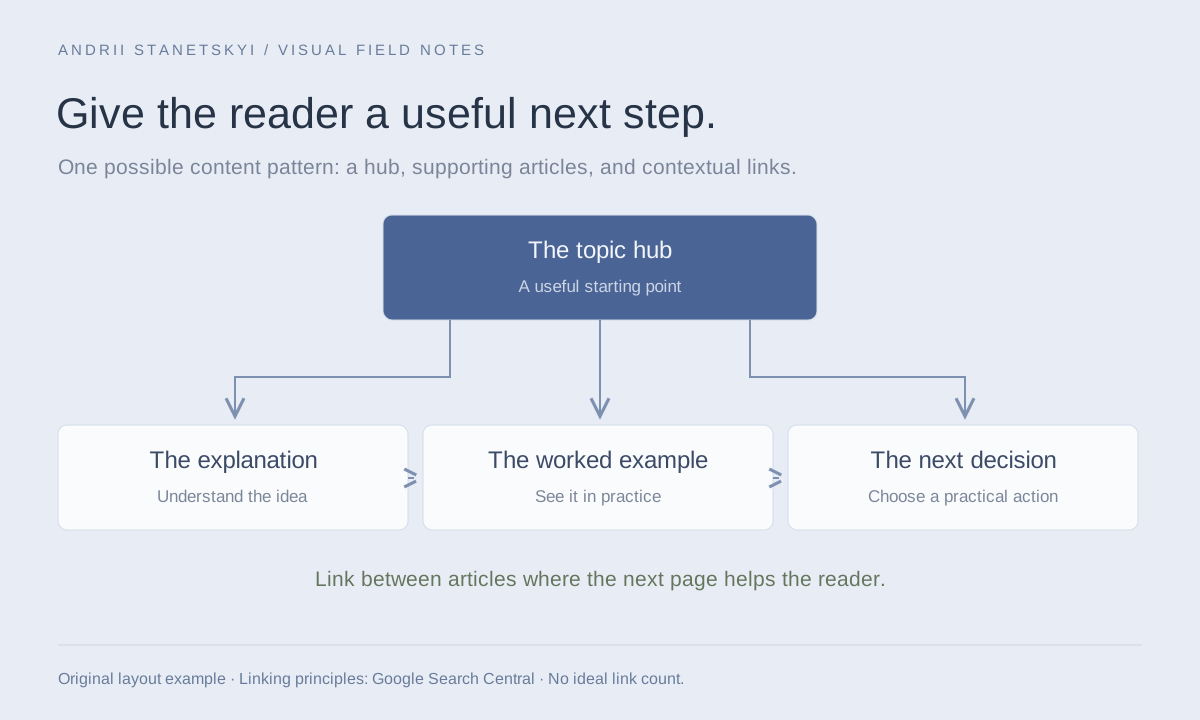
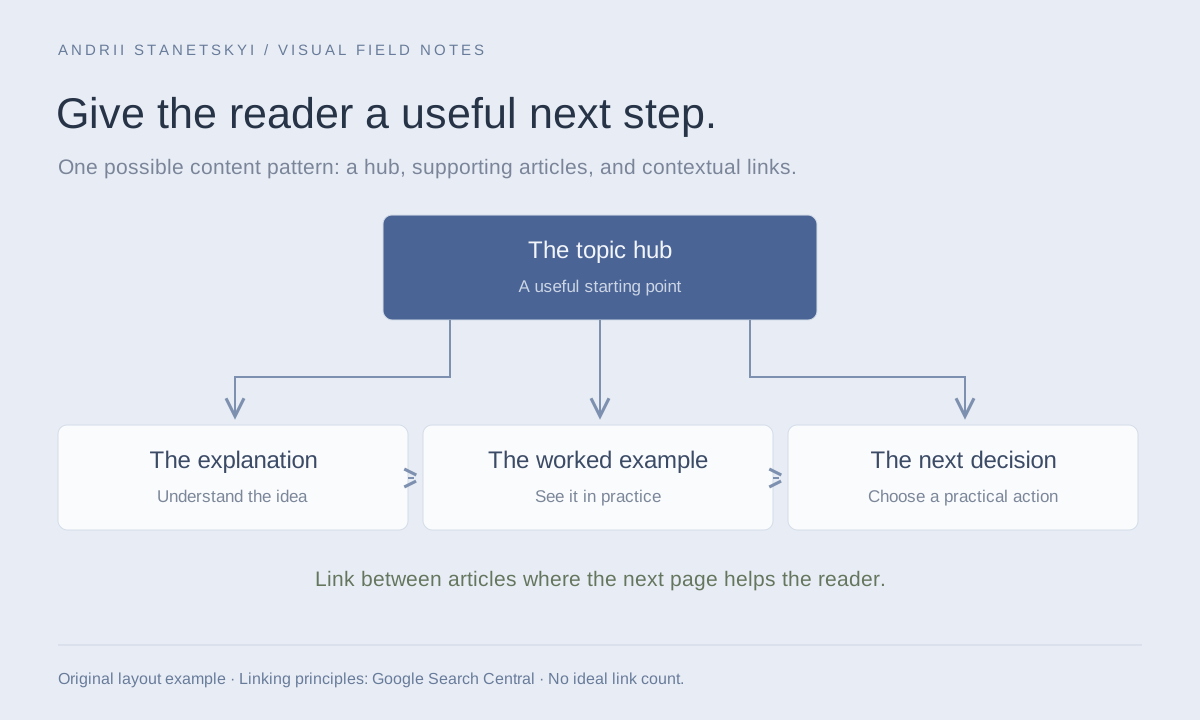
A topic hub connects an explanation, a worked example, and a next decision. Supporting articles link to each other where relevant.
The Architecture: Pillars, Clusters, and Hubs Defined Precisely
Most sites that claim to use topic clusters have simply renamed their category pages "pillar pages" and kept everything else the same. That is not a cluster strategy—it is a relabeling exercise. The genuine architecture has three distinct layers:
Pillar Page
A comprehensive, single-URL resource that covers a broad topic at sufficient depth to satisfy user intent for the parent keyword AND provide clear navigational pathways into sub-topics. A pillar page for "keyword research" covers what it is, why it matters, how it differs from SEO broadly, and introduces every sub-topic—long-tail keywords, search intent, keyword difficulty, clustering, etc.—without fully resolving any of them. Each sub-topic is covered enough to be useful but anchors a link down to a dedicated cluster page. Length: typically 3,500–7,000 words. Target keyword: high-volume, broad, moderately difficult (KD 40–65 in Ahrefs). Example: "Keyword Research Guide" targeting "keyword research" (volume: 33,000/month US, KD: 58).
Cluster Pages
Dedicated pages that fully resolve a specific sub-topic within the pillar's domain. A cluster page for "long-tail keywords" covers that topic exhaustively—definition, identification methods, tools, examples, when to use them, case studies. It is the definitive resource for that sub-topic. Length: 1,500–3,500 words depending on topic complexity. Target keyword: moderate-volume, lower-difficulty (KD 15–40). The cluster page links back to the pillar and across to relevant adjacent cluster pages. It does NOT try to rank for the pillar's broad head term.
Hub (Content Hub vs. Topic Cluster)
The terms are sometimes conflated. A topic cluster is the structural relationship between a pillar and its cluster pages. A content hub is the editorial strategy that populates and maintains that cluster over time. You can have a cluster without a hub (build it once, rarely update) or a hub without a cluster (a category page with regular content but no intentional linking architecture). The most effective sites run both: deliberate cluster architecture WITH an editorial calendar (hub) that continuously adds cluster pages and refreshes the pillar. Our content hub and topic authority guide covers the editorial strategy layer.
Keyword Mapping to Cluster Architecture
Cluster architecture begins with keyword research that groups keywords by topic ownership, not by individual page assignment. The mapping process:
Step 1: Seed Keyword Expansion
Start with your core product/service categories as seed keywords. Run each through Ahrefs Keyword Explorer "Matching terms" and "Related terms" reports. Export all keywords with volume ≥ 100 and KD ≤ 70 (adjust thresholds to your domain's DR). For a SaaS tool targeting "keyword research," this might yield 1,200–2,000 keyword variations.
Step 2: Cluster Grouping by SERP Similarity
Keywords that trigger the same top-10 SERP results should be targeted by the same page. Keywords with distinct SERPs need distinct pages. Use Keyword Insights or write your own clustering script:
# Python: SERP-similarity clustering using URL overlap
from collections import defaultdict
from itertools import combinations

def compute_serp_overlap(serp_a, serp_b):
    """Returns Jaccard similarity of two SERP URL sets."""
    set_a = set(serp_a[:10])
    set_b = set(serp_b[:10])
    intersection = len(set_a & set_b)
    union = len(set_a | set_b)
    return intersection / union if union > 0 else 0

def cluster_keywords_by_serp(keyword_serps, similarity_threshold=0.4):
    """
    keyword_serps: dict of {keyword: [url1, url2, ...url10]}
    Returns clusters as list of keyword sets
    """
    keywords = list(keyword_serps.keys())
    adjacency = defaultdict(set)

    for kw_a, kw_b in combinations(keywords, 2):
        overlap = compute_serp_overlap(
            keyword_serps[kw_a],
            keyword_serps[kw_b]
        )
        if overlap >= similarity_threshold:
            adjacency[kw_a].add(kw_b)
            adjacency[kw_b].add(kw_a)

    # Connected components (simple BFS)
    visited = set()
    clusters = []
    for kw in keywords:
        if kw not in visited:
            cluster = []
            queue = [kw]
            while queue:
                node = queue.pop()
                if node not in visited:
                    visited.add(node)
                    cluster.append(node)
                    queue.extend(adjacency[node] - visited)
            clusters.append(cluster)

    return clusters
Step 3: Assign Cluster Role
For each cluster group, identify:
- The head keyword: highest volume, broadest scope → pillar page or primary cluster page target
- Supporting keywords: more specific, lower volume → should be covered within the same page as the head keyword
- Adjacent keywords: related but distinct SERP → separate cluster page, internal link relationship
| Keyword | Volume (US/mo) | KD (Ahrefs) | CPC | Cluster Role | Target Page Type |
|---|---|---|---|---|---|
| keyword research | 33,000 | 58 | $4.20 | Pillar head | Pillar page |
| how to do keyword research | 8,100 | 52 | $3.80 | Pillar supporting | Within pillar page |
| keyword research for seo | 5,400 | 49 | $4.50 | Pillar supporting | Within pillar page |
| long tail keywords | 14,000 | 38 | $2.10 | Cluster head | Dedicated cluster page |
| keyword difficulty | 9,900 | 41 | $3.60 | Cluster head | Dedicated cluster page |
| zero volume keywords | 1,200 | 18 | $1.80 | Cluster head | Dedicated cluster page |
| keyword cannibalization | 2,900 | 29 | $2.90 | Cluster head | Dedicated cluster page |
Designing a Pillar Page That Actually Ranks
The pillar page has to accomplish two distinct jobs simultaneously: rank for a competitive head term AND serve as the topical index that makes cluster pages authoritative. These objectives are in tension. Ranking for a head term requires comprehensive depth. Serving as a cluster hub requires breadth with navigational clarity. The resolution is structural, not just editorial.
Pillar Page Structure
- Above-the-fold definition + value statement: What is this topic, why it matters, who this guide is for. 150–250 words. This section should answer the head term's definition query completely—capturing featured snippet real estate and AI Overview citations.
- Navigational table of contents with anchor links: Every major section linked. This signals document structure to Google and improves page usability signals.
- Core concept sections (H2s): Each H2 covers a sub-topic in enough depth to be genuinely useful (300–600 words), then ends with an explicit call-out linking to the dedicated cluster page: "For a complete breakdown of long-tail keyword strategy, see our [Long-Tail Keywords guide]."
- One comprehensive data/comparison table: This is a snippet magnet and link magnet. A well-structured table of keyword research tools with feature comparison earns links from referencing articles and increases dwell time.
- FAQ section: 5–8 H3 questions with direct, complete answers. These map to PAA boxes and AI Overview citations.
- Summary and next steps: Explicit internal links to the 3–4 most important cluster pages for someone ready to go deeper.
What Pillar Pages Are Not
A pillar page is not an "ultimate guide" that tries to be the only page a reader ever needs. That format—common in 2018–2021—produces pages that are too long for easy consumption, suffer from user behavior signals (people bail after section 3), and create cannibalization risk with their own cluster pages. The pillar is a gateway, not a destination. Its job is to introduce and route, with enough substance to earn the ranking.
Cluster Content: Standards, Formats, and Common Failures
The Minimum Bar for Cluster Pages
Each cluster page must be the best dedicated resource on the web for its specific sub-topic within your domain's authority context. "Best" does not mean longest—it means most useful for the specific search intent. A cluster page on "keyword difficulty" should define the metric, explain how Ahrefs KD, Semrush KD, and Moz KD differ (they use different inputs), provide interpretation guidance (KD 0–30: anyone can rank, KD 70+: requires significant authority), and offer practical examples. That is 1,500–2,500 words of focused depth. Not 4,000 words with filler.
Cluster Page Internal Linking Requirements
- Link UP to pillar page: once in body, once in the conclusion or next steps section
- Link ACROSS to 2–4 adjacent cluster pages with contextually relevant anchor text
- Do NOT link down to the pillar's other cluster pages unless there is genuine topical relevance
- Receive at least one link FROM the pillar page in the relevant section
Common Cluster Failures
Failure 1: Cluster pages that cannibalize each other. Two cluster pages targeting overlapping keywords because the initial keyword grouping was wrong. Solution: use SERP similarity clustering (see above) before assigning keywords to pages. Our keyword cannibalization guide covers detection and remediation of this specific failure mode.
Failure 2: Cluster pages with no inbound links except from the pillar. A cluster page that receives link equity only from its own pillar will not rank competitively for moderate-difficulty keywords. Build external links to cluster pages independently—treat each cluster page as a linkable asset, not just internal content.
Failure 3: Pillar page that tries to rank for cluster keywords. If your "Keyword Research" pillar page has a 2,000-word section on "long-tail keywords" and you also have a cluster page on the same topic, you have created cannibalization at the architectural level. Pillar sections should be substantive but introductory—200–600 words maximum per sub-topic.
Internal Linking Mechanics for Cluster Sites
The link equity flow within a cluster architecture is deliberate, not emergent. Here is the intended equity flow:
Homepage
    │
    ├── Pillar Page A (receives equity from homepage, distributes to clusters)
    │       ├── Cluster A1 (links back to pillar, across to A2, A3)
    │       ├── Cluster A2 (links back to pillar, across to A1, A3)
    │       └── Cluster A3 (links back to pillar, across to A1, A2)
    │
    └── Pillar Page B
            ├── Cluster B1
            ├── Cluster B2
            └── Cluster B3
Key mechanics:
- The homepage should link directly to all pillar pages (not just the blog category)
- Pillar pages should not link to other pillar pages unless there is genuine topical relationship (cross-cluster links dilute the cluster's equity concentration)
- Cluster pages from different clusters can cross-link when there is genuine semantic proximity—this actually strengthens both clusters by showing Google a broader knowledge graph
- Use descriptive anchor text for all cluster links: "long-tail keyword strategy guide" not "click here" or "read more"
Research on internal PageRank distribution patterns and cluster architecture confirms that concentrated, intentional cluster linking outperforms distributed, flat site architectures for topical authority signals.
Measuring Topical Authority: Metrics and Signals
Topical authority is not a metric any tool directly measures—but its effects are measurable:
| Metric | Tool | What It Signals | Target Trajectory |
|---|---|---|---|
| Topical coverage ratio | Custom / Keyword Insights | % of cluster keywords where you hold a top-10 position | Increasing quarter-over-quarter |
| Cluster keyword ranking distribution | Semrush Position Tracking | Positions across all cluster keywords vs. competitors | Concentrating toward positions 1–5 |
| Pillar page average position | GSC / Ahrefs | Head term competitiveness | Slow climb; 12–18 months to top 5 on KD 50+ |
| Cluster page linking domains | Ahrefs Site Explorer | External authority signals per cluster page | Each cluster page: ≥5 referring domains |
| Branded + unbranded click share in topic | GSC (custom segment) | Holistic visibility in topic space | Non-branded click share growing |
Step-by-Step: Building a Cluster from Keyword Research
- Define cluster scope: Identify one core topic that your product/service directly addresses and where you have (or can build) genuine expertise. Be narrow enough that a single pillar page can cover the topic comprehensively. "SEO" is too broad for a pillar; "keyword research" is appropriate; "long-tail keyword research" is a cluster page.
- Keyword research and SERP clustering: Export 500–2,000 candidate keywords from Ahrefs/Semrush. Apply SERP similarity clustering (Keyword Insights or custom Python). Identify clusters of ≥3 keywords with shared SERPs—these map to single pages. Clusters with 1–2 keywords may be supporting keywords for an existing page.
- Assign pillar vs. cluster roles: The highest-volume, broadest cluster becomes the pillar head keyword. Every other distinct cluster becomes a cluster page target. Check for cannibalization risk between your pillar head and cluster heads using the same SERP similarity tool.
- Content brief creation: For each page, write a brief specifying: target keyword, supporting keywords, required sections (mapped from SERP analysis of top 5 results), required internal links in/out, word count target, required data/examples.
- Build pillar first: Publish the pillar page before cluster pages. It needs to exist to receive internal links from clusters. Its URL becomes the canonical reference point for the entire cluster.
- Publish cluster pages in batches: Publish 3–5 cluster pages simultaneously per cluster. This signals to Google that the topic is being developed deliberately, not randomly.
- Implement bidirectional linking: Ensure every cluster page has the pillar link and the pillar page is updated to include links to new cluster pages in the relevant sections.
- External link acquisition for pillar: The pillar page is your primary link target. Run a link building campaign specifically for the pillar URL—it is the highest-leverage target because its link equity distributes across the entire cluster.
- Measure at 90, 180, and 365 days: Track topical coverage ratio (what % of cluster keywords rank top 10) and pillar page position. Adjust by adding new cluster pages for keyword groups you have not yet covered.
FAQ
How many cluster pages does a pillar need?
Minimum 5; effective clusters typically have 8–15. More is not always better—15 high-quality, well-linked cluster pages outperform 40 thin ones every time. The right number is however many distinct sub-topics your topic space contains that merit dedicated treatment. Map the sub-topics first; let content count follow.
Should my pillar page be gated or ungated?
Ungated, always, if ranking is your primary goal. Gated pillar pages cannot earn organic links, cannot be crawled fully, and cannot rank for top positions. If you need leads from a comprehensive guide, build the ungated pillar and gate a companion asset (template, checklist, workbook) that the pillar references. This gets you both organic visibility and lead capture.
Can I retrofit an existing site to use cluster architecture?
Yes, but it requires honest assessment. Map your existing content against the cluster framework. Content that fits cluster roles needs internal linking adjustment and potential optimization for the correct keyword. Content that does not fit any cluster needs either reassignment (change target keyword), consolidation (merge into a cluster page), or removal (if it serves no cluster purpose and has no traffic). Do not simply call existing category pages "pillar pages" without structural changes.
How does topic cluster architecture relate to E-E-A-T?
Directly. Google's E-E-A-T assessment of a site is influenced by whether the site demonstrates comprehensive, deep coverage of a topic area—or just a surface treatment. A site with 15 substantive, interlinked pages on keyword research demonstrates greater topical expertise than a site with 1 long page and 14 unrelated articles. Cluster architecture is, in part, a structural implementation of E-E-A-T signals at the site level.
What is the difference between a pillar page and a category page?
A category page organizes content by taxonomy—it lists articles in a category. A pillar page is a comprehensive resource that covers a topic and links to cluster content. The difference is in content depth and linking intent. A category page says "here are our articles about X." A pillar page says "here is what X means, how it works, and here are the specific aspects we cover in depth." Many sites benefit from converting their most important category pages into pillar pages by adding substantive content above the article index.
How long does it take for a new cluster to rank?
For cluster pages targeting KD 15–30 keywords, expect top-10 rankings within 3–6 months if the pillar is established and internal linking is in place. For pillar pages targeting KD 45–65 head terms, expect 12–24 months to reach top-5 positions from a standing start. These timelines assume active link building. Without external links, add 6–12 months to both estimates.
Do I need a separate cluster for every product category?
Each product or service category that has independent search demand (people search for information about it without looking for your brand) warrants its own cluster. If two categories share overlapping search demand—users search the same keywords when researching both—they may belong in a single cluster. Use SERP analysis: if the same SERP appears for category A and category B keywords, they belong together. If SERPs differ, separate clusters.
Key Takeaways
- Topic clusters are architectural decisions, not editorial ones—they require deliberate keyword-to-page mapping based on SERP similarity, not intuitive grouping
- Pillar pages are gateways that introduce and route, not encyclopedias that try to fully cover every sub-topic
- SERP-similarity clustering is the technically correct method for determining which keywords belong on the same page
- Internal linking within clusters must be bidirectional and structured: cluster pages link up to pillar, across to adjacent clusters, and receive links from the pillar in relevant sections
- Topical authority is measurable via topical coverage ratio, cluster keyword ranking distribution, and pillar page position trajectory
- Build pillar pages first; publish cluster pages in batches; run link acquisition specifically targeting the pillar URL as the highest-leverage asset
Conclusion
Topic clusters and pillar pages are not a trend or a framework du jour—they are the operationalization of how search engines evaluate topical expertise at the site level. The sites that will dominate organic search in 2026 and beyond are those that have built coherent, comprehensive, interlinked knowledge architectures around the topics that matter to their users. The sites that will lose are those still treating SEO as a page-by-page keyword targeting exercise. The implementation is not simple—it requires upfront keyword architecture work, ongoing quality discipline for cluster content, and a real link building commitment for pillar pages—but the compounding ranking advantages it produces are the closest thing to sustainable organic growth available in modern SEO.