Keyword cannibalization is one of those SEO problems that accumulates quietly. A site adds pages for three years, each new writer targets "the important keywords," and by the time someone notices performance has plateaued, there are 40 pages competing for 12 keyword groups and none of them rank well for anything. At scale—thousands of pages, multiple content teams, years of publishing history—cannibalization is not an edge case. It is the default state of any site that has not built explicit structural controls against it. This guide covers the detection methods that work at scale, the fix taxonomy that matches solution to severity, and the systems to prevent recurrence.
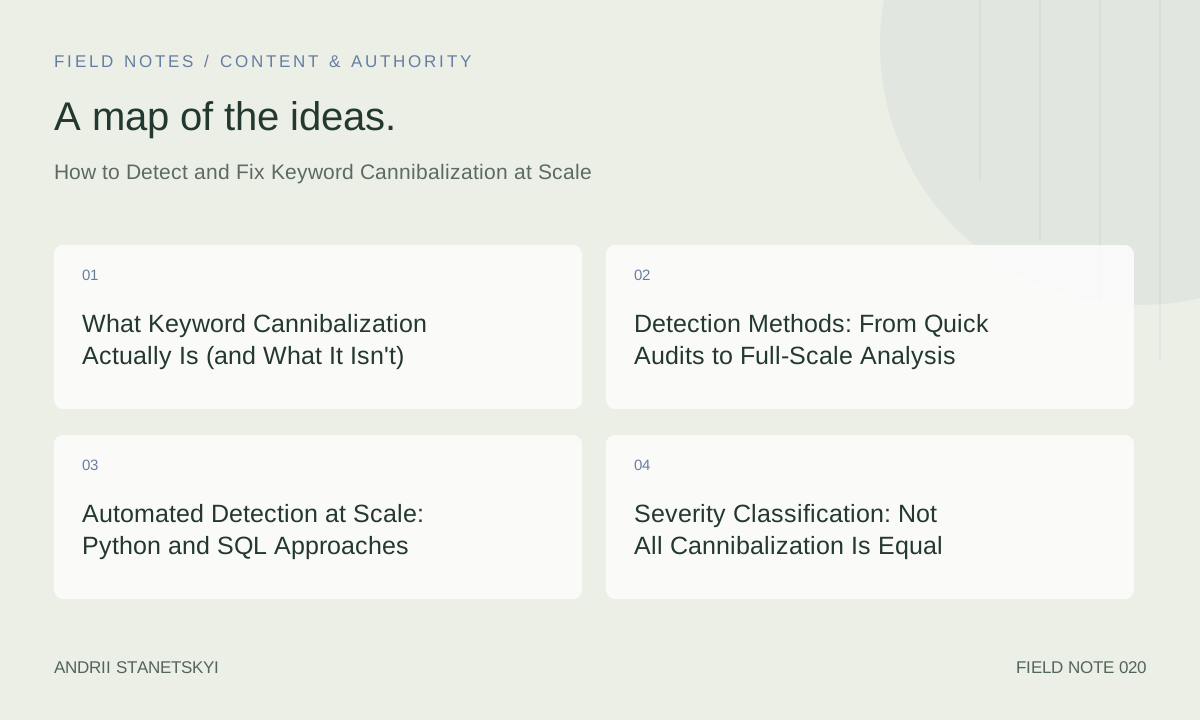
What Keyword Cannibalization Actually Is (and What It Isn't)
Keyword cannibalization occurs when two or more pages on the same domain compete for the same keyword in a way that confuses Google's page selection and dilutes ranking signals that would otherwise concentrate on a single, more authoritative page. The key word is "compete"—not merely "mention."
Having the phrase "keyword research" appear on 200 pages of your site is not cannibalization. Having a pillar page at /keyword-research/ and a separate optimized article at /blog/keyword-research-guide/ both targeting the keyword "keyword research" with full optimization (meta title, H1, internal links) IS cannibalization.
True Cannibalization vs. Common Confusions
- Not cannibalization: Multiple pages mentioning the same keyword but only one is structurally optimized for it
- Not cannibalization: A category page and product page that both rank for different query variants of the same broad topic
- Not cannibalization: Informational and transactional pages for the same topic (different intent = different SERP = different pages appropriate)
- Is cannibalization: Two blog posts with near-identical title tags and H1s targeting the same keyword cluster
- Is cannibalization: A pillar page and a cluster page optimized so similarly that they appear in the same SERP positions alternately across weeks
- Is cannibalization: Pagination pages (page 2, page 3) that inherit the head keyword from the parent category page without proper canonical/noindex handling
How Cannibalization Actually Hurts Rankings
The mechanism is more nuanced than "Google gets confused." What actually happens:
- Google crawls both pages and cannot definitively determine which one to rank for the query
- External links are split between both pages instead of concentrating on one—reducing the effective authority of either
- Internal link equity is diluted across both pages instead of concentrated on the intended target
- Click-through signals are split: users clicking from different SERP appearances land on different pages, producing inconsistent behavioral data that weakens ranking confidence
- Google's ranking selection oscillates between the two pages (you can observe this as rank volatility in Ahrefs Position History), preventing either from stabilizing in a high position
Detection Methods: From Quick Audits to Full-Scale Analysis
Method 1: GSC "Queries" Export with URL Analysis
The fastest high-signal approach for sites under 5,000 pages. In GSC, export the full Queries report for the last 90 days. For each query, check which URL is being served (GSC's "Pages" tab for that query). If multiple URLs appear for the same query across different date ranges—or if you manually check and find ranking oscillation—cannibalization is probable.
Limitation: GSC shows only the URL Google chose to serve, not all URLs competing. It misses latent cannibalization where Google has already made a (potentially wrong) choice.
Method 2: Site: Search Operator
For specific keyword investigation: site:yourdomain.com "target keyword phrase" in Google search. Any pages appearing in results are candidates for cannibalization review. This is fast but imprecise—it finds pages that mention a phrase, not necessarily those optimized for the keyword.
Method 3: Rank Tracker Comparison
In Semrush Position Tracking or Ahrefs Rank Tracker, run a report that shows which URL is ranking for each keyword. Filter for keywords where position is unstable (varies by 5+ positions week over week) AND where multiple URLs have appeared in the position history. This combination—instability + multiple URLs—is the clearest indicator of active cannibalization.
Method 4: Crawl-Based Keyword Overlap Analysis
The most comprehensive approach for large sites. Crawl the site with Screaming Frog or a custom crawler, extract title tags, H1s, and meta descriptions for all pages. Run a similarity analysis to find pages with overlapping optimization signals. This does not require SERP data—it detects structural cannibalization risk before Google resolves it.
Automated Detection at Scale: Python and SQL Approaches
Python: Title Tag Similarity Clustering
# Python: Detect cannibalization candidates via TF-IDF cosine similarity on title tags
import pandas as pd
from sklearn.feature_extraction.text import TfidfVectorizer
from sklearn.metrics.pairwise import cosine_similarity
import numpy as np

def detect_cannibalization_candidates(pages_df, similarity_threshold=0.65):
    """
    pages_df: DataFrame with columns ['url', 'title_tag', 'h1', 'monthly_traffic']
    Returns pairs of URLs that are likely cannibalizing each other
    """
    # Combine title + H1 for richer signal
    pages_df['optimization_text'] = (
        pages_df['title_tag'].fillna('') + ' ' +
        pages_df['h1'].fillna('')
    )

    vectorizer = TfidfVectorizer(
        ngram_range=(1, 3),
        stop_words='english',
        max_features=10000
    )
    tfidf_matrix = vectorizer.fit_transform(pages_df['optimization_text'])
    similarity_matrix = cosine_similarity(tfidf_matrix)

    candidates = []
    n = len(pages_df)

    for i in range(n):
        for j in range(i + 1, n):
            sim = similarity_matrix[i][j]
            if sim >= similarity_threshold:
                candidates.append({
                    'url_a': pages_df.iloc[i]['url'],
                    'url_b': pages_df.iloc[j]['url'],
                    'title_a': pages_df.iloc[i]['title_tag'],
                    'title_b': pages_df.iloc[j]['title_tag'],
                    'similarity_score': round(sim, 3),
                    'traffic_a': pages_df.iloc[i].get('monthly_traffic', 0),
                    'traffic_b': pages_df.iloc[j].get('monthly_traffic', 0)
                })

    result_df = pd.DataFrame(candidates)
    result_df = result_df.sort_values('similarity_score', ascending=False)

    return result_df

# Usage:
# pages_df = pd.read_csv('crawl_export.csv')
# candidates = detect_cannibalization_candidates(pages_df, threshold=0.65)
# candidates.to_csv('cannibalization_candidates.csv', index=False)
SQL: Identifying Cannibalization from GSC Data
-- SQL: Find keywords where multiple URLs appeared in GSC over 90 days
-- Assumes GSC data loaded into a table: gsc_data(date, query, url, clicks, impressions, position)

WITH ranked_urls AS (
    SELECT
        query,
        url,
        SUM(clicks) AS total_clicks,
        SUM(impressions) AS total_impressions,
        ROUND(AVG(position), 1) AS avg_position,
        COUNT(DISTINCT date) AS days_appeared,
        ROW_NUMBER() OVER (
            PARTITION BY query
            ORDER BY SUM(clicks) DESC
        ) AS rank_by_clicks
    FROM gsc_data
    WHERE date >= CURRENT_DATE - INTERVAL '90 days'
    GROUP BY query, url
),

multi_url_queries AS (
    SELECT query
    FROM ranked_urls
    GROUP BY query
    HAVING COUNT(DISTINCT url) > 1
        AND SUM(days_appeared) > 10  -- Filter out noise
)

SELECT
    r.query,
    r.url,
    r.total_clicks,
    r.total_impressions,
    r.avg_position,
    r.rank_by_clicks,
    r.days_appeared
FROM ranked_urls r
JOIN multi_url_queries m ON r.query = m.query
ORDER BY r.query, r.rank_by_clicks;

-- High-priority cases: queries with avg_position 4-15 and multiple URLs
-- These are the cannibalization instances closest to meaningful ranking improvement
Regex: Identifying Structurally Similar URL Patterns
# Python regex: Flag URL pairs with structural cannibalization patterns
import re
from itertools import combinations

def find_structural_duplicates(urls):
    """Find URLs that likely target the same content based on URL patterns."""

    # Normalize: remove trailing slash, lowercase
    normalized = [(url.rstrip('/').lower(), url) for url in urls]

    patterns = {
        'pagination': re.compile(r'/page/\d+/?$|[?&]page=\d+'),
        'print_version': re.compile(r'/print/?$|[?&]print=1'),
        'sort_filter': re.compile(r'[?&](sort|filter|order|color|size)='),
        'session_ids': re.compile(r'[?&](sid|session_id|jsessionid)='),
        'date_archive': re.compile(r'/\d{4}/\d{2}(/\d{2})?/'),
    }

    flagged = []
    for url_norm, url_orig in normalized:
        for pattern_name, pattern in patterns.items():
            if pattern.search(url_norm):
                flagged.append({
                    'url': url_orig,
                    'pattern_type': pattern_name,
                    'action': 'noindex or canonical'
                })
                break

    return flagged
Severity Classification: Not All Cannibalization Is Equal
| Severity | Signals | Traffic Impact | Fix Priority |
|---|---|---|---|
| Critical | Two pages alternating in positions 1–5 for same keyword; external links split; active rank oscillation ±10 positions | Estimated 40–70% of possible traffic being lost | Immediate (fix within 2 weeks) |
| High | Two pages ranking positions 5–15 for same keyword; title tags 75%+ similar; keyword appears as primary H1 on both | Estimated 20–40% traffic loss vs. consolidated page | Within 60 days |
| Medium | Latent cannibalization: pages not currently ranking but both optimized for same cluster; risk of competing when traffic grows | Minimal current impact; growing risk | During next content audit cycle |
| Low | Pagination, filter pages, print versions indexing without canonical | Crawl budget waste; minor authority dilution | Batch fix quarterly |
The Fix Taxonomy: Seven Solutions Matched to Problem Type
Fix 1: 301 Redirect (Consolidation)
When to use: Two competing pages where one is clearly weaker (lower traffic, lower links, lower content quality). Consolidate the weaker page into the stronger one via 301 redirect. Update all internal links pointing to the redirected URL. Expected timeline: Google recrawls and consolidates equity within 2–8 weeks.
Fix 2: Content Merge + Redirect
When to use: Both pages have unique, valuable content that neither fully contains. Extract the unique content from the weaker page, integrate it into the stronger page, then 301 redirect the weaker URL. This is the most labor-intensive fix but produces the strongest consolidated resource.
Fix 3: Canonical Tag
When to use: Pages that must remain accessible at their own URLs (pagination, filter/facet pages, session parameter variants) but should not compete in SERPs. Add <link rel="canonical" href="[preferred-url]" /> to the non-preferred pages. Caveat: Canonical is a hint, not a directive. If the canonicalized pages have significant inbound links, Google may override the canonical. In that case, 301 redirect is more reliable.
Fix 4: Noindex
When to use: Pages that should not appear in SERPs at all—internal search results, checkout steps, user-specific pages—but where a redirect is not appropriate. Add <meta name="robots" content="noindex">. Pages will eventually be removed from the index; Googlebot may continue crawling them.
Fix 5: Content Differentiation (Re-optimization)
When to use: Both pages have significant traffic and external links; neither can be safely redirected. Clearly differentiate each page's keyword target so they serve distinct queries. Rewrite titles, H1s, and primary content focus. This is the highest-risk fix—it requires correctly predicting which keyword belongs to which page, and Google may not respond as expected. Use SERP data to inform the differentiation (which page currently ranks better for which query variant).
Fix 6: Internal Link Rebalancing
When to use: Google is ranking the wrong page (lower quality, less relevant) because it receives more internal link equity than the intended target. Audit internal links pointing to each competing page. Remove or redirect internal links from the page you want to demote; increase contextual internal links to the page you want to rank. This is a softer fix with slower effect (4–12 weeks) but lower risk than content changes. See our internal link equity distribution guide for the full methodology.
Fix 7: Structured Hierarchy Enforcement
When to use: Systematic cannibalization from pillar/cluster architecture failures (pillar page competing with cluster pages). Implement clear keyword ownership rules: pillar page targets only the head term; cluster pages target sub-topic terms only. Rewrite meta titles and H1s to enforce this hierarchy. Add explicit breadcrumb schema to reinforce page hierarchy signals to Google. Our topic clusters guide covers the structural architecture that prevents this class of cannibalization.
Case Study: Fixing Cannibalization Across 12,000 Pages
A large B2C e-commerce site with 12,000 indexed pages had accumulated 3+ years of content production across 4 different editorial teams. An automated audit identified 847 cannibalization candidate pairs. Manual review reduced this to 312 confirmed cannibalization instances affecting live keywords with measurable traffic.
Severity breakdown:
- Critical (active rank oscillation): 41 pairs
- High (both pages ranking, same keyword cluster): 94 pairs
- Medium (latent, structural overlap): 177 pairs
Fix allocation:
- 301 redirects (consolidation): 58 instances — average 6 hours of dev work each
- Content merges + redirects: 22 instances — average 4 hours of editorial + 2 hours dev each
- Canonicals (facet/filter pages): 144 instances — batch implementation via template change
- Content differentiation: 31 instances — highest-effort, reserved for pages with significant link profiles on both URLs
- Noindex (internal search, parameter variants): 57 instances — bulk fix via robots meta template
Implementation timeline: 14 weeks for full remediation. Critical instances fixed in week 1–2; high-severity in weeks 3–8; medium-severity batched into quarterly content audit cycle.
Results at 120 days post-fix:
- Organic traffic: +34% (from 890K to 1.19M monthly sessions)
- Average position for affected keywords: improved from 11.4 to 6.8
- Crawl budget efficiency: crawl rate on target pages increased 28% (Googlebot shifted from cannibalizing duplicates to deeper crawl of unique content)
- Pages with active rank oscillation: reduced from 41 to 3 (the 3 remaining require external link consolidation which is still in progress)
Semrush's position tracking data on cannibalization resolution timelines aligns with these results—expect the majority of equity consolidation within 60–90 days of 301 redirect implementation.
Prevention Systems: Stopping Cannibalization Before It Starts
Detection and fixing are reactive. At scale, the real leverage is in prevention systems that make cannibalization structurally difficult to create accidentally.
Keyword Ownership Registry
Maintain a shared spreadsheet or CMS field that maps every target keyword to exactly one canonical URL. Before any new content is commissioned, a required step is checking whether the keyword (or a SERP-similar variant) is already registered. New content on an owned keyword requires explicit decision: update the existing page or build a differentiated page for a distinct sub-intent. No registration = no publishing approval.
Automated Pre-Publish Check
# Python: Pre-publish cannibalization check
# Runs before content is approved for publication

import re
from sklearn.metrics.pairwise import cosine_similarity
from sklearn.feature_extraction.text import TfidfVectorizer

class CannibalizationChecker:
    def __init__(self, existing_pages_df):
        """
        existing_pages_df: DataFrame with ['url', 'title_tag', 'h1', 'target_keyword']
        """
        self.pages = existing_pages_df
        self.vectorizer = TfidfVectorizer(ngram_range=(1,2), stop_words='english')
        self.tfidf_matrix = self.vectorizer.fit_transform(
            self.pages['title_tag'].fillna('') + ' ' + self.pages['h1'].fillna('')
        )

    def check_new_page(self, new_title, new_h1, new_keyword, threshold=0.60):
        """Check if a new page would cannibalize existing content."""
        new_text = new_title + ' ' + new_h1
        new_vec = self.vectorizer.transform([new_text])
        similarities = cosine_similarity(new_vec, self.tfidf_matrix).flatten()

        # Also check direct keyword match
        keyword_matches = self.pages[
            self.pages['target_keyword'].str.lower() == new_keyword.lower()
        ]

        conflicts = []

        for idx, sim in enumerate(similarities):
            if sim >= threshold:
                conflicts.append({
                    'existing_url': self.pages.iloc[idx]['url'],
                    'existing_title': self.pages.iloc[idx]['title_tag'],
                    'similarity': round(sim, 3),
                    'conflict_type': 'title_similarity'
                })

        for _, row in keyword_matches.iterrows():
            conflicts.append({
                'existing_url': row['url'],
                'existing_title': row['title_tag'],
                'similarity': 1.0,
                'conflict_type': 'exact_keyword_match'
            })

        return conflicts if conflicts else None
Quarterly Cannibalization Audit Cadence
Run the full automated detection pipeline quarterly. Any site producing more than 20 pieces of content per month will generate new cannibalization candidates faster than annual audits can catch. The quarterly cycle ensures that medium-severity instances get remediated before they become high-severity through continued content production around the same topic.
Canonical URL Strategy for Dynamic Content
E-commerce sites with faceted navigation, filter parameters, and sorting options must implement canonical strategy at the template level, not page by page. Every filtered/faceted URL should canonical back to the root category URL unless the filter combination generates sufficient unique, high-quality content to warrant its own SERP presence (for example, a "women's running shoes" filter on a "shoes" category page might warrant its own indexed URL if it has distinct purchasing behavior data).
FAQ
Does keyword cannibalization affect all keywords equally?
No. The severity of cannibalization impact scales with keyword difficulty and competitive density. For a KD 5 keyword with no competition, having two pages targeting the same term may result in both ranking in the top 10—not ideal, but not catastrophic. For a KD 50 keyword in a competitive market, cannibalization can mean neither page breaks into the top 20 when either one individually might rank top 5. Prioritize fixing cannibalization on high-KD, high-value keywords first.
What is the difference between keyword cannibalization and content duplication?
Content duplication (duplicate or near-duplicate content) is about text similarity—the same or very similar content at multiple URLs. Keyword cannibalization is about optimization targeting—multiple pages competing for the same keyword, even if their content is completely different. You can have cannibalization without duplication (two original articles both targeting "keyword research") and duplication without cannibalization (a product page and its print version, properly canonicalized). Treat them as separate problems requiring separate diagnostic approaches.
Can internal search results cause keyword cannibalization?
Yes, and this is extremely common on e-commerce sites. Internal search result pages often get indexed and can rank for long-tail product queries. They produce poor user experience (search results pages as landing pages) and dilute link equity from real product pages. Fix: add noindex to all internal search result URLs, either via robots meta tag or in the robots.txt as a Disallow (Disallow prevents crawling; noindex prevents indexing of already-crawled pages—you often want both).
How do I handle cannibalization between a blog post and a product page targeting the same keyword?
This is the most common B2B SaaS cannibalization scenario. The resolution depends on intent: if the keyword is informational, the blog post should rank and should include a CTA linking to the product page. If the keyword is transactional, the product page should rank and the blog post should be re-targeted to a different, informational keyword variant. Use SERP analysis to determine intent, then adjust which page is optimized for the keyword. 301-redirect the de-prioritized page to its intended target only if the content is truly duplicative—otherwise, re-optimize for a different keyword.
Will Google automatically consolidate cannibalizing pages over time?
Sometimes, but not reliably. Google will often make a choice between cannibalizing pages—but it may choose the wrong one (from your perspective), and its choice can change with algorithm updates. The "Google will figure it out" approach produces unpredictable results. An explicit canonical or 301 redirect is always faster and more reliable than waiting for Google to self-resolve the conflict. Do not rely on Google's judgment when a clear structural fix is available.
How do I know if my fix worked?
After implementing a 301 redirect or canonical: (1) Verify in GSC that the previously-ranking URL is no longer appearing in the Queries report for affected keywords (takes 4–8 weeks); (2) Check Ahrefs position history for the target keyword and confirm only one URL is now appearing; (3) Monitor the surviving page's position—it should stabilize and improve as link equity consolidates. For canonical fixes, use Google Search Console URL Inspection tool on the canonicalized pages to confirm Google has acknowledged the canonical.
Should I disavow links pointing to the redirected page after consolidation?
No. 301 redirects pass link equity, so links to the redirected URL will contribute to the surviving page's authority. Disavowing them would destroy equity you have earned. The only reason to disavow links after cannibalization fixes is if those links were already low-quality and harmful—a separate issue from the redirect itself.
Key Takeaways
- Keyword cannibalization is the default state of any mature site without structural controls—treat it as a maintenance requirement, not an edge case
- Use three diagnostic approaches in combination: GSC query/URL analysis for active cannibalization, rank tracker oscillation detection for high-severity cases, and crawl-based title tag similarity analysis for latent cannibalization at scale
- Severity classification determines fix priority: critical (active oscillation in top 5) gets immediate attention; low-severity pagination/filter issues get batched quarterly
- Match the fix to the problem type—301 redirects for consolidation, canonicals for parameter variants, content differentiation only when both pages have significant link profiles that cannot be merged
- Prevention is higher-leverage than detection at scale: implement keyword ownership registries and pre-publish automated checks to eliminate new cannibalization at the source
- Expect 60–90 days for full equity consolidation after 301 redirect implementation; canonical fixes take longer and are less certain
Conclusion
Keyword cannibalization at scale is a systems problem, not a content problem. The individual content decisions that produce it are usually defensible in isolation—a writer targeting an important keyword is doing their job. The problem is the absence of coordination systems that prevent multiple people making individually defensible decisions from collectively undermining the site's ranking potential. The detection and fix work in this guide addresses the accumulated debt. The prevention systems—keyword ownership registries, automated pre-publish checks, quarterly audit cadences—address the ongoing production process. Both are necessary. Fixing without prevention means running the same audit in 18 months. Prevention without fixing means new content works correctly while old cannibalization continues dragging performance.
Related: How topic cluster architecture prevents systematic cannibalization from the ground up.