Search volume is a lie — or at least, it's a half-truth. For years, SEO practitioners built entire content strategies around a single number pulled from Keyword Planner, only to publish pages that ranked and sent zero qualified traffic. In 2026, the practitioners who win aren't the ones chasing the highest monthly search volume. They're the ones who understand what a searcher actually wants when they type a query, and they build content that delivers it precisely.
This guide is a practitioner's field manual for modern keyword research. We'll cover intent modeling, SERP feature analysis, tool-stack workflows, and the specific signals that separate a keyword worth targeting from one that will waste your crawl budget and editorial calendar.
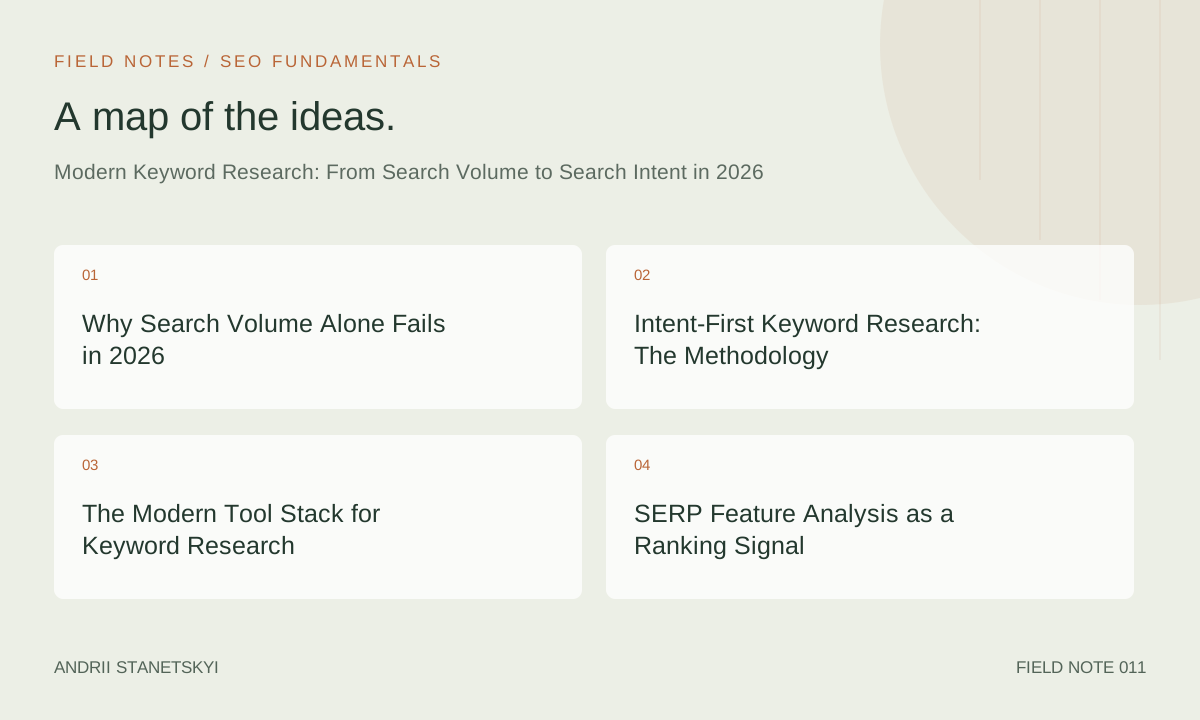
Why Search Volume Alone Fails in 2026
Google's 2024 and 2025 core updates accelerated a trend that's been building for nearly a decade: ranking positions correlate less with keyword frequency and more with topical authority and intent satisfaction. Pages that perfectly match search intent routinely outrank higher-DA competitors who are just stuffing the right keywords.
The collapse of the "volume = opportunity" model has a few concrete causes:
- AI Overviews absorb informational queries. For head-term informational queries with KD above 60, Google's AI Overviews now appear in over 43% of SERPs (SparkToro, Q1 2026). Ranking #1 for "what is CRM software" delivers far fewer clicks than it did in 2022.
- Zero-click searches are structural, not temporary. Featured snippets, knowledge panels, and People Also Ask boxes intercept 58–65% of searches (SimilarWeb, 2025). High-volume ≠ high-traffic.
- Search volume data is an estimate, not a measurement. Ahrefs and Semrush both use click-stream data blended with panel data. For niche B2B terms, the margin of error can exceed 200%.
This doesn't mean volume is useless. It means it's one input in a multi-variable decision, not the decision itself.
Intent-First Keyword Research: The Methodology
Intent-first research starts at the SERP, not at a keyword tool. Before you open Ahrefs, open an incognito browser window and search the seed query. What you see on that SERP is Google's best current hypothesis about what the searcher wants.
The Four Intent Categories (and Why the Taxonomy Is Incomplete)
The classic taxonomy — Informational, Navigational, Commercial, Transactional — is a useful starting point but insufficient on its own. Real SERPs often blend intent signals. "Best project management software" is simultaneously commercial investigation and transactional intent, because a significant portion of searchers are ready to sign up for a trial if the content convinces them.
In practice, I model intent along two axes:
- Awareness level: Problem-unaware → Problem-aware → Solution-aware → Product-aware → Most Aware
- Action orientation: Learn → Compare → Evaluate → Purchase → Support
A keyword's position on these axes tells you what content format to produce, what CTA to include, and what conversion metric to track — more useful than "informational" alone.
Extracting Intent Signals from SERP Composition
When you search a keyword, the SERP itself tells you the dominant intent signal Google has modeled. Parse it systematically:
- If the top 3 results are all list articles ("10 best X"), the SERP is clearly commercial-investigative.
- If the top 3 are product pages or e-commerce category pages, it's transactional.
- If the top 3 are Wikipedia, how-to guides, and YouTube, it's informational.
- If a featured snippet appears, Google believes one authoritative answer satisfies the query — you either win the snippet or compete for the next position down.
The Modern Tool Stack for Keyword Research
No single tool gives you the full picture. Here's the stack I use in 2026 and what each tool does that the others don't:
| Tool | Primary Use | Unique Advantage | Limitation |
|---|---|---|---|
| Ahrefs Keywords Explorer | Volume, KD, SERP analysis | Click-through rate data by position | Volume estimates skew high for niche terms |
| Semrush Keyword Magic | Cluster discovery, intent tagging | Intent labels at scale; CPC data | Intent classification is algorithmic, sometimes wrong |
| Google Search Console | Actual impression and click data | Ground truth for your existing pages | Only shows queries you already rank for |
| AlsoAsked | PAA hierarchy mapping | Reveals intent depth and sub-topics | Limited query volume |
| Keyword Insights | AI-powered clustering | Clusters by SERP similarity, not just string matching | Cost scales with keyword set size |
| Google Keyword Planner | CPC and bid range data | First-party advertiser intent signals | Volumes bucketed; poor for organic research |
The GSC + Ahrefs Combination
GSC shows you queries driving impressions with zero clicks — these are your cannibalisation candidates and featured-snippet opportunities. Export GSC data for queries with impressions > 100 and CTR < 2%, then cross-reference in Ahrefs to check SERP features. A query with a featured snippet dominating position 0 and low CTR is a snippet-capture opportunity, not a dead keyword.
SERP Feature Analysis as a Ranking Signal
Before targeting any keyword, map the SERP features it triggers. In Ahrefs Keywords Explorer, the SERP Overview tab shows which features appear. Each feature type tells you something different:
- Featured Snippet: Optimize for a concise, directly-answering definition paragraph. Aim for 40–60 words, use the query verbatim in the first sentence.
- People Also Ask: Signals adjacent sub-topics Google associates with the query. Each PAA box is a potential H3 subheading in your article.
- Video carousel: Google believes visual format satisfies intent. Written content may rank but video has structural advantage.
- AI Overview: Informational queries where Google's own model answers. The organic ranking value is diminished; target only if you can earn the cited source position.
- Shopping results: Transactional signal; editorial content will struggle here.
- Image pack: Visual asset opportunity; optimize image alt text and file names.
Beyond Volume: The Metrics That Actually Matter
Keyword Difficulty vs. Traffic Potential
KD scores in Ahrefs and Semrush measure the link-strength of current ranking pages. A KD of 45 means the current top-10 pages have a median DR of around 55-60 and a meaningful backlink count. But KD ignores content quality gaps — a KD-50 keyword where all ranking content is thin and outdated is far more attackable than the score suggests.
Traffic Potential (Ahrefs' metric) is more useful than volume alone because it aggregates the total clicks the #1 ranking page receives from all the keywords it ranks for — not just the seed keyword. A keyword with 1,200 monthly volume but 8,400 traffic potential means the top-ranking page captures a wide semantic neighbourhood.
Cost-Per-Click as an Intent Proxy
CPC is an advertiser's revealed preference for a query's commercial value. A keyword with CPC > $8 in a B2B vertical signals that buyers are present and willing. Cross-referencing CPC from Google Keyword Planner against organic KD from Ahrefs surfaces the most commercially attractive, organically feasible keywords in any niche.
The Opportunity Score Formula
I use a simple normalised score for prioritisation:
Opportunity Score = (Traffic Potential × CPC) / (KD × Competition Adjustment)

Competition Adjustment = 1 if top 3 results have thin content
                       = 1.5 if top 3 results have strong E-E-A-T signals
                       = 2 if top 3 are branded/authoritative domains
This isn't a tool-generated metric — it's a manual judgment model. But making it explicit forces you to be honest about difficulty instead of optimistically targeting high-volume head terms.
A Repeatable Keyword Research Workflow
- Define the audience segment and their jobs-to-be-done. Keyword research disconnected from customer understanding produces technically correct but strategically useless lists.
- Generate seed keywords from three sources: product/service descriptions, competitor URLs run through Ahrefs Site Explorer (organic keywords report), and GSC queries filtered to impressions > 200.
- Expand seeds in Ahrefs Keywords Explorer using the "Matching terms" and "Related terms" tabs. Export with filters: volume > 50, KD < 60.
- Map each keyword to an intent axis position. Use SERP inspection for top 10 keywords; use Semrush intent labels (with manual spot-checking) for the rest.
- Cluster keywords by SERP similarity. Use Keyword Insights or a Python TF-IDF approach to group keywords that trigger overlapping top-10 results.
- Identify SERP feature opportunities. Flag keywords with featured snippets currently held by low-authority domains — these are fast-win targets.
- Score and prioritise using the Opportunity Score formula above.
- Assign to content types: long-form guide, comparison page, landing page, FAQ page, product page. The SERP composition dictates the format.
Mini Case Study: SaaS B2B Keyword Research
A project management SaaS targeting SMB teams came to us with a seed list of 12 broad keywords. The instinct was to chase "project management software" (KD 72, 90,000 monthly searches). SERP inspection showed the top 5 results were Asana, Monday.com, ClickUp, Notion, and PCMag — every one of them with DR > 80 and thousands of referring domains. Competing there was a 24-month project, not a 6-month one.
Instead, we ran their homepage URL through Ahrefs and identified the keyword gap against three direct competitors. The gap analysis surfaced 340 keywords with KD < 35 and monthly volume 100–2,000, including "project management for construction teams" (KD 18, volume 880, CPC $9.40) — a segment where no competitor had a dedicated, optimised page.
We built a cluster of 11 pages targeting construction-specific PM queries. Within 4 months, those pages were driving 1,200 organic sessions per month with a 3.8% trial signup rate — 2.4x the site's baseline conversion rate. See our keyword clustering methodology for how we grouped those 340 keywords into 11 content briefs.
FAQ
How often should I refresh my keyword research?
For established sites: quarterly for core clusters, monthly for fast-moving verticals (AI tools, finance, news-adjacent topics). For new sites: every 6 weeks until you have at least 50 ranking pages with GSC data to learn from.
Is it worth targeting keywords with zero monthly search volume?
Yes, in specific conditions. Zero-volume keywords from Ahrefs or Semrush often represent niche B2B queries where the tool's panel data doesn't have enough users to register frequency. Our guide to zero-volume keyword research covers this in depth. If GSC shows impressions for related queries, that's a stronger signal than a zero in a third-party tool.
What's the minimum KD I should target for a new site?
For a site with DR < 20, target KD ≤ 20. At DR 20–40, target KD ≤ 35. These aren't hard rules — SERP composition matters more than the score — but they're useful guardrails against chronic over-reaching in the first 12 months.
How do AI Overviews affect keyword targeting decisions?
Avoid building content strategies around informational head terms where AI Overviews consistently appear. Instead, target: (a) commercial and transactional queries where AI Overviews rarely fire, (b) very specific how-to queries where step-by-step content earns a cited source position inside the AI Overview, or (c) queries where freshness signals matter (AI Overviews don't update in real time).
Should I use Ahrefs or Semrush for keyword research?
Both. They have different keyword databases and different volume estimation methodologies. For head terms: they'll agree. For long-tail niche terms: they'll diverge. Cross-referencing both gives you confidence. If you can only afford one, Ahrefs has better click-through data and SERP analysis; Semrush has better competitive intelligence and more robust local data.
How do I handle keyword research for international sites?
Run keyword research per locale, not per language. "CRM software" in British English vs. US English has meaningfully different SERP compositions, different ranking pages, and different CPC. Use Ahrefs' country filter and always validate with GSC data for the target country property.
What's the biggest keyword research mistake senior SEOs make?
Treating keyword research as a one-time project rather than a continuous intelligence function. Markets shift, competitors publish new content, and Google's understanding of queries evolves. The teams that win are the ones with a quarterly cadence of monitoring keyword rankings, GSC impression trends, and competitor content gaps.
Key Takeaways
- Search volume is an input, not a conclusion. Combine it with Traffic Potential, CPC, KD, and SERP feature composition before making targeting decisions.
- Start every keyword research session on the SERP, not in a tool. The SERP composition is Google's ground truth about intent.
- AI Overviews have structurally reduced the organic value of informational head terms. Shift budget toward commercial and transactional query clusters.
- Keyword Difficulty scores ignore content quality gaps. A KD-50 keyword with weak existing content is often more achievable than a KD-30 keyword with strong, comprehensive ranking pages.
- The GSC + Ahrefs combination surfaces the highest-value opportunities: existing impressions with low CTR that can be improved with featured snippet optimisation or content upgrades.
- Cluster first, assign formats second. Keyword clustering prevents content sprawl and protects against keyword cannibalization.
- CPC from Keyword Planner is an advertiser's revealed preference — the most honest signal of commercial intent available.
Conclusion
Modern keyword research is less about finding high-volume keywords and more about understanding what a query signals about a person's needs, context, and readiness to act. The practitioners who master intent modeling, SERP feature analysis, and structured prioritisation frameworks will consistently outperform those relying on volume-sorted keyword lists.
The methodology outlined here isn't theoretical — it's the specific process used across dozens of client engagements in 2025 and 2026. The details change per vertical, but the logic is consistent: understand intent before producing content, use the SERP as your primary data source, and build a measurement cadence that catches opportunities and cannibalization before they compound.
For a deeper dive into how intent maps to the full purchase lifecycle, read our keyword-to-buyer-journey mapping framework. For the technical clustering approach that makes this workflow scalable, see the Python keyword clustering tutorial.
Further reading: Google's Search Quality Evaluator Guidelines remain the canonical document for understanding how Google defines quality and intent satisfaction.