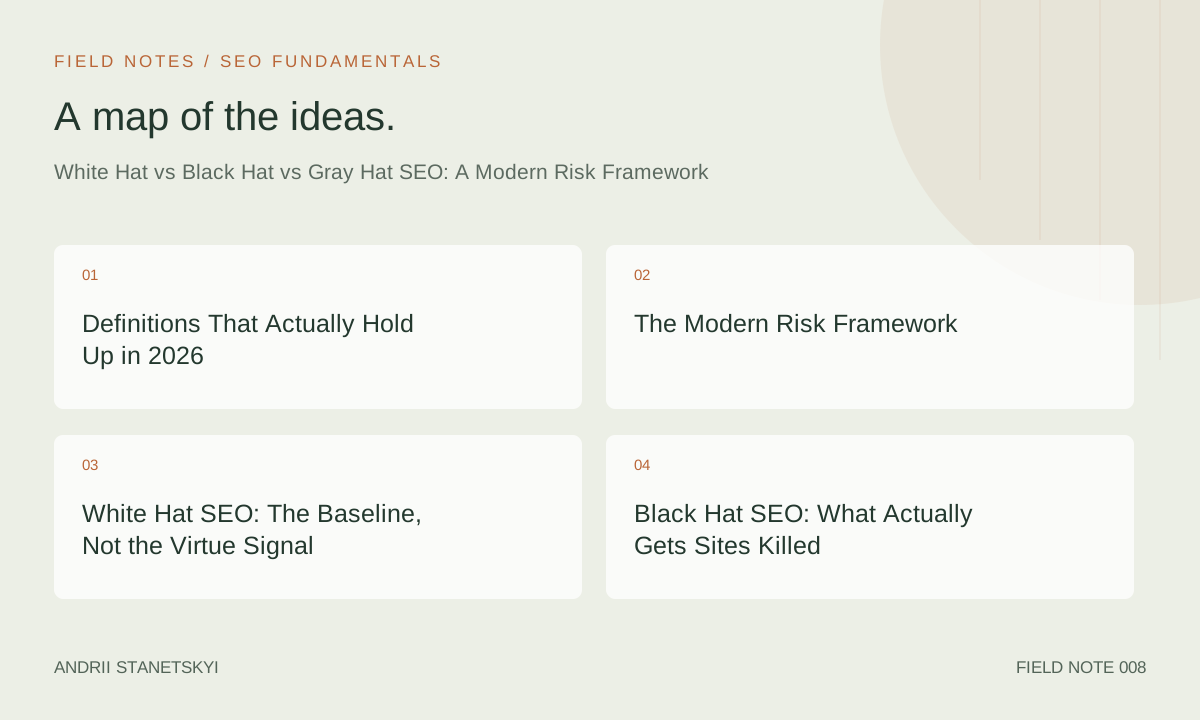
Every SEO practitioner operates somewhere on a risk spectrum, whether they acknowledge it or not. The industry's instinct to sort tactics into tidy moral buckets — white, black, gray — has always been an oversimplification. What matters in 2026 is not the color of the hat but the probability of penalty, the reversibility of damage, and the return on risk-adjusted effort. This guide builds a practical framework for evaluating SEO tactics the way a senior practitioner actually should: with clear eyes, not dogma.
Definitions That Actually Hold Up in 2026
The hat taxonomy was coined in the early 2000s, borrowed from Western film archetypes. It was never precise. Google's own guidelines don't use the terminology — they describe spam policies and helpful content standards. Understanding what Google actually penalizes requires reading the source documents, not industry blog posts that recycle 2011 thinking.
The Only Definition That Matters: Google's Spam Policies
Google's spam policies (formerly Webmaster Guidelines) define prohibited tactics in concrete terms: cloaking, doorway pages, hidden text, link schemes, scraped content, sneaky redirects, and user-generated spam. Everything outside those explicit categories exists in a spectrum of risk, not a binary moral category. The Google Search Essentials documentation is the authoritative reference — not forum posts, not speculation about what an algorithm might do.
Why "Gray Hat" Is Analytically Useless Without Context
A press release distributed to 200 journalists with a followed link in the boilerplate: gray hat or white hat? It depends entirely on whether Google's systems flag the link pattern as manipulative. Context, scale, velocity, and anchor text distribution all determine the actual risk level. Calling something "gray hat" without quantifying those variables is not analysis — it's a hedge.
The Modern Risk Framework
The framework I use with clients evaluates every tactic across four dimensions. This replaces the hat color metaphor with something actionable.
Dimension 1: Detection Probability
How likely is Google to algorithmically flag or manually review this tactic? Detection probability has increased dramatically since 2022 as Google's spam-detection systems became AI-native. Tactics that required human review teams in 2015 are now caught algorithmically at scale. The practical implication: tactics with high detection probability that were "safe" at low volume no longer have a safe volume threshold.
Dimension 2: Penalty Severity
Penalties range from rank suppression on specific pages to full domain deindexation. The spectrum:
- Algorithmic suppression: Automated ranking reduction; reverses when the signal is corrected. Example: thin content pages suppressed after a Helpful Content system update.
- Manual action — partial: Applied to specific sections or link types. Recoverable via disavow and reconsideration request. Average recovery: 3–6 months in 2025 data.
- Manual action — site-wide: Full site suppression. Recovery requires addressing root cause, submitting reconsideration, waiting for human review. Average recovery: 6–18 months.
- Deindexation: Domain removed from the index. Effectively terminal for established brands; sometimes faster to rebuild on a new domain.
Dimension 3: Reversibility
Can you undo the tactic if Google signals a problem? Links can be disavowed. Cloaking cannot be "partially" corrected — the architecture must be rebuilt. Content that was generated by AI without editorial oversight can be rewritten, but the historical signals around that content may persist. Reversibility is often the deciding factor when penalty severity is moderate.
Dimension 4: Risk-Adjusted ROI
A tactic with a 15% detection probability, moderate penalty severity, high reversibility, and a projected 40% organic traffic lift has a very different risk profile than one with identical detection probability but low reversibility and low projected lift. Most practitioners skip this calculation. Do the math.
White Hat SEO: The Baseline, Not the Virtue Signal
White hat SEO means operating within Google's explicit guidelines. It is not a philosophy — it is a risk position. Practitioners who frame it as ethical superiority tend to underinvest in tactics that are technically compliant but aggressive. That is a strategic mistake.
What White Hat Actually Includes
- Publishing original research, data, or analysis that earns editorial links
- Technical optimization: Core Web Vitals, structured data, crawlability, indexability
- On-page optimization: title tags, meta descriptions, header hierarchy, internal linking
- Content built around demonstrated search demand with genuine editorial depth
- Digital PR: pitching journalists and creators with legitimately newsworthy stories
- Site architecture designed for user experience and crawler efficiency
The Misconception: White Hat Is Slow
This is statistically false for competitive verticals. A content hub strategy executed with programmatic internal linking and original data assets routinely produces top-10 rankings within 90 days for mid-competition keywords. The "white hat is slow" belief persists because most practitioners don't execute it at sufficient scale or quality. The ceiling is higher than black hat — you don't lose rankings when an algorithm update ships.
Aggressive White Hat: The Senior Practitioner's Position
The best white hat practitioners are aggressive within the rules. They publish 5,000-word definitive guides with proprietary data. They run digital PR campaigns targeting 50+ publications simultaneously. They build internal link structures with the deliberateness of PageRank sculpting. None of this violates Google's guidelines. All of it is significantly more effective than passive content production.
Black Hat SEO: What Actually Gets Sites Killed
Black hat tactics are those explicitly prohibited by Google's spam policies. The list has not fundamentally changed since 2012, but detection has become near-certain for most of them.
Link Schemes at Scale
Buying links from private blog networks (PBNs), link farms, or link brokers constitutes a link scheme under Google's policies. The detection mechanisms now include: domain pattern analysis across Google's crawl database, anchor text distribution anomalies, link velocity signals, and cross-referencing with known link sellers (whose sites Google monitors). A well-run PBN might evade detection for 12–24 months. The failure mode is catastrophic and affects the entire domain.
Cloaking and Sneaky Redirects
Serving different content to Googlebot than to users is cloaking. JavaScript-based cloaking, IP-based cloaking, and user-agent cloaking are all detectable via Google's crawler infrastructure. Sneaky redirects — forwarding users to a different URL than the one that ranked — are caught by comparing Googlebot crawl responses to real-user navigation patterns via Chrome data.
Scaled Content Abuse
Publishing AI-generated content at scale with no editorial oversight, or scraping and republishing third-party content, triggers Google's scaled content abuse policy introduced in the March 2024 core update. The signal is not purely content quality — it includes crawl pattern analysis, link acquisition behavior, and traffic pattern anomalies. Sites that scaled to 50,000+ AI pages in 2023 saw 60–90% traffic losses in 2024 updates.
Hidden Text and Keyword Stuffing
These tactics have near-100% algorithmic detection rates in 2026. White text on white background, text sized at 0px, and keyword density above approximately 3–4% for non-primary terms are all flagged automatically. The ROI calculation is simple: trivial upside, high penalty severity, and zero reversibility without content rewrite. Do not use these tactics.
Gray Hat SEO: Where Most Real Campaigns Live
Gray hat is the most analytically interesting category because it requires actual judgment rather than rule-following. Most competitive SEO campaigns — even those run by reputable agencies — operate in gray hat territory on at least some tactics.
Guest Post Link Building
Publishing content on third-party sites with a followed link back to your domain is explicitly listed as a link scheme in Google's policies if "links with optimized anchor text in articles or press releases distributed on other sites." In practice, Google's enforcement is probabilistic — it targets patterns (high volume, exact-match anchors, low-quality host sites) rather than individual instances. A well-executed guest post program on legitimate editorial sites with natural anchor text operates at low detection probability. Scale it to 50 posts per month on low-DA sites with optimized anchors and you are firmly in penalty territory.
Parasite SEO
Publishing SEO-optimized content on high-authority third-party platforms (Reddit, Medium, LinkedIn, Quora, Forbes contributor pages) to capture rankings you can't win on your own domain. Google has actively suppressed this tactic since late 2024, reducing rankings for forum and UGC platform pages in commercial informational queries by roughly 30% based on SERP analysis. Still effective for brand-name queries and low-competition informational terms.
Expired Domain Redirects
Acquiring expired domains with existing link equity and 301-redirecting to your site. Clearly manipulative. Clearly effective in the short term. Google's systems detect unnatural redirect patterns and discount link equity from expired domains within 6–18 months. Risk-adjusted ROI is positive for affiliate sites with 12-month investment horizons; negative for brand sites that need to protect their long-term domain authority.
AI-Assisted Content with Editorial Review
Using AI to draft content that is then substantially edited by a subject matter expert sits in a gray zone — not because it's technically prohibited, but because content quality outcomes are highly variable and Google's helpful content systems evaluate outcome, not process. An AI-drafted article reviewed by a practicing physician that genuinely helps users is indistinguishable from white hat. An AI-drafted article with five minutes of light editing in a YMYL vertical is a liability.
Penalty Types and Recovery Timelines
| Penalty Type | Trigger | Detection Method | Avg Recovery Time | Recovery Path |
|---|---|---|---|---|
| Algorithmic — Helpful Content | Thin/AI content at scale | Automated | 3–6 months post-fix | Content improvement + wait for next update cycle |
| Algorithmic — Link Spam | Unnatural link profile | Automated | 2–4 months post-disavow | Disavow file + wait for recrawl |
| Manual — Partial (Links) | Bought links detected | Human review | 4–8 months | Link removal/disavow + reconsideration request |
| Manual — Site-Wide | Severe spam policy violation | Human review | 9–18 months | Full site audit + reconsideration request |
| Deindexation | Egregious violations (cloaking, hacking) | Human review | 12–24+ months or never | Reconsideration (rare success) or new domain |
Diagnosing Penalty Type in Practice
Start with Google Search Console. A manual action appears in the Manual Actions report with explicit description. Algorithmic suppression shows as a traffic cliff correlating with a known algorithm update date — cross-reference against the Google algorithm update history in your tracking tool. In Semrush, the Sensor tool logs volatility events by date. In Ahrefs, the Traffic chart overlaid with Algorithm Updates timeline makes the correlation visual in seconds.
Tactic Decision Matrix
Apply this matrix before deploying any tactic at scale. Score each dimension 1–5 (1 = low risk/high reward, 5 = high risk/low reward) and sum for a composite score. Tactics scoring above 12 require explicit client sign-off.
| Tactic | Detection Prob. | Penalty Severity | Reversibility | Expected ROI | Composite Score |
|---|---|---|---|---|---|
| Original research + PR outreach | 1 | 1 | 1 | 1 (high ROI) | 4 — proceed |
| Guest posts (10/mo, natural anchors, DR40+) | 2 | 2 | 2 | 2 | 8 — acceptable |
| Expired domain 301 redirect | 3 | 3 | 3 | 3 | 12 — requires sign-off |
| PBN links (50+/mo) | 5 | 5 | 2 | 4 | 16 — avoid |
| Cloaking | 5 | 5 | 5 | 5 | 20 — do not use |
Mini Case Study: E-Commerce Site Recovery from Manual Link Action
A mid-size UK e-commerce retailer (50K monthly organic sessions) received a partial manual action for "unnatural links to your site" in March 2024. The previous agency had purchased approximately 800 links through a PBN over 18 months. Workflow: exported full backlink profile from Ahrefs (83,000 referring domains), identified 1,200 suspicious links using Ahrefs' DR score distribution and anchor text clustering, attempted outreach to remove 340 of them (112 removed), submitted disavow file covering 860 domains, filed reconsideration request. Manual action lifted in 6.5 months. Organic traffic recovered to 78% of pre-penalty levels within 9 months — the gap attributable to legitimate ranking losses during the clean-up period where disavowed links removed real equity alongside manipulative links.
FAQ
Does Google actually penalize gray hat tactics, or is it mostly theoretical risk?
Google enforces selectively and algorithmically. Individual gray hat tactics rarely trigger manual review — patterns trigger it. A site doing 5 guest posts per month with natural anchors for 3 years has effectively zero manual penalty risk. The same site doing 200 per month with keyword-matched anchors faces meaningful automated suppression risk. The enforcement is probabilistic, not deterministic.
How do I know if a site has a manual action before buying it?
You can't verify this without access to the site's Google Search Console. When acquiring a site, require the seller to share GSC access for 30 days pre-closing and look for the Manual Actions report. Also cross-reference the site's traffic history in Ahrefs or Semrush against known algorithm update dates. A traffic cliff that never recovered is a red flag regardless of whether a manual action is visible.
Is disavowing links still effective in 2026?
Yes, but more narrowly than in 2014. Google's systems already discount most low-quality links algorithmically before they affect rankings. Disavow files are most effective for: (1) clearing manual action flags, where disavowal signals intent to Google's quality team, and (2) removing links with highly manipulative anchor text that the algorithm may not have discounted. For most sites, mass disavow of DR 0–10 links produces no measurable ranking change. Focus disavow efforts on links that are flagged in GSC's Link Schemes manual action description.
What's the fastest legitimate way to build authority for a new domain?
Original data research covered by journalists produces the highest quality links in the shortest time. A well-designed survey with genuinely surprising findings, pitched to 30–50 publications in your vertical, can generate 20–50 editorial links in 6–8 weeks. Combine that with a digital PR strategy targeting seasonal news hooks and you can build meaningful authority within 3–4 months on a zero-link-history domain. No gray hat required.
Are AI-generated pages automatically penalized?
No. Google's policies target content that is low-quality and unhelpful, not content produced with AI assistance. The practical distinction: AI content that passes E-E-A-T evaluation by a domain expert and genuinely serves user intent is not penalized. AI content that is spun, auto-published, and targets keywords without editorial judgment is penalized — not because of the production method but because of the quality outcome. Use AI to scale good editorial processes, not to bypass them.
How should I advise a client who insists on black hat tactics?
Document the conversation and the risk disclosure in writing. Present the risk framework quantitatively — not moralistically. If the client proceeds after informed consent, decide whether you want to manage the associated reputation risk. Some practitioners disengage; others execute with clear contractual liability limitations. Never execute tactics that could harm end users (hacked content, pharmaceutical spam, etc.) regardless of client instruction.
Does competitor spammy link building hurt my site?
Negative SEO via link spam was largely neutralized by Google's algorithmic link discounting. Google's systems generally ignore links that don't fit a site's natural link profile rather than penalizing for them. The exception: if a competitor triggers a manual review of their own site and a quality reviewer notices your site in adjacent patterns. This is rare. Maintain a disavow file as insurance, not as active defense.
Key Takeaways
- The hat color taxonomy is a simplification — replace it with four-dimensional risk analysis: detection probability, penalty severity, reversibility, and risk-adjusted ROI.
- White hat SEO is not passive. The best practitioners execute aggressive, high-volume campaigns entirely within Google's guidelines and outperform most gray hat work over 12+ month horizons.
- Black hat tactics in 2026 have near-certain detection timelines and catastrophic failure modes. The math almost never justifies them for brand sites.
- Most real campaigns operate in gray hat territory. The skill is quantifying and managing that risk, not pretending it doesn't exist.
- Manual action recovery takes 6–18 months on average. Factor that into any client conversation about shortcut tactics.
- AI-assisted content is not inherently penalized. Editorial quality and E-E-A-T signals are what Google evaluates.
- Always document risk disclosures with clients before executing any tactic above a composite risk score of 10.
Conclusion
The white/black/gray taxonomy is a starting point for conversations, not a decision-making tool. Senior practitioners need a quantitative framework that evaluates detection probability, penalty severity, reversibility, and ROI in combination — and applies different thresholds based on client risk tolerance, domain age, brand sensitivity, and competitive context. Apply that framework consistently and you will make better tactic decisions than practitioners who rely on hat colors. More importantly, you will be able to defend those decisions with data when a client asks why you made the choices you did.
The most durable competitive advantage in SEO is not finding tactics Google hasn't caught yet. It is executing legitimate tactics better, faster, and at greater scale than your competitors. That has been true since 2012 and becomes more true with every algorithm update.