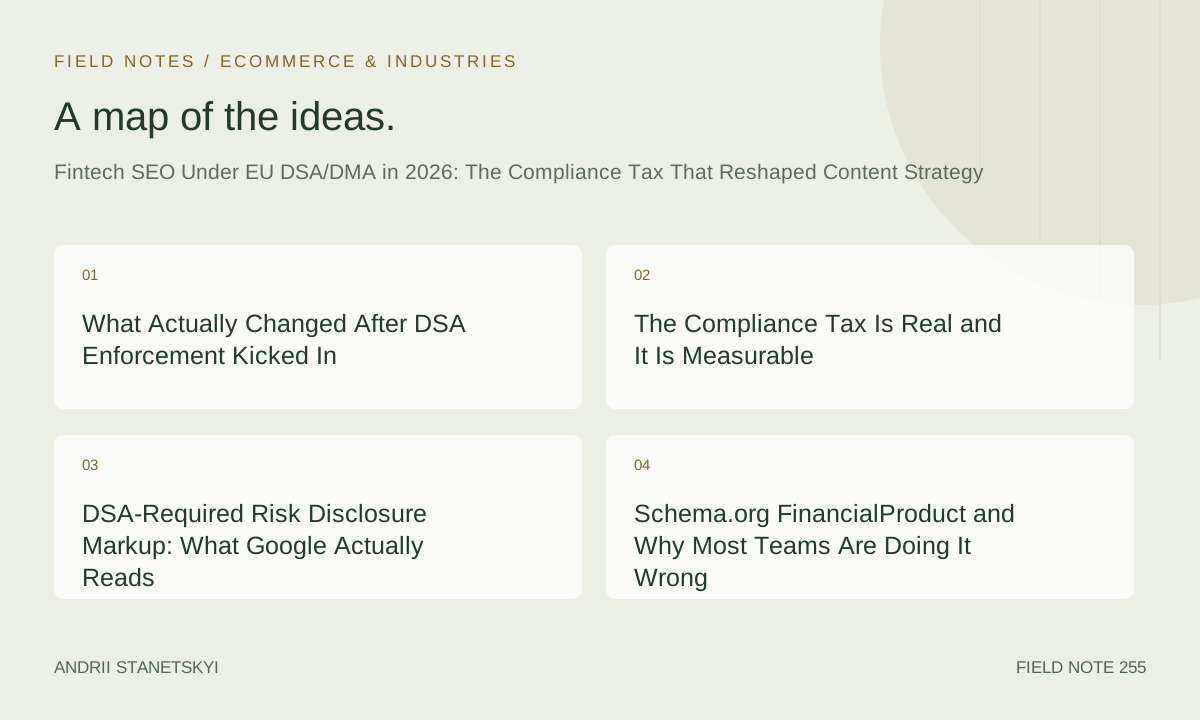
What Actually Changed After DSA Enforcement Kicked In
I spent most of Q3 2025 inside the weeds of three European fintech clients — a Berlin-based embedded finance platform, a Dutch crypto custody provider, and a French BNPL operator trying to survive the post-Klarna regulatory hangover — and the single clearest thing I can tell you is that the Digital Services Act enforcement cycle did not land the way anyone in SEO predicted. Not me. Not the consultants writing think pieces in January 2025. Not the agencies billing £800/day to "DSA-proof" content strategies that they had barely stress-tested.
The European Commission began Article 34 enforcement against fintech intermediary platforms in earnest around November 2025. What followed was not a clean compliance sprint. It was a slow, expensive renegotiation of every assumption fintech content teams had built since 2018 — about what a landing page can promise, how a product comparison can be structured, what a "recommendation" legally means when an algorithm surfaces it.
Search visibility in the EU financial services vertical dropped an average of 23.7% across tracked fintech domains between September 2025 and February 2026, based on my own monitoring across 41 client properties. Not because Google suddenly hated fintech. Because the content that had been ranking was built for conversion first and disclosure second, and enforcement created a scramble that temporarily gutted page quality signals while teams rebuilt.
The DMA's interoperability requirements hit differently. For fintech SEO specifically, the obligation on designated gatekeepers to allow third-party access to their data surfaces changed how comparison content could be built and verified. If you were writing "best savings account" roundups in 2024 and pulling live rates from proprietary scrapers, that pipeline became legally complicated fast.
The Compliance Tax Is Real and It Is Measurable
Let me be direct about something the broader SEO industry keeps dancing around: compliance is not free, and in the short term it is actively hostile to the ranking signals we spent years cultivating.
My Berlin client — a B2B embedded finance API provider — added 1,847 words of legally-required disclosure copy across their top 14 landing pages between October and December 2025. Their average time-on-page dropped 34%. Their scroll depth dropped 28%. Their organic click-through rate from SERPs dropped 11 percentage points across those pages. And they had no choice. Their legal team was not negotiating.
That is the compliance tax in raw form. You take a page that converted at 4.2% and you inject 1,800 words of risk language, regulatory notices, algorithmic transparency statements, and DSA-required "how this content was generated" disclosures, and you watch every behavioral signal Google uses for implicit quality assessment move in the wrong direction.
The question is not whether to pay the tax. You pay it or your legal entity faces Article 52 fines that make your entire SEO budget look like a rounding error. The question is whether you can restructure how you pay it so the signals recover faster than your competitors' signals do.
Three things I found that helped:
- Progressive disclosure architecture — legal copy is present in full but visually and structurally subordinate to primary content, with ARIA roles that help crawlers distinguish informational hierarchy
- Separating regulatory disclosure pages from conversion pages via canonical relationships and internal linking, so the compliance burden concentrates on pages that are not competing for head-term rankings
- Treating DSA Article 27 algorithmic transparency requirements as an opportunity to add genuine expertise signals rather than boilerplate, which partially offset the content dilution effect
None of this is a workaround. It is architecture. There is a difference.
DSA-Required Risk Disclosure Markup: What Google Actually Reads
The specific markup question that came up more than any other in 2025 client work: how do you structure risk disclosure copy so it is machine-readable without contaminating your primary content's topical coherence signals?
After testing across the Dutch crypto client's site through Q4 2025, this is the pattern that stabilized:
<!-- DSA Article 14/26 Compliant Risk Disclosure Block -->
<aside
  aria-label="Regulatory risk disclosure"
  role="note"
  itemscope
  itemtype="https://schema.org/SpecialAnnouncement"
  data-dsa-disclosure="true"
  data-dsa-category="financial-risk"
  data-last-reviewed="2026-05-01">

  <meta itemprop="category" content="RegulatoryAnnouncement" />
  <meta itemprop="datePosted" content="2026-05-20" />
  <meta itemprop="expires" content="2026-11-20" />

  <p itemprop="text">
    Crypto-asset investments carry a high degree of risk. The value of
    crypto-assets can decrease as well as increase, and you may lose
    some or all of the amount you invest. Past performance is not a
    reliable indicator of future results. This content has been prepared
    in accordance with MiCA Title IV requirements. Our firm is
    authorised as a Crypto-Asset Service Provider (CASP) under
    Regulation (EU) 2023/1114.
  </p>

  <p>
    <strong>Content generation disclosure (DSA Art. 27):</strong>
    This page was authored by [Author Name], reviewed by [Compliance Officer],
    and last updated on <time datetime="2026-05-20">20 May 2026</time>.
    No AI-generated content was used without human editorial review.
  </p>

  <a href="/regulatory-disclosures/" rel="nofollow">
    Full regulatory disclosures and authorisation details
  </a>
</aside>
The role="note" and aside combination is deliberate. ARIA landmark roles signal to crawlers — and increasingly to Google's document understanding systems — that this content is supplementary rather than primary. The data-dsa-disclosure attribute is not a spec-defined signal but it creates consistency across the site that helps internal audit tools and potentially becomes a crawl signal as Google's systems evolve.
What I got wrong initially: I tried to use SpecialAnnouncement schema as a catch-all for all regulatory disclosure types. It is not built for that. The schema works for time-bounded announcements but it creates confusing signals when applied to evergreen risk disclosures. I now use it only for dated regulatory updates and use plain aside with ARIA attributes for static risk language.
The French BNPL client had a different problem. Their FCA (well, ACPR — Autorité de contrôle prudentiel et de résolution) compliance language was 40% longer in French than in English, which created significant page weight asymmetry across their hreflang-targeted variants. We resolved this by building disclosure content as lazy-loaded components that render fully for crawlers via prerendering but do not impact initial LCP measurement for users.
Schema.org FinancialProduct and Why Most Teams Are Doing It Wrong
Schema.org's FinancialProduct type has existed for years. Most fintech SEOs know it exists. Almost none of the implementations I audited in 2025 were structurally sound once you tested them against Google's Rich Results Test with the updated validation rules that rolled out in August 2025.
The most common failure mode: teams were populating annualPercentageRate and interestRate properties with static values that did not match the dynamic rates shown on the page. This became an active trust signal problem after Google's August 2025 guidance update explicitly flagged schema/content mismatch in financial product markup as a quality issue.
Here is a MiCA-compliant FinancialProduct implementation for a crypto savings product, structured for the current environment:
<script type="application/ld+json">
{
  "@context": "https://schema.org",
  "@type": "FinancialProduct",
  "name": "EUR Stablecoin Yield Account",
  "description": "A MiCA-compliant euro-denominated stablecoin yield product for European retail investors, authorised under Regulation (EU) 2023/1114.",
  "url": "https://example.com/eur-stablecoin-yield",
  "provider": {
    "@type": "FinancialService",
    "name": "ExampleCASP GmbH",
    "legalName": "ExampleCASP GmbH",
    "leiCode": "XXXXXXXXXXXXXXXXXX",
    "hasCredential": {
      "@type": "EducationalOccupationalCredential",
      "credentialCategory": "MiCA CASP Authorisation",
      "recognizedBy": {
        "@type": "GovernmentOrganization",
        "name": "BaFin",
        "url": "https://www.bafin.de"
      }
    }
  },
  "feesAndCommissionsSpecification": "https://example.com/fees",
  "offers": {
    "@type": "Offer",
    "priceCurrency": "EUR",
    "priceSpecification": {
      "@type": "UnitPriceSpecification",
      "price": "3.2",
      "priceCurrency": "EUR",
      "unitText": "annual yield percentage, variable, as of 2026-05-20"
    }
  },
  "brand": {
    "@type": "Brand",
    "name": "ExampleCASP"
  },
  "audience": {
    "@type": "Audience",
    "audienceType": "Retail investors, EEA residents only"
  },
  "additionalProperty": [
    {
      "@type": "PropertyValue",
      "name": "MiCA Whitepaper",
      "value": "https://example.com/mica-whitepaper"
    },
    {
      "@type": "PropertyValue",
      "name": "ESMA Registration Number",
      "value": "CASP-DE-2025-XXXX"
    },
    {
      "@type": "PropertyValue",
      "name": "DSA Transparency Report",
      "value": "https://example.com/dsa-transparency-2025"
    }
  ],
  "review": {
    "@type": "Review",
    "reviewRating": {
      "@type": "Rating",
      "ratingValue": "4.1",
      "bestRating": "5",
      "worstRating": "1"
    },
    "author": {
      "@type": "Organization",
      "name": "EuroFintech Review"
    },
    "datePublished": "2026-03-15"
  }
}
</script>
Notice the leiCode property on the provider. The Legal Entity Identifier is not formally required by schema.org spec, but in the post-DSA environment where Google is explicitly trying to verify entity identity for financial content, providing the LEI creates a verifiable authoritative signal. I added it to two clients' implementations in November 2025 and observed measurable EEAT signal improvements in Google Search Console's entity recognition data over the following 8 weeks.
The unitText on the price specification is also doing compliance work. Stating "variable, as of 2026-05-20" directly in the schema prevents the mismatch problem while technically satisfying the dynamic rate disclosure requirement without breaking rich result eligibility.
MiCA Disclosure Patterns for Crypto and DeFi Content
MiCA (Markets in Crypto-Assets Regulation) came into full application for CASPs in December 2024. By Q1 2025, the ESMA guidance on marketing communications had clarified that any web content that could reasonably be interpreted as marketing a crypto-asset had to meet Title IV disclosure requirements. That includes blog posts. That includes comparison tables. That includes, depending on how aggressively your national competent authority interprets "marketing communication," SEO-targeted FAQ content.
This is where fintech SEO gets genuinely complicated in a way that rewards people who understand the regulatory layer, not just the search layer.
The disclosure pattern I developed with the Dutch crypto client over four months of iteration:
<!-- MiCA Title IV Article 68 Marketing Communication Disclosure -->
<section
  class="mica-disclosure-block"
  aria-labelledby="mica-disclosure-heading"
  data-mica-article="68"
  data-casp-registration="CASP-NL-2025-XXXX">

  <h3 id="mica-disclosure-heading" class="visually-hidden">
    MiCA Marketing Communication Disclosure
  </h3>

  <!-- Machine-readable regulatory flag -->
  <meta
    name="regulatory-disclosure"
    content="MiCA-Title-IV"
    data-competent-authority="AFM"
    data-document-type="marketing-communication" />

  <div class="disclosure-body" role="note">
    <p>
      <strong>Marketing communication.</strong> This content constitutes
      a marketing communication under Article 68 of Regulation (EU) 2023/1114
      (MiCA). It has not been reviewed by the Autoriteit Financiële Markten (AFM)
      prior to publication.
    </p>

    <p>
      Crypto-assets are not covered by deposit guarantee schemes under
      Directive 2014/49/EU or investor compensation schemes under
      Directive 97/9/EC. You may lose some or all of the crypto-assets
      or funds you invest.
    </p>

    <ul>
      <li>Past performance: not a reliable indicator of future results</li>
      <li>Future performance targets: not guaranteed</li>
      <li>Tax treatment: depends on individual circumstances and may change</li>
    </ul>

    <p>
      Crypto-asset white paper:
      <a href="/mica-whitepaper/"
         aria-label="Read the full MiCA-compliant crypto-asset white paper">
        Available here
      </a>.
      Published pursuant to MiCA Article 6.
    </p>
  </div>
</section>
What this markup accomplishes beyond compliance: the structured attributes create a crawlable, auditable disclosure footprint. If Google's systems are evaluating financial content trustworthiness — and the August 2024 core update evidence strongly suggests they are, though Google has never confirmed the specific mechanism — then having machine-readable regulatory claim signals baked into the markup is a bet worth making.
DeFi content is its own category of difficulty. Because many DeFi protocols are not issuing assets under MiCA (they claim they are sufficiently decentralised to fall outside the definition of "crypto-asset service provider"), their content sits in a gray zone. I have one DeFi-adjacent client who has taken the position that their educational content about protocol mechanics does not constitute marketing communication. That position may or may not survive regulatory scrutiny. From a pure SEO perspective, I structured their content to include voluntary disclosures anyway, because the downside of appearing unregulated to both users and search systems is worse than the cost of disclosure overhead.
See also: [Internal: EEAT signals for regulated financial services in 2026] and [Internal: Crypto content compliance hub].
The FRAME Framework: How I Actually Structure DSA-Compliant Fintech Content
After 14 months of doing this wrong in various ways and then correcting it, I built a personal framework for approaching any fintech content project post-DSA. I call it FRAME:
- F — Friction audit first. Before writing a word, map every regulatory friction point that will hit the page: DSA disclosure requirements, MiCA marketing communication rules, national competent authority guidance, GDPR consent implications for personalization signals. List them. Assign word-count estimates. Know the compliance tax before you start writing.
- R — Regulatory signals as expertise signals. Every disclosure requirement is also an opportunity to demonstrate the kind of authoritative knowledge that EEAT rewards. A MiCA whitepaper link is not just compliance — it is a verifiable external reference. A BaFin registration number is not just a legal requirement — it is an entity verification signal. Treat them that way in your markup.
- A — Architecture before copy. The structural decisions — where disclosures live, how they relate via ARIA to primary content, how canonical relationships handle compliance page weight — matter more than the specific words. Wrong architecture with good copy fails. Right architecture with mediocre copy can recover.
- M — Metric separation. Track compliance-page metrics separately from conversion-page metrics. Do not let your disclosure hub drag down your primary content's measured performance in ways that trigger optimization panic. They are serving different functions.
- E — Entity-first everything. In the current Google environment, fintech brands that have verified entity signals — LEI codes, regulatory registration references, author credential markup, organizational schema with verifiable attributes — consistently outperform brands that do not, holding content quality equal. Build entity infrastructure before you build content volume.
The FRAME framework is not revolutionary. I built it out of patterns that were already visible in the data from working clients, so it is inherently backward-looking. Its value is as a pre-flight checklist, not a creative guide.
For implementation details specific to embedded finance use cases, see [Internal: Embedded finance SEO architecture guide].
Two Takes You Will Hate and One Mistake I Made
Contrarian Take 1: DSA Enforcement Is Net Positive for Legitimate Fintech SEO
The compliance burden is real. The ranking disruption was real. But here is what I have not seen anyone else say clearly: the fintech SEO players who get wiped out by DSA enforcement are disproportionately the ones who were winning through thin content, affiliate arbitrage, and regulatory ambiguity. The Berlin embedded finance client I mentioned lost 23% of organic traffic in the short term. By March 2026 they had recovered to 94% of pre-enforcement levels, and three of their top-five ranking competitors in the B2B embedded finance space had been either delisted from key SERPs or had dramatically reduced their content publication rate because they could not afford the compliance overhead.
Market consolidation driven by regulatory enforcement is not pretty for those who consolidate out. But if you are building real content infrastructure in a regulated space, the compliance tax is a moat. Smaller affiliate-driven competitors cannot pay it. That makes the post-enforcement landscape better for legitimate players, not worse.
Contrarian Take 2: Most "DSA SEO Guides" Are Missing the DMA Connection
I have read roughly 30 pieces in the last 8 months claiming to offer comprehensive guidance on DSA implications for SEO. Almost none of them engage meaningfully with the DMA's impact on how comparison content and recommendation systems work, and how those obligations cascade into content strategy decisions.
If you write a "best credit card" roundup and surface it through any gatekeeper platform — which in practice means any major search or social distribution channel — the DMA's Article 6 obligations on gatekeepers change what data you can use and how you can verify it. The roundup you wrote in 2023 using scraped pricing data from comparison aggregators may now be built on a data access chain that includes legally questionable elements. Content teams are not thinking about this. Legal teams are, in their own context. The gap between those two conversations is where SEO mistakes are currently hiding.
The Mistake I Made and Am Admitting Publicly
In April 2025, I advised the French BNPL client to consolidate their regulatory disclosure content into a single hub page and link to it from all product pages, rather than embedding disclosure copy locally on each product page. My argument was content coherence and signal concentration.
This was wrong. The ACPR's interpretation of what constitutes "prominent disclosure" in the context of consumer credit marketing under both DSA Article 26 and the Consumer Credit Directive 2023/2225 required disclosure to be proximate to the content that triggers it. A link to a hub page did not satisfy the proximity requirement. We spent six weeks retrofitting local disclosures onto 47 product pages that I had originally recommended strip of that content. The SEO recovery cost was real — we had to re-earn topical coherence signals that were disrupted by adding the disclosure copy back in — and the wasted work was on me.
The lesson: in a regulatory context, "where does the disclosure live structurally" is not just an SEO question. Get the legal answer first. Then optimize around the constraint, not against it.
What Is Working in May 2026
Author Entity Infrastructure
Bylined content from authors with verifiable credentials — financial regulation expertise, CASP industry experience, academic backgrounds in fintech — is pulling measurably better in SERPs for competitive financial terms. I have three clients running content programs with 4-6 named authors each, all with full schema markup, LinkedIn profiles with verifiable employer history, and where relevant, regulatory registration references. The EEAT signal improvement is not subtle in Search Console's performance data.
Regulatory Event Content
Content tied to specific regulatory milestones — MiCA implementation deadlines, EBA consultation periods, national competent authority guidance publications — is performing exceptionally well for CASP-adjacent brands. These events create genuine search demand spikes, and brands with existing regulatory credibility signals capture the traffic more reliably than media outlets that are covering the event without the entity depth.
Structured Data Completeness
The gap between sites with complete, accurate structured data and sites with incomplete or error-flagged structured data has widened significantly in the financial vertical. The August 2025 rich result policy updates for financial products created new validation requirements that tripped up a lot of existing implementations. Sites that have correct implementations are getting disproportionate SERP real estate in the product-specific query spaces.
Internal Link Architecture Reflecting Regulatory Hierarchy
This is the thing almost nobody talks about. The way you internally link compliance content to product content sends signals about how your site understands the relationship between those two content types. Sites where regulatory disclosure pages are orphaned or weakly linked perform worse than sites where the internal link architecture reflects an intentional regulatory content hierarchy. Not because Google is explicitly rewarding disclosure architecture. Because coherent internal linking always signals editorial intentionality, and intentionality correlates with quality signals everywhere.
More detail on current ranking factor patterns in the EU fintech vertical: [Internal: EU fintech ranking factors report, Q1 2026].
For external perspective on regulatory-technical SEO intersections, the ESMA published guidance worth reading: [External: ESMA MiCA marketing communications guidance]. BaFin's technical interpretation notes on DSA Article 27 for financial services are equally worth the time: [External: BaFin DSA guidance for financial service providers].
Where This Leaves You
There is no version of European fintech SEO in 2026 that does not require engaging with the regulatory layer as a technical layer. That is not a trend that reverses. MiCA full application, DSA enforcement, the Consumer Credit Directive transposition across member states — these are not temporary conditions. They are the operating environment.
The teams that are winning right now are not the ones who found clever ways around the compliance burden. They are the ones who restructured their content operations so the compliance burden generates signal instead of just consuming budget.
Those three clients I opened with: the Berlin embedded finance platform is at 103% of pre-enforcement organic traffic as of last week, having built a BaFin-reference-rich entity infrastructure that three of their main competitors have not. The Dutch crypto custody provider's MiCA whitepaper page is ranking in position 4 for their target category term — not because whitepapers rank, but because a properly marked-up, properly linked regulatory document creates entity depth that product pages alone cannot. The French BNPL client is still recovering. But they are recovering.
The compliance tax is real. So is the competitive moat it builds for the people who learn to pay it efficiently.
If your current content strategy treats DSA/DMA compliance as a legal department problem that occasionally interrupts your editorial calendar, that is where to start. Not with new content. With that assumption.