Hreflang is the specification that most international SEO implementations get wrong, not because the concept is hard, but because the failure modes are subtle and the feedback loop is slow. A broken hreflang cluster doesn't produce a 500 error — it produces organic traffic loss in specific locales over weeks, which practitioners often attribute to algorithm updates. This guide covers implementation mechanics, validation at scale, and the edge cases that actually matter in production environments.
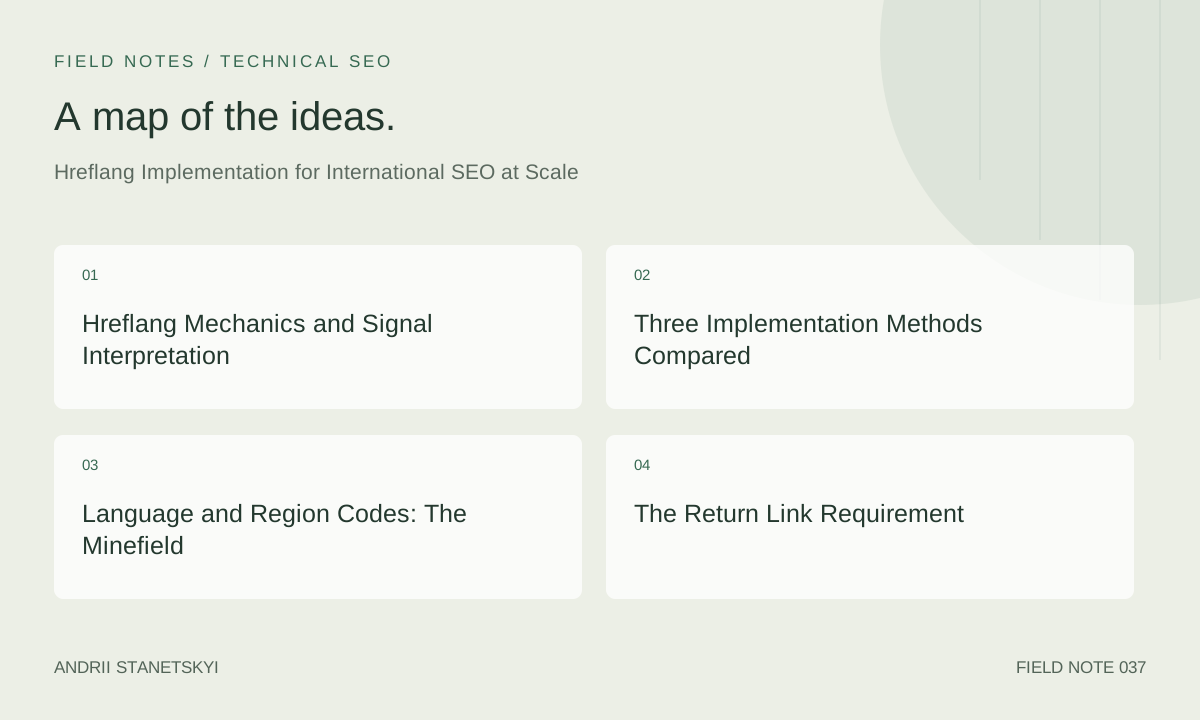
Hreflang Mechanics and Signal Interpretation
Hreflang tells Googlebot which language and/or region a URL serves, and which alternative URLs serve other languages or regions. Google uses this to serve the correct locale URL in the correct country's SERPs. Bingbot also supports hreflang, with somewhat less granular implementation — it primarily uses the language code and is more forgiving of region-code errors than Google.
The specification requires three things to function correctly: valid language/region codes per BCP 47, return links in every alternate URL, and consistency between declaration methods. When any of these breaks down at scale, the result is Google ignoring the hreflang cluster entirely and falling back to its own geolocation signals — primarily ccTLD, server location, and link distribution.
What Google Does With Valid Hreflang
For a user searching in French from France, Google will serve the fr-FR URL if one is declared and valid. If only fr is declared (no region), Google serves it to all French-language searchers regardless of country. This is an important distinction — fr matches French language everywhere; fr-FR matches French language in France specifically.
What Google Does With Broken Hreflang
When Google encounters errors in an hreflang cluster — missing return links, invalid codes, or inconsistent declarations — it does not partially apply the hreflang. It ignores the entire cluster and relies on other signals. This means a single error in a large cluster (say, missing return links on 5% of pages) can invalidate hreflang for the entire site.
Three Implementation Methods Compared
Method 1: HTML <head> Tags
<!-- English US (canonical/default) -->
<link rel="alternate" hreflang="en-us" href="https://example.com/en-us/page" />
<link rel="alternate" hreflang="en-gb" href="https://example.com/en-gb/page" />
<link rel="alternate" hreflang="fr-fr" href="https://example.com/fr-fr/page" />
<link rel="alternate" hreflang="de-de" href="https://example.com/de-de/page" />
<link rel="alternate" hreflang="x-default" href="https://example.com/page" />
This is the most common method and the most fragile at scale. Every page must declare all alternates — including itself. A CMS that generates these dynamically must query the full localization map for every page render, which creates database load at scale. For sites with 50+ locales and 100k+ pages per locale, this method alone generates enormous HTML bloat.
Method 2: XML Sitemap
<?xml version="1.0" encoding="UTF-8"?>
<urlset xmlns="http://www.sitemaps.org/schemas/sitemap/0.9"
        xmlns:xhtml="http://www.w3.org/1999/xhtml">
  <url>
    <loc>https://example.com/en-us/page</loc>
    <xhtml:link rel="alternate" hreflang="en-us"
                href="https://example.com/en-us/page"/>
    <xhtml:link rel="alternate" hreflang="en-gb"
                href="https://example.com/en-gb/page"/>
    <xhtml:link rel="alternate" hreflang="fr-fr"
                href="https://example.com/fr-fr/page"/>
    <xhtml:link rel="alternate" hreflang="x-default"
                href="https://example.com/page"/>
  </url>
  <url>
    <loc>https://example.com/en-gb/page</loc>
    <xhtml:link rel="alternate" hreflang="en-us"
                href="https://example.com/en-us/page"/>
    <xhtml:link rel="alternate" hreflang="en-gb"
                href="https://example.com/en-gb/page"/>
    <xhtml:link rel="alternate" hreflang="fr-fr"
                href="https://example.com/fr-fr/page"/>
    <xhtml:link rel="alternate" hreflang="x-default"
                href="https://example.com/page"/>
  </url>
</urlset>
The sitemap method offloads the hreflang cluster declaration from individual page HTML to a centralized file. This is the preferred method for large sites. The trade-off: sitemaps are crawled on a schedule, not with every page fetch, so hreflang updates in the sitemap can lag behind live site changes by days or weeks. For sites with frequent URL changes, combine both methods.
Method 3: HTTP Headers
# Nginx — for non-HTML resources
location /docs/spec.pdf {
    add_header Link '<https://example.com/en-us/docs/spec.pdf>; rel="alternate"; hreflang="en-us", <https://example.com/fr-fr/docs/spec.pdf>; rel="alternate"; hreflang="fr-fr"';
}
HTTP headers are only necessary for non-HTML files. For HTML pages, they add server complexity without benefit over the HTML method. Only use this for PDF or document localization.
Language and Region Codes: The Minefield
BCP 47 is the standard. ISO 639-1 for language codes, ISO 3166-1 alpha-2 for region codes. The errors that actually appear in production:
| Wrong | Correct | Error Type |
|---|---|---|
| hreflang="EN" | hreflang="en" | Case sensitivity — must be lowercase |
| hreflang="en_US" | hreflang="en-US" | Underscore instead of hyphen |
| hreflang="zh" | hreflang="zh-Hans" or hreflang="zh-TW" | Ambiguous Chinese — Simplified or Traditional? |
| hreflang="pt" | hreflang="pt-BR" or hreflang="pt-PT" | Portuguese without region — valid but imprecise |
| hreflang="en-UK" | hreflang="en-GB" | UK is not a valid ISO 3166-1 code; GB is |
| hreflang="no" | hreflang="nb" or hreflang="nn" | Norwegian macrolanguage — use Bokmål or Nynorsk |
| hreflang="lat" | Not applicable | Three-letter codes are not BCP 47 primary subtags |
The Chinese case deserves elaboration. zh-Hans (Simplified, used in mainland China and Singapore) and zh-Hant (Traditional, used in Taiwan and Hong Kong) are different writing systems used by different audiences. Using bare zh is technically valid per BCP 47 but leaves Google to infer which script you mean. Always be explicit. For Hong Kong Cantonese: zh-HK maps to Traditional Chinese in Hong Kong.
The Return Link Requirement
Every URL in an hreflang cluster must include the full set of alternates, including a link pointing back to itself. This is the most common failure point in large-scale implementations. If page A declares alternates B and C, then B must declare A and C, and C must declare A and B. Missing any link in this bidirectional graph invalidates the cluster for the affected URL.
<!-- On https://example.com/en-us/page -->
<link rel="alternate" hreflang="en-us" href="https://example.com/en-us/page" />  <!-- self -->
<link rel="alternate" hreflang="fr-fr" href="https://example.com/fr-fr/page" />
<link rel="alternate" hreflang="de-de" href="https://example.com/de-de/page" />
<link rel="alternate" hreflang="x-default" href="https://example.com/page" />

<!-- On https://example.com/fr-fr/page (must include en-us return link) -->
<link rel="alternate" hreflang="en-us" href="https://example.com/en-us/page" />
<link rel="alternate" hreflang="fr-fr" href="https://example.com/fr-fr/page" />  <!-- self -->
<link rel="alternate" hreflang="de-de" href="https://example.com/de-de/page" />
<link rel="alternate" hreflang="x-default" href="https://example.com/page" />
At scale, return link failures most commonly happen when: (a) a new locale is added but existing-locale templates aren't updated to include the new locale's URLs; (b) a page is translated but the English page template isn't updated to include the translation's URL; or (c) locales are served from separate CMS instances that don't share a centralized localization map.
Implementing at Scale: CMS Architecture and Sitemap Strategy
Centralized Localization Map Pattern
For sites with 10+ locales, the localization map — the data structure that maps each content item to all its locale URLs — must be a first-class database entity, not assembled on the fly. This typically means a table like:
-- Localization map table
CREATE TABLE locale_map (
  content_id    VARCHAR(255) NOT NULL,
  locale        VARCHAR(10)  NOT NULL,
  canonical_url TEXT         NOT NULL,
  PRIMARY KEY (content_id, locale),
  INDEX idx_content (content_id)
);
Both the HTML tag generator and the sitemap generator query this table. New locales update one place; all pages pick up the new alternate automatically.
Sitemap Splitting by Locale Cluster
For very large sites, generate per-locale hreflang sitemaps and reference them from the sitemap index:
<?xml version="1.0" encoding="UTF-8"?>
<sitemapindex xmlns="http://www.sitemaps.org/schemas/sitemap/0.9">
  <sitemap>
    <loc>https://example.com/sitemaps/hreflang-en-us.xml</loc>
    <lastmod>2026-04-29</lastmod>
  </sitemap>
  <sitemap>
    <loc>https://example.com/sitemaps/hreflang-fr-fr.xml</loc>
    <lastmod>2026-04-29</lastmod>
  </sitemap>
  <sitemap>
    <loc>https://example.com/sitemaps/hreflang-de-de.xml</loc>
    <lastmod>2026-04-29</lastmod>
  </sitemap>
</sitemapindex>
Each locale sitemap contains all URLs for that locale, each with the full hreflang cluster. This keeps individual sitemap files under the 50MB/50,000 URL limits and makes validation per locale much easier.
URL Structure Decisions
The URL structure choice (ccTLD, subdomain, subdirectory) affects hreflang in several ways:
| Structure | Example | Hreflang Consideration |
|---|---|---|
| ccTLD | example.fr, example.de | Strongest geo-signal; hreflang less critical but still required for language variants |
| Subdomain | fr.example.com | GSC treats as separate properties; must verify each; hreflang spans properties |
| Subdirectory | example.com/fr/ | Single GSC property; easiest hreflang management; requires careful robots.txt per-path rules |
Diagnostic Workflow and Tooling
Step 1: Validate Code Syntax
# Fetch a page and extract all hreflang declarations
curl -s https://example.com/en-us/page | \
  grep -oP 'hreflang="[^"]+"' | sort

# Validate against BCP 47 — check for underscores, uppercase, invalid codes
curl -s https://example.com/en-us/page | \
  grep -oP 'hreflang="[^"]+"' | \
  grep -E 'hreflang="[A-Z]|hreflang="[a-z]{2}_'
Step 2: Verify Return Links
For each URL in the cluster, fetch it and confirm it contains a link back to the originating URL:
# Check that fr-fr page contains return link to en-us
ENURL="https://example.com/en-us/page"
FRURL="https://example.com/fr-fr/page"
curl -s "$FRURL" | grep -F "$ENURL"
# If no output, return link is missing
Step 3: Screaming Frog Hreflang Audit
Configuration → Hreflang → enable. After crawl: Reports → Hreflang. Filter for:
- "Missing Return Links" — the most common failure
- "Non-Canonical Returns" — alternate points to a URL that itself canonicalizes elsewhere
- "Incorrect Language Codes" — BCP 47 violations
- "Unlinked Hreflang URLs" — declared alternates that 404 or redirect
Step 4: GSC International Targeting Report
GSC → Legacy Search Console → International Targeting → Language tab. This shows hreflang errors Google has detected. The "Language" tab aggregates errors by type. Cross-reference with the Sitebulb "Hreflang" audit for URL-level detail.
Step 5: Log Analysis for Locale Crawl Distribution
# Check Googlebot is crawling all locale directories proportionally
grep "Googlebot" /var/log/nginx/access.log | \
  grep -oP '"GET /[a-z]{2}-[a-z]{2}/' | \
  sort | uniq -c | sort -rn | head -20
If Googlebot is crawling /en-us/ heavily but barely touching /fr-fr/, either crawl budget is being consumed before reaching French pages, or there are crawl barriers (robots.txt, noindex) blocking the French locale. See our crawl budget guide for remediation strategies.
Edge Cases: x-default, Subdomains, CDNs
x-default: What It Actually Does
hreflang="x-default" designates the fallback URL for users who don't match any specific locale. Misuse is common: many implementations point x-default to the English US URL, which means all unmatched locales get the US English experience. A better pattern:
<!-- x-default points to language selector or global homepage -->
<link rel="alternate" hreflang="x-default" href="https://example.com/choose-region" />
If you serve users in 15 countries but the country isn't in your hreflang set (e.g., a user from Nigeria), x-default determines what they see in search results. Point it to a page that helps them self-select, not to an arbitrary locale.
Hreflang Across Subdomains
<!-- On en.example.com/page -->
<link rel="alternate" hreflang="en" href="https://en.example.com/page" />
<link rel="alternate" hreflang="fr" href="https://fr.example.com/page" />

<!-- On fr.example.com/page -->
<link rel="alternate" hreflang="en" href="https://en.example.com/page" />
<link rel="alternate" hreflang="fr" href="https://fr.example.com/page" />
Subdomains are distinct GSC properties. You must submit sitemaps to each property. The hreflang cluster spans subdomains without issue — Google handles cross-subdomain hreflang correctly — but you need to verify each subdomain has its GSC property configured and the hreflang report checked separately.
CDN Edge Caching and Hreflang Headers
CDNs that cache HTML can serve stale hreflang tags. If you update a page's locale set and the CDN serves a cached version missing the new locale's link, return links break. Configure CDN cache rules to include Vary: Accept-Language or purge HTML caches on content deployment. See our CDN configuration guide for SEO.
When Hreflang Interacts With Canonicals
Each URL in an hreflang cluster must self-canonicalize. Never canonicalize a locale URL to another locale. Never canonicalize an hreflang alternate to a URL not in the cluster. If /fr-fr/page canonicalizes to /en-us/page, Google treats the French page as a duplicate of English and will never serve it in French SERPs — the hreflang annotation is functionally destroyed.
<!-- WRONG: French page canonicalizing to English -->
<link rel="canonical" href="https://example.com/en-us/page" />
<link rel="alternate" hreflang="fr-fr" href="https://example.com/fr-fr/page" />

<!-- CORRECT: Self-referencing canonical -->
<link rel="canonical" href="https://example.com/fr-fr/page" />
<link rel="alternate" hreflang="fr-fr" href="https://example.com/fr-fr/page" />
<link rel="alternate" hreflang="en-us" href="https://example.com/en-us/page" />
FAQ
Do I need hreflang if I only have one language but multiple countries?
Yes. If you serve en-US and en-GB versions with different content (pricing, products, spellings), hreflang prevents Google from treating one as a duplicate of the other and ensures each country's searchers see the appropriate version. Without it, Google typically picks one version as canonical and ranks it globally.
How long does it take for hreflang changes to take effect?
For HTML tag changes: Googlebot must recrawl each affected page. On a large site, this can take 2–6 weeks for full propagation. For sitemap changes: faster, since Googlebot fetches sitemaps more frequently than individual pages. For urgent changes (fixing a broken cluster), request recrawl via GSC for critical pages and resubmit the sitemap.
Can I use hreflang in a separate <link> header file or include?
No. Hreflang must be in the HTML <head> of the page itself, in the HTTP response headers, or in the XML sitemap. Including it via JavaScript-rendered content is unreliable — Googlebot may not execute JavaScript on first fetch. Never rely on client-side rendering for hreflang delivery.
What happens if my hreflang URLs return 404?
Google ignores the hreflang annotation for the affected URL. Worse, it may flag the cluster as having errors and reduce trust in the entire cluster's hreflang declarations. Audit hreflang targets for 404/redirect status monthly, especially after site migrations or URL restructuring.
Should I include noindex pages in hreflang clusters?
No. A noindex page will be removed from Google's index, so including it as an hreflang target is noise at best and confusing at worst. If a locale page doesn't warrant indexing, remove it from the hreflang cluster entirely and redirect the URL to the nearest appropriate locale.
How do I handle hreflang for a site with 50 locales and 500k pages?
Use the sitemap method exclusively — HTML tags would add 50 link elements to every page's head, which is significant HTML bloat and render time. Generate locale-specific sitemaps programmatically from a centralized localization database. Use Google's hreflang validator tools to spot-check clusters, and set up automated monitoring that alerts when return link coverage drops below 99%.
Does Bingbot support hreflang?
Yes, Bingbot supports hreflang but its implementation is more lenient. Bing's primary international signal is the Bing Webmaster Tools geo-targeting setting combined with hreflang. Bing is more forgiving of missing return links and tends to rely more heavily on IP geolocation and ccTLD signals than Google. Still implement hreflang correctly — treating Bingbot as a secondary concern for hreflang means you're leaving Bing international traffic on the table.
Key Takeaways
- Hreflang is validated as a cluster — a single missing return link or invalid code can invalidate the entire cluster for affected URLs.
- Every locale URL must self-canonicalize. Canonicalizing to another locale destroys the hreflang signal for that page.
- For sites with 10+ locales, use the XML sitemap method over HTML tags. Generate from a centralized localization database.
- BCP 47 codes must be lowercase language, uppercase region, separated by a hyphen.
en-GBnotEN_gb. - Chinese requires
zh-Hans(Simplified) orzh-Hant(Traditional). Barezhis ambiguous. x-defaultshould point to a language/region selector, not an arbitrary locale URL.- Run Screaming Frog's hreflang report monthly. Prioritize "Missing Return Links" and "Non-Canonical Returns" errors.
- CDN HTML caching can serve stale hreflang. Purge caches on content deployment.
Conclusion
Hreflang at scale is fundamentally a data architecture problem. The tag syntax is straightforward; keeping a complete, accurate, bidirectional localization map synchronized across a large site as content changes is the hard part. The teams that do this well treat the localization map as a database concern with tooling around validation, rather than a template concern solved per page. Get the data model right, automate the validation, and the ranking benefits in international SERPs compound over time.