Auditing a 500-URL startup site and auditing a 10-million-URL enterprise platform are not the same task performed at different volumes. They are categorically different problems — requiring different tooling, different prioritization logic, different communication strategies, and different definitions of "done." The techniques that serve a boutique agency well actively mislead when applied to enterprise: full crawls that never finish, issue reports nobody can action, and recommendations that conflict with engineering constraints that nobody told you about.
This guide is written for practitioners who have already mastered the fundamentals and need a framework for operating at scale. The focus is on what changes at enterprise — tooling, scoping, stakeholder management, and the emerging AI-era dimensions of technical audit work.
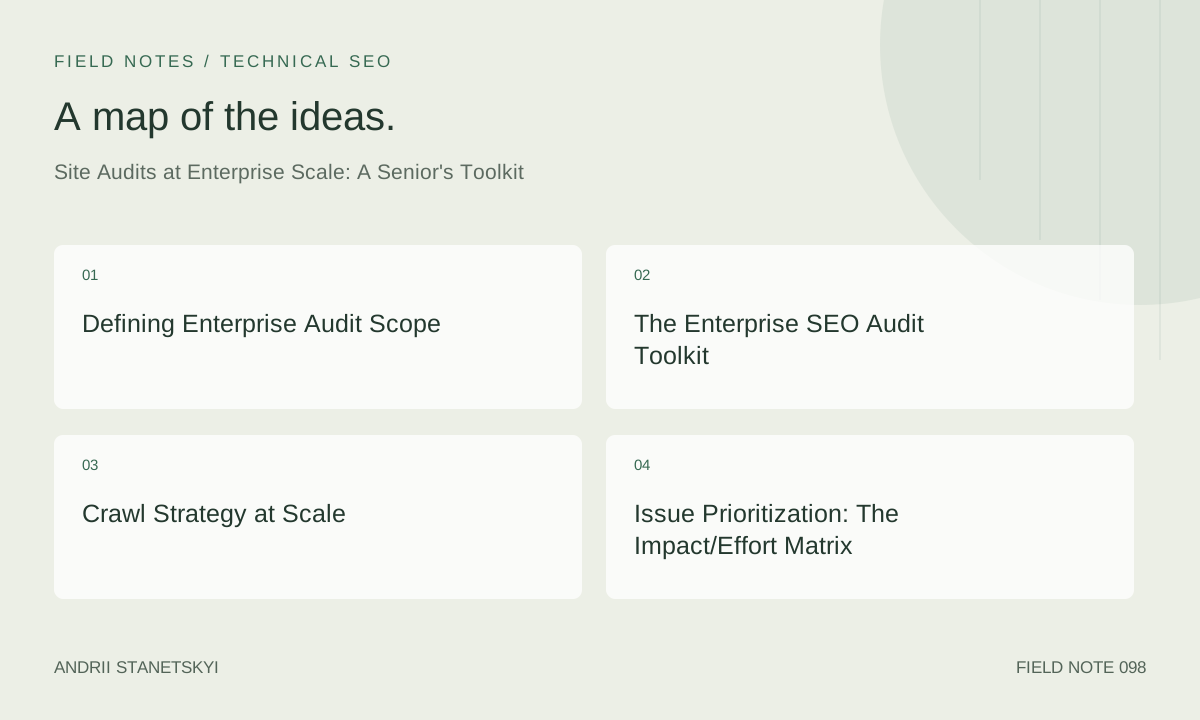
Defining Enterprise Audit Scope
Enterprise is not purely a URL count. A 200,000-URL e-commerce site with a monolithic CMS and quarterly deploy cycles is very different from a 200,000-URL publishing platform deploying 50 times per day. The defining characteristics of enterprise audit complexity are:
- Dynamic URL generation at scale — faceted navigation, parameterized search, user-generated content, infinite scroll pagination
- Multiple stakeholder groups with conflicting priorities (engineering, product, marketing, legal, brand)
- Partial crawlability — robots.txt blocks, authentication requirements, CDN edge caching that masks server behavior
- CMS constraints — changes require template modifications affecting millions of pages simultaneously
- Multi-region, multi-language complexity — hreflang at scale, geotargeting, country-specific canonical structures
The first step of any enterprise audit is scoping: explicitly defining what is in scope, what is out of scope, and why. Document this. Scope creep in enterprise audits is career-damaging — it produces audits that are never completed, recommendations that are never implemented, and relationships with engineering teams that never recover.
The Enterprise SEO Audit Toolkit
| Tool | Purpose | Effective at Scale | Limitation at Enterprise |
|---|---|---|---|
| Screaming Frog SEO Spider | Crawl, on-page audit | Up to ~2M URLs | RAM constraints; single-machine bottleneck |
| Sitebulb | Crawl + visualization | Up to ~1M URLs | Limited custom extraction |
| JetOctopus | Log analysis + crawl | Billions of log lines | Crawl depth less mature than SF |
| Botify | Enterprise crawl + log analytics | 100M+ URLs | Cost; requires onboarding investment |
| Lumar (DeepCrawl) | Enterprise crawl + reporting | 50M+ URLs | Less flexible for custom analysis |
| Custom Python (Scrapy/httpx) | Targeted extraction, custom logic | Unlimited (distributed) | Engineering overhead; requires dev time |
| Google Search Console API | Indexation, performance data | Unlimited via API | Sampling above ~1M rows; 16-month history limit |
| BigQuery + GSC data | Query-level performance at full scale | Unlimited | Requires GCP setup; cost for large exports |
The working setup for most enterprise audits: Botify or JetOctopus for the primary crawl and log analysis, Screaming Frog for targeted segment audits, GSC API + BigQuery for performance data, and custom Python for bespoke extraction tasks (schema validation, hreflang verification, canonical chain analysis).
Crawl Strategy at Scale
Never Crawl Everything
The instinct to "get a full picture" produces a crawl that finishes in three days, surfaces 800,000 issues, and paralyzes action. Enterprise audits require strategic sampling and segment-based crawling.
Segment your crawl by:
- URL pattern: product pages, category pages, blog articles, landing pages, account pages (exclude these)
- Traffic tier: GSC performance export → top 10,000 pages by clicks → crawl these first
- Revenue attribution: if you have GA4 or analytics data, sort by conversion-contributing pages
- Link equity: Ahrefs/Majestic export → pages with most referring domains → crawl these
This produces four targeted crawls of manageable scope, each with actionable outputs, rather than one overwhelming full-site crawl.
Crawl Rate Configuration
Enterprise sites have real traffic. A crawler misconfigured at 50 requests/second on a site with 50ms server response times will degrade site performance and trigger CDN rate limiting. Configure crawl rate to not exceed 10% of server capacity. For critical production environments, schedule crawls for off-peak hours (typically 2–6 AM in the primary market timezone).
Rendering Audit
JavaScript-rendered content is endemic in enterprise sites. The crawl must distinguish between what is in the server-rendered HTML and what requires JavaScript execution. Screaming Frog's "Rendered" vs. "HTML" comparison mode is the fastest way to identify JavaScript-dependency gaps. For Botify users, the Spider + JavaScript rendering toggle achieves the same. Flag any content visible in rendered view but absent in raw HTML — this includes nav links, product attributes, and structured data injected by React/Vue/Angular.
Issue Prioritization: The Impact/Effort Matrix
Every enterprise audit surfaces more issues than can be actioned. Prioritization is not optional — it is the practitioner's core deliverable. A list of 400 issues is useless; a ranked set of 15 issues with business impact estimates is actionable.
The Four-Quadrant Framework
Map every identified issue on two axes: SEO Impact (traffic/revenue risk if unresolved) × Implementation Effort (engineering time, risk, and CMS limitations).
- High Impact / Low Effort: Fix immediately. Examples: missing canonical tags on faceted navigation, incorrect hreflang language codes, disallowed crawl paths in robots.txt.
- High Impact / High Effort: Sprint planning — these require engineering buy-in and project scoping. Examples: Core Web Vitals rearchitecture, pagination restructure, JavaScript rendering overhaul.
- Low Impact / Low Effort: Batch and fix opportunistically. Examples: title tag length optimization, meta description updates, image alt text gaps on low-traffic pages.
- Low Impact / High Effort: Deprioritize or reject. These consume resources better spent elsewhere.
Quantifying Business Impact
Prioritization gains credibility when issues are associated with revenue estimates, not just SEO metrics. The formula:
Estimated Revenue Impact = Affected Pages × Average Monthly Organic Sessions per Page × Organic CVR × AOV × Estimated Traffic Recovery %
For a technical issue affecting 50,000 category pages with an average of 200 organic sessions/month, 2.5% CVR, $85 AOV, and an estimated 15% traffic recovery if fixed: 50,000 × 200 × 0.025 × $85 × 0.15 = $3.19M annual revenue at risk. This number gets a ticket to the top of the engineering backlog. "Category pages have canonicalization issues" does not.
Log File Analysis at Enterprise Scale
Log file analysis is the ground truth of crawl behavior — it shows what Googlebot actually does, not what you think your robots.txt allows. At enterprise scale, logs contain millions of lines per day. Raw analysis is not feasible; structured queries are mandatory.
Setting Up Log Analysis
Options by sophistication:
- JetOctopus or Botify: Upload raw logs; get segmented Googlebot crawl data by URL pattern, status code, and time series. Best for teams without data engineering support.
- BigQuery: Parse and upload logs to BigQuery; query at scale with SQL. More flexible, requires setup.
- Custom Python: For real-time log streaming, use a pipeline (e.g., Datadog, Splunk, or self-hosted ELK) to filter for Googlebot user-agent and extract URL, status code, timestamp, and response size.
Key Log Analysis Queries
SQL example — identifying crawl waste on non-indexable URLs in BigQuery:
SELECT
  url_path,
  COUNT(*) AS googlebot_requests,
  response_status
FROM project.dataset.access_logs
WHERE
  user_agent LIKE '%Googlebot%'
  AND DATE(timestamp) BETWEEN '2026-03-01' AND '2026-04-01'
  AND response_status IN (301, 302, 404, 410)
GROUP BY url_path, response_status
ORDER BY googlebot_requests DESC
LIMIT 500;
This query identifies the top 500 URLs where Googlebot is spending crawl budget on redirect or error responses — prime candidates for robots.txt exclusion or redirect correction.
AI-Era Audit Checks
The standard technical audit checklist has not changed in its fundamentals, but a new layer of checks is now required for AI search surfaces. Every enterprise audit should now include the following.
AI Crawler Access Audit
Verify which AI crawlers are permitted and which are blocked. Pull the current robots.txt and cross-reference against the known AI crawler list:
# Enterprise robots.txt — AI crawler policy (recommended baseline)
User-agent: GPTBot
Allow: /blog/
Allow: /docs/
Disallow: /private/
Disallow: /account/
Disallow: /checkout/

User-agent: ClaudeBot
Allow: /blog/
Allow: /docs/
Disallow: /private/

User-agent: PerplexityBot
Allow: /blog/
Allow: /docs/
Disallow: /private/

User-agent: CCBot
Disallow: /

User-agent: Google-Extended
Allow: /
Disallow: /private/
Disallow: /account/
There is no universally correct policy — the decision depends on the client's content licensing position, competitive sensitivity, and AI citation strategy. The audit deliverable is: (a) document the current state, (b) identify where the policy is undefined or inconsistent, (c) present options with trade-offs. See our discussion in AI Overviews and CTR impact analysis.
llms.txt Implementation Check
Proposed by Anthropic researcher Jeremy Howard in 2024, llms.txt is a machine-readable file at /llms.txt that signals to LLM crawlers which content is suitable for AI training and context. While not yet adopted by all AI systems, it is a forward-looking best practice worth implementing and auditing.
# /llms.txt example for enterprise site
# https://llmstxt.org

# ExampleCorp — llms.txt v1.0
# Content available for AI training and citation

## Preferred Content
- /blog: Technical articles and industry analysis (CC-BY license)
- /docs: Product documentation (all rights reserved — citation permitted)
- /research: Whitepapers and studies (citation required with attribution)

## Excluded Content
- /account: Private user data — do not index
- /internal: Internal tools — do not index
- /draft: Unpublished content — do not index

## Contact
For licensing inquiries: [email protected]
Structured Data for AI Understanding
AI systems including Gemini, Perplexity, and ChatGPT increasingly use structured data to understand entity relationships, not just for rich results. Audit structured data completeness, accuracy, and coverage across the site:
- Schema coverage rate (% of target page types with valid schema)
- Schema accuracy (does structured data match visible page content?)
- Entity disambiguation quality (are Organization, Person, Product entities consistently identified with
sameAsWikidata/Wikipedia URLs?)
Stakeholder Management and Audit Communication
The most technically perfect enterprise audit fails if it cannot be communicated to the people who implement the changes. Engineering teams do not respond to a list of Screaming Frog export tabs. Product managers do not action vague "SEO improvements." Legal teams block recommendations that lack risk assessment.
The Three-Layer Audit Deliverable
- Executive summary (1 page): Revenue at risk, top 3 issues, estimated fix timeline, and resource requirement. No technical jargon. Decision-maker audience.
- Prioritized issue register (spreadsheet): Issue, affected URLs (count and sample), impact estimate, implementation effort, ticket/owner assignment. This is the engineering team's working document.
- Technical appendix (full detail): Methodology, full crawl data, supporting evidence for each issue, specific implementation guidance. Reference document for implementation questions.
Ticket Writing for Engineering
SEO recommendations that are not written as engineering tickets do not get implemented. The format:
- Problem statement: What is wrong and where (with URL examples)
- Business impact: Revenue/traffic estimate
- Acceptance criteria: Exactly what "fixed" looks like (testable)
- Implementation guidance: Specific code or config change suggested
- Validation method: How SEO will verify the fix post-deployment
Audit Cadence and Continuous Monitoring
A point-in-time audit is a snapshot. Enterprise sites change continuously — new pages are published, templates are modified, CDN rules are updated, third-party scripts are added. An annual audit cadence is insufficient for enterprise; continuous monitoring is the standard.
Recommended cadence:
- Real-time: Alerting on critical status code changes (5xx spikes, canonical tag disappearance from homepage) via Botify or custom monitoring.
- Weekly: Log file Googlebot crawl review — crawl budget waste trends, new 404 patterns, redirect chain growth.
- Monthly: Segment crawl of top-traffic page templates. Structured data validation. Core Web Vitals field data review (CrUX).
- Quarterly: Full audit of a defined scope segment. Schema coverage audit. AI crawler policy review. Competitive position comparison.
- Annual: Comprehensive cross-functional audit with executive reporting. Architecture review. AI search visibility assessment.
Related reading: crawl budget optimization for large sites and log file analysis methodology.
FAQ
How do you scope an enterprise audit without spending 200 hours?
Define the scope explicitly upfront: which URL segments, which issues categories, which time period, and which deliverable format. A scoped 40-hour audit that produces a prioritized, actionable issue register is worth more than an unscoped 200-hour crawl-everything exercise that produces a 600-line spreadsheet nobody reads. Scope is a professional skill, not a concession of thoroughness.
What is the single highest-ROI audit check for enterprise e-commerce?
Faceted navigation crawl waste. In virtually every large e-commerce audit, the top crawl budget wasters are parameter-generated URLs from filters: color, size, brand, price range. These URLs are often canonicalized to category pages but still crawled, creating crawl budget waste without indexation benefit. Auditing and fixing this consistently produces measurable improvements in core page indexation rates.
How do you handle a client who wants "all issues fixed" rather than a prioritized approach?
Quantify the trade-off explicitly. If fixing all 8,000 identified issues would require 1,200 engineering hours at an average allocation of 20 hours/week, it takes 60 weeks. During those 60 weeks, the top 50 issues — fixable in 80 hours — deliver 80% of the revenue recovery. Present both paths with timelines and outcomes; let the client choose with full information. The answer is almost always prioritized.
When should I use a custom Python crawler instead of a commercial tool?
When you need custom logic: schema validation against a proprietary schema, hreflang consistency checking across 40 language variants, redirect chain analysis across 5M URLs, or integration with an internal data warehouse. Commercial tools handle standard audit tasks well; custom crawlers handle custom questions. Build the custom tool when the question cannot be answered otherwise, not as a demonstration of technical prowess.
How do I convince a CTO to invest in fixing technical SEO issues?
Revenue-impact framing, always. "Pages with Core Web Vitals failures below threshold show 23% lower conversion rate versus pages above threshold" (use your own data if available) is compelling. "Our LCP is 4.2s which is above the 2.5s threshold" is not. Translate every technical metric into a business outcome estimate. If you cannot, the issue may not be prioritizable — and that is also a legitimate conclusion.
Should enterprise sites implement llms.txt now, in 2026?
Yes, with low urgency. The implementation cost is trivial (a static text file). The forward-looking benefit is significant if AI systems adopt it more broadly. The downside risk is minimal. It is a ten-minute investment with asymmetric upside. Legal review of the content policy within llms.txt is recommended for enterprise clients with sensitive content or licensing concerns.
How do AI crawlers behave differently from Googlebot at enterprise scale?
AI crawlers (GPTBot, ClaudeBot, PerplexityBot) generally crawl less frequently, do not respect recrawl rate signals as reliably, and prioritize content-rich text pages over navigation or utility pages. They do not process JavaScript rendering equivalently to Googlebot. Log analysis will show them clustered on articles, documentation, and FAQ pages rather than product detail or category pages. At enterprise scale, their crawl volume can be significant — worth monitoring separately in your log analysis pipeline.
Key Takeaways
- Enterprise audits require scope definition before any crawl begins. Undefined scope produces unusable deliverables.
- Segment-based crawls of high-value URL clusters outperform full-site crawls for actionability and speed.
- Prioritization is the core deliverable — an impact/effort matrix with revenue estimates converts SEO findings into engineering tickets.
- Log file analysis is ground truth. No enterprise audit is complete without a Googlebot crawl behavior review.
- AI-era checks — AI crawler policy, llms.txt, structured data for entity disambiguation — are now standard additions to the enterprise audit checklist.
- The three-layer deliverable (executive summary, issue register, technical appendix) serves different stakeholder audiences and improves implementation rates.
- Continuous monitoring replaces point-in-time audits at enterprise scale. Implement real-time alerting and weekly log review as the baseline standard.
Enterprise audit mastery is not about knowing more audit checks — it is about knowing which checks matter for which site, how to translate findings into implementable recommendations, and how to maintain momentum across organizational complexity. The technical knowledge is the entry requirement; the operational and communication skills are the differentiator.
See also: XML sitemaps for enterprise sites, JavaScript SEO and rendering, and Google Search Central documentation on large site best practices.