Google's AI Overviews have done what no previous SERP feature managed: they have restructured the click-through rate curve for every position on the page, not just the top result. Featured snippets reduced clicks for position one. AI Overviews reduce clicks for positions one through ten—and sometimes generate a traffic redistribution so significant it invalidates every historical forecasting model in your spreadsheet.
This is not a crisis to react to. It is a structural shift to model, adapt to, and in some cases exploit—because AI Overviews create citation opportunities that did not previously exist. This article gives you the empirical picture of what has happened to CTR since AI Overviews launched, the mechanics behind the shift, and the strategic responses that are actually working.
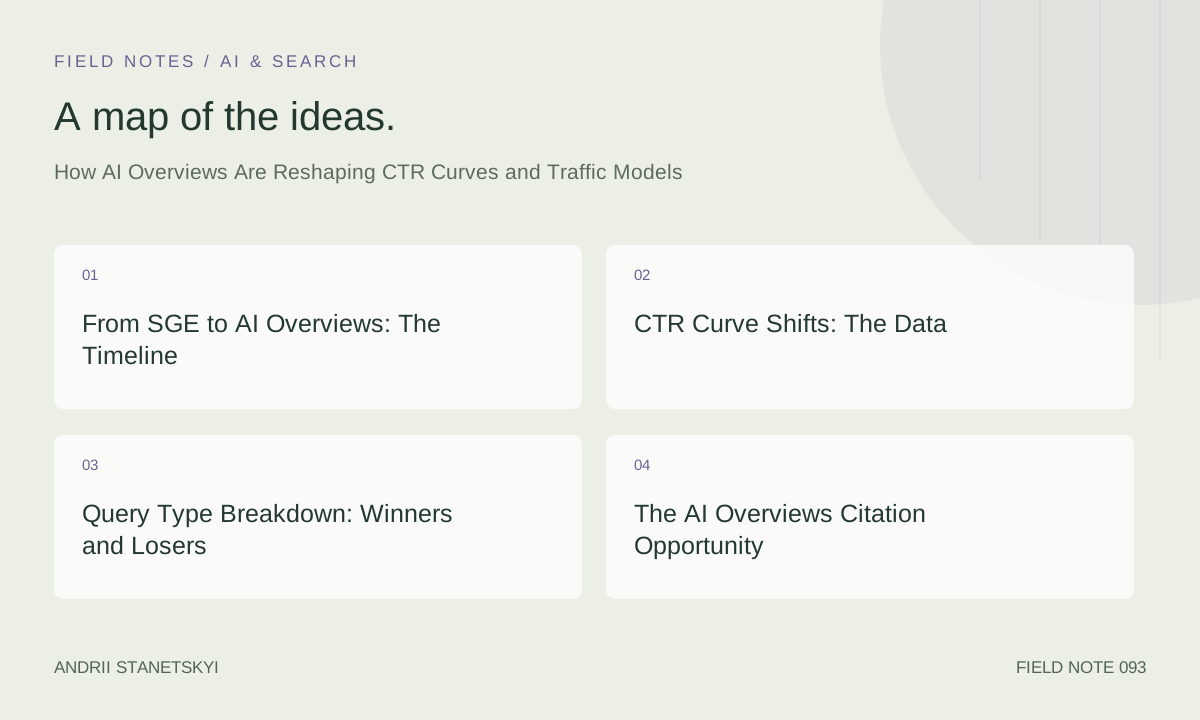
From SGE to AI Overviews: The Timeline
Understanding where AI Overviews came from helps calibrate how mature they are and what changes remain ahead. The timeline:
| Date | Event | Scope |
|---|---|---|
| May 2023 | SGE (Search Generative Experience) launched in Google Search Labs | Opt-in, US English only |
| Aug 2023 | SGE expanded to India and Japan (English, Hindi, Japanese) | Opt-in, limited markets |
| Nov 2023 | SGE integrated shopping features and follow-up questions | Opt-in, US |
| Mar 2024 | SGE renamed to "AI Overviews" in internal testing | Internal |
| May 2024 | AI Overviews launched to all US users at Google I/O | Default-on, US |
| Jun 2024 | AI Overviews accuracy controversies; Google reduces trigger frequency | US |
| Aug 2024 | AI Overviews expanded to 6 additional countries (UK, India, Australia, etc.) | Default-on, 7 markets |
| Oct 2024 | Google Search Console adds AI Overviews filter | All GSC users |
| Jan 2025 | AI Overviews triggering on ~15–20% of US queries (BrightEdge est.) | US, growing internationally |
| Q1 2026 | AI Overviews expanded to most major markets with multilingual support | Global rollout ongoing |
The accuracy controversy of June 2024 is an important inflection point. Google reduced AI Overview trigger frequency sharply after viral screenshots of inaccurate answers. This produced a brief traffic recovery for publishers. By Q4 2024, however, AI Overviews trigger rates had rebounded as Google improved the underlying model quality.
CTR Curve Shifts: The Data
Pre-AI Overviews, the organic CTR curve for a standard informational query in a competitive space looked roughly like: position 1 at 28–32%, position 2 at 15–18%, position 3 at 10–12%, declining sharply through positions 4–10. This is the CTR model most SEO forecasts have been built on for the last decade, based on Sistrix, AWR, and Advanced Web Ranking data.
Post-AI Overviews, the published research (Semrush, March 2025; BrightEdge, Q4 2024; Authoritas, early 2025) shows the following pattern for queries where AI Overviews appear:
| Position | CTR Without AI Overview | CTR With AI Overview | Relative Change |
|---|---|---|---|
| 1 | 31.7% | 19.2% | -39% |
| 2 | 17.2% | 10.8% | -37% |
| 3 | 11.4% | 7.2% | -37% |
| 4 | 7.8% | 5.3% | -32% |
| 5 | 5.3% | 3.9% | -26% |
| 6–10 | 2.9% avg | 2.1% avg | -28% |
| AI Overview Citation | N/A | ~1.5–3.0% | New traffic source |
Two points demand attention here. First, the CTR reduction is not limited to position one—it affects the entire first page. This means forecasts that assumed position 3 was "safe" from AI Overview cannibalization were wrong. Second, AI Overview citations generate a new, small but real traffic stream. A citation in an AI Overview for a high-volume query can produce comparable traffic to position 5–7 in the traditional results—at much lower marginal cost if you were already ranking on page one.
Query Type Breakdown: Winners and Losers
AI Overviews do not trigger uniformly across query types. The traffic impact varies significantly by intent classification:
High AI Overview Trigger Rate (Significant CTR Impact)
- Informational queries: "how does X work," "what is X," "why does X happen"
- Comparison queries: "X vs. Y," "best X for Y use case"
- Definition queries: medical terms, legal concepts, technical terminology
- Recipe and how-to: step-by-step processes
Low AI Overview Trigger Rate (Relatively Safe)
- Transactional queries with strong commercial intent: "buy X," "X price," "X near me"
- Navigational queries: brand names, specific URLs
- News and time-sensitive queries (Google defaults to freshness-ranked results)
- Local queries: "plumber in [city]," "restaurants near [location]"
- YMYL (Your Money Your Life) high-stakes queries where accuracy risks are highest
The practical implication: if your traffic depends heavily on informational content driving commercial awareness (the classic content marketing flywheel), you are in the high-impact zone. If your traffic is primarily transactional, you are relatively protected—for now.
The AI Overviews Citation Opportunity
The narrative that AI Overviews are purely destructive to organic traffic is incomplete. For publishers whose content is cited in AI Overviews, there is a meaningful traffic gain. The BrightEdge 2024 study found that pages cited in AI Overviews for queries where they ranked position 4–10 organically received traffic increases of 12–28% compared to their pre-AI Overviews baseline.
This is the key strategic insight: if you were already ranking on page one but outside positions 1–3, AI Overviews may be net positive for your traffic if you can earn a citation. The citation redistributes some of the total-page CTR reduction from positions 1–3 toward the cited source, wherever it ranks organically.
How to earn an AI Overview citation:
- FAQPage schema: The strongest individual technical signal correlated with AI Overview citation in independent analysis. Every major informational page should have FAQPage markup with 3–5 relevant Q&A pairs.
- Direct answer in the opening paragraph: AI Overviews preference-cite content where the first 100–150 words directly address the query. Bury your answer in paragraph three and you are less likely to be cited.
- Ranking on page one for the query: AI Overviews almost exclusively cite from pages already indexed in positions 1–10. If you are not on page one, you cannot be cited. Traditional ranking work remains the prerequisite.
- Authoritative link profile to the cited page: Internal correlation studies show cited pages have above-average referring domain counts for their keyword difficulty range.
Rebuilding Your Traffic Model for AI Overviews
Every traffic forecast built on pre-2024 CTR curves needs to be recalibrated. The approach I use with enterprise clients:
Step 1: Segment Your Keyword Set by AI Overview Trigger Rate
Use the AI Overviews filter in GSC to identify which of your ranking queries are currently triggering AI Overviews. This is your high-impact segment. For forecasting, apply the depressed CTR curves from the table above to these queries. For non-AI Overview queries, use your historical CTR data.
Step 2: Add a Citation Traffic Model
For queries where you are on page one and have a realistic path to AI Overview citation, add a citation traffic estimate. Use 1.5–2% CTR as a baseline for AI Overview citation clicks, scaled by query volume. This is a new traffic category that did not exist in your model before.
Step 3: Adjust Forecasting Assumptions for Query Intent Mix
If your content is primarily informational, apply a 30–40% haircut to your historical CTR assumptions for those keywords. If primarily transactional, apply a 5–10% haircut. This is a blunt instrument—refine with your actual GSC data as it accumulates.
Step 4: Separate "Organic Traditional" from "Organic Generative" in Reporting
In GA4, segment your organic traffic into traditional (users who clicked a ranked result) and generative (users from Perplexity referrals, AI Overview citations visible in GSC). Track them separately. Blended organic metrics will mask the structural shift that is happening in your traffic mix.
For a complete forecasting methodology, see our SEO traffic forecasting framework.
Publisher Responses: What Is Actually Working
Different publisher types have responded to AI Overviews traffic loss with different strategies. Here is an honest assessment of what the evidence shows:
What Is Working
- Doubling down on transactional content: Publishers who shifted content investment from informational to transactional and commercial content have maintained or grown organic traffic. The AI Overview trigger rate for commercial queries remains low.
- Earning AI Overview citations: Publishers who added FAQPage schema and restructured content for direct-answer opening paragraphs have seen citation rates improve and in some cases traffic recover to above pre-AI Overviews levels for specific pages.
- Building direct-traffic channels: Email newsletters, podcast audiences, and direct URL navigation are outside AI Overview influence. Publishers who treated AI Overviews as a catalyst to diversify away from search dependency have fared best.
- Long-tail specificity: AI Overviews trigger less frequently on highly specific, niche queries. Publishers who moved up the specificity curve—targeting queries like "how to configure X for Y in a Z environment" instead of "how to configure X"—have seen lower AI Overview interference.
What Is Not Working
- Blocking Googlebot in protest: This eliminates both traditional rankings and AI Overview citation eligibility. It is self-defeating.
- Expecting recovery without change: Publishers who have waited for Google to reduce AI Overview trigger rates have seen partial recovery at times (as in June 2024) but not a sustained reversal.
- Over-optimizing for AI Overview citation at the expense of user experience: Stuffing FAQPage schema with low-quality Q&A to maximize citation attempts has not produced sustained citation rates and has in some cases triggered quality penalties.
The Measurement Stack for AI Overview Tracking
You cannot manage what you cannot measure. The minimum measurement stack for AI Overview tracking in 2026:
- Google Search Console — AI Overviews filter: Filter impressions and clicks by AI Overview appearance. Track which queries and pages are appearing in and being clicked from AI Overviews. This is your ground truth for Google.
- GA4 — Channel segmentation: Create a custom channel for AI Overview referral traffic. GSC data will show the click in organic, but GA4 can sometimes distinguish the source with UTM parameters if you control the citation page.
- Rank tracker with SERP feature tracking: Tools like STAT, Semrush, or Ahrefs track which of your target queries have AI Overview SERP features. Monitor this monthly—AI Overview trigger rates fluctuate as Google adjusts the system.
- Pre/post analysis in GSC: Use the date comparison feature to measure CTR and click changes before and after AI Overviews began appearing for specific queries. This is how you quantify the impact, not estimates.
For connecting this measurement to forecasting and executive reporting, see our enterprise site audit framework, which includes a section on AI Overview impact assessment.
FAQ
How much traffic have publishers actually lost to AI Overviews?
Published studies range from 15% to 64% traffic decline for informational content depending on niche and query mix. The most credible data (Semrush, BrightEdge, Authoritas, 2024–2025) clusters around 20–35% for publishers heavily reliant on informational queries with high AI Overview trigger rates. Transactional-focused publishers have seen 5–10% declines.
Can I opt out of AI Overviews?
You cannot opt out of AI Overviews using your content for generating answers—AI Overviews uses Googlebot data, and blocking Googlebot eliminates all your Google search presence. You can block Google-Extended, which affects Gemini training data, but this has no effect on AI Overviews. There is currently no mechanism to block AI Overview use of your content while maintaining organic rankings.
Are AI Overview citations shown in Google Search Console?
Yes, since October 2024. GSC added an "AI Overviews" filter in the Search Results report that lets you see impressions and clicks from AI Overview appearances separately from traditional organic results. This is currently the best direct measurement tool available.
Do AI Overviews appear in mobile search?
Yes. AI Overviews appear on both desktop and mobile, though trigger frequency and formatting differ. On mobile, AI Overviews occupy even more screen real estate proportionally, making the CTR impact on traditional results more severe on mobile devices.
Will AI Overviews trigger rates continue to increase?
The trend since May 2024 (with the exception of the June 2024 dip) has been toward higher trigger rates. Google has financial and strategic incentives to expand AI Overviews—they keep users in Google's ecosystem even when zero-click outcomes occur. Expect continued expansion to new query types and international markets through 2026–2027.
Does having a featured snippet protect against AI Overview cannibalization?
Partially. Pages that hold featured snippets are often cited in AI Overviews, which can offset some of the CTR loss. However, featured snippet pages still see lower traditional-result CTR when AI Overviews appear above them. The featured snippet is more valuable as a citation path to AI Overviews than as a standalone traffic driver now.
Key Takeaways
- AI Overviews reduce CTR across all page-one positions, not just position one—a ~30–39% reduction for informational queries with AI Overview appearances.
- AI Overview trigger rates vary dramatically by query type. Transactional and local queries are significantly safer than informational and comparison queries.
- AI Overview citations are a net traffic positive for pages ranking positions 4–10 that earn citations. The citation opportunity partially compensates for the CTR depression.
- Every traffic forecast built on pre-2024 CTR curves is wrong for queries with high AI Overview trigger rates. Recalibrate using GSC AI Overviews filter data.
- FAQPage schema and direct-answer opening paragraphs are the highest-leverage technical interventions for earning AI Overview citations.
- Blocking Googlebot is not a viable response to AI Overviews. Direct channel diversification (email, video, community) is the sustainable hedge.
- GSC's AI Overviews filter (added October 2024) is currently the best direct measurement tool. Use it before making any strategic decisions.
Conclusion
AI Overviews represent the most structurally significant change to Google's search result pages since the introduction of ads above organic results. The CTR curve has been permanently flattened for informational queries. The practitioners who adapt their forecasting models, invest in citation optimization, and diversify their traffic sources will navigate this well. Those who treat it as a temporary aberration will find themselves with traffic models that bear no relationship to reality.
The good news: this is a solvable problem, not an existential one. The measurement infrastructure now exists. The optimization levers (schema, content structure, direct-answer paragraphs) are understood. The question is execution speed. See our GEO guide for the full optimization framework and our traffic forecasting methodology for the modeling approach.