SEO forecasting has a credibility problem. Projections delivered to stakeholders are routinely either wildly optimistic (because they were built to justify budget) or uselessly vague (because the practitioner hedged every number into meaninglessness). Neither serves the business. Neither serves the discipline's professional standing.
Building realistic traffic projections is a methodological skill, not a guessing exercise. It requires understanding the data sources, their limitations, the compounding variables, and how to communicate uncertainty honestly without rendering the forecast useless. This article covers the mechanics of SEO forecasting from data acquisition through stakeholder presentation — including how the rise of AI search surfaces changes the assumptions every model must now incorporate.
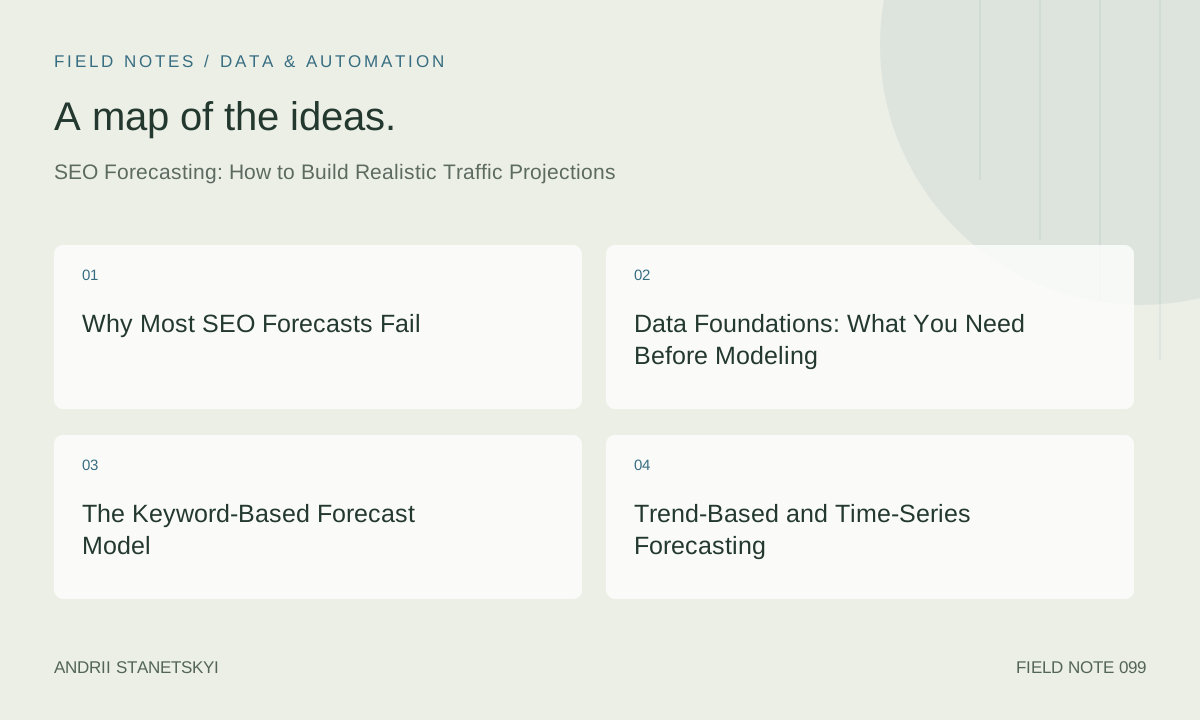
Why Most SEO Forecasts Fail
Before building a better model, understand why the standard approach breaks down:
- Search volume data is an estimate, not a measurement. Google Keyword Planner, Ahrefs, and SEMrush all model search volume; they do not report it directly from query logs. For low-volume keywords, these estimates can be off by 200–500%. For high-volume terms, they are more reliable but still approximate.
- CTR curves are ecosystem-wide averages. Published CTR curves (position 1 = 28%, position 2 = 15%, etc.) are aggregated across billions of queries and page types. A specific site, in a specific vertical, on a specific query type, may see CTR 50% above or below these averages.
- Ranking timelines are notoriously variable. A new page targeting a competitive keyword might take 3 months to rank; it might take 18. Forecasts that assume linear ranking progress within a defined timeframe consistently disappoint.
- SERP features increasingly suppress organic CTR. AI Overviews, featured snippets, People Also Ask boxes, local packs, shopping carousels — every feature that appears above organic results depresses CTR for those results. A forecast built on position-only assumptions ignores this.
- AI search is actively cannibalizing click-through. Perplexity, ChatGPT's SearchGPT, and Google's AI Overviews all answer queries without a click. This is not a minor correction factor; for informational query types, it is an existential change to expected CTR.
Data Foundations: What You Need Before Modeling
Historical Performance Data
The most reliable forecast input is historical performance on the site you are forecasting for. Export from Google Search Console:
- 16 months of search performance data by page and by query
- Filter by country and device if the site has significant cross-regional or mobile/desktop variation
- Capture both branded and non-branded query segments separately — they have very different growth characteristics
Historical data establishes your actual CTR curve for this site. If position-1 pages average 22% CTR (not the published 28%), use 22% in your model. The site-specific curve is always more accurate than published averages.
Keyword Dataset Construction
Build the keyword target set from multiple sources:
- GSC "Queries" export — keywords the site already ranks for (positions 1–50)
- Competitor gap analysis — keywords competitors rank for that your site does not (Ahrefs/SEMrush Keyword Gap tool)
- Topic cluster expansion — semantic variants identified through NLP or manual analysis of SERP features
- Internal search data — queries users type in the site's own search box (often highest-intent terms not yet in organic content)
For each keyword, record: estimated monthly search volume, current ranking position (or "not ranking"), target ranking position, SERP feature presence (AI Overview, featured snippet, local pack), and commercial intent tier.
Competitive and Market Context
A forecast built without competitive context is a forecast built in a vacuum. Document: who holds positions 1–3 for your target keywords, their domain authority relative to the forecasted site, and whether the SERP is dominated by one type of result (e.g., aggregate sites, government domains, or media brands that are essentially unbeatable). Forecasting traffic gains in SERPs you structurally cannot win is a forecast that will disappoint regardless of execution quality.
The Keyword-Based Forecast Model
The keyword-based model estimates traffic by projecting rank changes across target keywords and applying CTR estimates to the resulting positions.
Step-by-Step Build
- Define the keyword universe: All target keywords with volume estimates and current positions.
- Assign target positions: For each keyword, define a realistic target position at months 3, 6, and 12. Be conservative — most keywords take longer to move than expected. Use historical rank velocity on this site as a calibration input.
- Apply position-specific CTR: Use your site-specific CTR curve where available. If not available, use a published curve adjusted downward for AI Overview presence (typically -20% to -40% for informational queries, -5% to -15% for commercial queries).
- Apply SERP feature adjustment: For keywords where AI Overviews appear, apply an additional CTR reduction (see AI Search Adjustment section below).
- Sum projected monthly clicks: Keyword volume × estimated position CTR × SERP feature adjustment = estimated monthly clicks per keyword. Sum across all keywords for total projected traffic.
- Apply seasonality: Adjust monthly totals by historical seasonality index from GSC data or Google Trends.
Model Output Example
| Keyword | Monthly Vol. | Current Pos. | Target Pos. (M6) | Est. CTR (M6) | AI OV. Adj. | Projected Clicks (M6) |
|---|---|---|---|---|---|---|
| best project management software | 18,000 | 14 | 5 | 6.3% | -25% | 851 |
| project management tools comparison | 4,400 | 8 | 3 | 11.4% | -20% | 402 |
| agile project management software | 9,900 | 22 | 8 | 3.1% | -15% | 260 |
| how to manage remote teams | 6,600 | 35 | 12 | 1.9% | -35% | 81 |
| [Branded term] | 2,200 | 1 | 1 | 48.0% | -5% | 1,003 |
Sum the projected clicks column across all keywords in the model to produce the total monthly traffic forecast for month 6. Repeat for months 3, 9, and 12 with adjusted target positions.
Trend-Based and Time-Series Forecasting
For established sites with 12+ months of traffic history, time-series models often outperform keyword-based models because they incorporate actual site-level signals rather than estimated keyword-level inputs.
Prophet and ARIMA for SEO
Facebook's Prophet library (open source, Python) handles seasonality and trend decomposition well for monthly organic traffic data. Setup requires only a date-value time series — export from GSC or analytics. The model outputs trend, seasonality, and a confidence interval for future periods.
import pandas as pd
from prophet import Prophet

# GSC export: date, clicks
df = pd.read_csv('gsc_monthly_clicks.csv')
df.columns = ['ds', 'y']

model = Prophet(
    yearly_seasonality=True,
    weekly_seasonality=False,
    daily_seasonality=False,
    interval_width=0.80  # 80% confidence interval
)
model.fit(df)

future = model.make_future_dataframe(periods=12, freq='MS')
forecast = model.predict(future)

print(forecast[['ds', 'yhat', 'yhat_lower', 'yhat_upper']].tail(12))
The output provides a central estimate and an 80% confidence interval for each future month. Present the interval, not just the point estimate — it is more honest and forces the conversation about uncertainty.
Adjusting Time-Series Models for Known Events
Prophet and ARIMA extrapolate from historical patterns and cannot account for future planned events. Add adjustment factors for:
- Planned content initiatives (expected to increase traffic — model as a positive additive factor)
- Site migrations or major changes (model as temporary suppression, then recovery)
- Historical algorithm update impacts (if you can identify them in the time series, model as changepoints)
- AI search growth trajectory (model as a downward adjustment on the trend, not a one-time event)
Adjusting for AI Search Impact
This is the most important addition to SEO forecasting methodology in 2025–2026. AI Overviews, SearchGPT, Perplexity, and Claude all reduce organic click-through for a subset of queries. Ignoring this produces forecasts that systematically overestimate future traffic.
Quantifying the AI Search CTR Reduction
Published research and practitioner data as of Q1 2026 suggest:
- Informational queries with AI Overview present: CTR reduction of 20–45% versus baseline (no AI Overview). The range is wide; queries with definitive answers (facts, definitions) see larger reductions than queries requiring evaluation or comparison.
- Commercial investigation queries: CTR reduction of 10–20%. AI Overviews appear less frequently on commercial queries; when they do, users still often click through to compare options.
- Transactional queries: Minimal CTR impact from AI Overviews (0–10%). Purchase-intent queries typically retain organic clicks because the transaction itself happens on the destination site.
- Branded queries: Minimal impact from AI Overviews (0–5%). Users querying a brand name typically want the brand's site.
For Perplexity and SearchGPT: these are separate sessions that do not typically generate GSC impressions for non-cited pages. The impact shows up as a reduction in overall query volume in your category, not as a CTR change for ranking positions you hold. This is harder to model and requires market-level search volume trend monitoring.
AI Overview Detection by Keyword
To apply accurate AI adjustment factors, audit your target keyword list for AI Overview prevalence. Tools: SE Ranking, Semrush Position Tracking (AI Overview filter), or manual SERP sampling (10–20% of keyword set, stratified by intent tier). Classify each keyword as: AI Overview present always, sometimes, or never — then apply adjustment factors by class.
Scenario Planning and Confidence Ranges
Single-point forecasts are false precision. Present three scenarios:
- Conservative (downside): Ranking targets achieved at 50% of planned rate; AI search impact at the high end of the range; no new algorithm gains. This is the "business as usual, nothing goes as planned" scenario.
- Base case: Ranking targets achieved at the planned rate; AI search impact at the midpoint estimate; planned content and technical initiatives executed on schedule.
- Optimistic (upside): Ranking targets achieved faster than planned; algorithm tailwind; AI search impact at the low end; one or more keywords achieves featured snippet or AI Overview citation. Do not use this scenario to justify budget; use it to communicate upside potential.
Present confidence intervals, not just scenario labels. "We expect 85,000–140,000 monthly clicks by month 12, with our base case at 108,000" is honest and actionable. "We expect 108,000 monthly clicks by month 12" is a single number that will be remembered as a commitment regardless of how many caveats accompanied it.
Communicating Forecasts to Stakeholders
The technical quality of the forecast matters less than its clarity in the room. Observations from practitioner experience:
- Lead with business outcomes, not traffic metrics. "We project $420,000–$680,000 in additional organic revenue by month 12" is the metric that matters to a CMO. "We project 108,000 monthly organic clicks" is a proxy metric that requires translation.
- Show the model's inputs explicitly. "This projection assumes: 20% CTR reduction for queries with AI Overviews; ranking targets based on historical rank velocity of 3 positions/month for mid-competition keywords; and no major algorithm changes." Showing your assumptions invites scrutiny and builds credibility.
- Define what would cause the forecast to be wrong. Algorithm update, a competitor investing heavily in content, delayed technical fixes. Naming the failure modes demonstrates analytical honesty and preempts the "why didn't you predict this?" conversation.
- Establish a review cadence at the time of delivery. "We will review actual versus forecasted at months 3 and 6 and update the model based on observed performance." This reframes the forecast from a commitment to a living model.
Tracking Forecast Accuracy Over Time
Practitioners who track and publish their own forecast accuracy improve faster than those who do not. Build a simple accuracy dashboard:
- Forecasted monthly traffic vs. actual monthly traffic (absolute and % variance)
- Variance attribution: algorithm changes, ranking target miss/beat, AI search impact vs. modeled, seasonality error
- Running mean absolute percentage error (MAPE) across all forecasts delivered
A practitioner with a documented 15% MAPE across 12 forecasts is significantly more credible than one who has never tracked their accuracy. This is also the data that improves future models — variance attribution tells you which assumptions to calibrate.
Related resources: keyword research methodology, AI Overviews and CTR impact analysis, and Google's Search Console performance data documentation.
FAQ
How far out should an SEO forecast extend?
Twelve months is the practical maximum for keyword-based models in a volatile AI search environment. Beyond 12 months, uncertainty compounds to the point where the confidence interval spans 3–5× the point estimate — not meaningfully informative. For budget planning purposes, build a 12-month model, acknowledge it as directional beyond month 6, and commit to updating it quarterly with actual performance data.
Can I forecast SEO traffic for a brand-new site with no history?
Yes, but you must rely entirely on external benchmarks rather than site-specific data. Use: (a) industry CTR benchmarks by position and query type, (b) rank velocity data from comparable sites in the same vertical at comparable domain authority levels, (c) competitive analysis of what is already ranking and at what domain metrics. Widen your confidence intervals significantly — new sites have no calibration data and early performance is highly unpredictable.
How do I account for Google algorithm updates in a forecast?
You cannot predict specific updates, but you can model their historical impact on the site. Analyze the site's GSC performance around the last 3–5 confirmed Google algorithm updates (use Google's confirmed update timeline). If the site consistently loses 10–15% traffic in core updates, include a downside scenario that models an update impact in the forecast period. This is risk management, not prediction.
Should I include branded traffic in SEO forecasts?
Separately, always. Branded and non-branded traffic have fundamentally different drivers, different CTR curves, and different optimization levers. A site that doubles its branded search volume due to a PR campaign will show traffic "growth" that has nothing to do with SEO activity. Reporting them combined obscures both the credit and the diagnostics. Present both, clearly labeled.
How do I forecast the impact of AI Overview cannibalization going forward?
Model it as a trend, not a step change. AI Overview coverage is expanding to more query types at approximately 3–5% of query categories per quarter (based on practitioner SERP monitoring data through Q1 2026). Apply a trajectory model: current AI Overview coverage in your keyword set × expansion rate × CTR reduction factor = incremental quarterly traffic erosion from AI effects. Revise quarterly based on observed SERP changes.
What is a realistic rank velocity assumption for forecasting?
For pages targeting mid-competition keywords (KD 30–60) with adequate domain authority: 2–5 positions per month is the median range once ranking begins moving. Pages outside the top 50 often stay outside the top 50 for extended periods before breaking through — model them conservatively, or exclude them from near-term forecasts and include them only in 12-month upside scenarios. High-competition keywords (KD 70+) should be modeled with 6–18 month timelines to reach page 1, not 3 months.
How do I handle seasonality in a new-to-me client's forecast?
Use two sources: the client's historical GSC data (if available for 24+ months — 12 months captures one seasonal cycle but not year-over-year variation) and Google Trends for the primary keyword category. Overlay both to identify seasonal patterns. For new sites without GSC history, rely entirely on Google Trends and industry benchmarks. Always show the seasonality assumption in your model documentation.
Key Takeaways
- SEO forecasting is a methodological discipline, not an estimation exercise. Defined inputs, explicit assumptions, and calibrated uncertainty produce credible forecasts; guesses do not.
- Site-specific CTR curves always outperform published average curves. Build your own from GSC data before using industry benchmarks.
- AI search impact is a structural reduction in organic CTR for informational queries — model it explicitly, not as a footnote. Apply 20–45% reductions for queries with AI Overview presence.
- Present three scenarios (conservative, base, optimistic) with confidence intervals, not single-point estimates. Single numbers become commitments regardless of caveats.
- Branded and non-branded traffic must be forecasted and reported separately — they have different drivers and different implications for SEO credit.
- Track forecast accuracy and publish your MAPE. It builds credibility and improves future models through variance attribution.
- The 12-month horizon is the practical limit for actionable SEO forecasting in the current AI search environment. Beyond that, present directional ranges only.
An SEO forecast that earns stakeholder trust is not the most optimistic forecast or the most hedged one. It is the forecast that shows its work, acknowledges its limitations, and is updated regularly with actual data. Build that habit and the credibility problem corrects itself over time.