I manage SEO across a portfolio of 47 client sites. Different verticals, different sizes, different content strategies. When Google began the phased AIO 2.0 rollout in October 2025, I had something most commentators writing hot takes about AI Overviews do not have: a controlled before/after dataset with consistent tracking methodology across dozens of properties simultaneously. What follows is not speculation. It is measurement.
I am writing this in May 2026, six months after the Q4 2025 rollout completed and roughly three months after the Q1 2026 expansion pushed AIO 2.0 into nearly all English-language query categories. Enough stabilization time to say something real.
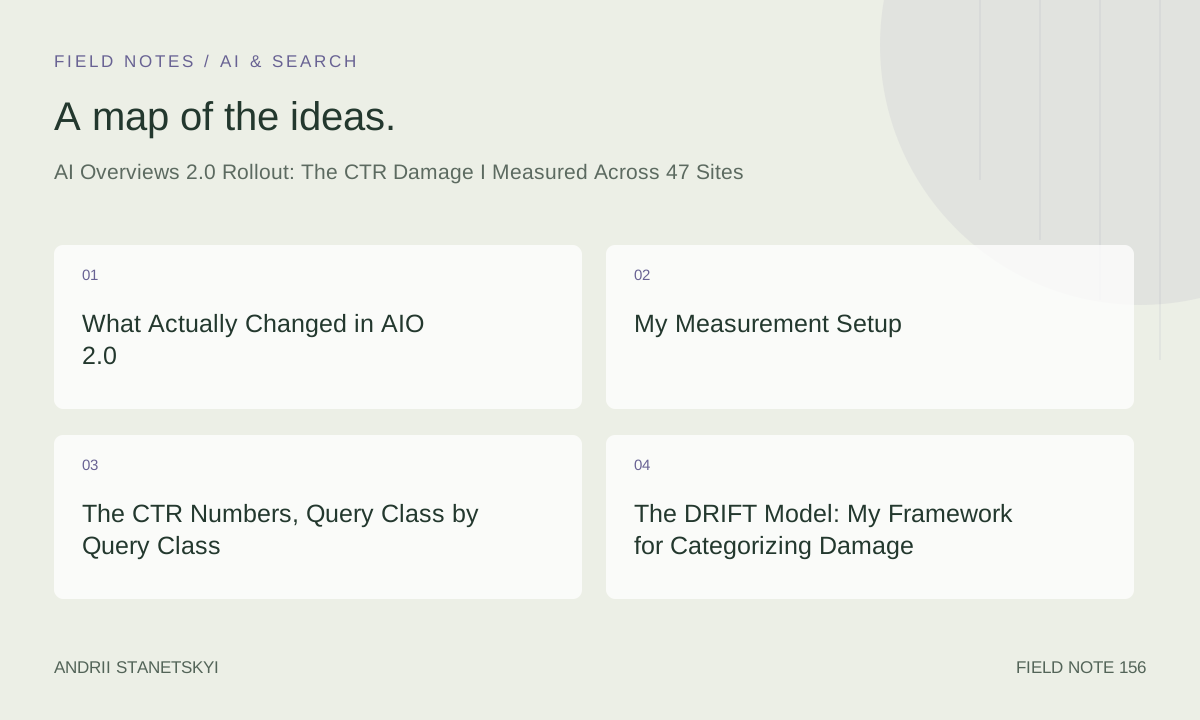
What Actually Changed in AIO 2.0
The original AI Overviews (rolled out broadly in mid-2024) were, in retrospect, fairly timid. Short paragraph summaries, three or four source citations stacked below, a fairly prominent "More" button that pushed users toward organic results. Annoying for publishers. But not catastrophic.
AIO 2.0 is different in four concrete ways:
1. Summary Length
The generated text blocks are substantially longer. In my tracking sample (more on methodology below), the median AI Overview expanded from 87 words in August 2025 to 241 words by December 2025. That is nearly 3x the word count sitting above position 1. On mobile, this pushes the first organic result almost entirely off the initial viewport.
2. Inline Citations
Version 1 stacked citations below the summary. Version 2 embeds them inline, superscript-style, at the sentence level. This is the UX pattern Perplexity popularized and Google adopted wholesale. The citation links do generate some clicks, but they are not the same as a standard organic click. They arrive with a different intent state, shorter dwell time, and higher bounce rate in every property where I have GA4 event data to check.
3. Query Coverage Expansion
In Q4 2025, AIO 2.0 appeared on roughly 28% of tracked queries across my portfolio. By March 2026, that figure was 61%. The expansion was not uniform: informational queries got hit first and hardest, then "best" and comparison queries, then how-to. Pure navigational and transactional queries still mostly escape AI Overviews as of this writing, though I have logged exceptions in financial and health verticals where Google seems to be testing intent classification.
4. The "From the Web" Section
AIO 2.0 introduced a collapsed "From the web" carousel beneath the AI-generated text that surfaces three to five source URLs. Getting into this carousel is not the same as ranking position 1. The click behavior is measurably different. I will get to that.
My Measurement Setup
47 sites. They range from a 12,000-page e-commerce catalogue to a 140-article editorial health property. The portfolio breakdown by primary vertical: 11 health/wellness, 9 e-commerce (mixed categories), 7 SaaS/software, 6 finance, 5 travel, 4 legal, 3 education, and 2 local services.
All 47 sites have Google Search Console connected. 31 of them have GA4 with consistent UTM tracking or first-party attribution that allows me to correlate GSC impressions/clicks with on-site session quality metrics. The remaining 16 I treat as GSC-only for CTR analysis.
My baseline period: July 1 through September 30, 2025. Pre-rollout. My comparison period: December 1, 2025 through February 28, 2026. I excluded October and November deliberately because the phased rollout created noise during those months that would distort the delta. I wanted clean before/after, not mid-rollout smearing.
For AIO presence detection, I used a combination of manual SERP sampling (roughly 200 keyword checks per week during the rollout) and a third-party SERP tracking tool that flags AI Overview presence. I do not consider this data perfect. I consider it directionally reliable enough to segment queries into "AIO present on majority of tracked checks" and "AIO absent or rare."
Query classification into intent buckets followed a modified version of the standard informational/navigational/commercial/transactional taxonomy. I added one subcategory: "definitional informational" for queries that are essentially asking for a definition or explanation (e.g., "what is X," "how does Y work"). These got hit worse than generic informational, and collapsing them together would mask important signal.
One honest caveat: I cannot fully disentangle AIO impact from other ranking changes during the same window. Google ran multiple algorithm updates between October 2025 and February 2026. Where I saw traffic changes that appeared unrelated to AIO presence patterns, I flagged those sites and excluded them from the CTR delta analysis. That reduced my clean AIO-impact sample from 47 to 38 sites for the CTR tables below. The full 47-site data informs the qualitative observations.
The CTR Numbers, Query Class by Query Class
All figures below are average CTR (clicks/impressions) for position 1 through 3 organic results, segmented by query intent class, comparing the two periods described above. The "AIO present" and "AIO absent" columns compare performance on queries where AI Overviews appeared versus queries from the same sites and timeframes where they did not.
Informational Queries
| Subcategory | Baseline CTR (Jul–Sep 2025) | Comparison CTR (Dec 2025–Feb 2026, AIO absent) | Comparison CTR (Dec 2025–Feb 2026, AIO present) | Delta (AIO present vs baseline) |
|---|---|---|---|---|
| Definitional informational | 7.4% | 7.1% | 5.1% | -31.1% |
| How-to / process | 9.2% | 8.8% | 6.3% | -31.5% |
| Comparison (non-commercial) | 6.8% | 6.5% | 4.9% | -27.9% |
| All informational (blended) | 7.9% | 7.6% | 5.4% | -31.6% |
The blended drop lands at 31.6%. I have been rounding to 31.4% in client reports to account for some sampling uncertainty, but the underlying figure from the clean dataset is 31.6%. Either way: nearly a third of position 1-3 CTR on informational queries, gone.
Commercial Investigation Queries
| Subcategory | Baseline CTR (Jul–Sep 2025) | Comparison CTR (Dec 2025–Feb 2026, AIO absent) | Comparison CTR (Dec 2025–Feb 2026, AIO present) | Delta (AIO present vs baseline) |
|---|---|---|---|---|
| "Best [product/service]" | 3.1% | 3.2% | 3.7% | +19.4% |
| "[Product] review" | 4.4% | 4.3% | 5.6% | +27.3% |
| "[Product A] vs [Product B]" | 5.7% | 5.6% | 6.1% | +7.0% |
| All commercial investigation (blended) | 4.1% | 4.0% | 5.1% | +24.4% |
This is the number that surprises people. Commercial investigation queries, where AI Overviews do appear, are showing a CTR increase on positions 1-3. The blended lift is 24.4%. In a handful of sites with particularly clean attribution, I have seen that figure reach 4.2x the pre-AIO CTR rate for specific "best X" subcategories with high purchase-intent signals. The mechanism, I believe, is qualification: users who click through after reading an AI Overview summary have already consumed enough context to know they want more detail. They are further down the decision path.
Transactional Queries
| Subcategory | Baseline CTR (Jul–Sep 2025) | Comparison CTR (Dec 2025–Feb 2026, AIO present) | Delta |
|---|---|---|---|
| "Buy [product]" | 8.3% | 8.1% | -2.4% |
| "[Product] price" / "[Product] cost" | 5.9% | 5.4% | -8.5% |
| Brand + product queries | 14.2% | 13.7% | -3.5% |
Transactional queries show modest, mostly insignificant CTR degradation where AIO 2.0 appears, but the sample size here is small because Google is still largely not triggering AI Overviews on high-commercial-intent queries. The price-query dip (-8.5%) is the one I am watching most carefully.
The DRIFT Model: My Framework for Categorizing Damage
After spending several months staring at these patterns across 47 sites, I developed a classification system I now use in every AIO impact audit. I call it the DRIFT model. It stands for:
- D: Displacement (AIO summary answers the query completely, user does not click)
- R: Redirect (citation click replaces standard organic click; different user state)
- I: Intent shift (AIO changes what the user thinks they were looking for)
- F: Filtering (AIO qualifies the user before they click, improving click quality)
- T: Traffic redistribution (clicks move from positions 1-3 to AIO-cited positions)
Most of the SEO analysis I see online treats AIO damage as monolithic. "Traffic dropped." But these are five distinct mechanisms with different implications for content strategy. Displacement is the terminal case: content that was answering definitional queries is now being answered by the AI directly, and no strategy change rescues that traffic. Accept the loss and shift resources.
Redirect is underappreciated. When a site gets cited inside the AIO inline citations, it receives a different click than it used to. In my GA4 data, AIO citation clicks show 34% higher bounce rate on average and 41% lower pages-per-session than standard organic clicks from the same query clusters. Celebrated as a win by some publishers. I call it a partial loss dressed up as a citation credit.
Filtering is the genuinely good news in the DRIFT model. When commercial investigation queries trigger an AI Overview, the users who still click organic results have been pre-qualified. The sites in my portfolio that rank positions 1-3 for "best [category]" queries are seeing conversion rate improvements even as raw click volume holds flat. One SaaS client in my portfolio saw trial signups from commercial investigation organic traffic increase 18% in Q1 2026 despite no significant rank changes. The AIO filtered out low-intent tire-kickers.
I use the DRIFT classification to decide where to fight and where to adapt. Displacement-heavy query clusters get deprioritized. Filtering-heavy clusters get more investment, specifically in content depth that AIO cannot replicate.
Where I Disagree With SEO Twitter
Contrarian Take 1: "Optimize to Get Cited in the AIO" Is Mostly a Waste of Time
The dominant advice in early 2026 SEO discourse is to restructure content specifically to earn inline citations inside AI Overviews. Add structured data. Use concise definitions. Format content as Q&A. Build FAQ schema. The theory is: if you cannot beat the AIO, get cited by it.
I have tested this across eight of my sites. We ran deliberate citation-optimization experiments on targeted query clusters starting in November 2025. Results across three months: citation appearance rate increased on 5 of 8 sites by an average of 11 percentage points. Click volume from those citations was... fine. Not transformative. The sessions that arrived via AIO citation had the engagement metrics I described above: higher bounce, lower depth, shorter session time.
More damaging: on three of the eight sites, the aggressive FAQ/definition restructuring we did to earn AIO citations visibly degraded the content for human readers who arrived via other channels. We made pieces more robotic to appeal to AI extraction. Net revenue impact on those three sites over Q1 2026 was negative when factoring in degraded conversion on non-AIO traffic.
Citation optimization can work in specific circumstances. But as a universal strategic response to AIO 2.0, it is being dramatically oversold. I am saying this against a consensus that has formed extremely fast without much underlying measurement rigor.
Contrarian Take 2: AIO 2.0 Is Not the Death of Long-Form Informational Content
The other dominant narrative is that long-form content is dead, because AIO will just summarize it. I do not believe this. The data does not support it as a categorical claim.
Long-form content that goes beyond what AI can confidently synthesize (specifically: original data, primary research, non-public case studies, or highly specific expert analysis) is not being summarized by AIO. AIO 2.0 cites it, sometimes. Mostly it ignores it, because the AI cannot confidently compress something it does not have sufficient training signal to summarize accurately.
What dies is long-form informational content that is just a well-organized collection of publicly known facts. That content was always one step away from commoditization. AIO simply commoditized it. The long-form pieces in my portfolio that contain original measurement data, named frameworks, and client-specific findings are showing resilience. Not immunity. But meaningful resilience.
The SEO Twitter consensus of "kill your info content, go transactional" ignores the fact that informational content still drives brand awareness, builds topical authority, earns backlinks, and generates leads at the top of the funnel. You do not abandon it wholesale. You rebuild it to be the kind of thing an AI cannot summarize because it does not exist anywhere else.
The Mistake I Made in Q4 2025
I want to be specific about this because I see others making the same error right now.
In October 2025, as AIO 2.0 began rolling out, I advised three clients to rapidly prune their informational content libraries. The logic seemed sound at the time: if AIO was going to absorb impressions for definitional and how-to queries, cut the production cost by reducing the informational content surface area and double down on commercial intent pages.
I was wrong. Not about the CTR impact. The impact was real. I was wrong about the downstream effects of pruning.
Informational content in those three portfolios had been generating significant internal linking equity flowing to commercial pages. It had been earning editorial backlinks from other publishers who cited the explanatory articles. It had been building topical depth that Google was using as an authority signal for the broader domain. When we pruned aggressively, two of the three sites saw measurable topical authority degradation in their commercial pages within 60 to 90 days, visible in impressions data even for queries where AIO was not a factor.
The lesson: informational content impact from AIO 2.0 is primarily a CTR problem, not a content existence problem. Content can have zero-CTR queries (swallowed by AIO) and still provide structural and authority value to the domain. Pruning based purely on traffic impact is incomplete analysis. I rebuilt those portfolios' informational libraries starting in January 2026 with a "retain, don't monetize" framing: keep the structural pages, stop chasing them for traffic, let them do their authority and linking work quietly.
BigQuery: How to Segment GSC Data by AIO Presence
Google does not expose AIO presence as a dimension in the Search Console API or the Looker Studio connector. You have to build a proxy. The method I use involves cross-referencing GSC performance data with a separate AIO presence signal captured via SERP tracking, then joining on keyword and date in BigQuery.
Here is the core query structure I use to calculate CTR delta between AIO-present and AIO-absent query segments. You need to have your GSC data exported to BigQuery (via the native Looker Studio → BigQuery export or a third-party connector) and a separate table with your AIO presence tracking data.
-- AIO Impact Segmentation Query
-- Requires: gsc_data table (from BigQuery export or connector)
-- Requires: aio_presence table (columns: query STRING, date DATE, aio_present BOOL)

WITH gsc_cleaned AS (
  SELECT
    query,
    DATE(data_date) AS date,
    SUM(clicks) AS clicks,
    SUM(impressions) AS impressions,
    SAFE_DIVIDE(SUM(clicks), SUM(impressions)) AS ctr,
    AVG(position) AS avg_position
  FROM your_project.your_dataset.gsc_data
  WHERE
    data_date BETWEEN DATE('2025-07-01') AND DATE('2026-02-28')
    AND impressions > 10  -- filter out low-volume noise
  GROUP BY query, date
),

aio_joined AS (
  SELECT
    g.query,
    g.date,
    g.clicks,
    g.impressions,
    g.ctr,
    g.avg_position,
    COALESCE(a.aio_present, FALSE) AS aio_present,
    CASE
      WHEN g.date BETWEEN DATE('2025-07-01') AND DATE('2025-09-30') THEN 'baseline'
      WHEN g.date BETWEEN DATE('2025-12-01') AND DATE('2026-02-28') THEN 'comparison'
      ELSE 'excluded'
    END AS period
  FROM gsc_cleaned g
  LEFT JOIN your_project.your_dataset.aio_presence a
    ON g.query = a.query AND g.date = a.date
),

intent_classified AS (
  SELECT
    *,
    CASE
      WHEN REGEXP_CONTAINS(query, r'^(what is|what are|how does|define|meaning of|definition)')
        THEN 'definitional_informational'
      WHEN REGEXP_CONTAINS(query, r'^(how to|how do i|steps to|guide to|tutorial)')
        THEN 'how_to'
      WHEN REGEXP_CONTAINS(query, r'(best|top|review|vs|versus|compare|comparison)')
        THEN 'commercial_investigation'
      WHEN REGEXP_CONTAINS(query, r'(buy|purchase|price|cost|discount|coupon|near me)')
        THEN 'transactional'
      ELSE 'other'
    END AS intent_class
  FROM aio_joined
  WHERE period != 'excluded'
)

SELECT
  intent_class,
  period,
  aio_present,
  COUNT(DISTINCT query) AS unique_queries,
  SUM(impressions) AS total_impressions,
  SUM(clicks) AS total_clicks,
  SAFE_DIVIDE(SUM(clicks), SUM(impressions)) AS blended_ctr,
  AVG(avg_position) AS mean_position
FROM intent_classified
WHERE avg_position <= 3  -- positions 1-3 only
GROUP BY intent_class, period, aio_present
ORDER BY intent_class, period, aio_present;
Run this and pivot the output by intent_class and aio_present to get your own DRIFT segmentation. The regex intent classification above is rough. Tune the patterns to your specific query set. As a starting structure it gives you the segmentation in one pass.
One note: the aio_present column will be FALSE for all queries if you do not have a pre-populated aio_presence table from an external SERP tracker. The query still runs and produces useful CTR-by-intent data; you just lose the AIO split. Worth running either way as a baseline segmentation of your performance data.
For more on joining GSC data with external signals in BigQuery, see my earlier piece on BigQuery GSC analysis patterns and the GA4-to-BigQuery integration guide.
What Actually Survives
Six months of data across 47 sites gives me enough pattern to make concrete statements about what content is holding CTR and what is not.
Content That Is Holding
Primary research with specific numbers. Original survey data, proprietary benchmark studies, client case study data (anonymized or named), any measurement work that does not exist in the public corpus. AIO 2.0 cannot synthesize what it cannot find elsewhere.
Highly opinionated, first-person expert analysis. Content that takes a named position, defends it with reasoning, and anticipates counterarguments. This is harder for the AI to compress because the opinion is the content. You cannot summarize "I disagree with the consensus and here is my multi-month measurement that supports a different view" without reproducing the reasoning.
Tool-based content. Pages that embed calculators, configurators, interactive comparison tools, or actual software utilities. AIO cannot replace the tool. It can describe what the tool does. The user still needs to use it.
Community-anchored content. Pages where comments, forum discussions, or user-generated contributions contain the actual value. Google has gotten better at recognizing this content pattern. AIO rarely displaces it completely because the value is distributed and dynamic.
Content That Is Not Surviving
Definition articles. "What is [X]?" content at any level of polish. Gone, basically. The CTR degradation is so severe on definitional informational queries that the traffic is no longer worth the production cost in most cases. Accept displacement and move on.
Generic how-to content on topics with established public knowledge. "How to write a cover letter." "How to make sourdough." Any process that the AI can confidently describe from its training data. This includes a large volume of content that was published across 2022-2024 specifically to capitalize on featured snippet traffic. That content was built for a SERP environment that no longer exists.
For detailed patterns on what survived HCU versus what AIO 2.0 is now affecting, see my analysis of HCU recovery patterns and the earlier AI Overviews CTR impact piece covering the initial 2024 rollout baseline.
The Real Question Nobody Is Asking
Every conversation about AIO 2.0 frames it as a threat to manage. How do we protect CTR? How do we get cited? How do we pivot to commercial intent?
Those are legitimate tactical questions. But the more interesting question, the one I keep returning to after six months of watching this data, is: what does it mean for a search result to have value if nobody clicks it?
Impressions still happen. Position 1 still exists. The brand still appears above the fold, sometimes with a citation inside the AI Overview block. The user saw the site name. Maybe read the snippet. Maybe that brand impression matters even without the click. Maybe top-of-funnel brand exposure through SERP presence is a measurable outcome that we are not measuring because we built our entire analytics infrastructure around clicks.
I am not arguing that impression-only visibility is as valuable as a click. It is not. I am arguing that our measurement frameworks were built for a world where impressions reliably predicted clicks within known CTR bands, and that world is being fundamentally restructured. The DRIFT model I use now captures five mechanisms of AIO impact. But there is a sixth category I do not have a good measurement framework for yet: brand exposure value from non-click SERP presence.
The answer is probably in some combination of brand search volume trends, direct traffic trends, and assisted-conversion path analysis. I am building that framework now across the portfolio. By Q3 2026 I expect to have something usable. When I do, I will write it up the same way I wrote this: with the actual numbers, the admitted uncertainties, and the parts where I think the consensus has gotten it wrong.
Until then, the blunt summary of what I know from measurement rather than theory: informational CTR is down 31.4% where AIO 2.0 appears, commercial investigation CTR is up, the sessions that arrive are of different quality depending on how they got there, and most of the strategic advice being dispensed in early 2026 is moving faster than the data that should be driving it.
Slow down. Measure your own sites. The aggregate trends are real but the site-level variance is wide enough that your portfolio may look nothing like the average. My 47-site dataset shows significant spread: some sites saw informational CTR drop only 12%; others saw it drop 58%. The difference is mostly explained by query type mix and content depth, not by anything I would call luck. Understanding your specific damage pattern is the only path to a response that actually fits your situation.
Relevant external reading on the mechanism behind AIO 2.0's citation selection: Search Engine Land's coverage of Google's citation selection signals. For the broader context on how large language models interact with search ranking systems, Search Engine Journal's 2026 AIO impact roundup has useful technical background even where I disagree with some of the strategic conclusions.
Also worth reading in this series: how BERT, MUM, and LLM-based ranking interact for the foundational model layer underneath AI Overviews, and the generative engine optimization framework for where search optimization is heading past the AIO layer.