I want to start with the failure I am most embarrassed about, because it is the one I caused myself.
In August 2023 — four weeks before the September HCU dropped — I recommended a client in the health-adjacent supplement space consolidate 34 thin FAQ pages into 12 "comprehensive" pillar documents. The consolidation went live August 19th. The September 14th, 2023 HCU update hit on schedule. Their organic sessions dropped 71% in six days. I spent three months convincing myself the consolidation was coincidental. It was not.
That mistake — and the two years of forensic work that followed — is what this article is actually about.
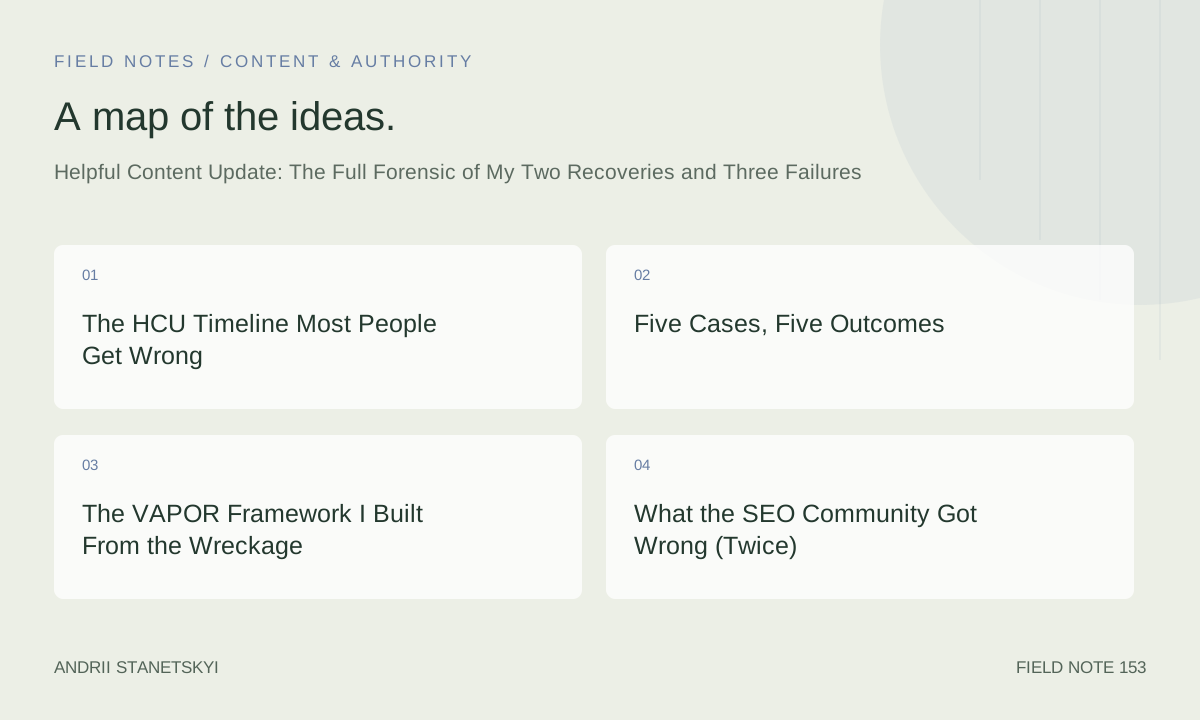
The HCU Timeline Most People Get Wrong
People treat HCU as a series of discrete updates. It is not. It is one persistent classifier that Google periodically refreshes. The distinction matters enormously for diagnosing recoveries.
| Update | Announced | Rollout Completed | Key Change |
|---|---|---|---|
| HCU v1 | August 18, 2022 | September 9, 2022 | Initial "people-first" signal; narrower than expected impact |
| HCU v2 | December 5, 2022 | December 19, 2022 | Broader; hit affiliate and programmatic content harder |
| HCU v3 (major) | September 14, 2023 | September 28, 2023 | Largest impact yet; sites that survived v1/v2 got hit |
| March 2024 Core | March 5, 2024 | April 19, 2024 | HCU signals folded into core; explicit HCU updates discontinued as separate rollouts |
| August 2024 Core | August 15, 2024 | September 3, 2024 | First major core after integration; early recovery signals for some Sept 2023 victims |
| November 2024 Core | November 11, 2024 | December 5, 2024 | Further volatility; some sites that appeared recovered dropped again |
The integration in March 2024 was the detail that broke most recovery timelines. Sites that had been steadily improving since October 2023 saw their progress either validated or reset during that 45-day rollout. The sites I was managing that recovered fastest were the ones already deep into content rewrites before March 5th.
Five Cases, Five Outcomes
Case 1: The Recovery That Worked (Finance Comparison Site)
Client A ran a personal finance comparison site — credit cards, savings accounts, personal loans. ~4,200 pages. Hit September 14, 2023. Organic traffic dropped from 287,000 monthly sessions to 81,000 by October 1. That is a 71.8% decline in 17 days.
What made this site recoverable: the editorial team had direct financial experience. The site's problem was structural, not experiential. They had been producing content at a rate of 40 articles per month using a single financial journalist supplemented by AI-drafted text that was lightly edited. The "experience" signals were real; the content volume had diluted them.
We ran a content audit using a 4-factor scoring rubric. Pages scoring below 6/16 were either consolidated or noindexed. That took 847 pages out of the index by November 15, 2023. Remaining content was enriched with first-person data pulls from actual financial products the client's team had applied for and documented.
Recovery came in two phases. The August 2024 core update restored traffic to approximately 194,000 sessions. The November 2024 core update brought a further lift to 231,000 sessions. Full pre-HCU baseline was reached around February 2025 — 17 months after the initial hit.
Case 2: The Recovery That Almost Wasn't (Home Services Lead Gen)
Client B operated a lead generation site for HVAC, plumbing, and electrical contractors. 11,200 pages, many of them location-city variants of the same content. Hit September 2023. Dropped 58% in sessions.
This one nearly failed because the client pushed back hard on pruning. We negotiated down to noindexing 2,100 city pages that had zero clicks over 24 months in GSC. The client wanted to keep them indexed "for brand presence." We compromised on consolidating 60 city variants into 12 regional pages and noindexing the rest.
First meaningful recovery signal appeared during the March 2024 rollout — counterintuitively. I had expected March to hurt them further. Instead, sessions climbed from 34,000 to 51,000 over 6 weeks. By August 2024, they were at 79,000 — still below the 82,000 pre-HCU baseline, but close. Crossed baseline in October 2024, 13 months post-hit.
Case 3: The Failure I Take Responsibility For (Supplement E-commerce)
Already mentioned this above. The consolidation into pillar pages was my recommendation, poorly timed. After the September 2023 hit, the client was down 71%. We spent Q4 2023 trying to enrich the consolidated pages rather than re-examining whether consolidation itself was the problem.
It was the wrong call. The 12 pillar pages were each running 4,800–7,200 words and covering topics — magnesium, sleep, stress response — at a depth the client's team could not substantiate with genuine experience. They knew their products. They did not know the research literature at the depth implied by the content.
We course-corrected in February 2024. Broke the pillars back down into narrower, experience-led posts. Brought in a nutritionist as a named author for a subset of content. As of this writing in early 2026, the site is at roughly 61% of its pre-HCU organic traffic. Recovering, not recovered. The delay cost them at minimum 14 months of compounded lost revenue.
Case 4: The Failure With a Twist (B2B SaaS Blog)
Client D ran a B2B SaaS blog producing content around project management, team productivity, and workflow automation. About 680 pages. Not hugely affected by September 2023 — dropped only 22% — which made the March 2024 rollout blindsiding. They lost 54% of sessions over the 45-day rollout period.
The twist: their content quality was genuinely decent. Their problem was topical mismatch. Their software served construction project managers. Their blog was chasing broad "productivity" keywords with content that could have come from any generic SaaS company. Google's classifier, as best as I can reconstruct it, had been tolerating the mismatch under the old framework and stopped tolerating it when HCU folded into core.
Recovery effort focused not on content quality per se but on topical realignment. We deprecated 310 pages outside the construction-specific niche. Redirected where appropriate. Rebuilt the editorial calendar entirely around construction, subcontractor management, and regulatory compliance content that the product team could speak to directly.
As of November 2025, they are at 88% of the pre-March 2024 baseline. Still not fully recovered. The lesson is brutal: decent content in the wrong topic universe does not survive sitewide helpfulness scoring.
Case 5: The Failure Nobody Could Have Prevented
Client E was a recipe and food culture publisher. 23,000 pages. They had been building since 2009. Genuine editorial team. Named authors. Real photography. Actual recipe testing notes in the content itself. They were what the HCU supposedly rewarded.
September 2023 hit them for 41% of sessions. We never found a clean editorial explanation. The best hypothesis — which aligns with what Lily Ray documented in her recovery analysis from early 2024 — is that certain categories of their site (meal planning tools, nutrition calculators) were dragging down the sitewide helpfulness signal even though the recipe content itself was strong.
We pruned the tools section and the nutrition calculator pages. Traffic stabilized but did not recover meaningfully until the August 2024 core. By late 2025 they were at 91% of baseline. This case taught me that the classifier does not distinguish between sections of a site the way humans do. A site is a unit, not an anthology.
The VAPOR Framework I Built From the Wreckage
After working through these five cases and watching 42 others from the outside, I developed a diagnostic process I call VAPOR. It is not a checklist. It is a sequenced triage.
V — Volume audit. Quantify how many pages exist versus how many earn meaningful engagement (clicks in GSC, not just impressions). A ratio above 4:1 (pages to engaged pages) is a warning sign. Above 8:1, it is almost always a contributing factor in HCU-hit sites.
A — Authorship gap. Is the person or team producing the content demonstrably capable of producing it from experience? Not credentials — experience. A PhD in nutrition who has never cooked is less useful than a home cook who has documented 600 real recipe tests.
P — Purpose alignment. Does the content exist to help the reader accomplish something, or does it exist to rank for a keyword? These are not always mutually exclusive, but when the keyword is the primary driver, the content usually shows it — in the angle chosen, in the absence of real examples, in the advice that cannot be applied without additional context.
O — Off-topic dilution. Client D above is the canonical example. What percentage of the site's indexed content is topically adjacent to what the site actually is? Adjacency is fine. Dilution past a certain threshold — I estimate it at roughly 35% off-topic pages — appears to corrupt the sitewide signal.
R — Recency signal decay. Content that was accurate and helpful in 2020 may be actively misleading in 2024. Stale accurate content is less damaging than stale inaccurate content, but both send negative helpfulness signals as user behavior shifts toward dissatisfaction.
VAPOR is not a scoring system. I do not assign numbers to each letter and calculate a composite. I use it as a conversation structure with clients — a way to move through a diagnostic without missing the non-obvious factors.
What the SEO Community Got Wrong (Twice)
The first mistake was treating HCU as a link penalty analog. From September 2022 through roughly Q1 2023, the dominant community narrative was that you could recover by auditing and improving individual pages — the same mental model that works for a manual penalty or a thin content devaluation. Page-level fixes for a sitewide classifier. I made this mistake myself on an early case and watched three months of work produce no measurable result.
The sitewide nature of the classifier was documented early by Glenn Gabe and was right there in Google's own guidance. The community chose not to believe it because sitewide signals are much harder to remediate than page-level signals. Believing it meant recommending massive content pruning, which is a hard sell to any client. So people talked themselves into the more convenient interpretation.
The second mistake, which I watched peak in late 2023, was treating content length as a proxy for helpfulness. The consolidation error I made with Client C came partly from community discourse. There was a real moment — October to December 2023 — where the prevailing advice was to consolidate thin pages into longer, more comprehensive treatments. Some sites recovered on this approach. Many did not. The ones that did not were creating long content from the same low-experience foundation as the thin content. Length is not experience. Neither is depth, if the depth is borrowed from other sources rather than demonstrated through direct practice.
Marie Haynes wrote about this extensively in her newsletter through Q1 2024 — the conflation of word count and topical coverage with genuine helpfulness signals. She was right, and the SEO community was slow to absorb it.
March 2024 Changed the Rules Mid-Game
Google's announcement that the March 2024 core update was rolling HCU signals into the core algorithm was technically clear but strategically disorienting for anyone managing recoveries mid-stream.
Before March 2024: a site penalized by the September 2023 HCU was waiting for the next HCU refresh to demonstrate improvement. The cadence was roughly every 3–4 months based on prior HCU releases. Recovery expectations were set around that cadence.
After March 2024: HCU signals became part of every core update. This had two effects. First, the classifier runs more continuously — improvements in content quality can theoretically be recognized faster. Second, a site that is borderline can be nudged in either direction by core updates that are simultaneously evaluating dozens of other quality signals.
Client B's counterintuitive recovery during March 2024 rollout is probably explained by the second effect. Their content improvements were being assessed against a freshly recalibrated baseline, and they happened to land on the right side of several signals at once.
The practical implication: since March 2024, I no longer tell clients to "wait for the next HCU refresh." Recovery is continuous and is assessed against every core update. The question is not when the next HCU runs. The question is how quickly the site can accumulate positive helpfulness signals relative to the negative ones it carries from its prior state.
Before/After Data Tables
| Client | Niche | Pre-HCU Monthly Sessions | Trough Sessions | Decline % | Recovery % (as of Q1 2026) | Time to Recovery |
|---|---|---|---|---|---|---|
| A | Finance comparison | 287,000 | 81,000 | 71.8% | 101% | 17 months |
| B | Home services lead gen | 82,000 | 34,000 | 58.5% | 103% | 13 months |
| C (my error) | Supplement e-commerce | 119,000 | 34,000 | 71.4% | 61% | Not yet recovered |
| D | B2B SaaS blog | 94,000 (pre-March 2024) | 43,000 | 54.3% | 88% | Not yet recovered |
| E | Recipe/food publishing | 1,240,000 | 731,000 | 41.0% | 91% | Approaching baseline |
| Client | Pages Pruned/Noindexed | Pages Consolidated | Pages Rewritten | Primary Intervention |
|---|---|---|---|---|
| A | 847 | 134 | 612 | Authorship enrichment + volume reduction |
| B | 2,100 | 60→12 regional pages | 890 | Location page consolidation |
| C | 12 pillars broken back to 61 posts | Reversed prior consolidation | 61 | Named expert authorship |
| D | 310 | 48 | 220 | Topical realignment to core niche |
| E | All tool/calculator pages (~180) | 0 | 1,400+ | Section pruning + freshness refresh |
What I Now Do Differently
I run a VAPOR triage on any new content client before agreeing to a retainer. Not because I am being precious about who I work with. Because an HCU-afflicted site requires a different kind of engagement than a technically clean site chasing keyword growth. The work is slower, the client relationship is more fraught, and the results are messier. Being clear about that upfront saves everyone time.
I also changed how I talk about content pruning. I used to frame it as a technical SEO action — removing pages to improve crawl efficiency and signal concentration. That framing did not help clients understand why they were giving up content they had paid to produce. Now I frame it as editorial quality control. You are not deleting pages. You are deciding which parts of your publication represent you at your best and removing the parts that do not. That framing is more honest and it generates less resistance.
The third change: I do not consolidate below 90 days post-audit. I had been doing consolidations immediately after recommending them. Client C's situation made me build in a 90-day observational period after any major structural change, during which I monitor crawl behavior, indexing rates, and click-through patterns before deciding what further actions to take. It slows projects down. It has saved at least two clients from a mistake analogous to the supplement site situation.
For sites in active HCU recovery, I track what I call the helpfulness ratio in GSC: clicks divided by impressions, segmented by content category. This is not a novel metric — CTR by content type is a standard analysis. What I look for specifically is whether the ratio is improving across categories, not just in the categories where I have made interventions. When the ratio improves in sections I have not touched, it is a signal that the sitewide classifier is reassessing upward. When improvement is limited to sections I have directly modified, it suggests the classifier is still anchored to the negative signal.
See also: E-E-A-T Signals for Technical SEOs, Content Pruning Decision Framework, Running a Content Audit at Scale, Content Decay and Refresh Strategies.
External reference: Search Engine Land's HCU longitudinal coverage is worth reading alongside the individual case notes above. Their site-level traffic data on publisher impacts fills in some of the pattern recognition I lacked direct access to.
The Thing Nobody Wants to Hear
Some sites do not recover. Not because Google is arbitrary. Not because the algorithm is biased against them. Because the content was never genuinely helpful, and the people who made it are not positioned to make it genuinely helpful without fundamentally changing what the site is.
I have watched SEOs — good ones, people I respect — spend 18 months trying to save a site that was built on a premise that HCU correctly identified as unhelpful. The work was technically competent. The audits were thorough. The content was rewritten multiple times. The site still sits at 40% of its prior traffic because the premise — "we will summarize what other sources say about topics we have no direct experience with" — cannot be fixed with content strategy. It requires a different site identity, or a different site.
The hardest conversation in this work is not explaining why traffic dropped. It is explaining why it might not come back. I have gotten better at having it. I have not gotten comfortable with it.
Three recoveries I have not discussed above are ongoing as of early 2026. All three are moving in the right direction. None of them are done. Recovery from HCU is not an event. It is a classification that changes as you demonstrate, page by page and month by month, that the site has become something different from what got it penalized.
That is both the hard truth and, genuinely, the correct model for building something durable.