Every content team celebrates the day a page cracks the first page of Google. Few teams build a system to keep it there. Content decay — the gradual erosion of organic traffic, rankings, and relevance — is one of the least glamorous yet highest-ROI problems in technical SEO. A well-executed refresh can restore 30–60% of lost traffic without a single new link. This guide shows you exactly how to find decaying pages, triage them, and ship refreshes that compound over time.
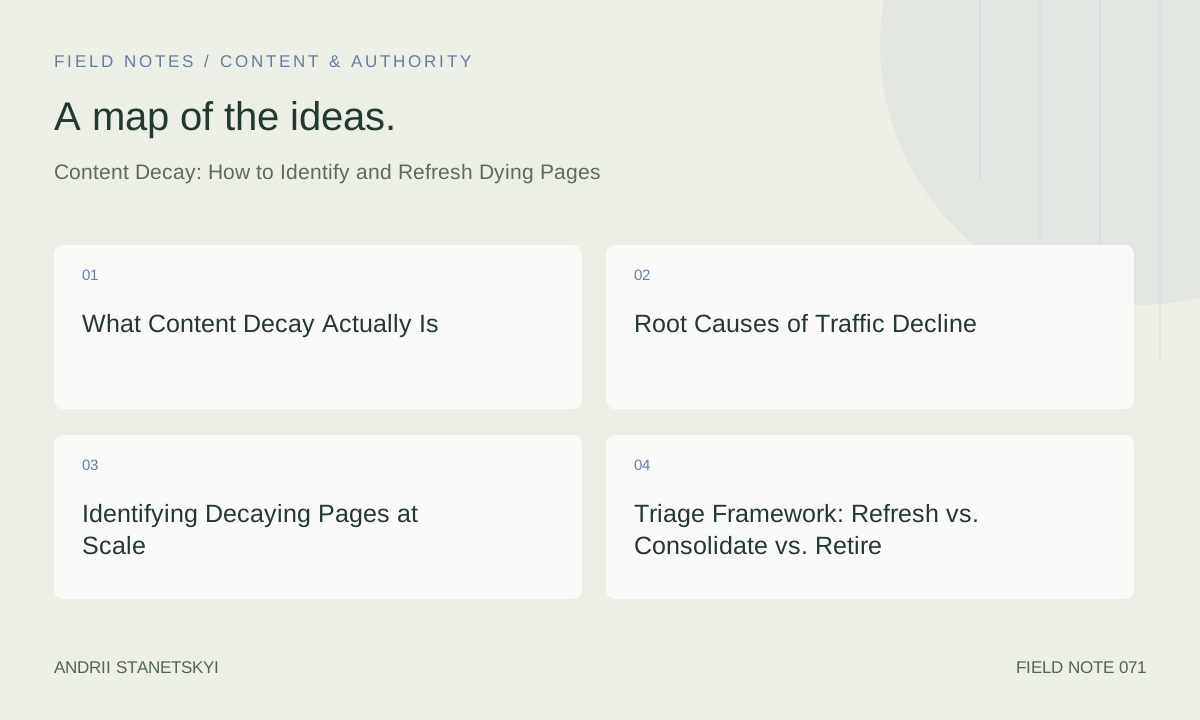
What Content Decay Actually Is
Content decay is not a single event. It is a trajectory. A page that ranked #3 in 2022 might drift to #7 by mid-2023, to page two by early 2024, and out of the top 50 by 2026 — all without any algorithmic penalty and without anyone touching the page. The traffic chart looks like a slow bleed, not a cliff.
The mechanism is competitive displacement. While your page sits static, competitors publish fresher articles with updated statistics, deeper coverage, and more recent E-E-A-T signals. Google's ranking systems continuously re-evaluate documents against the current pool of results. Freshness is a direct ranking factor for time-sensitive queries (news, "best X 2026," how-to content in fast-moving industries), but even evergreen content gets penalized indirectly when competitors demonstrably serve the user better.
Industry benchmarks suggest the average B2B blog post loses 20–30% of its peak organic traffic within 18 months of publication. For content in fast-moving verticals — AI, finance, regulation, software — the half-life is closer to six months.
Root Causes of Traffic Decline
1. Freshness Mismatch
Queries with implicit or explicit date modifiers ("best CRM software," "Python tutorial 2026") heavily favor recently updated documents. If your article cites 2021 data and a competitor published in Q1 2026, you will lose impressions even if your backlink profile is stronger.
2. SERP Feature Displacement
The organic click-through rate (CTR) at every position has eroded as Google adds more zero-click features. A page that ranked #3 in 2020 with a 10% CTR might occupy the same position in 2026 with a 5.5% CTR because a Featured Snippet, People Also Ask block, or AI Overview now sits above it.
3. Competitor Content Investment
Well-funded competitors with dedicated content teams regularly outpublish and outcoverage you. A rival that publishes a 4,000-word, data-rich refresh with original research will displace your original article even if yours was the first on the topic.
4. Intent Drift
Search intent evolves. A query that was informational three years ago may now be predominantly transactional, or vice versa. If the SERP shifted toward comparison pages and your article is a pure how-to, you are misaligned regardless of quality.
5. Technical Regression
Core Web Vitals degradation, accumulation of JavaScript bundle weight, or a poorly migrated CMS can slow page load times over years. A page that passed thresholds in 2022 may fail them in 2026 after several rounds of CMS upgrades.
Identifying Decaying Pages at Scale
GSC Performance Report: The Baseline Pull
Google Search Console is the starting point. Export the full Performance report for the maximum available window (16 months). Filter to Web and compare two date ranges: the most recent 6 months vs. the prior 6 months. Sort by impressions decline. Any URL losing more than 20% of impressions YoY warrants investigation.
# Python: Pull GSC data via API and flag decaying pages
import pandas as pd

df = pd.read_csv("gsc_export.csv")  # columns: page, clicks_current, clicks_prior, impressions_current, impressions_prior

df["click_delta_pct"] = (df["clicks_current"] - df["clicks_prior"]) / df["clicks_prior"] * 100
df["impression_delta_pct"] = (df["impressions_current"] - df["impressions_prior"]) / df["impressions_prior"] * 100

# Flag pages with >20% decline in both metrics
decaying = df[(df["click_delta_pct"] < -20) & (df["impression_delta_pct"] < -20)]
decaying = decaying.sort_values("click_delta_pct")
print(decaying[["page", "click_delta_pct", "impression_delta_pct"]].head(50))
Ahrefs Content Gap for Displaced Keywords
For each decaying page, run an Ahrefs Content Gap analysis: set your page as the target and the top three current SERP competitors as references. The keywords they rank for that you do not represent topics your refresh must address. This is the single most efficient way to identify coverage gaps that caused displacement.
Semrush Position Tracking Over Time
Semrush's Position Changes report shows keyword-level rank history. Export rank history for your top 200 URLs. Plot average ranking position over 24 months. Pages with a consistent downward slope (rank deterioration of 3+ positions sustained over 6+ months) qualify as decaying regardless of absolute traffic volume.
Crawl-Based Freshness Signals
Using Screaming Frog or Sitebulb, export Last-Modified headers and compare against your traffic data. Pages with a Last-Modified date older than 18 months that show traffic decline are strong refresh candidates. Cross-reference with the publication date visible on the page — if it says "Published 2021" with no update date, Google's freshness signals are working against you.
Triage Framework: Refresh vs. Consolidate vs. Retire
| Signal | Refresh | Consolidate | Retire (301 or Noindex) |
|---|---|---|---|
| Backlinks pointing to URL | 5+ referring domains | 1–4 referring domains | 0 referring domains |
| GSC impressions (last 6 mo.) | >500/month | 100–500/month | <100/month |
| Intent match with current SERP | Aligned or fixable | Partially misaligned | Fundamentally misaligned |
| Conversion history | Any confirmed conversions | Low/none | Zero, no funnel role |
| Cannibalization risk | No stronger sibling exists | Stronger sibling exists | Duplicate of active page |
This matrix is not a replacement for judgment. A page with zero backlinks but 2,000 monthly impressions still deserves a refresh if the keyword is strategically important. Use the matrix as a first-pass filter, not a final verdict.
The Refresh Playbook: Step-by-Step
Step 1: SERP Audit Before You Write a Word
Open an incognito window and search the primary keyword. Analyze the top five results: What format dominates (list, guide, comparison, tool)? What's the average word count? Are there tables, videos, calculators? What questions do the People Also Ask boxes surface? Your refresh must match or exceed the dominant format and answer the PAA questions the current article ignores.
Step 2: Keyword Expansion via Surfer or Clearscope
Run the primary keyword through Surfer SEO's Content Editor or Clearscope. Export the full NLP-term list. Identify terms with high importance scores that appear zero times in your current article. These are your semantic coverage gaps. Frase's brief builder can auto-generate a list of missing headings by comparing your article against top-10 competitors.
Step 3: Update All Factual Content
Replace every dated statistic with current data. Link to primary sources published within the last 12 months. If you cited a 2022 study, find the 2025 equivalent or note the original study's enduring relevance explicitly. Remove references to products, features, or regulations that no longer exist.
Step 4: Expand Coverage Gaps
Based on your Ahrefs Content Gap and Surfer outputs, add new H2/H3 sections covering topics competitors rank for that you missed. This is often where a 1,800-word article becomes a 3,200-word article — not padding, but genuine coverage of subtopics that users query.
Step 5: Update On-Page Signals
Rewrite the title tag and meta description. Include the current year if the query has date sensitivity. Update the dateModified field in your Article schema. Change the visible "Last updated" date on the page. These signals tell both users and Googlebot that the document is current.
Step 6: Internal Link Audit
Ensure the refreshed page receives internal links from your highest-authority pages. See the internal linking for content hubs guide for anchor text distribution strategy. Add outbound internal links from the refreshed article to pages you want to support.
Step 7: Request Indexing
After publishing, use GSC's URL Inspection tool to request re-crawling. For large sites, ensure the page appears in the updated XML sitemap with the correct lastmod timestamp.
Mini Case Study: SaaS Blog Recovery
A B2B SaaS company with a 600-article blog saw a 38% YoY decline in organic traffic between Q1 2024 and Q1 2025. The audit identified 87 pages in active decay. After applying the triage matrix: 41 pages qualified for refresh, 22 for consolidation, and 24 for retirement (301 to relevant live pages).
The team prioritized the top 15 refresh candidates by estimated traffic recovery value (current impressions × average CTR improvement from position gain). Within four months of refreshing those 15 articles — updating statistics, expanding coverage with Surfer-identified gaps, rebuilding internal link architecture — the site recovered 44% of its lost traffic. The 22 consolidations, completed in month two, reduced crawl budget waste and pushed link equity toward surviving pages.
Total effort: approximately 160 hours of content and SEO work across four months. The alternative — creating 87 net-new articles — would have required 10× the resources with no guaranteed outcome.
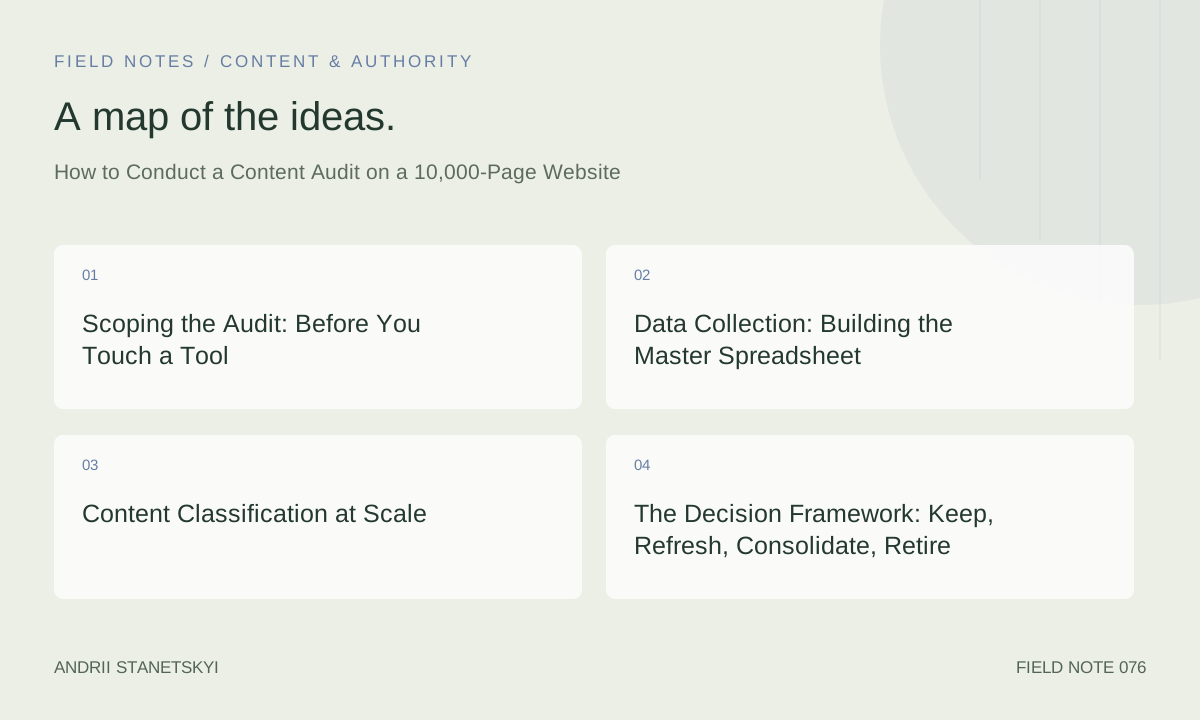
Related: How to Conduct a Content Audit on a 10,000-Page Website
Templates and Checklists
Content Refresh Checklist
[ ] SERP audit completed (format, length, PAA questions)
[ ] Ahrefs Content Gap run against top 3 competitors
[ ] Surfer/Clearscope NLP terms reviewed and gaps noted
[ ] All statistics updated to sources published within 12 months
[ ] Outdated product/feature references removed
[ ] New H2/H3 sections added for coverage gaps
[ ] Title tag updated (include year if date-sensitive query)
[ ] Meta description rewritten
[ ] dateModified updated in Article schema
[ ] Visible "Last updated" date changed on page
[ ] Internal links from authority pages added (min. 2)
[ ] Outbound internal links added (min. 2)
[ ] Featured snippet opportunity addressed (definition box or numbered list)
[ ] Page speed check run post-publish
[ ] URL Inspection / index request submitted in GSC
Google Sheets Formula: Decay Score
=IF(AND((C2-B2)/B2 < -0.20, (E2-D2)/D2 < -0.20), "HIGH DECAY",
  IF(OR((C2-B2)/B2 < -0.20, (E2-D2)/D2 < -0.20), "MODERATE DECAY", "STABLE"))
Where B=prior clicks, C=current clicks, D=prior impressions, E=current impressions.
Download the full content decay audit template
FAQ
How often should I audit for content decay?
For sites publishing more than 20 articles per month, run a quarterly decay audit. For smaller blogs (under 200 total URLs), a semi-annual audit suffices. Use GSC's date comparison feature to automate the initial detection — you do not need to manually check every URL every quarter.
Does changing the URL slug reset rankings?
Yes, a URL change is a migration event that requires a 301 redirect. It typically causes a temporary ranking dip of 2–8 weeks. Unless the slug contains a year that makes it obviously outdated (e.g., /best-tools-2019), keep the original URL. Update the title and visible content without touching the permalink.
Should I delete thin content or just noindex it?
For truly low-value pages (auto-generated tags, faceted navigation duplicates, parameter pages), use canonical tags or noindex before deletion. For content that once ranked and has backlinks, always 301 redirect rather than delete. Deleting an indexed URL with backlinks destroys link equity permanently.
How does Google's Helpful Content system affect decay?
The Helpful Content system evaluates content quality at the site level, not just the page level. A large proportion of unhelpful or thin content can suppress the entire domain's rankings. Retiring or consolidating low-quality decaying pages is therefore not just about those individual URLs — it is about raising the overall quality signal of your domain.
What's the minimum viable refresh for a page with heavy decay?
At minimum: update all statistics, rewrite the introduction to reflect current context, add one new section covering the most prominent competitor topic gap, update the title tag with the current year, and update the dateModified schema field. This "light refresh" typically takes 60–90 minutes per article and can recover 15–25% of lost traffic while you queue deeper refreshes.
How do I measure refresh success?
Set a 90-day measurement window post-publish. Track: (1) average ranking position for the primary keyword in GSC, (2) total clicks and impressions YoY for the URL, (3) organic-assisted conversions in GA4. Compare to a control group of unrefreshed pages with similar starting conditions to isolate the refresh effect from seasonal or algorithmic shifts.
Can refresh work on pages that have never ranked well?
A page that never ranked likely has a structural problem — wrong format for intent, missing backlinks, or targeting a keyword beyond the domain's current authority. Refreshing content alone will not fix an authority gap or a fundamental intent mismatch. Triage these pages honestly: if they never performed, the issue may be targeting or link equity, not freshness.
Key Takeaways
- Content decay is competitive displacement, not punishment — your page sits still while the world moves around it.
- Use GSC Performance date comparison + Ahrefs Content Gap as your primary detection toolkit.
- Triage every decaying page into refresh, consolidate, or retire before writing a single word.
- The refresh playbook follows a fixed order: SERP audit → keyword expansion → factual updates → coverage expansion → on-page signals → internal links → index request.
- Refreshing 15 high-value pages almost always outperforms publishing 15 net-new articles in the same timeframe.
- Update
dateModifiedin your Article schema and the visible date on the page — both matter for Google's freshness signals. - Measure refresh impact over 90 days with a control group to distinguish your work from external ranking shifts.
Conclusion
Content decay is not inevitable — it is manageable. The teams that win in search over multi-year horizons are not the ones that publish most; they are the ones that maintain best. Build a quarterly decay audit into your content calendar, create a triage protocol your editors can execute consistently, and treat refresh as a standing line item in your content budget. The ROI on recovering existing assets almost always beats the ROI on creating new ones, yet most content programs chronically underinvest in it. Fix that, and you compound your content investment instead of watching it depreciate.