Domain Authority is dead — or at least, it's been dethroned. If you're still running content strategy decisions through the lens of DA scores and raw backlink counts, you're playing a game that Google quietly retired. The signal that now drives rankings, click-through rates, and long-term organic equity is topic authority: the demonstrable depth and breadth of your site's expertise in a specific subject domain.
This shift didn't happen overnight. The 2022 Helpful Content Update, the subsequent E-E-A-T reinforcements through the March 2023 core update, and the rollout of Search Generative Experience all pointed at the same structural truth — Google rewards sites that own a topic, not sites that scatter thin content across dozens of loosely related keywords. This article breaks down what topic authority actually means, how to measure it, how to build it, and why it should be the organizing principle of every content decision you make in 2026.
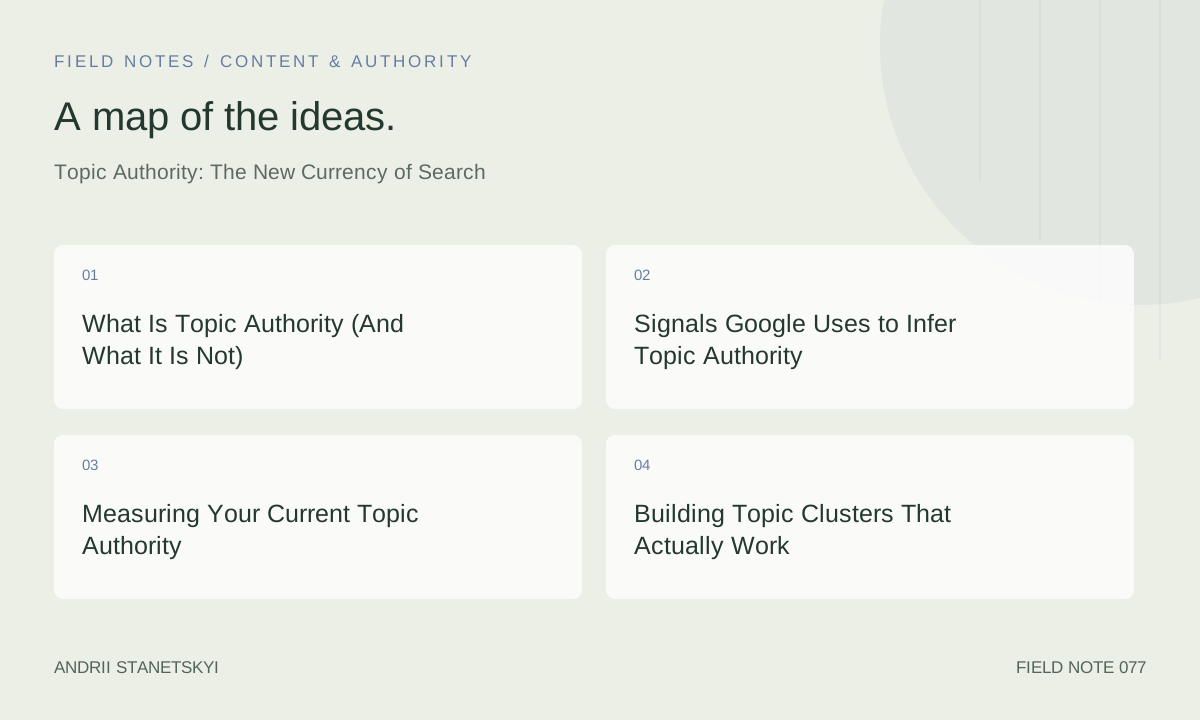
What Is Topic Authority (And What It Is Not)
Topic authority is the search engine's assessment of how comprehensively and reliably a site covers a given subject area. It is inferred from a constellation of signals — content coverage, internal link architecture, user engagement patterns, backlink anchor text distribution, entity associations, and author credentials — not from any single metric.
What it is not: a vendor metric. Moz's Domain Authority, Ahrefs' Domain Rating, and Semrush's Authority Score are all link-graph approximations that correlate loosely with rankings but fail to capture topical depth. A DA-40 site that has published 80 deeply interconnected articles on enterprise data governance can outrank a DA-70 generalist news site on virtually every data governance keyword — and does, regularly.
The practical consequence: your content investment should prioritize depth within chosen verticals over horizontal sprawl. A site with 30 exceptional, interlinked articles on a tight topic will outperform a site with 300 thin articles covering adjacent topics that never reinforce each other.
The E-E-A-T Connection
Google's Search Quality Evaluator Guidelines define E-E-A-T (Experience, Expertise, Authoritativeness, Trustworthiness) as the framework human raters use to assess content quality. Topic authority is the structural layer that makes E-E-A-T signals legible to automated systems. You can have a world-class expert writing your content, but if that content exists in isolation — no supporting articles, no topical interlinking, no entity markup — Google's systems have limited capacity to propagate that credibility across your site.
Signals Google Uses to Infer Topic Authority
Google has never published a "topic authority score" document, but between patent filings, Search Quality Guidelines updates, and the observable behavior of ranking systems, we can map the key signals with reasonable confidence.
Content Coverage Depth
Does your site address the full spectrum of a topic — head terms, mid-tail, long-tail, and question-based queries — or only the high-volume head terms? Sites that rank for 80%+ of keyword variations in a topic cluster signal comprehensive coverage. Use Ahrefs' Topical Authority report or Semrush's Keyword Gap tool to benchmark coverage against competitors.
Internal Link Architecture
Internal links are the connective tissue of topic authority. A pillar page that receives links from 12 supporting cluster articles concentrates topical signals at the pillar level, which Google can then redistribute to supporting content. Sites with flat internal link structures — every page pointing only to the homepage — waste enormous topical potential.
Entity Salience
Google's Knowledge Graph recognizes named entities: people, organizations, concepts, places. When your content consistently references and contextualizes the key entities within a topic domain, Google's NLP systems can associate your site with those entities. Use structured data (schema.org/Article with about and mentions properties) to make entity associations explicit.
Backlink Anchor Text Distribution
Inbound links whose anchor text includes topic-relevant terms strengthen the topical signal. A site earning links with anchor text like "enterprise data governance framework" builds topical authority differently than a site earning links with "click here" or branded anchors alone.
User Engagement Signals
Long click durations, return visits within a session, and low pogo-sticking rates (returning to SERP immediately after visiting a page) signal that content satisfies intent. Google's machine-learned ranking models incorporate these behavioral signals as quality proxies.
Measuring Your Current Topic Authority
Before you can build topic authority, you need a baseline. Here's a practical measurement workflow using tools available to most SEO practitioners.
Step 1: Define Your Topic Clusters
Identify the 3–5 core topic domains your site should own. These should align with business objectives and have demonstrable search demand. Use Ahrefs' Content Explorer or Semrush's Keyword Magic Tool to size each cluster.
Step 2: Inventory Existing Coverage
Export all indexed URLs from Google Search Console. Map each URL to a topic cluster. Calculate coverage ratio: (URLs covering topic / total estimated keyword opportunities in topic) × 100.
Step 3: Measure Topical Visibility
In Semrush, use the Position Tracking tool with a cluster-specific keyword set. Track average position, visibility percentage, and SERP feature capture (featured snippets, PAA boxes) for each cluster separately. This gives you a topical visibility score that's more actionable than site-wide averages.
Step 4: Assess Internal Link Depth
Use Screaming Frog or Ahrefs' Site Audit to identify pages within each topic cluster with zero internal inlinks. Orphaned content is dead content from an authority-propagation standpoint.
# Python snippet: identify orphaned cluster pages using Screaming Frog export
import pandas as pd

pages = pd.read_csv('screaming_frog_export.csv')
# Filter to topic cluster URLs
cluster_pages = pages[pages['Address'].str.contains('/data-governance/')]
# Find pages with 0 inlinks
orphans = cluster_pages[cluster_pages['Inlinks'] == 0]
print(f"Orphaned cluster pages: {len(orphans)}")
print(orphans[['Address', 'Title 1']].to_string())
Building Topic Clusters That Actually Work
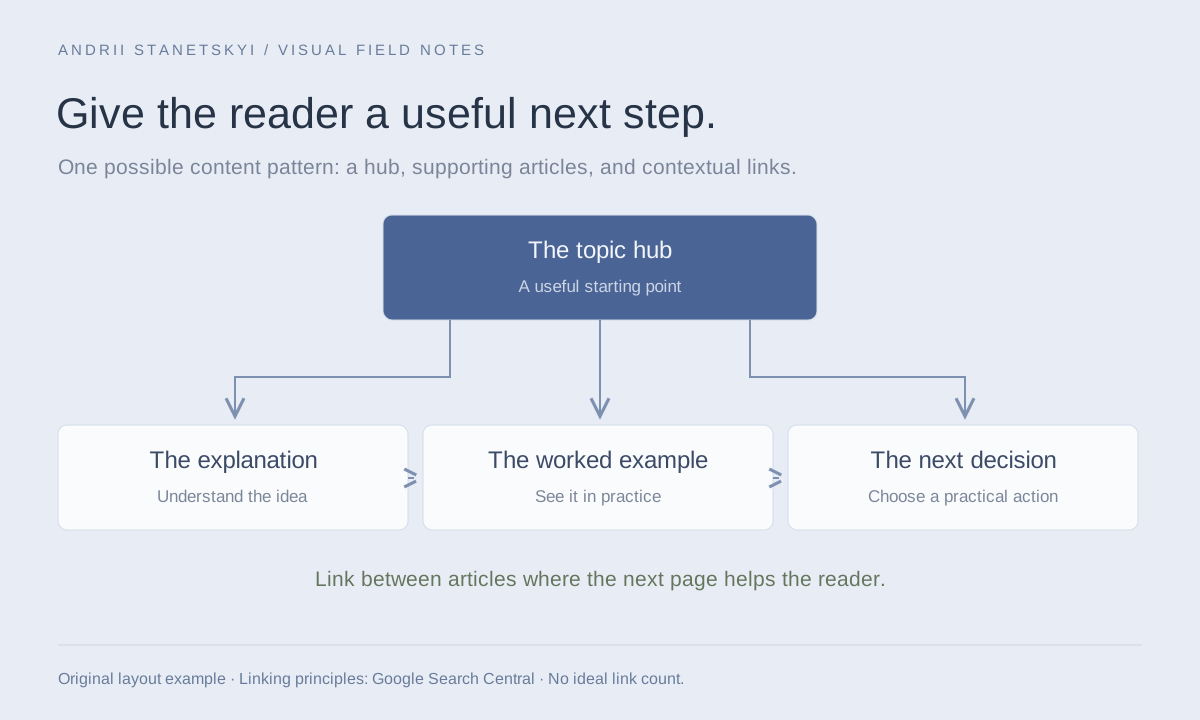
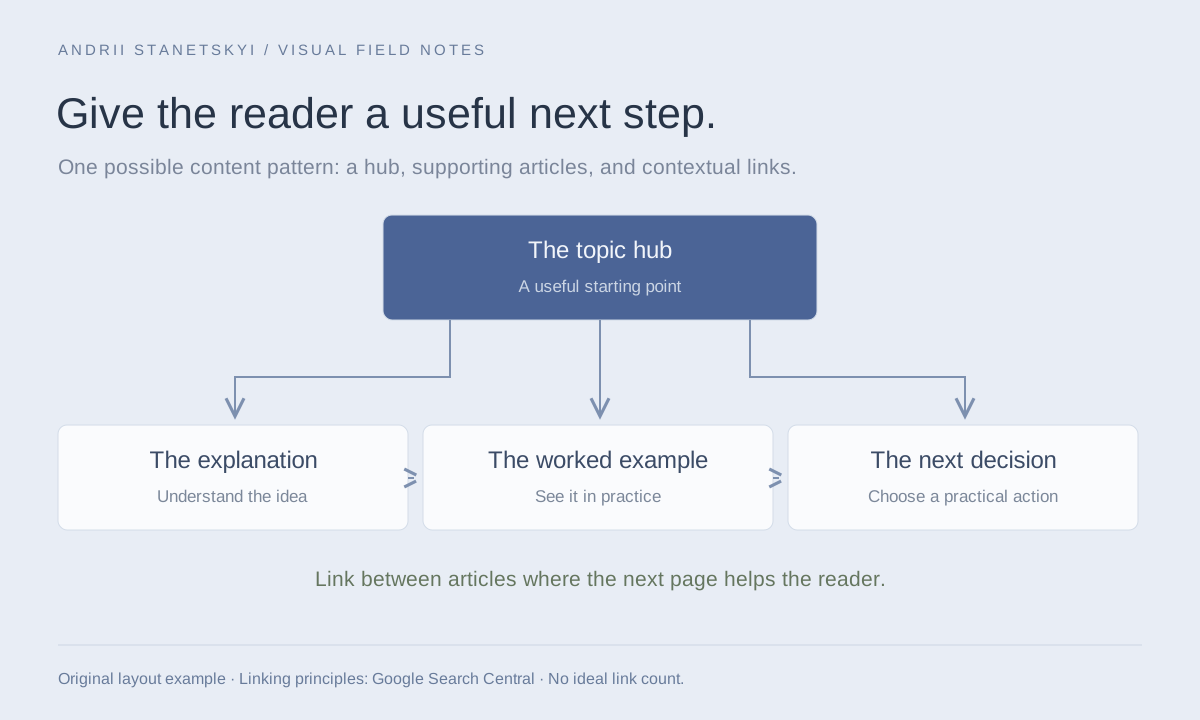
The topic cluster model — a pillar page supported by cluster articles, all interlinked — was popularized by HubSpot in 2017. The concept is sound; the execution is usually poor. Most implementations fail for three reasons: pillar pages that are actually thin overview pages, cluster articles that don't link back to the pillar, and cluster definitions that are too broad to reinforce any coherent authority signal.
The Pillar Page Standard
A genuine pillar page should be the single most comprehensive treatment of a topic on your site. Think 3,000–6,000 words covering the topic at a strategic level, with anchor links to supporting cluster articles for deeper dives on subtopics. It should rank for the head term and the highest-volume question variations of that head term.
Cluster Article Criteria
Each cluster article should: (1) target a specific long-tail or question-based keyword that the pillar page mentions but doesn't fully address; (2) link back to the pillar page with relevant anchor text; (3) link to at least 2–3 sibling cluster articles; and (4) be comprehensive enough to satisfy the specific search intent without needing to be exhaustive.
Topic Cluster Sizing
A well-functioning cluster typically requires 8–15 cluster articles per pillar to achieve measurable authority lift. Below 8, the coverage signal is too thin. Above 20, you risk keyword cannibalization and content quality dilution unless your team has exceptional editorial bandwidth.
Content Gap Analysis: Finding Authority Holes
Content gap analysis is the most direct path to identifying where your topic authority breaks down. Two tools dominate this workflow: Ahrefs Content Gap and Semrush Keyword Gap.
Ahrefs Content Gap Workflow
- Navigate to Ahrefs Site Explorer → your domain → Content Gap
- Enter 3–4 competitor domains that rank well in your target topic cluster
- Set "Show keywords that the below targets rank for" with intersection mode: "at least one target"
- Filter: exclude keywords your site already ranks for in positions 1–20
- Export and segment by topic cluster using keyword modifiers
The output gives you a prioritized list of keyword opportunities your competitors capture but you don't — organized by search volume and keyword difficulty. These are your authority holes: the gaps that, when filled, extend your topical coverage and reinforce your cluster's authority signal.
Semrush Keyword Gap for Intent Mapping
Semrush's Keyword Gap adds intent classification (informational, navigational, commercial, transactional) to gap analysis. This lets you identify not just what keywords you're missing but what types of content you're missing — critical for diagnosing authority gaps at the intent level rather than just the keyword level.
See our complete guide to content gap analysis workflowsMini Case Study: Building Topic Authority in B2B SaaS
A mid-market CRM software company (anonymized) had a domain rating of 52 and was struggling to rank above position 8 for any of their target keywords despite publishing 4 blog posts per month for three years. Their blog covered topics ranging from "cold email templates" to "what is CRM software" to "sales forecasting methods" — broad, disconnected, and individually weak.
Diagnosis
Topic coverage analysis revealed the site had approximately 30% coverage of keywords in the sales automation cluster but less than 10% coverage in the CRM implementation and CRM ROI clusters — exactly the topics their buyers were researching before purchase.
Intervention (6-Month Sprint)
- Consolidated 14 thin articles into 4 comprehensive cluster articles (500-word articles → 2,000+ words with original data)
- Published a 4,800-word pillar page on "CRM implementation for mid-market companies"
- Rebuilt internal link architecture: every cluster article now links to the pillar with descriptive anchor text
- Added schema markup (Article + HowTo where applicable) to all cluster content
- Acquired 6 topically relevant backlinks through original research publication
Results (6 Months)
Average position for the CRM implementation cluster improved from 14.2 to 5.8. Organic traffic to the cluster increased 187%. Three cluster articles captured featured snippet positions. The pillar page ranked #2 for the head term "CRM implementation guide" — a keyword with 8,100 monthly searches that had been previously unranked.
The Topic Authority Scoring Framework
| Dimension | Metric | Weak (<4) | Moderate (4–7) | Strong (8–10) |
|---|---|---|---|---|
| Coverage | % of cluster keywords with ranking content | <25% | 25–60% | >60% |
| Depth | Avg. word count of cluster articles | <800 | 800–2000 | >2000 |
| Internal Links | Avg. inlinks per cluster page | <3 | 3–8 | >8 |
| Backlink Quality | Topically relevant referring domains | <5 | 5–20 | >20 |
| SERP Visibility | % of cluster keywords in top 10 | <10% | 10–35% | >35% |
| Entity Coverage | Schema markup + entity mentions | None | Partial | Comprehensive |
Score each dimension on a 1–10 scale, weight them by your current strategic priorities, and average to get a composite Topic Authority Score per cluster. Run this audit quarterly. Track trajectory, not just absolute scores.
Download the full Topic Authority Audit templateIntegrating GSC Performance Data
Google Search Console's Performance report is underutilized for topic authority measurement. Filter by a topic-specific URL path or query filter, then track: average CTR by position (benchmark: position 1 = 28–32% CTR, position 3 = 10–12%, position 5 = 5–7%), impressions trend, and query diversity. A healthy topic cluster shows growing query diversity over time as Google associates your site with more variations of the core topic.
-- Hypothetical GSC data query to identify cluster performance trends
-- (Using BigQuery export of GSC data)
SELECT
  query,
  page,
  AVG(position) AS avg_position,
  SUM(clicks) AS total_clicks,
  SUM(impressions) AS total_impressions,
  SUM(clicks) / SUM(impressions) AS ctr
FROM project.dataset.searchconsole_data
WHERE
  page LIKE '%/crm-implementation/%'
  AND date BETWEEN '2025-10-01' AND '2026-03-31'
GROUP BY query, page
HAVING total_impressions > 100
ORDER BY total_clicks DESC;
FAQ
How long does it take to build topic authority?
Meaningful topical authority signals — measurable improvements in cluster keyword rankings — typically emerge 3–6 months after a coordinated cluster build. Full authority consolidation, where your site ranks in the top 5 for the majority of cluster keywords, takes 9–18 months depending on competition level and content publication cadence. This is not a quick-win tactic; it's infrastructure investment.
Can I build topic authority in multiple verticals simultaneously?
Yes, but with resource constraints. Most sites can effectively build authority in 2–3 topic clusters simultaneously without diluting editorial quality. Attempting 5+ clusters with the same team almost always results in thin coverage across all of them — the opposite of what authority-building requires. Prioritize ruthlessly.
Does topic authority transfer when I migrate to a new domain?
Topical authority is partly domain-level and partly URL-path-level. A well-executed domain migration with proper 301 redirects preserves the majority of topical signals over 3–6 months. However, entity associations in Google's Knowledge Graph are slower to transfer. Plan for a temporary authority dip and build in a 6-month recovery runway in migration timelines.
How does the Helpful Content System affect topic authority?
Google's Helpful Content System applies a site-wide quality signal that can suppress an entire domain's rankings if a significant portion of content is deemed "unhelpful." This is directly connected to topic authority: a site with 400 thin, keyword-stuffed articles undermines the authority of its 20 excellent articles. Content pruning — consolidating, redirecting, or deleting low-quality content — is often the fastest way to unlock latent topic authority on established sites.
Is topic authority the same as Topical Authority in Ahrefs?
Ahrefs' "Topical Authority" metric is their proprietary approximation of this concept, measuring how well a site covers a given topic relative to the full keyword universe. It's a useful directional signal but not a direct representation of how Google scores topical depth. Treat vendor metrics as directional inputs, not ground truth.
Should every page on my site belong to a topic cluster?
Ideally, yes. Pages that exist outside of any cluster structure — isolated blog posts, one-off landing pages, thin product pages — contribute little to your site's topical coherence and often dilute authority signals. The exception is navigational content (pricing, about, contact) which serves user needs but sits outside cluster architecture by design.
How do I handle topics where my competitors have years of head start?
Attack from the flanks. If competitors dominate the broad head terms in a cluster, identify sub-topics where coverage is thin across all competitors — typically emerging subtopics, long-tail question clusters, or regional/vertical variations of the core topic. Build authority in those sub-clusters first, then use that authority as a platform to challenge head-term rankings.
Key Takeaways
- Topic authority — not domain authority — is the primary lever for sustained organic ranking performance in 2026. Vendor DA/DR metrics are proxies, not targets.
- Google infers topic authority from content coverage breadth, internal link architecture, entity associations, backlink topicality, and user engagement signals — not from any single factor.
- The topic cluster model works when pillar pages are genuinely comprehensive (3,000+ words), cluster articles address specific intent gaps, and internal linking is systematic and descriptive.
- Content gap analysis using Ahrefs Content Gap and Semrush Keyword Gap is the fastest way to identify where your topical coverage breaks down.
- Measure topic authority quarterly using the six-dimension scorecard: coverage, depth, internal links, backlink quality, SERP visibility, and entity coverage.
- The Helpful Content System means thin content anywhere on your site suppresses authority everywhere. Content pruning is often the highest-ROI intervention for established sites.
- Realistic timeline: 3–6 months for early ranking gains, 9–18 months for cluster-level authority consolidation.
Conclusion
Topic authority is the structural bet that separates sites with sustainable organic growth from sites that chase algorithm updates. The mechanics are well-understood: deep coverage, tight internal link architecture, entity clarity, and consistent quality signals. The execution is where most organizations fail — not from lack of knowledge but from lack of commitment to the long game.
Start with an honest audit of your current topic clusters. Find the holes. Fill them systematically. Prune what doesn't belong. And measure progress with metrics that actually reflect topical depth, not vanity scores that flatter mediocrity.
Continue reading: How to run a technical content audit Google Search Quality Evaluator Guidelines (official)