E-E-A-T is not a ranking factor. This distinction matters, and confusing it with direct algorithmic input is what leads to unfalsifiable SEO theater: adding author bios, slapping credentials in metadata, and calling it E-E-A-T optimization. The reality is more nuanced and more interesting: E-E-A-T is the framework Google's quality raters use to evaluate whether a page deserves to rank, and the signals that demonstrate E-E-A-T are what drive rankings.
Since the addition of the first "E" (Experience) to the Quality Rater Guidelines in December 2022, the emphasis has shifted toward demonstrating first-hand, lived experience with a topic — not just credential-based expertise. This has profound implications for content strategy, author identity, and how you build a site's reputational footprint in 2026.
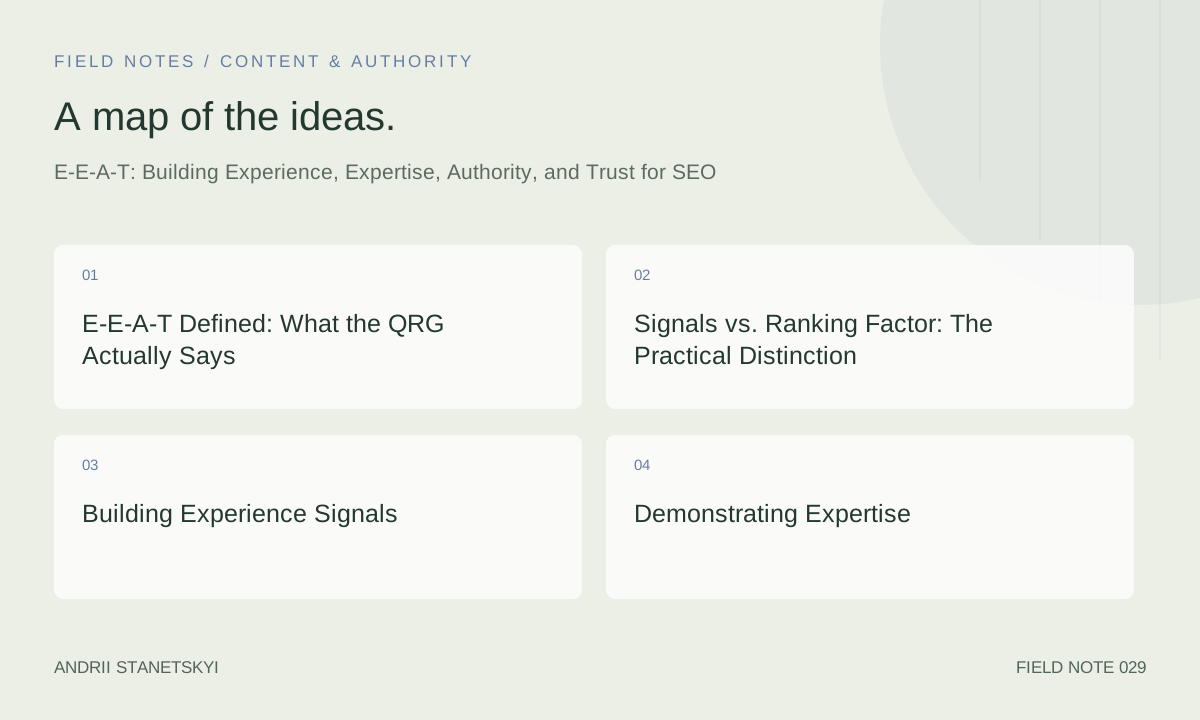
E-E-A-T Defined: What the QRG Actually Says
Google's Search Quality Rater Guidelines define E-E-A-T across four dimensions:
- Experience: Does the content creator have first-hand, real-world experience with the topic? Have they used the product, visited the place, lived through the situation they're writing about?
- Expertise: Does the creator have formal or demonstrable knowledge in the relevant field? For medical content, this is a licensed practitioner. For a product review, it may simply be someone who has used many products in the category.
- Authoritativeness: Is the creator, or the site, recognized as a go-to source by others in the space? Is it cited, linked to, or referenced by authoritative external sources?
- Trust: Is the page and site honest, transparent, and safe? Does the site make it clear who is responsible for the content? Are there accurate contact details, a clear privacy policy, and transparent ownership?
Trust is positioned as the most critical of the four in the QRG. A site can have high expertise and authority but low trust — and will be rated poorly if it's deceptive, unclear about authorship, or has patterns consistent with manipulation.
Signals vs. Ranking Factor: The Practical Distinction
Google does not have a single E-E-A-T score that goes into the ranking algorithm. Instead, various rankable signals serve as proxies for E-E-A-T quality:
| E-E-A-T Dimension | Proxy Signals Google Can Measure | Optimization Target |
|---|---|---|
| Experience | First-person narrative, original images/data, author bylines with background | Content strategy, author identity |
| Expertise | Entity mentions in authoritative sources, credential visibility, content depth/accuracy | Author pages, structured data, content quality |
| Authoritativeness | Inbound links from authoritative domains, brand mentions, entity citations in Knowledge Graph | Link building, PR, entity optimization |
| Trust | HTTPS, clear authorship, accurate contact info, third-party reviews, entity consistency | Technical trust signals, reputation management |
The implication: improving E-E-A-T means improving the underlying signals, not gaming surface-level indicators. Adding "MD" to an author name without that person being a real, findable entity with medical credentials does not improve E-E-A-T — and with Google's entity resolution capabilities in 2026, it's increasingly detectable as a signal mismatch.
Building Experience Signals
The "Experience" dimension is the newest and most misunderstood. It's specifically about demonstrating that content is created by someone with direct experience — not just research knowledge.
Content-Level Experience Signals
- Original imagery and video: Photos you took, screenshots you captured, videos you recorded. Stock photography signals no experience. An original image of a product you actually tested signals direct contact.
- Specific, non-obvious details: A review that mentions "the battery drain accelerates noticeably when GPS is active" versus "battery life is good" — the specificity signals that the author actually used the product.
- First-person narrative where appropriate: "When I tested this tool on a 50,000-page crawl" is an experience signal. "Users have reported" is not.
- Temporal specificity: "As of March 2026, the interface has changed to..." signals active, current engagement with the subject.
Author-Level Experience Signals
Author pages should document relevant experience clearly and factually. For a technical SEO blog, an author page should list past client industries, tool certifications, speaking engagements, and link to external profiles (LinkedIn, conference sites, podcast appearances). These create entity connections that Google can resolve.
Demonstrating Expertise
Expertise is easier to establish for professionals with credentials but is available to any genuine subject matter expert. The key is making expertise visible and verifiable.
Author Schema Markup
Implement Article schema with author properties that reference a Person entity with credentials, URLs, and professional identifiers:
{
  "@context": "https://schema.org",
  "@type": "Article",
  "author": {
    "@type": "Person",
    "name": "Andrii Benrey",
    "url": "https://benrey.io/about",
    "sameAs": [
      "https://www.linkedin.com/in/andriibenrey",
      "https://twitter.com/andriibenrey"
    ],
    "jobTitle": "Senior Technical SEO Specialist",
    "knowsAbout": ["Technical SEO", "On-Page Optimization", "E-E-A-T"]
  }
}
The sameAs property is critical. It connects the on-site entity to established external entities, helping Google resolve the author identity with confidence. A Person entity with three verified external profiles is dramatically more trustworthy than one with none.
Credential Visibility Without Overclaiming
Formal credentials (degrees, licenses, certifications) should be mentioned specifically and verifiably. "Board-certified cardiologist at [Hospital Name]" is verifiable. "Health expert" is not. In YMYL categories, vague credentials actively undermine trust rather than building it.
For non-credentialed expertise (a software engineer writing about programming, a chef writing about cooking), the expertise signal comes from content quality, publication history, and third-party recognition — not title claims.
Building Authoritativeness
Authoritativeness is the dimension most directly tied to traditional link-building and PR — but with important nuances. In 2026, Google's entity-based understanding of authority means that mentions without links (brand mentions, citations) carry more weight than they did historically.
Link Authority
Inbound links from topically relevant, authoritative domains remain the strongest signal. A link from Search Engine Journal or Search Engine Land to a technical SEO article carries substantially more E-E-A-T authority than a link from a general directory. Use Ahrefs' Link Intersect to identify domains linking to competing content but not to yours — these are the highest-priority link targets.
Unlinked Brand Mentions
Google has confirmed the ability to process co-citation and brand mentions without hyperlinks. Monitoring for unlinked mentions (Ahrefs Alerts, Semrush Brand Monitoring) and converting them to links where possible is useful — but the mention itself has signal value. A consistent pattern of your brand being cited by authoritative sources in your topic space is an authority signal independent of link structure.
Third-Party Recognition
Speaking at conferences, being quoted in industry publications, podcast appearances, and awards — these create entity signals in authoritative external contexts. They're not easily scalable, but they're high-value for E-E-A-T because they represent external validation from sources Google trusts.
Trust: The Umbrella Concept
The QRG explicitly states that Trust is "the most important member of the E-E-A-T family." Trust failures can negate strong expertise and authority signals. Trust operates at multiple levels:
Technical Trust Signals
- HTTPS with a valid certificate (table stakes, but failures are trust-destroying)
- Core Web Vitals within acceptable ranges (poor performance correlates with distrust heuristics)
- No deceptive redirects, cloaking, or content that changes based on user agent
Transparency Signals
- Clear authorship on every piece of content (not just "Staff Writer" — real, named, linkable authors)
- Accurate and current "About" page with organizational identity
- Contact information that works (tested regularly)
- Disclosed conflicts of interest (affiliate relationships, sponsored content)
- Clear editorial policy and correction process
Reputation Trust
- Third-party review profiles (Google Business, Trustpilot, G2) with authentic, recent reviews
- No recent manual actions in Google Search Console
- No patterns in GSC security issues reports
- Absence of negative entity mentions in reliable sources
Trust is also the dimension most damaged by over-optimization. A site that has an obviously manufactured set of author credentials, an About page that reads like marketing copy, and a review profile with suspicious velocity of identical 5-star reviews will score low on trust regardless of its link profile.
YMYL Pages and Elevated E-E-A-T Requirements
Your Money or Your Life (YMYL) categories — health, finance, legal, safety — face the highest E-E-A-T bar in the QRG. For these topics, missing or vague expertise signals are treated as quality failures, not just missed opportunities.
For YMYL content:
- Every piece must have a named author with verifiable credentials in the specific YMYL domain
- Medical content should have a medically licensed reviewer (not just a wellness blogger)
- Financial advice should be from or reviewed by a licensed financial professional
- Dates of publication and last review must be visible and accurate
- Sources must be cited, specifically, and linked to primary research or authoritative institutions
The impact of HCU-related algorithmic updates has been disproportionately felt by YMYL sites with thin or unverifiable expertise signals. Sites that survived — and in some cases gained — had genuine expert authors, editorial review processes, and transparent correction policies.
Entity SEO and Knowledge Panel Optimization
Google's understanding of authority increasingly operates at the entity level, not just the domain or URL level. An organization or person recognized in the Knowledge Graph has stronger authority signals than one that isn't.
Building Entity Presence
- Claim and verify Google Business Profile (for organizations with a physical presence)
- Complete Wikidata entry for the organization or key individuals (must meet notability requirements — cannot manufacture this)
- Maintain consistent NAP (Name, Address, Phone) across all authoritative directories
- Use Organization and Person structured data with consistent
sameAsreferences across all site pages - Publish an authoritative "About" page that serves as the canonical entity reference
Monitoring Entity Signals
Track Knowledge Panel presence for brand and key author entities. Use Google's Entity Search (https://www.google.com/search?q=kg:/m/ENTITY_ID) to verify recognition. Monitor Semrush's Brand Monitoring for citation consistency. Use Ahrefs to track the growth of referring domains linking to author pages specifically.
For a detailed walkthrough of entity optimization as an on-page strategy, see our guide to structured data and entity SEO.
Auditing Your Site's E-E-A-T Signals
An E-E-A-T audit is not a technical crawl audit — it's a content and reputational audit. Here's a structured approach:
Author Audit
- Crawl all posts/articles with Screaming Frog, extract author bylines via custom extraction
- Identify any anonymous or pseudonymous content — especially on YMYL topics
- Check that every named author has a live author page with external profile links
- Verify Article schema includes author entity with
sameAsproperties
Reputation Audit
- Search
site:domain.comto assess indexed coverage and surface any thin/doorway pages - Search for brand mentions with negative modifiers: "[brand] scam", "[brand] review"
- Check GSC for any manual actions or security issues
- Review third-party profiles for review velocity and sentiment anomalies
Content Quality Spot Check
- Pull 20 random pages from your top traffic segments
- Evaluate against QRG "highest quality" criteria: beneficial purpose, expertise, accuracy, sources cited, no deception
- Rate them honestly against what you'd expect from the top-ranking competitors
See also our content pruning decision framework for how to act on low-quality pages identified in this audit.
Case Studies
Case Study 1: Health Publisher Post-HCU Recovery
A health information site lost 60% of organic traffic after a Helpful Content Update. Audit identified: all articles attributed to "Health Team" with no individual bylines, no medical reviewer credentials, no source citations. Recovery plan: hired three licensed medical writers as full-time contributors, created author pages with verified credentials and headshots, added a medical review process with reviewer byline distinct from author byline, added citations to PubMed sources. Recovery took 14 months. Traffic recovered to 85% of pre-HCU levels; revenue per session improved 31% due to higher-quality audience.
Case Study 2: B2B SaaS Blog Authority Building
A B2B SaaS company's blog was ranking inconsistently for competitive marketing terms despite strong content. E-E-A-T audit showed: no named authors (all posts said "Marketing Team"), no external entity presence for any author, no external links pointing to author pages. Action: identified three internal subject matter experts, created detailed author pages, published guest articles on industry publications linking back to their author pages, and enrolled them in industry podcast circuit over six months. Twelve months later, author entity signals measurable in Knowledge Graph; blog organic traffic up 47%; top-5 rankings for target terms increased from 12 to 31.
FAQ
Is E-E-A-T a direct Google ranking factor?
No. E-E-A-T is a framework used by human quality raters to evaluate search results. Those evaluations are used to train and calibrate Google's algorithms, not as direct input. The ranking signals are the measurable proxies: links, entity recognition, content quality, trust signals. Optimize those, not a fictional E-E-A-T score.
How important is E-E-A-T for non-YMYL content?
Less critical than for YMYL, but not irrelevant. Recipe sites, travel blogs, and product review sites without YMYL implications still benefit from clear authorship and experience signals — especially since the "Experience" addition to the QRG explicitly targets these content types. A recipe from a food blogger who tested it versus a recipe aggregator scraping content without attribution signals differently.
Can AI-generated content have good E-E-A-T?
AI-generated content that is not reviewed, fact-checked, or enhanced by a human expert with real credentials and experience will score poorly on E-E-A-T regardless of its surface quality. AI can assist with content production, but the E-E-A-T signals must come from human expertise and real-world experience layered onto or into that content. In 2026, Google's ability to detect undisclosed AI content and correlate it with authority signals is more sophisticated than most site operators assume.
How long does it take to build E-E-A-T?
For a new site, 12–24 months is a realistic timeline to build meaningful authority signals from scratch. For an established site recovering from an algorithmic demotion, 6–18 months depending on the severity of the issue and the comprehensiveness of the remediation. E-E-A-T cannot be bought quickly. It's built through consistent publication, third-party recognition, and reputational signals accumulated over time.
What is the best tool for auditing E-E-A-T?
There is no single tool that audits E-E-A-T — because it's not a single measurable signal. The closest approximations: Ahrefs for authority and link-based signals, Semrush for brand monitoring and reputation, Screaming Frog with custom extraction for author metadata audit, and manual review against the QRG criteria. The QRG itself is the most important reference document — read it directly.
Does having a Wikipedia page help E-E-A-T?
Wikipedia is one of the most trusted sources for entity data in Google's Knowledge Graph. A Wikipedia entry for your organization or key authors — if you legitimately meet notability requirements — is a strong entity signal. But Wikipedia has strict notability requirements and is maintained by editors who reject promotional entries. Do not attempt to create a Wikipedia page if you don't meet the criteria; it will be deleted and the attempt itself can create negative reputation signals.
How does E-E-A-T apply to user-generated content?
UGC presents unique E-E-A-T challenges. The platform is responsible for the trust and safety of UGC, even if not for the expertise of individual contributors. Platforms hosting YMYL UGC (health forums, financial Q&A) must have strong moderation, clearly distinguish expert versus community responses, and not allow anonymous answers on sensitive topics to appear as authoritative answers in search results.
Key Takeaways
- E-E-A-T is a quality evaluation framework, not a direct ranking factor. Optimize the underlying signals, not the label.
- Trust is the most important dimension — a trust failure undermines strong expertise and authority signals.
- Experience signals (first-hand, specific, original) are increasingly weighted for content types like reviews, guides, and how-tos.
- Named, credentialed, entity-resolved authors are table stakes for YMYL content and increasingly expected for all content.
- Entity SEO — building consistent, cross-platform entity presence — is the scalable path to authority signals.
- AI-generated content without human expert oversight fails on E-E-A-T regardless of surface quality.
- E-E-A-T building is measured in months and years, not weeks. It's reputational infrastructure, not a campaign.
Conclusion
The frustrating truth about E-E-A-T is that it cannot be fully hacked. You can optimize trust signals, improve structured data, build author entities, and earn quality links — all of which are legitimate and effective. But the underlying quality that Google is trying to measure with these signals is real: does your content come from people with genuine experience and expertise, and can users trust it?
Sites that built genuine authority before the Helpful Content Updates largely survived or benefited. Sites that had been manufacturing the appearance of authority through thin content, fake credentials, and manipulative link patterns lost traffic and have struggled to recover. The lesson is clear: build real expertise into your content operation, make it visible and verifiable, and let the algorithmic signals follow.