Broken link building has a reputation as a tactical also-ran — something junior SEOs do when they run out of ideas. That reputation is wrong, but it applies to the 2015 version of the tactic. The 2026 version is a structured prospecting system that, when executed with precision, delivers consistent DR 40–75 links from highly relevant pages at conversion rates that beat most other outreach methods. The catch: it requires real replacement content, systematic prospecting, and outreach timing that most teams get completely wrong.
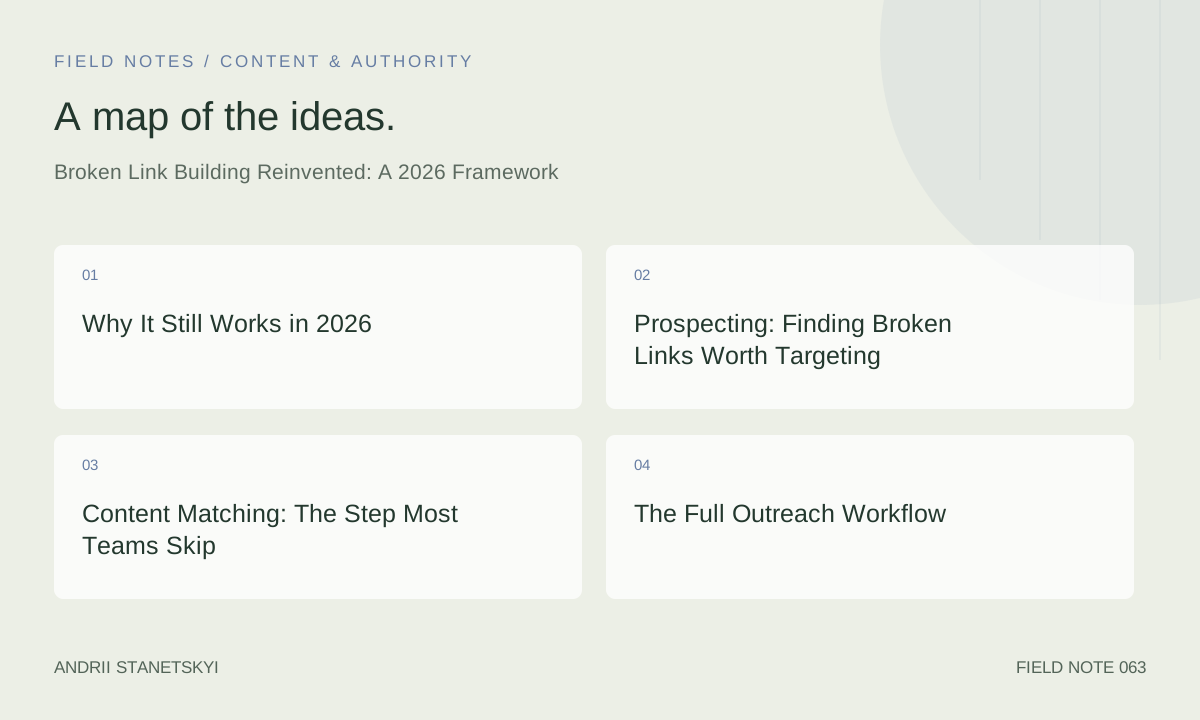
Why It Still Works in 2026
Broken link building works because it is the only major outreach tactic built on a genuine value exchange. You are not asking a webmaster for a favor. You are reporting a problem their visitors are experiencing (a 404 error on a resource they recommend) and offering a solution (your replacement content). The framing is fundamentally different from a standard link request, which is why response rates are 3–5x higher than cold outreach.
The reasons practitioners give up on it — "all the good broken links are gone," "it takes too long," "the conversion rates are too low" — all trace back to using it as a manual, opportunistic tactic rather than a systematic, scaled workflow. This guide is about the latter.
Google's algorithm treats broken link building-earned links the same as any editorially placed link, provided the replacement content genuinely serves the linking page's context. This is a critical point: the content quality requirement has increased since 2022. A thin replacement page will get placed but will not earn lasting link equity.
Prospecting: Finding Broken Links Worth Targeting
Method 1: Competitor Backlink Analysis in Ahrefs
Start with sites that link to your competitors. In Ahrefs Site Explorer, enter a competitor's domain and navigate to Backlinks. Apply these filters:
Ahrefs Backlink Filter Settings:
- Link type: Dofollow
- One link per domain: ON
- DR filter: 30–80 (adjust per your target tier)
- Platform: Blog / News / Resource
- HTTP code on linking page: 200 (live pages only)

Then export and cross-check target URLs in Ahrefs Batch Analysis
to identify which target pages return 404 status.
This gives you a list of sites that have already shown willingness to link to your niche and are currently linking to broken content — the highest-quality broken link prospecting pool available.
Method 2: Wayback Machine + Ahrefs Broken Links Report
For any competitor or resource site, run Ahrefs Site Explorer → Broken Links (internal). This shows you all the 404 pages on their site that other pages link to. Cross-reference with the Wayback Machine to see what content used to live at that URL — this is your content matching intelligence.
# Ahrefs API query for broken outbound links (for programmatic prospecting)
GET https://apiv2.ahrefs.com?
  target=example.com
  &mode=domain
  &output=broken_links
  &select=url_from,url_to,anchor,type
  &where=type%3Ddofollow
  &limit=1000
  &token=YOUR_TOKEN
Method 3: Screaming Frog + Resource Page Crawl
Resource pages ("useful links," "recommended resources," "further reading") are goldmines for broken links. Identify resource pages in your niche using Google operators, then crawl them with Screaming Frog:
Google search operators for resource page discovery:
inurl:resources "your keyword"
inurl:links "your keyword"
"useful resources" + "your keyword"
intitle:"resources" "your keyword" -site:wikipedia.org

In Screaming Frog:
Mode → Spider → Configuration → Custom → Extraction
Then: Reports → Response Codes → Client Error (4xx)
to surface broken outbound links on crawled pages.
Prospecting Quality Filter
Not all broken links are worth pursuing. Apply this filter before adding to your outreach queue:
| Signal | Accept | Marginal | Reject |
|---|---|---|---|
| Linking page DR | 40+ | 25–39 | <25 |
| Linking page UR | 15+ | 5–14 | <5 |
| Linking page organic traffic | 500+/mo | 100–499/mo | <100/mo |
| Topical relevance to your content | Direct match | Adjacent niche | Unrelated |
| Number of outbound broken links on page | 1–3 | 4–7 | 8+ (likely abandoned) |
| Last updated date of linking page | <2 years ago | 2–4 years ago | 4+ years ago |
Content Matching: The Step Most Teams Skip
This is where most broken link building campaigns fail. Teams find a broken link, send an outreach email pointing to a loosely related page on their site, and wonder why conversion rates are 2%. The linking webmaster's implicit question is: "Will your replacement content serve my readers as well or better than the original?" If the answer isn't obviously yes, they'll do nothing.
Using the Wayback Machine for Content Intelligence
Before pitching any broken link, retrieve the original content from archive.org. Look at what the page covered, how long it was, what format it used, and what specific resources or data it cited. Your replacement content needs to meet or exceed that quality standard.
If you don't have existing content that matches: don't pitch. Either create a purpose-built replacement asset first, or skip that opportunity. A thin replacement page earns the link but doesn't pass meaningful equity — and may be removed during the webmaster's next site update.
The 80% Match Rule
Your replacement content must cover at least 80% of the same topic territory as the original, plus add something new (updated data, additional depth, a relevant tool). This is what earns the link and keeps it. Anything less is a conversion at the cost of a low-quality link that may eventually be removed.
The Full Outreach Workflow
- Prospect and score (see above). Target: 100 qualified opportunities per campaign.
- Verify broken status within 48 hours of outreach. A page that returns 404 today may redirect tomorrow, making your pitch irrelevant.
- Find contact information. Prioritize: (a) direct email for the content/web team, (b) contact form, (c) social media DM. Use Hunter.io patterns to find email addresses when not listed.
- Send initial pitch (template below). Keep it short — under 150 words.
- Follow up once on day 5–7 if no response. Two contacts maximum. Do not send a third follow-up.
- Track responses in Pitchbox or BuzzStream. Log: contacted, responded positively, link placed, declined, no response.
- Monitor link placement in Ahrefs and GSC within 2 weeks of positive response.
Email Templates and Scripts
Primary Broken Link Outreach Template
Subject: Broken link on [page title or URL segment]

Hi [First name],

Quick heads-up — I found a broken link on your [page title] page:

The link to "[anchor text]" pointing to [broken URL] is returning a 404.

I recently published a piece that covers the same topic and would make a solid replacement: [your URL]

It covers [brief 1-sentence description matching the original's scope].

Either way, thought you'd want to know about the broken link.

[Name]
Notes on this template: the opening is a service, not a request. The link suggestion is framed as secondary. The closer acknowledges they may not use your content ("either way"). This framing consistently outperforms templates that lead with the pitch.
Alternative: Rapport-First Approach (for DR 70+ targets)
Subject: Found something off on your resources page

Hi [First name],

Saw your [page title] page while researching [topic] — great collection of resources.

One issue: the link to [anchor text] → [broken URL] is dead. Returns a 404 now.

I wrote a fairly comprehensive piece on [topic] last month ([your URL]) that might work as a replacement, but no pressure — just wanted to flag the broken link.

Thanks for keeping that resource page maintained. It's one of the better ones in [industry].

[Name]
Success Metrics and Conversion Benchmarks
Based on executing broken link campaigns across multiple industries, here are realistic benchmarks for a well-run campaign:
- Response rate (any response): 12–18%
- Positive response rate: 8–12%
- Link placement rate (from positive responses): 70–85%
- Net conversion rate (links placed / emails sent): 6–10%
- Average DR of placed links: varies by prospecting quality, target 45–65
For a campaign with 100 qualified prospects: expect 6–10 placed links. This sounds modest but is consistently competitive with other outreach methods when adjusted for link quality. The average broken link building placement is higher quality than the average guest post link because it's placed in an established editorial context rather than a contributed article. Compare this to HARO editorial link rates in our HARO guide.
Mini Case Study: B2B Software, 41 Links in 60 Days
Client: Project management software company, DR 52, targeting resource pages in the productivity and business operations niche.
Approach: Used Ahrefs' broken links report on 15 top competitor sites combined with a manual crawl of 200+ resource pages identified via Google operators. Applied the scoring criteria above, resulting in 410 qualified broken link opportunities.
Content preparation: Before outreach, audited existing content library against identified broken link topics. Created 4 new long-form guides (2,500–4,000 words each) to cover gaps where no existing content matched the broken link topic.
Outreach execution: 410 emails sent via Pitchbox over 3 weeks. Used the primary template with personalized first lines for DR 50+ targets.
Results:
- Response rate: 14.6%
- Links placed: 41
- Net conversion: 10% (41/410)
- DR range: 28–74
- 22 links from DR 40+ sites
- Domain rating impact: +4 DR points over 60-day window
Key learning: The 4 purpose-built replacement guides accounted for 19 of the 41 placements — a disproportionate 46% of links from 4 assets. Purpose-built content for specific broken link opportunities consistently outperforms retrofitting existing pages.
FAQ
Is broken link building scalable?
Yes, with the right tooling. The prospecting can be partially automated via Ahrefs API, Screaming Frog batch crawls, and Pitchbox's broken link finder. The content creation and quality review cannot be automated. A realistic throughput for one outreach specialist: 300–500 prospected opportunities and 200–300 emails per month.
Should I disclose that I want a link in my outreach?
The template above discloses it implicitly by providing your URL. Some practitioners prefer explicit disclosure ("I'd love it if you considered replacing it with my content"). Implicit is generally higher converting. What you should never do is hide the self-interest entirely — recipients who feel manipulated don't convert and sometimes publicly complain.
What if the broken link I found is a competitor's content that was removed?
This is actually the best scenario. If a competitor's content was good enough to earn an editorial link, there's a clear demand for that content type. Use the Wayback Machine to study what they published, build something better, and pitch it as a replacement. This is the intersection of broken link building and the Skyscraper technique. See our Skyscraper 2.0 guide for the combined approach.
How do I find the right contact person on large sites?
For large publications: find the byline author on the specific page linking to the broken resource. Use LinkedIn + Hunter.io to find their direct email. Editors-in-chief at large sites rarely respond to unsolicited link emails. The specific writer is far more likely to update their own content when notified of a resource issue.
Does the anchor text of the broken link matter?
Yes, for two reasons. First, it tells you what context the webmaster wanted to convey with that link — your replacement content should cover the same semantic territory. Second, when the webmaster replaces the link, they'll often reuse or adapt the original anchor text. If the original anchor was a partial match for your target keyword, this is an additional upside.
How do I track whether placed links are maintained long-term?
Set up monthly Ahrefs alerts for lost links on your domain. Any broken link-earned link that disappears within 6 months suggests the linking page was either updated without re-linking or the webmaster did a broader resource page overhaul. Note these patterns — they help you identify which types of pages tend to maintain links long-term vs. which are likely to be overhauled. See our backlink audit guide for monitoring workflows.
Key Takeaways
- Broken link building works in 2026 because it offers genuine value — fixing a broken user experience — not just a link exchange.
- Systematic prospecting via Ahrefs broken links reports and Screaming Frog resource page crawls is far more efficient than manual hunting.
- Content matching is the critical success factor. Purpose-built replacement content outperforms retrofitted existing pages 2–3x in conversion rate.
- Keep outreach templates short and frame the link suggestion as secondary to the broken link notification.
- Realistic benchmarks: 6–10% net conversion rate, DR 45–65 for quality-filtered prospects.
- Never send more than two contact attempts per prospect. Persistence beyond this damages your domain reputation with webmasters.
Conclusion
The teams winning with broken link building in 2026 are those who treat it as a precision operation, not a volume game. Rigorous prospect scoring, genuine content matching, and transparent outreach framing are the three pillars. Get these right and broken link building will produce some of the most cost-efficient high-DR links in your program. Ahrefs' own guide to broken link building provides additional prospecting approaches.