HARO (Help A Reporter Out) rebranded to Connectively, then effectively shut down its free tier in 2024. Journalists didn't stop needing expert sources — the ecosystem just fragmented. In 2026, earning editorial links through expert commentary requires working across four or five platforms simultaneously, with a sharper response quality standard than ever before. This guide maps the complete landscape, from Connectively's paid tier to Help A B2B Writer, Qwoted, and the direct journalist relationship approach that top practitioners prefer over all automated platforms.
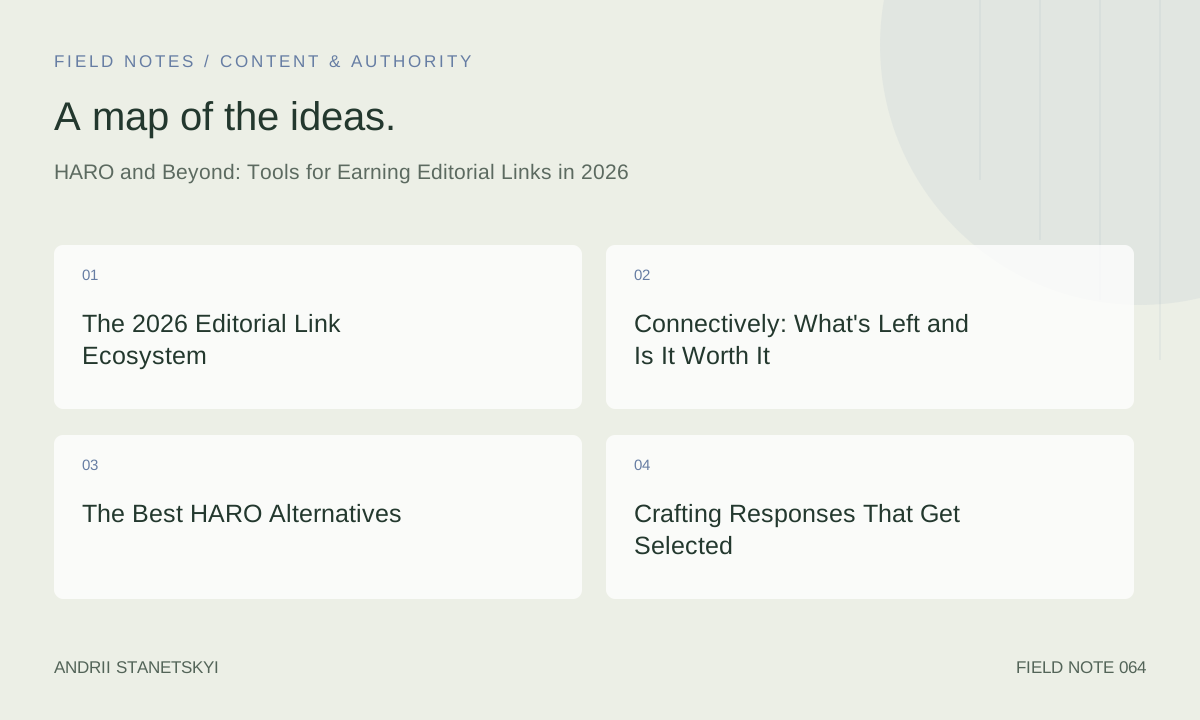
The 2026 Editorial Link Ecosystem
Editorial links — links earned because a journalist chose to cite you as a credible expert — are the gold standard of link building. They carry full editorial endorsement, tend to come from high-DR publications, and are virtually impossible for Google to classify as manipulative. A single editorial link from Forbes, Business Insider, or a top trade publication can move rankings for highly competitive terms.
The challenge is supply. Journalists receive hundreds of source requests per query on the major platforms. Standing out requires both platform strategy (being on the right platforms) and response quality (being genuinely more useful than the 200 other responders).
The ecosystem has consolidated and diversified simultaneously since HARO's free tier closed:
- Fewer casual responders on paid platforms = higher signal-to-noise ratio
- More specialized platforms for specific niches (B2B, tech, finance)
- Direct journalist outreach has become more viable as platforms become less efficient
Connectively: What's Left and Is It Worth It
Connectively (formerly HARO) in 2026 operates a paid model with tiered subscription access. The free tier limitations made it impractical for serious link building — response quotas and delayed query access put free users at a systematic disadvantage.
The paid tier ($49–149/month depending on features) provides:
- Real-time query alerts without delay
- Category filtering (business, tech, lifestyle, finance, etc.)
- Response tracking
- Profile visibility features
Is it worth it? For teams with a strong expert bench and a consistent response process: yes. The platform still reaches journalists at major publications. Response rates have improved since the free-tier cull reduced response volume. Expect a 12–20% success rate on well-crafted responses to relevant queries, translating to DR 45–85 links from major publications.
The honest assessment: Connectively alone is not a complete editorial link strategy. It needs to be part of a multi-platform approach.
The Best HARO Alternatives
Help A B2B Writer
Purpose-built for B2B content. Queries are more specific than Connectively, response volumes are lower (meaning less competition), and the linking sites tend to be specialized trade publications and high-quality business blogs. Particularly effective for SaaS, fintech, HR tech, and marketing technology companies. Free tier available; paid features from $25/month. See our B2B link building guide for the full B2B editorial link workflow.
Qwoted
Positions itself as the more professional alternative to Connectively. Journalists on Qwoted tend to be from larger publications. The verification process for both journalists and sources reduces spam. Response competition is lower than Connectively. Pricing: source subscription from $79/month.
SourceBottle
More active in Australia, UK, and Canada than the US market. Useful for regional link building campaigns targeting English-language publications in those markets. Free with premium features available.
Terkel (now part of Featured.com)
Aggregates expert responses for content creators publishing on medium-DR blogs and industry publications. Link quality is more variable than Connectively — expect DR 25–60 range. Volume is higher but quality screening is lower. Best used as a supplementary platform.
Direct Twitter/X and LinkedIn Sourcing
Journalists increasingly post source requests directly on social media. Following reporters who cover your beat on X and searching for "#journorequest" and "#PRrequest" hashtags surfaces opportunities that never appear on any platform. Response time advantage: you can respond within minutes of a journalist posting.
# Twitter/X search operators for journalist source requests
#journorequest [your industry keyword]
#HARO [your industry keyword]
"looking for sources" [your topic]
"need an expert" [your topic]

# LinkedIn search
Keywords: "looking for experts" OR "source request" OR "seeking comment"
Filter: Past 24 hours, sort by Recent
Crafting Responses That Get Selected
The most common mistake is treating editorial response platforms like a mass outreach channel. Journalists are experts at pattern-matching generic responses and deleting them. What earns a selection is a response that makes the journalist's job easier while making them look smarter to their readers.
The Four Elements of a Selected Response
- Specificity over generality. "Email marketing has a high ROI" will never be selected. "In our analysis of 3,200 B2B campaigns across 2024, segmented list email achieved 4.2x the open rate of broadcast sends, with the highest performers using behavioral triggers within 24 hours of a qualifying action" will be cited.
- A contrarian or underreported angle. Journalists are looking for something their readers haven't already read 50 times. If the conventional wisdom says X, and your experience says X is incomplete, lead with that.
- Quotable compression. Journalists need sentences that can be directly quoted without editing. Write your key insight as a single, punchy sentence that works as a standalone quote.
- Credential alignment. Your stated credential must match the query's context. If a journalist is writing for a tech publication, "10 years managing enterprise cloud infrastructure" is more compelling than "digital marketing consultant."
Length and Format
Optimal response length: 150–250 words for the core response, plus a two-line bio. Longer responses are rarely read in full. Shorter responses are perceived as low-effort. Structure: one-sentence direct answer to the query → supporting evidence or data → practical implication → quotable conclusion.
Response Templates and Frameworks
Data-Led Response Template
Re: [Query topic]

[Direct answer to the query question in one sentence.]

In our experience [or: In our analysis of X clients / X campaigns / X data points],
[specific finding with numbers]. For example, [concrete illustrative example].

The practical implication for [the journalist's audience]: [actionable takeaway
in one sentence].

[One-sentence quotable summary that could stand alone in an article.]

---
[Your name] | [Title] | [Company]
[Brief 1-line credential relevant to this specific query]
[Website or LinkedIn]
Contrarian/Insight Response Template
Re: [Query topic]

Most coverage of [topic] focuses on [conventional wisdom]. What's less discussed
is [your contrarian angle].

[Evidence or reasoning in 2–3 sentences.]

The result: [specific outcome or implication].

"[Quotable one-sentence version of your key point that works as a standalone pull quote]"

---
[Your name] | [Title] | [Company]
[Relevant credential]
Step-by-Step Process Response (for "how to" queries)
Re: [Query topic]

The process we use at [Company] / that I recommend:

1. [Step 1 — concrete and specific]
2. [Step 2 — with a detail that shows real-world experience]
3. [Step 3 — the step most people skip or get wrong]

The most common mistake: [specific error with consequence].

"[Quotable insight about the process or the mistake.]"

---
[Your name] | [Title] | [Company]
Building Direct Journalist Relationships
The highest-conversion editorial link source is a journalist who already knows and trusts you. Platform responses are a foot-in-the-door strategy. The goal is to convert platform citations into direct relationships where journalists come to you without a query.
The Post-Citation Follow-Up Process
- When a journalist uses your response and publishes the article, send a thank-you email within 24 hours. Keep it to two sentences. Do not ask for anything.
- Two weeks later, send a brief follow-up with a genuinely useful data point or observation relevant to the beat they cover. Still no ask.
- If they engage, offer to be a standing expert source: "I keep close track of [topic area] — happy to be a resource if you're ever looking for a quick data point or quote on this beat." This is the soft ask that converts responders to relationships.
Ten active journalist relationships in your niche will produce more high-quality links per year than any platform-based approach. The investment is in being genuinely useful over time. See our digital PR guide for how to scale journalist relationship management.
Platform Comparison and ROI Benchmarks
| Platform | Monthly Cost | Query Volume | Avg. DR of Linked Publications | Response Competition | Best For |
|---|---|---|---|---|---|
| Connectively (paid) | $49–149 | High | 50–85 | Medium-High | Consumer brands, generalist topics |
| Help A B2B Writer | $0–25 | Medium | 40–70 | Low-Medium | B2B SaaS, tech, HR, marketing |
| Qwoted | $79+ | Medium | 55–90 | Low | Finance, enterprise, press coverage |
| Featured.com | $0–99 | High | 30–65 | High | Volume strategy, supplementary |
| Direct (X/LinkedIn) | $0 | Variable | 50–95 | Very Low | All niches, highest quality ceiling |
Mini Case Study: HR Tech Company, 23 Editorial Links in Q1
Client: HR software platform, DR 44, targeting editorial links in the HR, future of work, and business management space.
Strategy: Multi-platform approach across Connectively, Help A B2B Writer, and direct X monitoring. Appointed one senior team member as the designated "source" — the company's VP of People with genuine expertise and a developed point of view on remote work policy.
Process implemented:
- Three platform query reviews per day (9am, 12pm, 4pm). Respond to all relevant queries within 2 hours of posting.
- Response templates pre-prepared for the five most common query themes on their beat (remote work policy, performance management, hiring trends, compensation benchmarking, HR tech adoption).
- Each response reviewed by VP before sending — enforcing the "would a journalist cite this?" standard.
- Post-citation follow-up process executed for every placed link.
Q1 results:
- Total responses submitted: 187
- Links earned: 23
- Overall conversion rate: 12.3%
- DR range: 38–88 (Forbes, Inc., SHRM, HR Dive among publications)
- Journalist relationships developed for ongoing access: 4
- DR impact: +5 points over 90 days
Key learning: The 2-hour response window was decisive. Queries that received a response within 2 hours converted at 18%. Queries responded to after 6 hours converted at 6%. Speed of response is the single most controllable variable on any source platform.
FAQ
Is HARO / Connectively still worth using in 2026?
The paid tier of Connectively is worth it for teams with a dedicated response process and genuine expert sources. The free tier is no longer viable for serious link building. Do not use it as your only editorial link source — diversify across platforms and direct outreach.
How many responses should I submit per week to see results?
Quality over quantity applies here too. 10 excellent, highly targeted responses per week will outperform 50 mediocre ones. A team submitting 15–20 high-quality responses per week across all platforms should expect 2–4 editorial links per month from a standing start.
What credential matters most to journalists when selecting sources?
Specific, verifiable experience relevant to their query. "Head of Marketing at [Named Company]" beats "digital marketing expert." A specific data point from your own research beats both. Journalists fact-check sources — the more verifiable your credential, the better.
How do I handle queries where I'm not a perfect match topically?
Don't respond. The competitive disadvantage of being a second-tier expert on a query is too large to overcome with response quality alone. Save your response bandwidth for queries where you have a genuine primary credential. Batting average matters more than volume.
Can I use AI to draft responses?
Using AI as a drafting tool is fine, but the output must be heavily edited with real data, specific examples from actual experience, and a distinct voice. Journalists recognize AI-generated generic responses immediately. A response that reads as if it could have been written by anyone will not be selected. The differentiator is specific, personal, verifiable expertise. See our content quality standards guide for how to check AI-assisted content before sending.
What should I do if a journalist uses my response but doesn't link to my site?
Follow up within 48 hours: "Loved how [article title] turned out — would you be open to adding a link to [your site] so readers can find more of [expert's] work on this topic?" Frame it as reader utility. Success rate: roughly 35–50%. Always worth asking once politely.
Are there industry-specific platforms I should be using?
Yes. Legal (LawFuel, law-specific PR wire), medical/health (HealthJournalist.org, AHCJ source board), finance (PR Newswire finance desk alerts), tech (TechRepublic editorial sourcing). Niche platforms have dramatically lower competition than general platforms. See the comprehensive directory of editorial sourcing platforms by vertical.
Key Takeaways
- HARO's closure of its free tier accelerated a shift to a multi-platform approach. No single platform is sufficient in 2026.
- Speed of response is the highest-leverage variable under your control. Respond within 2 hours for maximum conversion.
- Response quality is defined by specificity, data, and genuine expertise — not length or keyword density.
- Help A B2B Writer is underutilized and has lower competition than Connectively for B2B niches.
- The end goal is direct journalist relationships, not platform dependency. Use platforms to start relationships, not sustain them.
- A single DR 80 editorial link from Forbes, Inc., or a major trade publication is worth 3 months of standard link building effort. Prioritize these opportunities accordingly.
Conclusion
Editorial links from journalist citations are the most credible links a site can earn — editorially verified, topically contextual, and from publications with genuine organic traffic. The platform landscape for earning them has changed significantly since 2023, but the underlying mechanics haven't: be genuinely useful to journalists, respond fast, and write responses that make their job easier. Do this consistently and the links follow.