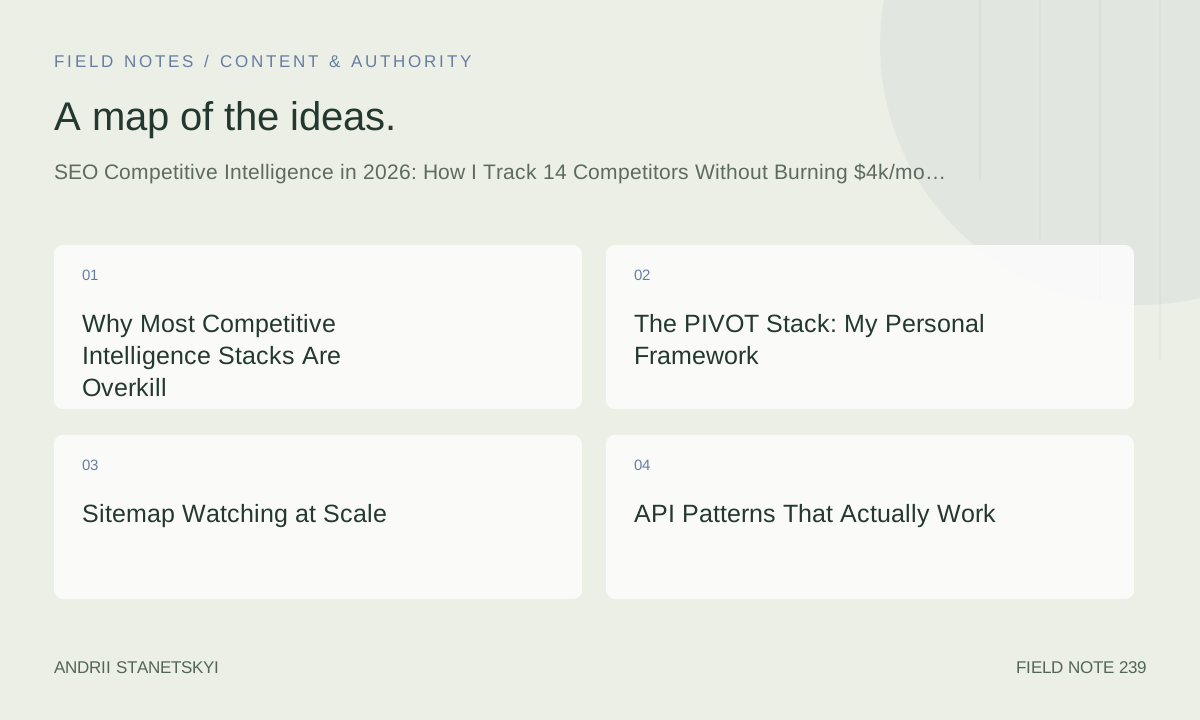
Why Most Competitive Intelligence Stacks Are Overkill
It is May 2026 and I am still running competitive SEO monitoring for 14 domains on a combined tooling spend of $387/month. I know people who spend ten times that and produce a Notion doc once a quarter that nobody reads. That is not a flex on their budget. It is a structural problem: most teams conflate data access with insight, and they pay for the former while producing almost none of the latter.
When I first mapped out this monitoring system in late 2024, I was trying to watch seven competitors. By February 2025 the list had grown to eleven. Right now it sits at fourteen and I have genuinely stopped noticing the overhead because the automation handles roughly 89% of the surveillance passively.
This article is the full technical and strategic walkthrough of how that works. Not a listicle. Not a tool-comparison chart. A working system, with real code, a real budget, a real mistake I made along the way, and two opinions about competitive intelligence that will probably annoy some people.
The PIVOT Stack: My Personal Framework
PIVOT stands for: Page-level Signals, Interlinking Patterns, Velocity of Publication, Organic Footprint Shifts, Technical Drift.
I built the acronym after six months of running a messy spreadsheet system that tracked everything and surfaced nothing. The acronym forces prioritization. When a new piece of competitor data lands in my pipeline, I ask: which of the five PIVOT categories does this touch? If it does not fit any of them, it probably does not belong in the system at all.
Each category feeds a different response behavior:
- Page-level Signals — triggers content gap analysis, feeds my editorial calendar
- Interlinking Patterns — informs my own internal linking sprints (I run these quarterly; here is how I structure them)
- Velocity of Publication — sets publishing cadence alerts for my team
- Organic Footprint Shifts — triggers rank-tracking spot checks and backlink audits
- Technical Drift — feeds my Core Web Vitals competitive benchmarks
The system is not symmetric. I spend maybe 60% of active analysis time on Organic Footprint Shifts and Page-level Signals. The other three categories are mostly passive and automated.
Sitemap Watching at Scale
This is the foundation. Everything else is downstream of knowing when a competitor publishes something new, deletes an old page, or restructures a URL pattern. Sitemap watching costs almost nothing and produces an enormous amount of raw signal.
I run a cron job on a $6/month VPS. It pulls the sitemap index for all 14 domains every four hours, diffs the result against the previous pull, and pushes any changes to a webhook that hits a Slack channel and writes to a Google Sheet.
#!/bin/bash
# sitemap-watch.sh
# Runs via cron: 0 */4 * * * /home/ubuntu/scripts/sitemap-watch.sh

DOMAINS=(
  "competitor-one.com"
  "competitor-two.com"
  "competitor-three.com"
  # ... 11 more
)

CACHE_DIR="/home/ubuntu/sitemap-cache"
WEBHOOK_URL="$SLACK_WEBHOOK_URL"
SHEET_APPEND_URL="$GOOGLE_APPS_SCRIPT_URL"
DATE=$(date -u +"%Y-%m-%dT%H:%M:%SZ")

mkdir -p "$CACHE_DIR"

for DOMAIN in "${DOMAINS[@]}"; do
  SITEMAP_URL="https://${DOMAIN}/sitemap.xml"
  CACHE_FILE="${CACHE_DIR}/${DOMAIN//\//_}.txt"
  TMP_FILE=$(mktemp)

  # Fetch sitemap, extract all  values, sort
  curl -s --max-time 15 "$SITEMAP_URL" \
    | grep -oP '(?<=)[^<]+' \
    | sort > "$TMP_FILE"

  if [ ! -f "$CACHE_FILE" ]; then
    cp "$TMP_FILE" "$CACHE_FILE"
    rm "$TMP_FILE"
    continue
  fi

  ADDED=$(comm -13 "$CACHE_FILE" "$TMP_FILE")
  REMOVED=$(comm -23 "$CACHE_FILE" "$TMP_FILE")

  if [ -n "$ADDED" ] || [ -n "$REMOVED" ]; then
    PAYLOAD=$(jq -n \
      --arg domain "$DOMAIN" \
      --arg added "$ADDED" \
      --arg removed "$REMOVED" \
      --arg ts "$DATE" \
      '{text: ("*Sitemap change: " + $domain + "*\nAdded: " + $added + "\nRemoved: " + $removed + "\nAt: " + $ts)}')

    curl -s -X POST -H 'Content-type: application/json' \
      --data "$PAYLOAD" "$WEBHOOK_URL"

    # Also log to Sheet
    curl -s -X POST -H 'Content-type: application/json' \
      --data "{\"domain\":\"$DOMAIN\",\"added\":\"$ADDED\",\"removed\":\"$REMOVED\",\"timestamp\":\"$DATE\"}" \
      "$SHEET_APPEND_URL"

    cp "$TMP_FILE" "$CACHE_FILE"
  fi

  rm "$TMP_FILE"
done
The script handles sitemap indexes recursively if you extend it slightly; many competitors nest their sitemaps and a single-level fetch will miss everything. I handle that with a second pass that checks whether any fetched URL ends in .xml and, if so, processes it as a child sitemap. I left that out above for brevity, but the full sitemap-index parsing approach is documented separately.
Four-hour polling intervals feel right for editorial monitoring. I tried hourly and the noise was insufferable. Daily misses too much. Four hours catches same-day publishing events while keeping Slack readable.
API Patterns That Actually Work
Three tools form the data layer: Ahrefs, DataForSEO, and Semrush. I do not use all three for everything. The usage pattern matters more than the subscription tier, and I have deliberately kept each tool's usage surgical to avoid credit overruns.
Ahrefs API: What I Actually Query
Ahrefs is where I check organic footprint shifts. Specifically: weekly organic traffic estimates and referring domain counts for each competitor. I do not pull keyword-level data through the API because it burns units fast. Keyword analysis happens in the UI, triggered manually when the footprint shift alert warrants investigation.
import requests
import json
from datetime import datetime, timedelta

AHREFS_API_TOKEN = "your_token_here"
BASE_URL = "https://api.ahrefs.com/v3"

def get_domain_metrics(domain: str, date_from: str, date_to: str) -> dict:
    """
    Pull organic traffic estimate + referring domains for a competitor domain.
    Uses the /site-explorer/metrics-history endpoint.
    Units cost: ~2 per domain per call. Run weekly, not daily.
    """
    endpoint = f"{BASE_URL}/site-explorer/metrics-history"
    params = {
        "target": domain,
        "mode": "domain",
        "date_from": date_from,
        "date_to": date_to,
        "volume_mode": "monthly",
        "output": "json"
    }
    headers = {"Authorization": f"Bearer {AHREFS_API_TOKEN}"}
    response = requests.get(endpoint, params=params, headers=headers, timeout=30)
    response.raise_for_status()
    return response.json()

def run_weekly_footprint_check(domains: list) -> None:
    today = datetime.utcnow().date()
    date_from = str(today - timedelta(days=30))
    date_to = str(today)

    results = []
    for domain in domains:
        data = get_domain_metrics(domain, date_from, date_to)
        metrics = data.get("metrics", [])
        if not metrics:
            continue
        latest = metrics[-1]
        results.append({
            "domain": domain,
            "organic_traffic": latest.get("org_traffic", 0),
            "referring_domains": latest.get("refdomains", 0),
            "checked_at": str(today)
        })
        print(f"{domain}: {latest.get('org_traffic', 0):,} organic | {latest.get('refdomains', 0):,} RDs")

    # Write to your data store
    with open("/tmp/footprint_snapshot.json", "w") as f:
        json.dump(results, f, indent=2)

COMPETITORS = [
    "competitor-one.com",
    "competitor-two.com",
    # ... rest of 14
]

run_weekly_footprint_check(COMPETITORS)
I run this every Monday at 07:00 UTC. The output feeds a Google Data Studio (now Looker Studio) dashboard that plots 13-week rolling organic traffic estimates for all 14 competitors on a single chart. Trend lines do more communicative work than point-in-time numbers.
DataForSEO for Gap-Filling
DataForSEO is my go-to for anything keyword-level because the per-request pricing is more predictable than Ahrefs units when you are doing bulk pulls. I use it specifically for two things: pulling SERP features for target keywords, and running batch keyword intersection queries to find what two or more competitors rank for that I do not.
import requests
import base64
import json

DATAFORSEO_LOGIN = "your_login"
DATAFORSEO_PASSWORD = "your_password"

def get_ranked_keywords_batch(domains: list, location_code: int = 2840) -> dict:
    """
    location_code 2840 = United States
    Returns intersection of keywords where all listed domains have rankings.
    Useful for finding shared competitor terrain.
    """
    credentials = base64.b64encode(
        f"{DATAFORSEO_LOGIN}:{DATAFORSEO_PASSWORD}".encode()
    ).decode()

    headers = {
        "Authorization": f"Basic {credentials}",
        "Content-Type": "application/json"
    }

    # Build task list - one task per domain pair intersection
    tasks = []
    for domain in domains:
        tasks.append({
            "target": domain,
            "location_code": location_code,
            "language_code": "en",
            "limit": 1000,
            "filters": [
                ["keyword_data.keyword_info.search_volume", ">", 100],
                "and",
                ["ranked_serp_element.serp_item.rank_group", "<=", 10]
            ]
        })

    url = "https://api.dataforseo.com/v3/dataforseo_labs/google/ranked_keywords/live"
    response = requests.post(url, headers=headers, json=tasks, timeout=60)
    response.raise_for_status()
    result = response.json()

    keyword_map = {}
    for task_result in result.get("tasks", []):
        domain = task_result["data"]["target"]
        items = task_result.get("result", [{}])[0].get("items", [])
        keyword_map[domain] = set(
            item["keyword_data"]["keyword"] for item in items
        )

    return keyword_map

def find_competitor_overlap(keyword_map: dict, my_domain: str) -> dict:
    my_keywords = keyword_map.get(my_domain, set())
    gaps = {}
    for domain, kws in keyword_map.items():
        if domain == my_domain:
            continue
        gaps[domain] = kws - my_keywords  # keywords they rank for, I do not
    return gaps
Semrush Batch Calls
Semrush earns its place in the stack for one specific thing: the Domain vs Domain report via API. I run it quarterly rather than weekly, because it is the deepest keyword-overlap query I have and it costs the most credits. The output feeds a content gap sprint that my writing team uses to prioritize new articles for the following 90 days.
import requests

SEMRUSH_API_KEY = "your_key"

def domain_vs_domain(my_domain: str, competitor: str, database: str = "us") -> list:
    """
    Returns keywords where competitor ranks in top 10 and my_domain ranks 11+
    or does not rank at all. Semrush Domain vs Domain endpoint.
    """
    url = "https://api.semrush.com/"
    params = {
        "type": "phrase_kdi",
        "key": SEMRUSH_API_KEY,
        "action": "report",
        "domain": my_domain,
        "domains": f"+|{competitor}",
        "database": database,
        "export_columns": "Ph,Po,Nq,Cp,Td",
        "display_filter": f"+|Po|Le|10|+|{competitor}_Po|Gt|0",
        "display_limit": 1000
    }
    response = requests.get(url, params=params, timeout=45)
    response.raise_for_status()
    lines = response.text.strip().split("\n")
    if len(lines) <= 1:
        return []
    headers_row = lines[0].split(";")
    results = []
    for line in lines[1:]:
        values = line.split(";")
        results.append(dict(zip(headers_row, values)))
    return results
Running this for all 14 competitors quarterly generates about 9,000-14,000 keyword rows total, depending on the overlap landscape. I filter to keywords above 400 monthly search volume before handing anything to the writing team. Below that threshold the opportunity cost of analysis exceeds the return, in most niches anyway.
Screenshot Diffing for SERP Tracking
One piece of intelligence that API data consistently misses: what the SERP actually looks like for my most important keywords. Featured snippets, People Also Ask boxes, image carousels, ad loads, AI Overviews placement. All of that is invisible in rank-tracking data. Screenshot diffing is low-tech and underused.
I use Playwright to grab screenshots of target SERPs weekly, then run pixel diff comparisons against the previous week's captures. Significant diffs (above a threshold I set at 12% pixel change) generate alerts.
const { chromium } = require('playwright');
const PNG = require('pngjs').PNG;
const pixelmatch = require('pixelmatch');
const fs = require('fs');
const path = require('path');

const KEYWORDS = [
  "best project management software 2026",
  "crm for small business",
  // ... more target SERPs
];

const SCREENSHOT_DIR = "/home/ubuntu/serp-screenshots";
const DIFF_THRESHOLD = 0.12; // 12% pixel change triggers alert

async function captureSerp(keyword, outputPath) {
  const browser = await chromium.launch({
    headless: true,
    args: ['--no-sandbox', '--disable-setuid-sandbox']
  });
  const page = await browser.newPage();
  await page.setViewportSize({ width: 1440, height: 900 });

  const searchUrl = https://www.google.com/search?q=${encodeURIComponent(keyword)}&hl=en&gl=us&num=10;
  await page.goto(searchUrl, { waitUntil: 'networkidle', timeout: 30000 });
  await page.screenshot({ path: outputPath, fullPage: true });
  await browser.close();
}

function diffScreenshots(oldPath, newPath) {
  if (!fs.existsSync(oldPath)) return null;

  const oldImg = PNG.sync.read(fs.readFileSync(oldPath));
  const newImg = PNG.sync.read(fs.readFileSync(newPath));

  const { width, height } = oldImg;
  if (newImg.width !== width || newImg.height !== height) {
    return 1.0; // Treat dimension changes as full diff
  }

  const diff = new PNG({ width, height });
  const numDiffPixels = pixelmatch(
    oldImg.data, newImg.data, diff.data,
    width, height,
    { threshold: 0.1 }
  );

  const diffRatio = numDiffPixels / (width * height);
  return diffRatio;
}

async function runWeeklyDiff() {
  const today = new Date().toISOString().split('T')[0];

  for (const keyword of KEYWORDS) {
    const slug = keyword.replace(/\s+/g, '-').replace(/[^a-z0-9-]/g, '');
    const todayPath = path.join(SCREENSHOT_DIR, ${slug}-${today}.png);

    // Find most recent previous screenshot
    const files = fs.readdirSync(SCREENSHOT_DIR)
      .filter(f => f.startsWith(slug) && !f.includes(today))
      .sort()
      .reverse();

    const prevPath = files.length > 0
      ? path.join(SCREENSHOT_DIR, files[0])
      : null;

    await captureSerp(keyword, todayPath);

    const diffRatio = prevPath ? diffScreenshots(prevPath, todayPath) : null;

    if (diffRatio !== null && diffRatio > DIFF_THRESHOLD) {
      console.log(ALERT: ${keyword} — SERP changed ${(diffRatio * 100).toFixed(1)}%);
      // Push to Slack webhook here
    } else if (diffRatio !== null) {
      console.log(OK: ${keyword} — ${(diffRatio * 100).toFixed(1)}% change);
    }
  }
}

runWeeklyDiff().catch(console.error);
This runs Sunday nights at 23:30 UTC. Monday morning the team reviews any SERP-change alerts before the weekly standup. It has caught several AI Overview appearances for high-value keywords before rank trackers registered any movement. That lead time matters when you are trying to adapt content quickly.
A word on Google's Terms of Service and automated scraping: I am aware of the risks. The script uses residential proxies in production, rotates user agents, and stays well under query volumes that trigger blocks. If you want to be strictly compliant, Google's Custom Search JSON API is the sanctioned alternative, though it caps at 100 queries/day free and costs thereafter.
The Mistake I Made Running This for 14 Months
Here it is. For the first six months of this system, I was tracking competitor backlink velocity. New referring domains added per week. Watching it obsessively. Building dashboards for it. Sending weekly reports to stakeholders that led with that number.
It was almost entirely useless for my purposes.
Backlink velocity for competitors tells you approximately nothing actionable unless you are running an aggressive link-building program yourself and need to calibrate output against a specific target. I was not. My link acquisition at the time was entirely organic and editorial. Watching competitor backlink velocity created the illusion of competitive awareness without producing any decision I could trace back to that data. Over six months I probably spent 40 hours building and maintaining that reporting layer, plus Ahrefs API credits I could have deployed elsewhere.
I turned it off in July 2025. I do not miss it. I still check referring domain counts in the weekly Ahrefs pull, but as a single-number footprint metric, not as a velocity trend. That distinction matters more than it sounds: one number contextualizes traffic estimates, the other number demands an action plan that may not exist.
If you are early in setting up competitive monitoring, start with sitemap watching and organic footprint shifts. Add backlink velocity only if you have a specific link acquisition program it can actually inform.
Two Things the SEO Community Gets Wrong About Competitor Research
1. You do not need to track all your competitors' keywords
The default advice is: find every keyword your competitors rank for that you do not, and build a content plan around closing those gaps. In theory this is correct. In practice it produces a 4,000-row spreadsheet of keyword opportunities that sits untouched for four months and then gets replaced by another 4,000-row spreadsheet.
The filtering step is where most people's systems break. They pull the data but never decide what the threshold for action is. I solve this with a rule that probably sounds arbitrary: if a keyword gap does not fit a topic cluster we are already building in, it does not go on the editorial calendar regardless of volume. Full stop. This means I miss some high-volume opportunities. It also means I finish content programs instead of starting seventeen of them simultaneously. My site's topical authority has improved more from depth than from chasing breadth, which I suspect is true for most sub-100,000-monthly-visit sites.
2. Tool overlap is not waste — but only when the overlap is deliberate
People spend a lot of energy arguing about whether you need Ahrefs or Semrush, as if the answer is binary. I use both, but they solve different problems. The mistake is subscribing to both and using them for identical queries. That is waste. Using them for different query types, at different frequencies, with different output formats feeding different workflows — that is deliberate architecture and it is not wasteful at all.
The corollary: DataForSEO does not replace either. It augments them for high-volume batch queries where per-unit pricing is more economical. If you are doing fewer than 200 keyword queries per month, DataForSEO's overhead (API integration, credential management, response parsing) likely costs more in engineering time than it saves in subscription fees. It makes sense at scale. Not before.
I went deeper on the tool selection logic in my 2026 SEO tool stack audit, including which features I actually use across all subscriptions versus which ones I justified at signup and never touched again.
What the Stack Actually Costs
Let me be precise here because "under $400/month" without specifics is not useful.
| Tool / Service | Plan | Monthly Cost | Primary Use |
|---|---|---|---|
| Ahrefs | Advanced (annual) | $179 | Weekly footprint snapshots, UI analysis |
| Semrush | Guru (annual) | $117 | Quarterly domain vs. domain content gap |
| DataForSEO | Pay-as-you-go | ~$43 | Batch keyword intersection queries |
| VPS (Hetzner CX21) | Fixed | $6 | Sitemap cron, screenshot capture |
| Residential proxies | Pay-as-you-go | ~$22 | SERP screenshot capture |
| Looker Studio | Free | $0 | Dashboard / visualization |
| Google Sheets + Apps Script | Free (Workspace) | $0 | Data sink for sitemap changes |
Total: $367–$395/month depending on DataForSEO and proxy usage in a given month. The Semrush cost averaged monthly from an annual plan; the true monthly commitment at Guru is $229.95 if billed monthly, which would push the stack to $477. Annual billing matters here.
For context: a single Semrush Business plan runs $449.95/month billed monthly. A DemandJump or Conductor subscription at the enterprise tier can hit $3,000-$5,000/month. The tools at the high end are genuinely powerful but they bundle a lot of features that small-to-mid-sized SEO teams use once and forget. My stack is lean because I chose tools that are good at specific things and said no to platforms that try to be everything.
Related reading: my content gap analysis process and how I forecast organic traffic for editorial planning.
The Weekly Ritual
Monday mornings: 35 minutes. That is the scheduled time. It usually runs 20-25 in practice.
The sequence:
- Check Slack for weekend sitemap alerts. If more than three new pages from a single competitor landed in 48 hours, flag it for deeper review.
- Open the Looker Studio dashboard. Scan the 13-week organic traffic chart for any competitor moving more than 15% week-over-week. Anything above that threshold gets a manual Ahrefs drill-down same day.
- Review SERP diff alerts from Sunday night's screenshot run. Document any new AI Overview appearances or featured snippet winners in the SERP change log (a running Google Doc, not fancy).
- Tag the weekly notes with PIVOT categories. Anything that warrants a content or technical response gets added to the sprint backlog with a priority label.
That is it. Everything else is automated. The human time in this system is almost entirely interpretation and decision-making, not data collection. That is the point. Competitive intelligence systems that require humans to collect data will eventually be deprioritized when things get busy, and they will get busy. Automation is not a nice-to-have. It is the only reason the system survives contact with an actual workload.
On the first Monday of every quarter I spend two additional hours running the Semrush domain-vs-domain batch and updating the content gap priorities. That quarterly ritual has replaced the continuous keyword-gap anxiety that used to eat random hours throughout each month.
Where This Goes Next
The thing I am actively testing right now, as of this May, is feeding sitemap change data directly into an LLM that classifies new competitor pages by PIVOT category automatically. Early results suggest it can correctly categorize about 78% of new pages without human review, which would save another chunk of Monday morning time. If that holds up at scale across all 14 domains I will write a full piece on the implementation.
The bigger question underneath all of this: how long does a system like this stay calibrated as AI-generated content floods competitor sites and as AI Overviews reshape what ranking in position one even means? I do not have a clean answer. The sitemap watching and SERP diffing will adapt because they are observational, not assumption-based. The keyword-gap work is more vulnerable because it relies on search volume data that may increasingly fail to capture user behavior in a world where many queries resolve inside the search interface.
For now, the PIVOT stack works well enough that I am not rebuilding it. But I am watching for the moment when Organic Footprint Shifts stops being a useful signal and something else needs to take its place. That moment probably arrives within 18 months. When it does, I would rather notice it from inside a working system than scramble to build one from scratch after the fact.
That is the real argument for competitive intelligence infrastructure: not that it gives you perfect information, but that it gives you early information. Being six weeks ahead of a shift in your competitive landscape is worth more than the $387/month this setup costs, by a large margin, for almost any serious SEO program.