A keyword gap analysis tells you what your competitors rank for that you don't — but most practitioners treat this as a report to browse rather than a structured intelligence process to execute. The raw gap output from Ahrefs or Semrush, without filtering, segmentation, and prioritisation, produces a list of thousands of keywords that's equally useless and a list of zero keywords. The value is in what you do after you pull the data.
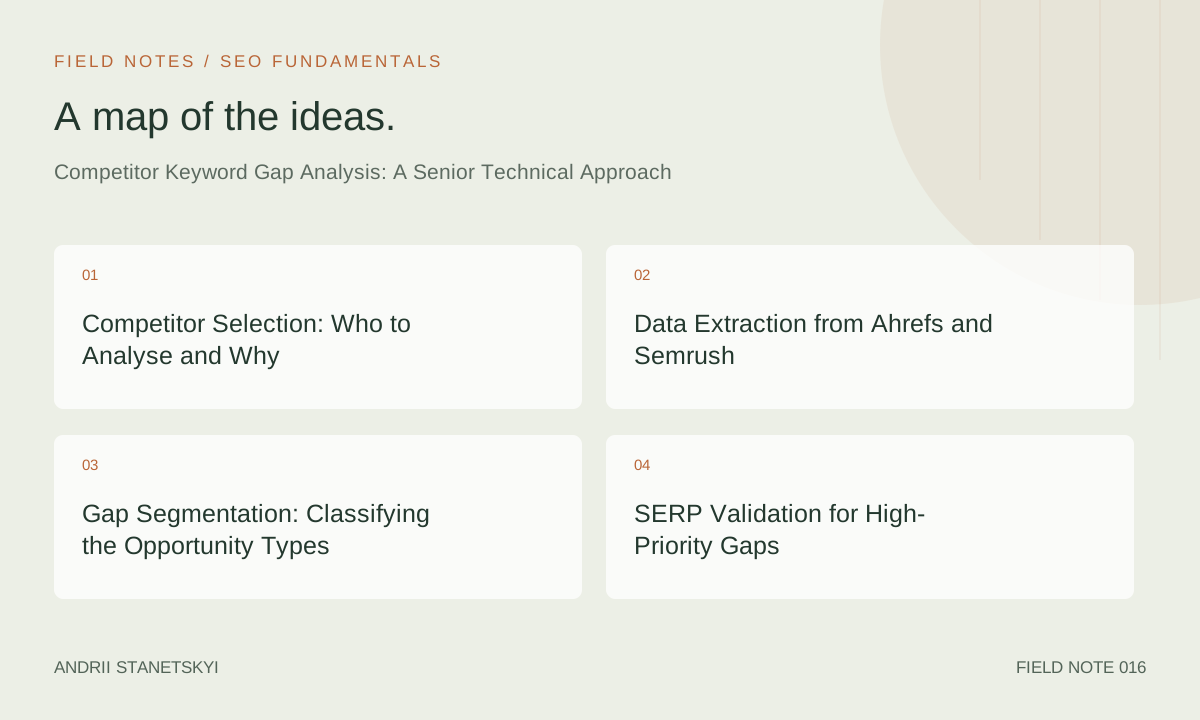
This guide covers the complete technical workflow for competitor keyword gap analysis in 2026: competitor selection, data extraction, segmentation strategy, SERP validation, and the decision framework that translates gap data into a prioritised content roadmap.
Competitor Selection: Who to Analyse and Why
Your business competitors and your SERP competitors are different sets. For keyword gap analysis, you want SERP competitors — the sites that consistently appear in top-10 results for the keyword clusters you're targeting, regardless of whether they compete for your customers directly.
How to Identify SERP Competitors
- Enter your site in Ahrefs Site Explorer → "Competing Domains" tab. This shows sites with the highest number of overlapping ranking keywords.
- Cross-reference with Semrush's "Competitors" report in Organic Research. Semrush uses a different algorithm, so you'll often see different (and complementary) competitors.
- Manually search your 10–15 most commercially valuable keywords and note which domains appear in top-5 results consistently. Any domain appearing in 4+ of those SERPs is a SERP competitor.
Selecting 3–5 Competitors for the Analysis
Don't run gap analysis against every competitor — the data becomes unmanageable and the signal dilutes. Select competitors across two tiers:
- Aspirational competitors (1–2): Sites with significantly higher DR (20–30 points above you) that dominate the category. Their gap keywords show you the full potential keyword landscape, including high-KD targets for longer-term investment.
- Peer competitors (2–3): Sites at similar DR (within 10 points). Their gap keywords are immediately actionable — similar authority means similar ranking prospects for the same keywords.
Running against aspirational competitors only produces a gap list full of KD 60+ keywords you can't rank for today. Running against peer competitors only produces a list of tactical quick wins but misses strategic opportunities. Both tiers together give you the full picture.
Data Extraction from Ahrefs and Semrush
Ahrefs Content Gap
- Open Ahrefs Site Explorer for your site
- Navigate to "Content Gap" in the left sidebar
- Enter competitor URLs (up to 10) in the "Show keywords that these targets rank for" section
- In the "But the following target doesn't rank for" section, enter your own URL
- Apply filters: Volume > 50, KD < 50 (adjust per your DR)
- Export full results (CSV)
The Ahrefs Content Gap report is keyword-level: it shows you all the keywords where at least one competitor ranks in top-100 but you don't rank at all. Apply an additional filter for "Intersect: 2+" to see keywords where multiple competitors rank — these are the highest-confidence gaps because multiple competitors independently determined these keywords were worth targeting.
Semrush Keyword Gap
- Navigate to Semrush → Keyword Gap
- Enter your domain and up to 4 competitor domains
- Select "Missing" keywords (keywords competitors rank for that you don't) or "Weak" (keywords where you rank significantly lower)
- Apply intent filter: Commercial + Transactional first (highest commercial value)
- Sort by KD ascending to surface most achievable gaps
- Export
Semrush's advantage here is the intent pre-labelling and the "Weak" category — keywords where you rank position 11–50 while competitors rank 1–10. These "Weak" keywords are often faster wins than "Missing" keywords because you already have some ranking signal.
Merging the Two Exports
import pandas as pd

# Load exports
ahrefs_gap = pd.read_csv("ahrefs_content_gap.csv")
semrush_gap = pd.read_csv("semrush_keyword_gap.csv")

# Standardise column names
ahrefs_gap = ahrefs_gap.rename(columns={
    "Keyword": "keyword",
    "Volume": "volume",
    "KD": "kd",
    "CPC": "cpc"
})

semrush_gap = semrush_gap.rename(columns={
    "Keyword": "keyword",
    "Volume": "volume",
    "Keyword Difficulty": "kd",
    "CPC": "cpc",
    "Intent": "intent"
})

# Merge on keyword
merged = pd.merge(ahrefs_gap[["keyword","volume","kd","cpc"]],
                  semrush_gap[["keyword","intent"]],
                  on="keyword", how="outer")

# Flag keywords appearing in both tools (higher confidence)
merged["in_both_tools"] = ~merged["intent"].isna() & merged["kd"].notna()

print(f"Total gap keywords: {len(merged)}")
print(f"Keywords validated in both tools: {merged['in_both_tools'].sum()}")
Gap Segmentation: Classifying the Opportunity Types
Not all keyword gaps are the same. Segmenting the gap into five types allows you to apply the right response to each:
| Gap Type | Definition | Response | Timeline |
|---|---|---|---|
| Content Gap (Pure) | No content exists on your site for the keyword cluster | Create new content | 4–12 weeks to publish |
| Content Quality Gap | Content exists but competitor's ranks higher due to depth/quality | Update existing content | 2–4 weeks to update, 4–8 weeks to see movement |
| Authority Gap | Content exists with equal quality but competitor has more links | Link building to existing page | 3–6 months |
| Structural Gap | Content exists but poor internal linking, wrong URL structure, or technical issues prevent ranking | Technical SEO fix | 2–6 weeks for fix, 4–8 weeks for ranking movement |
| Intent Gap | Your content targets the keyword but with wrong intent match | Content reformat or redirect to correct page | 2–4 weeks |
The segmentation decision happens during SERP validation. Pull up your site for each gap keyword in GSC — if you have impressions, it's not a pure content gap. If you have impressions and position 11–30, it's likely a quality or authority gap. If you have zero impressions, check if any page on your site mentions the topic — if yes, it may be a structural or intent gap.
SERP Validation for High-Priority Gaps
You cannot prioritise gap keywords without checking what's currently ranking for each one. The SERP composition tells you:
- Whether the intent matches your content capability
- Whether the competitor is ranking with content or with a product/landing page
- Whether the ranking is dominated by review aggregators (G2, Capterra, Trustpilot) — content alone won't beat these for product-category keywords
- Whether AI Overviews or featured snippets reduce the organic click opportunity
The SERP Validation Checklist
For each high-priority gap keyword (>200 volume or >$5 CPC), run this 5-point check:
- What type of content dominates the top 3? (Blog post, product page, comparison page, aggregator site)
- What is the average DR of ranking domains? (Ahrefs SERP overview) — compare to your DR.
- What is the content quality level? (Word count, recency, depth, data sources) — identify quality gaps in existing content.
- Are there SERP features reducing click opportunity? (Featured snippet, AI Overview, PAA, Shopping results)
- Does your competitor's ranking page have significant backlinks to it specifically? (Check the page-level backlink count in Ahrefs, not just domain DR)
Questions 1–2 tell you whether you can compete. Questions 3–5 tell you how to compete. Gaps where you can compete and have a clear how-to are your Tier 1 priorities.
Prioritisation Framework
After SERP validation, score each gap keyword using this weighted model:
# Gap keyword prioritisation scoring

def gap_priority_score(volume, kd, cpc, your_dr, avg_competitor_dr,
                       content_quality_gap, in_both_tools):
    """
    Returns a priority score from 0-100 for a gap keyword.

    Parameters:
    - volume: monthly search volume
    - kd: Ahrefs keyword difficulty (0-100)
    - cpc: cost per click in USD
    - your_dr: your site's Domain Rating
    - avg_competitor_dr: average DR of top-3 ranking competitors
    - content_quality_gap: 1-5 (5 = large quality gap, easy to beat existing content)
    - in_both_tools: True if validated in both Ahrefs and Semrush
    """
    import math

    # Volume score (log-normalised, max 25 points)
    volume_score = min(25, math.log(volume + 1) * 3)

    # Feasibility score (based on KD vs your DR, max 30 points)
    dr_kd_ratio = max(0, (your_dr - kd + 30) / 60)  # Normalised
    feasibility_score = dr_kd_ratio * 30

    # Commercial value score (CPC proxy, max 20 points)
    commercial_score = min(20, cpc * 2)

    # Content quality gap score (max 15 points)
    quality_score = (content_quality_gap / 5) * 15

    # Confidence bonus (max 10 points)
    confidence_bonus = 10 if in_both_tools else 0

    total = volume_score + feasibility_score + commercial_score + quality_score + confidence_bonus
    return round(total, 1)

# Example
score = gap_priority_score(
    volume=880,
    kd=22,
    cpc=8.40,
    your_dr=35,
    avg_competitor_dr=48,
    content_quality_gap=4,
    in_both_tools=True
)
print(f"Priority Score: {score}/100")  # Expected: ~72
Content Gap vs. Link Gap: Two Different Problems
One of the most common errors in gap analysis is treating all gaps as content gaps. Many gaps are actually link gaps — the competitor has equivalent or even weaker content, but their page has 3x the referring domains of your equivalent page. Creating new content for a link-gap keyword wastes editorial resources; the right response is link building to the existing page.
How to Distinguish Them
In Ahrefs, for each gap keyword where you have a ranking URL (even at position 15–50):
- Check "Backlinks" for your page vs. the competitor's ranking page
- Check "Content quality" by comparing word count, heading structure, and recency
- If your page has comparable content but <30% of the competitor's referring domains, it's a link gap — solve it with digital PR, link building, or internal link concentration, not content creation
- If your page has fewer than 50% of the competitor's word count and lacks their structural depth, it's a content quality gap — update the content first, then build links
Case Study: B2B Fintech Gap Analysis
A B2B payments software company (DR 38) conducted a competitor gap analysis against two peer competitors (DR 40, DR 44) and one aspirational competitor (DR 71, the category leader). The raw gap across three competitors contained 4,200 keywords.
After applying filters (Volume >100, KD <45), the list reduced to 840 keywords. After segmentation using the gap type classification:
- Pure Content Gaps: 310 keywords (no relevant content exists on site)
- Content Quality Gaps: 180 keywords (content exists but ranks 15–40)
- Authority/Link Gaps: 220 keywords (content exists at comparable quality but fewer links)
- Structural/Technical Gaps: 90 keywords (pages with technical issues preventing full ranking potential)
- Intent Gaps: 40 keywords (content targets wrong intent for the query)
SERP validation on the top 200 priority keywords (by gap priority score) reduced the immediately actionable set to 95 keywords. These were distributed into:
- 22 new content pieces (pure content gaps with high priority scores)
- 31 content updates (quality gaps)
- 12 link building targets (authority gaps where content was already strong)
- 18 technical fixes (structural gaps)
- 12 redirects or content reformats (intent gaps)
At month 9: new organic keyword rankings increased by 340, organic traffic from targeted gap pages reached 6,800 sessions/month, and organic-sourced demo requests increased 38% year-over-year.
The analysis also fed the keyword cannibalization audit — several "pure content gaps" turned out to be cannibalized by two competing pages on the site, which were merged as part of the structural gap fixes. See our topic clusters and pillar pages guide for how the 22 new content pieces were structured into a coherent site architecture.
FAQ
How many competitors should I include in a keyword gap analysis?
3–5 total. More competitors produce more keywords but also more noise. The sweet spot is 1–2 aspirational competitors (higher DR) and 2–3 peer competitors (similar DR). For any competitor set, focus on those with the highest organic keyword overlap with your site — Ahrefs' "Competing Domains" report ranks competitors by overlap count.
How often should I run a competitor keyword gap analysis?
For a comprehensive analysis: every 6 months. For monitoring specific competitors who are aggressive publishers: run a monthly Ahrefs Top Pages report on their site filtered to newly ranking pages, which surfaces their new keyword targets before they become established gaps.
Should I include indirect competitors in a gap analysis?
Yes, for informational keyword clusters. A content aggregator or industry publication that doesn't compete for your customers may rank for informational keywords that influence your buyers early in their journey. If you're a fintech SaaS, including a fintech-focused media publication as a gap competitor surfaces informational keywords you're missing in your content strategy.
What do I do with gap keywords where the top 3 results are all G2, Capterra, or review aggregators?
Generally, don't target these with standalone editorial content — aggregator sites have structural advantages (user-generated review content, domain authority from their category focus) that editorial content cannot overcome for those specific queries. Instead, ensure your G2 and Capterra profiles are fully optimised and appear in those aggregators' lists, capturing the traffic indirectly. Target adjacent keywords that aggregators don't dominate.
How do I handle gap keywords where the competitor's ranking page is a paid landing page?
Interesting signal: a competitor is investing in both paid and organic ranking for the same keyword, which confirms high commercial value. If the keyword has organic ranking potential (KD <50, no AI Overview), build editorial content targeting the keyword — editorial content often outranks landing pages for informational queries even if the landing page appears for commercial queries. Serve both intents with different content types.
What's the difference between Ahrefs Content Gap and Semrush Keyword Gap?
Ahrefs Content Gap is purely URL-based: you enter competitor URLs and your URL, and it shows you ranking keyword differences at the URL level. Semrush Keyword Gap is domain-based and pre-categorises gaps as "Missing," "Weak," "Strong," or "Untapped." For maximum coverage, run both and merge the outputs — each tool's keyword database captures different keywords, so the union of both gives you broader gap coverage.
Key Takeaways
- Select SERP competitors (sites ranking for your keywords) rather than just business competitors — the sets often differ significantly.
- Use two tiers of competitors: 1–2 aspirational (higher DR) for strategic opportunity mapping, 2–3 peers (similar DR) for immediately actionable gaps.
- Merge Ahrefs and Semrush gap exports — keywords appearing in both have higher validation confidence and should be prioritised.
- Segment gaps into five types: Pure Content, Content Quality, Authority/Link, Structural/Technical, and Intent. Each type requires a different response.
- SERP validation is mandatory for top-priority gaps — the tool data doesn't tell you whether the gap is winnable without seeing what's currently ranking.
- Not all gaps are content gaps. Identify link gaps (content exists, fewer backlinks) and resolve them with link building, not new content creation.
- Gap keywords appearing in both tools and where two or more competitors rank (Ahrefs "Intersect: 2+" filter) are the highest-confidence opportunities.
Conclusion
Competitor keyword gap analysis is only valuable when it produces an actionable, prioritised roadmap — not a raw keyword list. The workflow described here — dual-tool extraction, gap type segmentation, SERP validation, and weighted prioritisation scoring — converts thousands of raw gap keywords into a manageable set of specific actions: create these pages, update these pages, build links to these pages, fix these technical issues.
The practitioners who execute this workflow systematically, quarterly, build a compounding advantage: they're filling gaps before competitors identify them as gaps, and they're responding to competitor content gaps in near-real-time. That's the competitive moat that sophisticated keyword gap analysis builds.
Reference: Ahrefs' documentation on the Content Gap tool covers the technical methodology behind their keyword overlap calculations.