The majority of "SEO strategies" I've audited for new clients aren't strategies — they're task lists. Publish more content. Build more links. Fix technical issues. These are tactics without a governing logic. A real SEO strategy answers a different set of questions first: what does winning look like for this specific business, what constraints prevent winning, and what sequence of actions produces the fastest path to measurable business value? This guide builds that framework from scratch, the way I actually do it for clients in 2026.
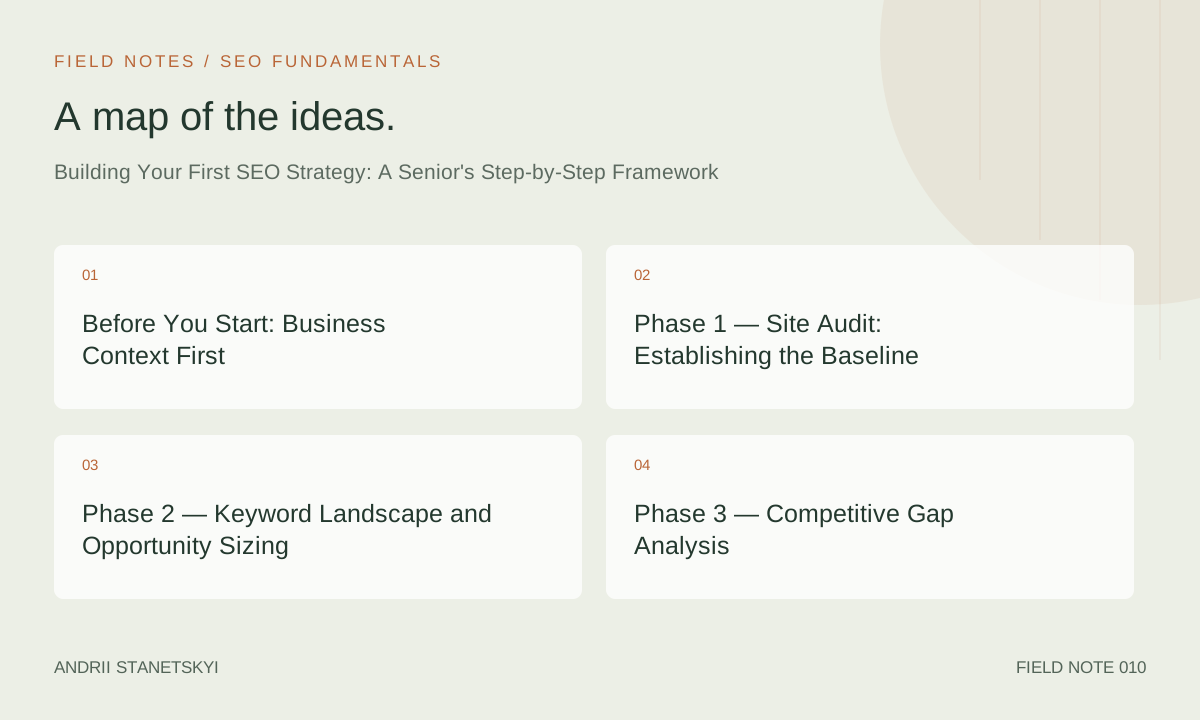
Before You Start: Business Context First
SEO strategy that isn't anchored to business objectives fails at the reporting stage even if it succeeds at the ranking stage. Before touching a keyword tool or crawling the site, you need answers to a specific set of questions. Some of these feel like they're above the SEO practitioner's scope — they are not. They are prerequisites.
The Seven Questions That Shape Every Strategy Decision
- What is the primary conversion action on this site? (Purchase, lead form, demo request, phone call, email signup.) This determines which keyword types to prioritize and which pages need optimization depth.
- What is the average order value or customer lifetime value? This determines how much resource justifiably goes into winning a specific keyword segment.
- What is the current organic traffic contribution to revenue? The baseline from which improvement is measured.
- Are there any content, legal, or regulatory constraints? Healthcare, finance, legal, and regulated industries have YMYL obligations and often brand-level restrictions on claims that fundamentally constrain content strategy.
- What is the competitive intensity of the primary market? A local service business competing against other local businesses has a fundamentally different strategy from a SaaS tool competing against Salesforce.
- What is the development resource available for technical implementations? A strategy that requires weekly developer sprints for a site with quarterly dev cycles is not executable.
- What is the time horizon for results? A business raising a Series B in 6 months needs a different strategy than one with a 3-year organic growth mandate.
Defining "Winning" Before You Start
Set a primary KPI, two supporting KPIs, and a timeframe. Example: "Increase organic-attributed lead volume by 40% within 12 months, with supporting KPIs of top-10 rankings for 50 target commercial keywords and organic traffic growth from 8,000 to 12,000 monthly sessions." This makes every subsequent strategy decision testable against a clear outcome definition. If a tactic doesn't contribute to these KPIs, it doesn't belong in the strategy.
Phase 1 — Site Audit: Establishing the Baseline
You cannot build a strategy for a site you don't understand. The baseline audit is not about finding every problem — it's about identifying the constraints that most limit organic performance right now. I use a three-layer audit structure.
Layer 1: Technical Health
Run a full Screaming Frog crawl (no limit, crawl JavaScript if the site is JS-heavy). Export the crawl data and triage in this sequence:
- Indexability: What percentage of URLs are indexable vs non-indexable? For a 10,000-page site, more than 40% non-indexable (after excluding known intentional exclusions like facets and params) is a structural problem.
- Response codes: Any 5xx errors on strategic URLs require immediate escalation. 4xx errors on URLs with inbound links (cross-reference Ahrefs' broken backlinks report) are PageRank leak points.
- Redirect chains: Screaming Frog flags chains of 2+ hops. More than 5% of URLs in chains indicates architectural debt. Each redirect hop loses approximately 15% of passing link equity.
- Page speed: Run a Lighthouse batch audit on your 20 highest-traffic pages using the PageSpeed Insights API. Identify pages with LCP >4s as priority interventions.
- Structured data: Use Screaming Frog's structured data extraction to identify pages with schema markup errors. Cross-reference with the GSC Rich Results report.
Layer 2: Content Inventory
Export all indexed URLs from GSC. Map them against your site architecture. Answer three questions for the content layer: (1) Which URLs are indexed that shouldn't be? (2) Which URLs should be indexed but aren't? (3) Which URLs are indexed but have not generated a single impression in 90 days?
The third category is particularly revealing. URLs with zero impressions in 90 days are either targeting queries with no search demand, have content quality problems preventing ranking, or are structurally isolated from the site's link equity flow. Segment this list — it tells you whether you have an architecture problem, a content quality problem, or a keyword strategy problem.
Layer 3: Authority Profile
Pull the backlink profile from Ahrefs. Key metrics to note at baseline:
- Domain Rating (DR) — understand this as a relative metric, not an absolute quality signal
- Number of referring domains (unique, followed)
- Link velocity trend (new referring domains per month over last 12 months)
- Anchor text distribution — what percentage is brand vs keyword-matched vs generic?
- Toxic or spammy link patterns — cross-reference with Semrush's Backlink Audit toxic score
Phase 2 — Keyword Landscape and Opportunity Sizing
Keyword research for a new strategy is not about finding keywords — it's about mapping the total addressable search demand for the business and identifying the segment where you can win fastest.
Building the Seed Keyword Universe
Start with 10–15 seed keywords that describe the product or service. In Ahrefs' Keywords Explorer, run each through the "Matching terms" and "Related terms" reports. Export the full dataset. For a typical B2B SaaS product, this produces 2,000–8,000 candidate keywords. In Semrush, run the Keyword Magic Tool in parallel — Ahrefs and Semrush have meaningfully different keyword databases and the union of both lists is substantially more complete than either alone.
Segmenting by Intent and Funnel Stage
Classify the keyword universe into four intent segments:
| Intent Segment | Examples | Content Type | Conversion Proximity | Priority If... |
|---|---|---|---|---|
| Navigational | "[Brand] login", "[Brand] pricing" | Brand/product pages | High | You have brand awareness gaps |
| Commercial investigation | "best [product category]", "[product] alternatives", "[product] reviews" | Comparison pages, reviews, landing pages | High | Short time-to-revenue needed |
| Informational | "how to [task]", "what is [concept]", "why does [problem]" | Blog posts, guides, tutorials | Low–Medium | Building topical authority |
| Transactional | "buy [product]", "[service] near me", "[product] price" | Product/service pages, category pages | Highest | E-commerce or local service |
Opportunity Sizing: The Realistic Traffic Projection
Apply a realistic CTR model to size the opportunity. Do not use tool-provided search volume as a proxy for traffic — it ignores SERP features, brand share, and position CTR curves. Instead: take a target keyword cluster's total search volume, apply CTR benchmarks by position (see the CTR analysis framework in our GSC guide), and multiply by a position-achievement probability based on your current domain authority versus the authority of top-ranking pages. This gives you a traffic range, not a point estimate — present it that way.
Phase 3 — Competitive Gap Analysis
Competitive analysis in SEO has two components that practitioners regularly conflate: who you're actually competing against in the SERPs, and who you perceive as your business competitors. These are not the same. A local accounting firm's business competitor is the firm down the street; their SERP competitors for "how to do business taxes" are NerdWallet, Investopedia, and the IRS website. Your SERP competitors determine the actual resource level required to rank.
Identifying True SERP Competitors
In Ahrefs' Site Explorer, use the Competing Domains report for your site. In Semrush, use the Organic Competitors report. These show which domains rank for the most overlapping keywords. Pull the top 5 SERP competitors by keyword overlap and run them through the same authority baseline audit you ran on your own site. Build this comparison table:
| Domain | Ahrefs DR | Referring Domains | Indexed Pages (GSC est.) | Est. Monthly Traffic | Content Velocity (new pages/mo) |
|---|---|---|---|---|---|
| Your site | [Baseline] | [Baseline] | [Baseline] | [Baseline] | [Baseline] |
| Competitor A | [Data] | [Data] | [Data] | [Data] | [Data] |
| Competitor B | [Data] | [Data] | [Data] | [Data] | [Data] |
| Competitor C | [Data] | [Data] | [Data] | [Data] | [Data] |
Content Gap: The Keyword Opportunity List
In Ahrefs, run the Content Gap tool: input your top 3 SERP competitors and filter for keywords where all 3 competitors rank in top 20 but you rank outside top 50 or don't rank at all. This is your content gap list — proven demand with competitor validation. Filter this list further: volume >100/month, keyword difficulty (KD) <40 for a new strategy (adjust based on your authority baseline). This produces your initial content production target list.
Link Gap: The Authority Deficit
Use Ahrefs' Link Intersect tool to identify domains that link to 2+ of your competitors but not to you. These are your highest-priority link acquisition targets — they've demonstrated willingness to link within your vertical. Export the list, filter for DR >30, and prioritize by topical relevance to your content clusters. This is the starting point for your link building outreach program.
Phase 4 — Prioritization: The Effort/Impact Matrix
By this point, you have a list of technical fixes, content opportunities, and link targets that likely exceeds available resources by a factor of 3–5x. Prioritization is where most strategy documents fail — they list everything without creating an executable sequence. Here is the framework I use.
The Four Quadrants
Plot every initiative on a 2x2 matrix: Impact (high/low) on the Y axis, Effort (high/low) on the X axis. Fill the quadrants in this execution order:
- Q1 (High Impact, Low Effort): Execute immediately. Examples: fixing redirect chains on high-authority pages, correcting structured data errors causing rich result exclusion, updating title tags on pages with CTR gaps, adding internal links from high-authority pages to target landing pages.
- Q2 (High Impact, High Effort): Plan into roadmap with milestone targets. Examples: comprehensive content hub creation, technical architecture migrations, major site speed improvements requiring dev resources.
- Q3 (Low Impact, Low Effort): Batch and execute when capacity allows. Examples: updating meta descriptions on mid-tier pages, adding alt text to existing images, minor schema markup additions.
- Q4 (Low Impact, High Effort): Defer or eliminate. If a task requires significant resources but doesn't move primary KPIs, it should not be in the active strategy. Add it to a backlog and re-evaluate when the strategic landscape changes.
The Quick Win Identification Workflow
Quick wins that generate early momentum are strategically important — not just for results but for stakeholder confidence. Specific quick win types that consistently deliver fast results:
- Page 2 proximate keywords: In GSC, filter for queries where you're averaging position 11–15. These pages are one substantive content update away from page 1. Identify the content gap versus top-ranking pages using a manual SERP comparison and add the missing depth.
- Internal link gap: Use Screaming Frog's internal linking analysis to identify target pages with fewer than 5 internal links. Add contextual links from relevant existing content. This requires no new content and often produces measurable ranking movement in 4–8 weeks.
- Structured data for rich results: Pages eligible for featured snippets, FAQ rich results, or How-To rich results that don't have schema markup. Adding FAQ schema to an already-ranking page can increase CTR by 15–30% with no ranking change required.
Phase 5 — Building the 12-Month Roadmap
The roadmap translates the prioritized initiative list into an execution calendar with accountable milestones. Structure it in three phases that account for how SEO actually compounds over time.
Months 1–3: Foundation (Technical + Quick Wins)
Objectives: fix technical blockers, activate quick wins, begin content production.
- Week 1–2: Deliver technical audit report with prioritized fix list. Begin developer sprint for Q1 technical items.
- Week 2–4: Execute internal linking quick wins (no dev required). Update CTR-gap title tags. Submit corrected sitemaps.
- Month 2–3: Publish first 4–6 content gap pieces targeting KD <30 clusters. Establish link acquisition outreach cadence (10–15 outreach emails/week).
Expected outcome: Technical health score improvement, first ranking movements on low-competition targets, 10–20% CTR improvement on optimized pages.
Months 4–8: Growth (Content + Authority Building)
Objectives: accelerate content production, build first authority signals, capture initial conversion-proximate rankings.
- Publish 8–12 content pieces per month across informational and commercial intent clusters.
- Execute 2–3 digital PR campaigns targeting editorial links from DR 50+ publications.
- Launch content hub architecture around primary topic cluster — establish the hub page and 6–10 spoke pages with deliberate internal link structure.
- Monitor position progression of target keywords weekly. Identify any appearing in positions 4–10 for accelerated optimization.
Expected outcome: Top-10 rankings beginning to appear for long-tail targets. Referring domain count growing at 8–15 new domains per month. Organic traffic increase of 25–40% versus baseline.
Months 9–12: Compound (Scale + Conversion Optimization)
Objectives: scale what's working, optimize for conversion on organic traffic, begin targeting competitive head terms.
- Identify which content pieces from months 2–8 are generating most conversions. Double down on those topic clusters and formats.
- Begin targeting mid-competition commercial keywords (KD 35–55) as domain authority has grown from link building activity.
- Implement conversion rate optimization on top 10 organic landing pages — most SEO strategies ignore this, leaving significant value on the table.
- Audit and refresh month 2–3 content pieces — early content published at lower authority may need link reinforcement and depth additions now that the domain is stronger.
Expected outcome: Primary KPI approaching target. Head term rankings beginning to appear. Organic channel contributing measurably to revenue.
Phase 6 — Measurement Framework and Reporting
Reporting is not a formality — it is the mechanism by which SEO work gets continued investment. Practitioners who can't explain the business impact of their work in client-friendly terms lose engagements regardless of their technical skill.
The Three-Layer Measurement Stack
Track leading indicators, lagging indicators, and business outcomes at separate frequencies:
| Metric Type | Examples | Reporting Frequency | Tool Source |
|---|---|---|---|
| Leading indicators | Indexed URL count, crawl errors fixed, internal links added, content published | Weekly | GSC, Screaming Frog |
| SEO KPIs | Top-10 keyword count, organic sessions, CTR by page group, referring domain growth | Monthly | GSC, Ahrefs, Semrush |
| Business outcomes | Organic-attributed conversions, organic revenue, organic-sourced lead volume, cost per organic acquisition | Monthly | GA4, CRM integration |
Setting Up Attribution Correctly
GA4's default attribution (last click, data-driven) often undervalues SEO in multi-touch journeys. Configure GA4 to track organic as an "assisted conversion" channel in addition to last-touch. Use the Conversion Paths report in GA4 to show how often organic is in the path even when it's not the last touch. For B2B sites, connect GA4 to your CRM (HubSpot, Salesforce) to track the lead-to-close journey — a lead that took 6 months to close after first touching your SEO content is still an organic-influenced conversion.
The Monthly Report Structure That Retains Clients
Lead with business impact (conversions, revenue), follow with the KPI trends that explain the business impact, end with the technical activities that drove the KPI changes. Never bury the business impact section. Clients who see "we fixed 47 redirect chains this month" without understanding why that generates revenue do not renew contracts.
Common First-Strategy Mistakes to Avoid
Mistake 1: Treating Technical SEO as a One-Time Phase
Technical health degrades continuously as sites grow. A site that passed a technical audit in month 1 will have new issues by month 6 — new deploys introduce redirect errors, content migrations create orphaned pages, CMS updates break structured data. Build recurring technical health checks into your monthly workflow, not just the initial engagement.
Mistake 2: Publishing Content Without Internal Link Architecture
A content piece published with zero internal links is effectively invisible to link equity flow from the rest of the site. Every new content piece should be linked from at least 3 existing pages before publication. Identify those pages in Screaming Frog before writing begins — reverse-engineer the internal linking into the content brief.
Mistake 3: Setting Unrealistic Month-3 Expectations
The compounding nature of SEO means months 1–3 produce less visible results than the resource investment suggests. New content published in month 2 typically begins ranking in months 4–6 as crawl, index, and link equity distribution takes time. Set this expectation explicitly at the start of the engagement. Show leading indicators (indexed pages, crawl health, content published) as evidence of progress during the lag period. Google's own documentation on ranking timelines supports a 4–12 month expectation for meaningful results on new content.
Mistake 4: Keyword-First Rather Than Topic-First Content Planning
Planning content around individual keywords produces disconnected pages that don't build topical authority. Plan content around topic clusters where the hub page targets a high-volume head term and spoke pages systematically cover every subtopic and related query. The internal link structure of a cluster communicates topical depth to Google's systems more effectively than individual high-quality pages.
Mistake 5: Ignoring the SERP Features That Reduce Click-Through
A keyword with 10,000 monthly searches where the SERP is dominated by an AI Overview, a featured snippet, and a "People Also Ask" block may generate fewer actual organic clicks than a keyword with 2,000 monthly searches and a clean SERP. Check SERP features before committing to a target keyword. In Ahrefs, the SERP overview for any keyword shows which features are present. In Semrush, the Keyword Overview shows the SERP features column. Prioritize keywords where organic clicks are accessible, not just where search volume is high.
FAQ
How do you prioritize technical SEO versus content when resources are limited?
Technical issues that block indexation come first — always. You cannot rank content that isn't indexed. After clearing indexation blockers, the prioritization depends on the site's authority level. For sites with DR below 30, content production generates more incremental ranking improvement than technical optimization beyond the basics. For sites with DR above 50, technical optimization of existing high-authority pages (page speed, structured data, internal linking) often produces faster returns than new content because the authority is already there.
What's the minimum viable content production rate for an SEO strategy to work?
There is no universal minimum, but there is a competitive floor. If your SERP competitors are publishing 20 pieces per month and you publish 2, you are losing the topical authority race regardless of content quality. Survey your top 3 SERP competitors' content publication velocity using Ahrefs' Content Explorer or by tracking their sitemaps. Match or exceed that rate at equivalent quality — or differentiate so heavily on depth and data that frequency matters less.
When should I hire an agency versus build in-house SEO capability?
Agency models make sense when: you need immediate execution capacity, your industry changes rapidly enough that an agency's cross-client pattern recognition adds value, or you need specialized technical skills your in-house team doesn't have. In-house models make sense when: SEO is a primary growth channel requiring strategic alignment with product and content teams, you need rapid iteration loops that agency communication overhead makes impossible, or your competitive advantage comes from proprietary data that can't be shared with external partners. Most high-growth companies do both: a senior in-house strategist directing a specialist agency for execution.
How do I handle stakeholder pressure for faster results?
Show leading indicators that are within your control and moving in the right direction: indexed URL count growing, technical errors declining, content published hitting plan. Simultaneously, set a visible milestone — "by month 4, we expect to see top-20 positions for this keyword cluster" — and track against it weekly. If you're behind on the milestone, diagnose why and communicate early. Stakeholders who are surprised by missed projections lose trust; stakeholders who get early warning with a recovery plan retain it.
Should I use programmatic SEO for a new strategy?
Programmatic SEO — generating large numbers of pages from structured data — is appropriate when you have a data set that genuinely maps to search demand at scale (e.g., location × service combinations for a national franchise, product attribute combinations for an e-commerce site with large SKU counts). It is not appropriate as a volume strategy for sites without this structural data advantage. Google's scaled content abuse policies have made low-differentiation programmatic pages increasingly risky. If you pursue programmatic SEO, each generated page must provide genuinely unique value — not just a mad-lib template.
How do I know when an SEO strategy needs to be revised?
Revise the strategy when: (1) a major algorithm update materially changes the ranking landscape for your target queries — check Semrush Sensor and Ahrefs' rank tracker for signal; (2) business objectives change (new product line, market pivot, M&A); (3) a competitor significantly increases their SEO investment, changing the competitive intensity of your keyword targets; (4) three consecutive months of leading indicators moving in the right direction but KPIs not improving — this signals a strategic assumption is wrong, not an execution problem.
What's the most common reason SEO strategies fail?
Misalignment between SEO activity and business value delivery. Strategies fail when the practitioner is measuring SEO metrics (rankings, traffic) while the business is measuring revenue metrics, and no one has built the connection between them. The second most common failure is resource starvation — the strategy is sound but content production, link building, and technical resources are cut when results don't appear in month 3. Both failures are preventable with better expectation-setting and measurement architecture at the strategy's outset.
Key Takeaways
- Start with business context and KPI definition before touching any SEO tool. A strategy without measurable objectives produces activity, not results.
- The baseline audit has three layers: technical health, content inventory, and authority profile. Understand all three before making strategic recommendations.
- Competitive analysis should identify your SERP competitors, not just your business competitors. These are often different entities requiring different strategies to compete with.
- Prioritize using the Effort/Impact matrix. Q1 (high impact, low effort) tasks should execute immediately — these are your quick wins that demonstrate early momentum.
- Structure the 12-month roadmap in phases: Foundation (months 1–3), Growth (months 4–8), Compound (months 9–12). Each phase has different success metrics.
- Measure at three layers: leading indicators (weekly), SEO KPIs (monthly), and business outcomes (monthly). Always lead client reporting with business outcomes.
- Every content piece needs internal links from existing pages before or at publication. Orphaned content is wasted production investment.
- Revise the strategy proactively when algorithm updates, competitive shifts, or business changes alter the landscape. A strategy document from month 1 should not govern month 12 execution without review.
Conclusion
An SEO strategy is not a list of tasks — it is a governing logic that determines which tasks to execute, in what sequence, measured against which outcomes, with what resources. Getting that logic right before execution begins determines whether a 12-month SEO engagement produces compounding organic growth or a collection of disconnected ranking movements that don't translate to business value.
The framework in this guide is not a template to be applied mechanically. It is a set of questions and analytical steps that produce a strategy specific to a given site, business, and competitive context. The questions in "Before You Start" will produce different answers for a local service business and a global SaaS platform — and those different answers should produce genuinely different strategies. That specificity is what separates a professional SEO strategy from a generic content marketing plan with keyword research bolted on.
Execute the framework rigorously. Measure relentlessly. Revise the strategy when evidence demands it. That discipline — not any individual tactic — is the durable competitive advantage in organic search.