Most people who ask "what is SEO?" already have a gut feeling that it matters. They've watched a competitor rank above them for three years, or they've heard the term in a board meeting and nodded along. This guide is for anyone who wants to move past the nodding and into the doing — written by someone who's spent a decade in the engine room of search, not pitching decks about it.
SEO in 2026 is not the same discipline it was in 2016. Google's Search Quality Rater Guidelines have expanded to over 170 pages. AI Overviews now appear on roughly 15% of queries. Core Web Vitals are table stakes, not a differentiator. But the fundamentals — earning relevance, authority, and trust in the eyes of a search engine — haven't moved.
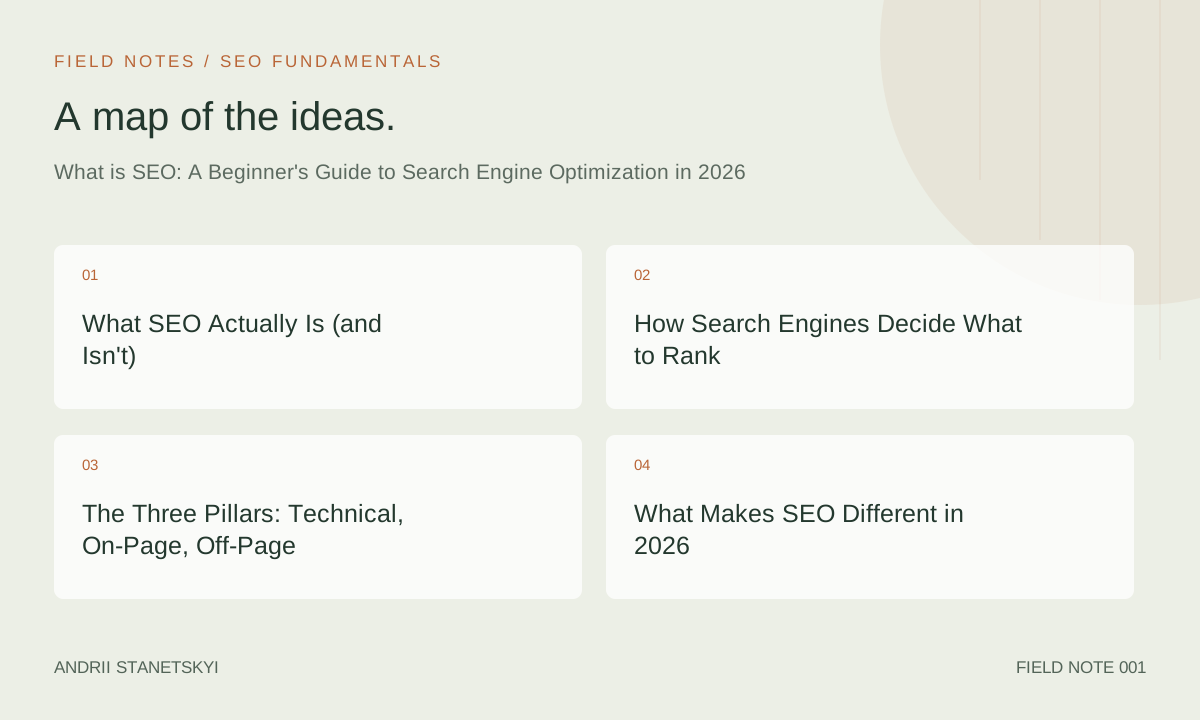
What SEO Actually Is (and Isn't)
Search Engine Optimization is the practice of improving a website's visibility in unpaid (organic) search results. The goal is to appear when people search for terms that are relevant to what you sell, publish, or provide — and to appear high enough that people actually click.
That's the simple version. The more accurate version: SEO is a set of ongoing decisions about your website's architecture, content, and external reputation that collectively determine how search engines understand and evaluate your pages relative to every other page trying to answer the same query.
What SEO is not:
- Paying Google to rank higher (that's Google Ads — see SEO vs SEM vs SMM explained)
- A one-time project with a clear end date
- Stuffing keywords into every paragraph
- A guaranteed outcome — search engines make their own decisions
- Separate from user experience — the two have converged significantly
How Search Engines Decide What to Rank
Google processes roughly 8.5 billion searches per day. For each query, it runs that search through several interconnected systems before returning results in milliseconds. Understanding this pipeline — even at a high level — changes how you think about optimization.
Crawling
Googlebot, Google's crawler, discovers pages by following links across the web and revisiting pages it already knows about. It fetches HTML, renders JavaScript, and sends everything back to Google's servers. If Googlebot can't reach your page — because of a robots.txt disallow, a misconfigured firewall, or a crawl budget issue — nothing else matters.
Indexing
After crawling, Google decides whether to add a page to its index. Not every crawled page gets indexed. Thin content, near-duplicate pages, and pages explicitly marked noindex are typically excluded. As of 2026, Google's index stores hundreds of billions of documents, but it's selective — indexing quality signals matter.
Ranking
When someone searches, Google's ranking systems evaluate indexed pages against hundreds of signals to determine the most relevant, useful result. These signals include keyword relevance, page quality, page experience (speed, stability, interactivity), backlink authority, freshness, and — increasingly — whether the content satisfies what Google calls the "helpful content" standard.
Serving
The final SERP (Search Engine Results Page) may include organic listings, paid ads, featured snippets, knowledge panels, People Also Ask boxes, shopping results, image packs, and — in 2026 — AI Overviews that synthesize answers across multiple sources. Ranking #1 organically doesn't mean you're the first result the user sees.
The Three Pillars: Technical, On-Page, Off-Page
Every SEO action you'll ever take falls into one of three categories. Understanding which pillar you're working on helps you prioritize and diagnose problems accurately.
Technical SEO
Technical SEO ensures that search engines can efficiently crawl, render, and index your site. It covers site architecture, URL structure, server response codes, XML sitemaps, robots.txt, canonical tags, structured data, Core Web Vitals, HTTPS, and mobile usability. If technical SEO is broken, on-page and off-page work is wasted.
Tools used for technical audits: Screaming Frog SEO Spider (desktop crawler, free up to 500 URLs), Sitebulb (stronger visualization), Google Search Console (GSC — the authoritative source on how Google sees your site).
On-Page SEO
On-page SEO covers everything within a page that you control: title tags, meta descriptions, heading structure, body copy, internal links, image alt text, URL slugs, and structured data. The goal is to make the page's topic, subtopics, and intent crystal clear to both crawlers and humans.
See how to write title tags and meta descriptions that rank for a deep dive into the elements that appear in the SERP itself.
Off-Page SEO
Off-page SEO refers primarily to backlinks — links from other websites to yours. Links remain Google's primary proxy for authority and trust. A link from a high-authority, topically relevant domain carries far more weight than a link from a low-quality directory. Link building, digital PR, brand mentions, and social signals all fall here.
| Pillar | Primary Focus | Main Tools | Time to Impact |
|---|---|---|---|
| Technical | Crawlability, indexability, performance | Screaming Frog, GSC, Lighthouse | Days to weeks after fixes deploy |
| On-Page | Relevance, content quality, UX | Ahrefs, Semrush, SurferSEO | Weeks to months |
| Off-Page | Authority, trust, entity recognition | Ahrefs, Majestic, Moz | Months to years |
What Makes SEO Different in 2026
The field has changed substantially. Here are the shifts that matter most for practitioners and newcomers alike.
AI Overviews and Zero-Click Search
Google's AI Overviews (the successor to Search Generative Experience) now dominate informational queries. Studies from early 2026 show click-through rates on queries with AI Overviews are 20–35% lower than the same queries without them. This means traffic from top-of-funnel informational content has declined, and the value of ranking for transactional, navigational, and branded queries has increased proportionally. Optimizing for inclusion in AI Overviews — by providing clear, citable factual claims — is a distinct skill.
E-E-A-T at the Entity Level
Experience, Expertise, Authoritativeness, and Trustworthiness (E-E-A-T) are evaluated not just at the page level but at the entity level. Google increasingly connects authors, organizations, and websites to their broader web presence. A site with no verifiable author information, no About page, no external mentions, and no structured data identifying its publisher will struggle — regardless of keyword optimization. Building your entity in Google's Knowledge Graph is now a serious SEO lever.
Core Web Vitals Are Table Stakes
Largest Contentful Paint (LCP) under 2.5 seconds, Interaction to Next Paint (INP) under 200ms, and Cumulative Layout Shift (CLS) under 0.1 are the 2026 passing thresholds. Failing these doesn't crater rankings outright, but it creates a measurable disadvantage when competing against equivalent content that passes. Use Lighthouse v12 in Chrome DevTools or PageSpeed Insights to audit.
Search Intent is Non-Negotiable
Google has gotten significantly better at matching results to the underlying intent of a query — not just the keywords. Informational, navigational, commercial investigation, and transactional intents each demand a different page format, depth, and call to action. Writing the right words on the wrong type of page (a blog post when Google serves product pages, for example) is one of the most common reasons good content underperforms.
How to Measure SEO Success
Vanity metrics killed more SEO programs than Google updates. Here's how to measure what matters.
Primary KPIs
- Organic sessions: Total visits from unpaid search (Google Analytics 4)
- Organic conversions and revenue: What the traffic does after landing
- Impressions and clicks from GSC: Google's own data, segmented by query and page
- Average position: Position trends for target queries
- Indexed page count: Is Google indexing what you want it to index?
Secondary KPIs
- Backlink profile growth (Ahrefs Domain Rating, referring domain count)
- Core Web Vitals pass rate across key templates
- Crawl coverage ratio (crawled vs. indexed)
- Featured snippet and AI Overview inclusion rate
"If you can't explain the SEO metric to a CFO in one sentence, you're probably tracking it for comfort, not decision-making."
Getting Started: Your First 30 Days
If you're new to SEO and want to start with maximum leverage, here's the sequence that matters:
- Verify GSC and GA4: Set up Google Search Console and Google Analytics 4. Link them together. This gives you the baseline data everything else is measured against.
- Run a crawl: Use Screaming Frog (free for up to 500 URLs) to crawl your site. Look for 4xx errors, redirect chains, missing title tags, and duplicate content.
- Check indexation: In GSC, go to Index → Pages. How many pages are indexed? How many are excluded, and why?
- Audit Core Web Vitals: In GSC, check the Experience tab. Fix any pages flagged as "Poor" — prioritize high-traffic templates.
- Research your target queries: Use Google's free tools (autocomplete, People Also Ask, Related Searches) to understand what your audience actually types. Supplement with Ahrefs Webmaster Tools (free tier) or Semrush's free 10-keyword daily limit.
- Optimize your top 5 pages: Don't spread effort across 50 pages. Find your highest-traffic pages in GA4 and make them better — clearer headings, better intent match, faster load time, more internal links.
- Fix technical blockers: Address any
noindextags on pages that should rank, anyrobots.txtblocks on important resources, and any canonical tag mistakes.
For a complete strategic framework, see building your first SEO strategy from scratch.
FAQ
How long does SEO take to show results?
For a new site with no authority, realistically 6–12 months to see meaningful organic traffic. For an established site fixing technical issues, you can see movement in 2–4 weeks. The honest answer depends on competition, domain history, and the quality of the work. See how long SEO takes — a data-backed breakdown for specifics.
Does SEO still work in 2026 with AI search?
Yes, emphatically. AI systems like Google's AI Overviews and Bing Copilot pull content from indexed web pages. If your content isn't indexed and trusted, AI systems won't cite it. SEO is increasingly about being the source AI tools reference, not just the link users click.
How much does SEO cost?
DIY SEO using free tools costs time, not money. Professional SEO services range from $1,000–$5,000/month for small businesses to $20,000+/month for enterprise campaigns. The ROI depends heavily on the competitive landscape and how well the strategy is executed — not the price tag.
What's the difference between on-page and off-page SEO?
On-page SEO covers elements you control on your own pages: content, title tags, headings, internal links, structured data. Off-page SEO covers signals from outside your site: backlinks, brand mentions, social proof, and entity recognition across the web.
Is keyword stuffing still a thing?
Keyword stuffing — the practice of overloading pages with exact-match keywords — has been penalized by Google since the Panda update in 2011. Modern Google evaluates topical coverage and semantic relevance, not keyword density. Write for humans; Google is sophisticated enough to understand context.
Do meta keywords still matter?
No. Google officially stopped using the meta keywords tag as a ranking signal in 2009. Bing ignores it for rankings (though it still reads it). Don't waste time on meta keywords.
What's the single most important SEO factor?
There isn't one — and anyone who says otherwise is oversimplifying. In practice, the bottleneck shifts: for a new site, it's usually authority (backlinks). For a large site, it's often technical crawlability. For a mid-size content site, it's usually content quality and intent matching. Diagnose your specific constraint before optimizing.
Key Takeaways
- SEO is the practice of making your site more visible, relevant, and trustworthy in the eyes of search engines — and by extension, users.
- The three pillars are Technical, On-Page, and Off-Page. All three must work together.
- In 2026, AI Overviews, E-E-A-T at the entity level, Core Web Vitals, and search intent matching are the defining factors.
- Google Search Console is the most important free tool in your stack — install it before anything else.
- SEO is not a campaign; it's an ongoing operational discipline that compounds over time.
- Measure organic conversions, not just traffic — traffic without conversion is vanity.
- Start with technical foundations, then optimize existing top pages, then build content and authority.
Conclusion
SEO in 2026 rewards the same thing it always has: genuine usefulness delivered on a technically sound platform with credibility signals from the broader web. The tools have changed, the SERP has changed, the AI layer is new — but the underlying logic is the same. Build something people want to find, make it easy for search engines to understand, and earn trust from the rest of the web. Start with Google Search Console today, run one Screaming Frog crawl, and fix the five most obvious problems you find. That's more ROI than six months of strategy decks.