The most common answer to this question is "it depends" — which is technically correct and practically useless. Every SEO agency on earth says "it depends" to avoid committing to a timeline and then missing it. This article gives you an actual answer, with real numbers, broken down by the variables that actually determine the timeline. If you come away with a range you can use in a budget conversation, it's done its job.
Short version: for a new site, expect 6–12 months before meaningful organic traffic. For an established site with existing authority, results from optimization can appear in 4–16 weeks. But neither number applies universally — read what follows to understand your specific situation.
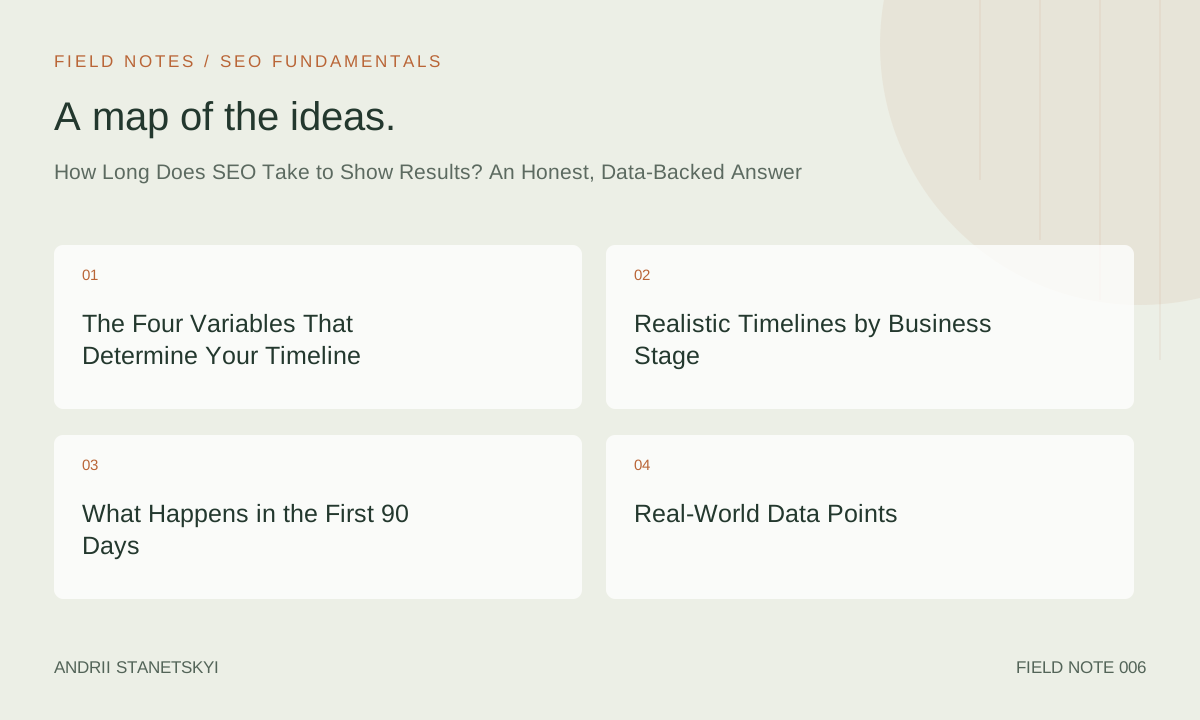
The Four Variables That Determine Your Timeline
Timeline is not random. It's determined by a handful of measurable inputs. Get these inputs right and you can estimate a timeline with reasonable confidence.
1. Domain Authority (Age, Backlinks, History)
A site with 500 referring domains and 5 years of history can rank a new page within weeks of publishing, assuming the content is competitive. A new site with zero backlinks and zero history is starting from zero trust — Google is genuinely uncertain what to make of it. The "Google Sandbox" effect (Google's observed reluctance to rank very new sites for competitive queries, even with good content) is real and typically lasts 3–6 months for new root domains.
Check your current authority baseline in Ahrefs (Domain Rating) or Semrush (Authority Score). These are proxy metrics, not Google's actual PageRank, but they correlate well with ranking speed in practice.
2. Keyword Competition
Keyword Difficulty (KD) in Ahrefs or Semrush estimates how hard it is to rank for a given term based on the authority of the current top-ranking pages. A KD 10 keyword on a DR 40 domain might rank within 4–8 weeks of publishing well-optimized content. A KD 70 keyword on the same domain might require 12–24 months of consistent content and link building to break into the top 10.
This is why keyword targeting relative to domain authority is the single most important strategic decision for timeline expectations. See the 12 most common SEO mistakes small businesses make for more on this targeting problem.
3. Content Quality and Intent Matching
Even on a high-authority domain, content that doesn't match search intent or is substantially inferior to existing ranking pages will not rank quickly, if ever. Google's ranking systems increasingly evaluate how well content satisfies user intent relative to alternatives. Thin content on an authoritative domain still underperforms good content on a weaker domain for intent-matched queries.
4. Technical Baseline
A technically broken site — crawl errors, indexation issues, slow performance, broken redirects — creates a ceiling on ranking performance regardless of content and link quality. Technical debt doesn't just slow SEO; it can actively prevent it. An audit with Screaming Frog before any content investment is not optional; it's the baseline diagnostic that determines whether content investment will actually convert to rankings.
Realistic Timelines by Business Stage
| Site Stage | Domain Authority | Target KD | Realistic First-Result Timeline | Meaningful Traffic Timeline |
|---|---|---|---|---|
| Brand new site | DR 0–10 | KD 0–15 | 3–6 months (long-tail) | 8–18 months |
| Early-stage site | DR 10–30 | KD 0–25 | 2–4 months | 6–12 months |
| Established site, technical issues | DR 30–50 | KD 20–40 | 4–12 weeks post-fix | 3–6 months |
| Established site, optimizing existing pages | DR 30–60 | KD 20–50 | 2–8 weeks | 2–4 months |
| Authority site, new content | DR 60+ | KD 30–60 | Days to weeks | 1–3 months |
What Happens in the First 90 Days
Understanding the typical progression prevents panic in the early stages and helps you identify when something is actually wrong versus when you're just being impatient.
Days 1–30: Foundation and Indexation
In the first month, the priority is technical foundation and establishing indexation. Submit your sitemap to GSC. Verify that key pages are indexed (not blocked by robots.txt or noindex tags). Fix any critical crawl errors. Start appearing in GSC's Search Performance report for a handful of long-tail, very-low-competition queries — often branded queries and exact-match long-tail searches. Don't expect traffic; expect data.
Days 30–60: Crawl Activity and Initial Signals
By week 6–8, Googlebot should be crawling your new content regularly. You'll start to see impressions in GSC for target queries even before positions improve. Pages may sit at position 40–80 as Google tests their relevance. This is normal — it's Google's process of evaluating where the content belongs relative to the competition before committing to a stable position. "Ranking volatility" in this phase is not a warning sign; it's the algorithm doing its job.
Days 60–90: Early Movement
By month 3, most pages that are going to rank have found a rough position. Pages that are competitive for their target query will be in positions 10–30. Some lower-competition targets may have broken into the top 10 already. Pages stuck at position 50–100 likely have a content quality problem, a competition problem, or a backlink gap. Diagnose and address.
Real-World Data Points
Ahrefs published a study of 2 million pages in 2023, measuring how long pages ranked in the top 10 took to get there. Key findings:
- Only 5.7% of newly published pages reached the top 10 within 12 months
- Of those that did break into the top 10, the average time was 61–182 days
- Pages that ranked in the top 10 fastest tended to be on high-authority domains (DR 60+)
- For low-DR domains (under 30), the rate of top-10 rankings within a year dropped to under 3%
These numbers might be discouraging, but they're actually useful — they clarify that SEO timelines are primarily determined by domain authority, and that new sites should set expectations accordingly while prioritizing low-competition keywords and building authority systematically.
Contrasting case: a mid-size B2B SaaS company with DR 45 implemented a technical audit fix (resolving a widespread noindex error on their product pages caused by a CMS misconfiguration) in 2024. Within 6 weeks of the fix deploying, their indexed product pages went from 80 to 340. Within 10 weeks, organic traffic from those pages had increased 280%. Technical fixes on established sites can move very fast.
What Accelerates Results
Building Links Proactively
For a new or low-authority site, link building is the primary lever for compressing timelines. Every high-quality referring domain added raises the authority ceiling for all pages on the site. Digital PR (getting cited in relevant publications), supplier partnerships, guest posts, and original research that earns organic links all accelerate the authority-building phase.
Targeting Low-Competition Keywords First
Winning on KD 5–15 keywords builds authority and ranking history that makes it easier to win on KD 30–50 keywords later. A content strategy that starts with the easiest-to-win queries and progressively targets harder ones consistently outperforms strategies that attack competitive queries from day one.
Fixing Technical Issues Before Publishing Content
Content published on a technically broken site accrues authority slowly and ranks poorly. Fix your technical baseline first — crawlability, indexation, Core Web Vitals, canonical tags — then publish content. This is the correct sequence, not a nice-to-have. Use Screaming Frog (free up to 500 URLs) or Sitebulb for the audit.
Updating Existing Content Rather Than Always Creating New
For an established site, refreshing high-quality but outdated content often produces faster results than publishing new content. An existing page with some authority that's slipped from position 5 to position 18 because competitors have updated their content can often be reclaimed in 4–8 weeks with a targeted content refresh — far faster than ranking a brand-new page.
What Delays Results
- Slow crawl frequency: Google crawls new and updated content faster when it trusts your site. Very new sites may have critical pages crawled only once every 2–3 weeks, delaying any ranking movement. Improve crawl frequency by building internal links to new content and submitting URLs in GSC.
- Algorithm updates during your timeline: A broad core update during your optimization window can reset positions as Google recalibrates the entire ranking set. These updates are outside your control; the best protection is building genuine authority rather than exploiting temporary tactics.
- Competitor response: If competitors see you ranking and improve their content or links in response, your timeline extends. In static or slower-moving markets, this is less of a concern.
- Wrong keyword targeting: Targeting queries that are too competitive for your current authority is the most common cause of "why isn't my content ranking?" Nothing is broken — you're just attempting to compete at a level your domain can't currently support. See keyword research strategy for realistic ranking for a more detailed framework.
- Index bloat: Thousands of indexed low-quality pages (e.g., faceted navigation, thin filter pages, URL parameters) can dilute crawl budget and authority signals. Cleaning up index bloat often accelerates results across the entire site.
How to Measure Progress While Waiting
The biggest psychological challenge of SEO is the lag between effort and result. Here's how to measure leading indicators — signals that predict future rankings — rather than just lagging indicators like traffic.
Leading Indicators (Predictive)
- GSC Impressions growth: Rising impressions (even without clicks) means you're appearing for more queries — a precursor to traffic.
- Position for target keywords in GSC: Movement from position 45 to position 22 is progress, even before you break into the top 10 and generate clicks.
- Indexed page count: Increasing indexed pages means Google is finding and trusting your content.
- Backlink velocity: New referring domains acquired per month. Consistent link acquisition accelerates authority building.
- Core Web Vitals improvement: Moving from "Poor" to "Needs Improvement" to "Good" removes friction from the ranking process.
Lagging Indicators (Results)
- Organic sessions (GA4)
- Organic conversions and revenue
- Top-10 keyword count
- Featured snippet count
Review leading indicators weekly. Review lagging indicators monthly. If leading indicators are improving but lagging indicators haven't moved after 4+ months, investigate whether there's a conversion problem (the traffic you're getting isn't the right traffic) or a SERP feature problem (you're ranking but losing clicks to featured snippets, AI Overviews, or ads).
FAQ
Is 6 months the standard timeline for SEO results?
It's a common benchmark, but it's often misunderstood. Many practitioners say "6 months" as a hedge. In reality, a new site targeting competitive queries may need 12–18 months. An established site fixing a major technical issue may see results in 6 weeks. The 6-month figure assumes a medium-authority site, medium-competition targets, and consistent execution. Use the framework in this article to estimate your specific timeline rather than defaulting to the industry average.
Why does it take Google so long to rank new content?
Google needs time to: discover the content (crawling), evaluate it against existing content (relevance assessment), test it at various positions to observe engagement signals, and determine where it stably belongs relative to all competing pages. Google also deliberately moves carefully with new sites to avoid indexing spam or low-quality content that games temporary signals. The delay is a feature of quality control, not a bug.
Can I speed up SEO with paid traffic?
Paid search (SEM) and paid social (SMM) can drive traffic immediately to validate conversion rates, but they don't directly accelerate organic rankings. Running Google Ads on a keyword does not cause Google to rank your organic result higher. What paid traffic can do: test content and landing page performance, generate real user engagement data, and in some cases drive the kind of direct traffic and brand signals that indirectly support organic authority.
How long does it take to recover from a Google penalty?
Manual actions (link-based or content-based penalties applied by Google's spam team) require a reconsideration request after fixing the underlying issue. Approval typically takes 2–6 weeks, and traffic recovery after approval can take 2–6 months. Algorithmic quality signals (Helpful Content, Panda-era thin content) recover during the next algorithm refresh, which may be weeks or months. There's no reliable "penalty recovery" timeline — the underlying issue and algorithm update frequency both matter.
Do Google algorithm updates reset my SEO progress?
Major core updates can cause significant position volatility. Sites that rely on tactics rather than genuine quality and authority tend to be most affected. Sites with strong E-E-A-T, high-quality content, legitimate link profiles, and good user experience signals tend to be stable across updates or recover quickly if they initially lose ground. An update that hurts you is diagnostic feedback — it means Google's quality assessment of your site changed. Treat it as an audit signal, not arbitrary punishment.
What if I'm in a very competitive industry — does SEO even make sense?
Competitive industries typically have higher search volumes, which means more traffic potential even at lower positions. The question is whether the ROI from eventual rankings justifies the longer timeline and greater investment needed. In most competitive B2B and high-value B2C categories, the answer is yes — but the strategy must be precise. You're not trying to rank #1 for the head term on day one; you're building authority through long-tail wins that eventually support competitive term rankings.
Key Takeaways
- New sites with no authority: expect 6–18 months to see meaningful organic traffic. This is not pessimism — it's the realistic timeline backed by Ahrefs data showing only 5.7% of new pages reach top 10 within 12 months.
- Established sites fixing technical issues: can see traffic movement in 4–12 weeks post-fix.
- The four variables that determine your timeline: domain authority, keyword competition, content quality, and technical baseline.
- Target keyword difficulty proportional to your domain authority — this single decision shapes your timeline more than anything else.
- Monitor leading indicators (impressions, position movement, backlink velocity) while waiting for lagging indicators (traffic, conversions) to materialize.
- Content refreshes on established pages typically produce faster results than publishing new content.
- Link building is the primary lever for compressing timelines on new or low-authority sites.
Conclusion
SEO timelines are deterministic, not mysterious. They're determined by domain authority, competition level, content quality, and technical health — all measurable inputs that you can assess before starting a campaign. The honest answer to "how long does SEO take?" is: as long as it takes to build enough authority and content quality to be genuinely competitive for your target queries. For most businesses, that's 6–12 months of consistent, well-targeted work. For businesses with existing authority investing in technical improvements, it can be weeks. Measure the right things, target the right keywords for your current stage, and avoid the temptation to judge results before the timeline has actually elapsed.