The 2.5x conversion rate advantage of long-tail keywords isn't marketing folklore — it's a measurable outcome that emerges consistently across verticals because of a simple mechanism: the more specific a search query, the further along the buyer's journey the searcher is. Someone searching "project management software" is browsing. Someone searching "project management software for remote construction teams under 50 users" is buying. The long-tail advantage is really an intent specificity advantage.
This guide breaks down exactly how to find, evaluate, and convert long-tail keywords into content that drives revenue, not just rankings.
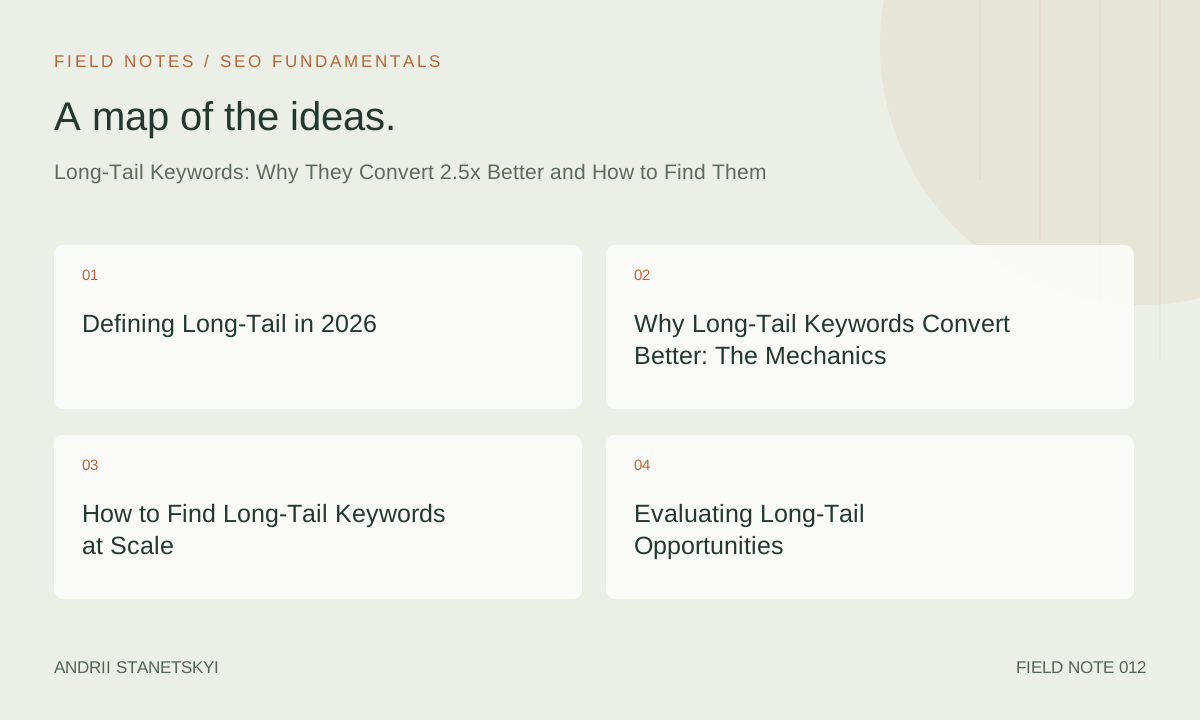
Defining Long-Tail in 2026
The original definition of "long-tail" was purely volume-based: keywords with low individual search volume that collectively represent the majority of all search queries. Chris Anderson's long-tail theory applied to search meant that the massive pool of low-volume queries, taken together, outweighed the handful of head terms everyone was competing for.
In 2026, the better definition is semantic specificity rather than word count. A long-tail keyword is one that represents a specific, contextualised intent with lower competition than its parent topic. "CRM software" is a head term. "CRM software for commercial real estate brokers" is long-tail, regardless of whether it's technically 6 words or 3.
The operational definition I use: a keyword is long-tail if the top-ranking pages for it are not the same as the top-ranking pages for the parent topic. That divergence signals niche specificity and reduced competition.
Why Long-Tail Keywords Convert Better: The Mechanics
Conversion rate differences between head and long-tail keywords aren't random. They follow from three structural advantages:
Intent Specificity = Reduced Friction
A user searching "best CRM for real estate" has already decided they want a CRM, already decided they work in real estate, and is now in evaluation mode. Your content doesn't need to explain what a CRM is or convince them they need one. It can start directly at comparison and recommendation — exactly where that searcher's buying process is. Fewer steps from landing to conversion = higher conversion rate.
Qualifier Words Signal Readiness
Long-tail keywords frequently contain modifier words that are strong buying-intent signals:
- Pricing modifiers: "affordable," "cheap," "cost of," "pricing," "how much" — searcher is in budget evaluation
- Comparison modifiers: "vs," "alternative to," "compared to," "difference between" — active vendor comparison
- Use-case modifiers: "for [industry]," "for [team size]," "for [use case]" — qualifying purchase for specific needs
- Action modifiers: "buy," "get," "download," "free trial," "demo" — bottom-funnel
- Problem modifiers: "how to fix," "not working," "issue with" — product support intent that converts to upgrades
Lower Competition = Higher Rankings = More Traffic
The conversion rate advantage compounds with a traffic advantage. For a new or mid-DA site, ranking #3 for a long-tail keyword with 200 monthly searches often delivers more actual revenue than ranking #9 for a head term with 10,000 monthly searches. Position 3 captures roughly 9% of clicks; position 9 captures roughly 2%. 200 × 0.09 × 0.03 (conversion rate) = 0.54 conversions vs. 10,000 × 0.02 × 0.01 (lower conversion from generic intent) = 2 conversions — but that comparison assumes you can actually rank #9, which for a competitive head term with DR 80 incumbents, you likely can't.
How to Find Long-Tail Keywords at Scale
Method 1: Ahrefs "Questions" and "Matching Terms" Filter
In Ahrefs Keywords Explorer, enter your seed keyword and navigate to "Matching terms." Apply filters:
- KD: 0–25
- Volume: 50–2,000
- Word count: 4+ words
Then switch to the "Questions" tab for the same seed — this surfaces interrogative long-tail queries that often trigger featured snippets and are consistently high-intent. Export and deduplicate.
Method 2: GSC "Queries" Report with Position Filter
In Google Search Console, filter Queries by position 8–20 and impressions > 30. These are pages you already have ranking signals for but haven't optimised. Many will be long-tail queries your existing content answers only partially. Optimising for these is the fastest long-tail win available — you're not creating new content, you're expanding existing content to fully satisfy what's already driving impressions.
Method 3: AlsoAsked PAA Mapping
AlsoAsked.com builds a hierarchical tree of People Also Ask questions from any seed query. This reveals the specific question-based long-tail queries that Google considers semantically adjacent. Each branch of the PAA tree is a potential long-tail page or section.
Seed: "email marketing"
Level 1 PAA: "What is email marketing?", "How does email marketing work?"
Level 2 from "email marketing for small business":
  → "What is the best email marketing platform for small businesses?"
  → "How much does email marketing cost for a small business?"
  → "Is email marketing worth it for small businesses?"
Level 2 and Level 3 questions are your long-tail goldmine — specific, intent-loaded, and rarely targeted with dedicated content.
Method 4: Semrush Keyword Magic with Intent Filter
In Semrush Keyword Magic Tool, filter by intent = "Transactional" or "Commercial" and apply word count ≥ 4. Sort by KD ascending. This gives you the commercially-oriented long-tail list, pre-filtered for buyer intent. Export and cross-reference CPCs from Keyword Planner to identify the highest commercial value subset.
Method 5: Competitor URL Analysis for Underserved Long-Tail
Take a competitor URL (not their homepage — a specific blog post or category page) and run it through Ahrefs Site Explorer → "Organic keywords." Filter for keywords where the competitor ranks position 6–20 with low KD. These are long-tail keywords where the competitor has partial ranking signals but hasn't built dedicated, optimised content. Build better content targeting those exact queries and you'll outrank a higher-DA competitor on their blind spots.
Evaluating Long-Tail Opportunities
Not all long-tail keywords deserve dedicated pages. The evaluation filter I use:
| Criterion | Threshold for Standalone Page | Threshold for Section/Subheading |
|---|---|---|
| Monthly Search Volume | > 100 | 20–100 |
| Keyword Difficulty (Ahrefs) | < 30 | < 20 |
| CPC | > $2.00 (B2C), > $5.00 (B2B) | Any CPC |
| Search Intent | Commercial or Transactional | Informational (supporting content) |
| SERP — top 3 have weak content? | Yes required | Not required |
| Cluster size (related keywords) | 5+ supporting long-tail keywords | 1–4 related |
Keywords that meet all standalone-page criteria get their own URL. Keywords that meet section thresholds get incorporated into a broader piece. Keywords that meet neither threshold get added to a long-tail watch list — revisit quarterly.
Content Strategy for Long-Tail Clusters
Programmatic Pages for High-Volume Long-Tail Sets
When you have hundreds of structurally similar long-tail keywords (e.g., "[software] alternative," "[city] + [service]," "[product] for [industry]"), programmatic page generation is the scalable answer. The pattern: a single page template with dynamic variable substitution for the differentiating element, supported by genuinely unique content in each variable section.
The key distinction between programmatic SEO that works and thin-content penalties: every variable element must add genuine informational value specific to that variant. City-based pages need city-specific data. Industry-specific pages need industry-specific use cases. Templates filled with lorem-ipsum-equivalent thin content have been penalised by Google's Helpful Content guidelines since 2023.
Hub-and-Spoke for Navigational Long-Tail
For long-tail keywords organised around a single parent topic, the hub-and-spoke model serves both users and crawlers. A hub page targets the parent topic and links to spoke pages that target specific long-tail variants. This creates topical authority signals while ensuring each long-tail keyword has a dedicated, crawlable URL.
See our topic clusters and pillar pages guide for the full implementation methodology.
FAQ Sections as Long-Tail Capture Mechanisms
FAQ sections on existing pages are an underutilised long-tail capture tool. Each FAQ question targets a specific long-tail query that's semantically related to the page topic. When structured with FAQPage schema, they can earn featured snippets for the question-based long-tail keywords without requiring a standalone URL.
Case Study: E-commerce Long-Tail Strategy
An online outdoor gear retailer was investing heavily in head terms ("hiking boots," "backpacking gear") and seeing diminishing returns against REI, Amazon, and Backcountry. DR 45 vs. 80+ incumbents made head-term competition a losing strategy.
We ran a long-tail audit using the GSC position 8–20 method and Ahrefs competitor gap analysis. We identified 820 long-tail keywords in three clusters:
- Use-case specific: "waterproof hiking boots for wide feet women," "lightweight backpacking tent under 2 lbs," etc. (440 keywords)
- Problem-based: "hiking boot blisters prevention," "backpack hip belt fit issues" (180 keywords)
- Comparison-based: "[brand] vs [brand] hiking boots," "[product] review 2026" (200 keywords)
We built 34 long-tail targeted pages across the three clusters over 90 days. At month 6:
- Combined organic traffic from long-tail pages: 4,200 sessions/month
- Average conversion rate: 4.1% (vs 1.6% site average from head-term traffic)
- Revenue attribution: $28,000/month from the 34-page cluster
The head terms were still there — but as aspirational targets for a link-building campaign that would take 18+ months. The long-tail strategy delivered ROI in quarter 2. Read more about mapping keywords to the buyer's journey using this framework.
FAQ
What defines a long-tail keyword — word count or search volume?
Neither, definitively. The most useful definition is semantic specificity: a keyword is long-tail if it represents a narrowly-defined intent that diverges from the parent topic's SERP. In practice, 3+ word keywords with volume under 1,000 meet the threshold in most verticals, but a 2-word highly specific query can also be long-tail in a niche B2B space.
How many long-tail keywords do I need for a viable content strategy?
For a standalone page strategy: aim for at least 5–10 related long-tail keywords per page to ensure you're capturing a meaningful traffic cluster, not just one query. For a programmatic approach, 50+ structurally similar keywords justifies template-based page generation. Quality and relevance cluster over quantity.
Can I target multiple long-tail keywords on one page?
Yes — and you should. A well-structured long-form page that thoroughly covers a topic will naturally rank for 20–100 long-tail variants of its primary keyword. The strategy is to intentionally incorporate the highest-value variants as subheadings, FAQ questions, and naturally within the body text — not to force-feed keyword repetition.
Do long-tail keywords still work when AI Overviews appear?
Better than head terms. AI Overviews are most prevalent on broad informational head terms. Long-tail commercial and transactional keywords have far lower AI Overview presence. Additionally, when AI Overviews do appear for long-tail queries, they frequently cite specific, authoritative sources — meaning well-optimised long-tail content has a path to cited-source visibility.
How do I know if a long-tail keyword has real volume if the tool shows zero?
Cross-reference with GSC impression data for related queries you already rank for. Check if AlsoAsked includes the query in its PAA tree. Use Google Trends to see if there's directional interest. And test it — create a page, submit to GSC, wait 60 days, and check if impressions register. Real demand reveals itself. Refer to our zero-volume keyword guide for a complete framework.
What's the typical conversion rate difference between head and long-tail keywords?
The 2.5x figure is a commonly cited benchmark from multiple industry studies, but the actual ratio varies significantly by vertical. In B2B SaaS, the ratio can reach 4–5x because long-tail queries in that space are often from practitioners with budget approval who have already done their research. In e-commerce, 2–3x is typical. Measure your own data in GSC and your analytics platform — segment by keyword intent and measure conversion rate per segment.
Should I prioritise long-tail or head terms for a new site?
Long-tail, without question, for the first 12–18 months. A new site with no domain authority cannot rank for competitive head terms regardless of content quality. Long-tail keywords with KD < 20 are rankable within 60–90 days for a new site with solid technical fundamentals and even minimal link acquisition. The traffic and conversion data from long-tail rankings then feeds your understanding of which head terms are worth the longer-term investment.
Key Takeaways
- Long-tail keywords convert 2.5x better on average because specificity in the query correlates with specificity of intent — searchers are further along the buying journey.
- The five most valuable long-tail modifier types are: pricing, comparison, use-case, action, and problem modifiers. Build your keyword lists around these categories.
- GSC position 8–20 report is the fastest long-tail win available: existing impressions, partial ranking signals, and no new link building required.
- AlsoAsked PAA hierarchies reveal Level 2 and Level 3 long-tail question clusters that are rarely targeted with dedicated content.
- Evaluation threshold: standalone page at volume >100, KD <30, CPC >$2 (B2C) or $5 (B2B), and a clear commercial/transactional intent signal.
- FAQ sections are an underutilised, high-leverage long-tail capture mechanism — each FAQ question can target a specific long-tail query without requiring a new URL.
- Programmatic pages work for high-volume structurally similar long-tail sets, but only if each variant contains genuinely unique, valuable content specific to that variant.
Conclusion
Long-tail keyword strategy isn't a fallback for sites that can't rank for head terms — it's often the smarter primary strategy even for established sites, because it delivers better conversion rates, faster ranking timelines, and more direct revenue attribution. The 2.5x conversion advantage is structural, not accidental.
The practical workflow: use AlsoAsked and Ahrefs to build a long-tail keyword list, apply the evaluation matrix to prioritise standalone pages vs. supporting sections, cluster related long-tail keywords around parent topics, and build content that fully satisfies the specific intent each cluster represents.
Authority reference: Ahrefs' study on long-tail keyword traffic distribution provides the most current data on how search volume distributes across the keyword length spectrum.