Every keyword tool shows a zero for thousands of queries that real people search every single day. The zero isn't a measurement — it's a data gap. Search volume tools work from panel data, clickstream samples, and proprietary modelling. When a query is too niche, too recent, too B2B, or too geographically specific for those panels to detect, it gets a zero. Meanwhile, the query still fires in Google 40 times a month and converts at 8% when it lands on the right page.
Ignoring zero-volume keywords is one of the most costly keyword research mistakes in B2B SEO. This guide is the complete framework for finding, validating, and prioritising zero-volume keywords that actually move the needle.
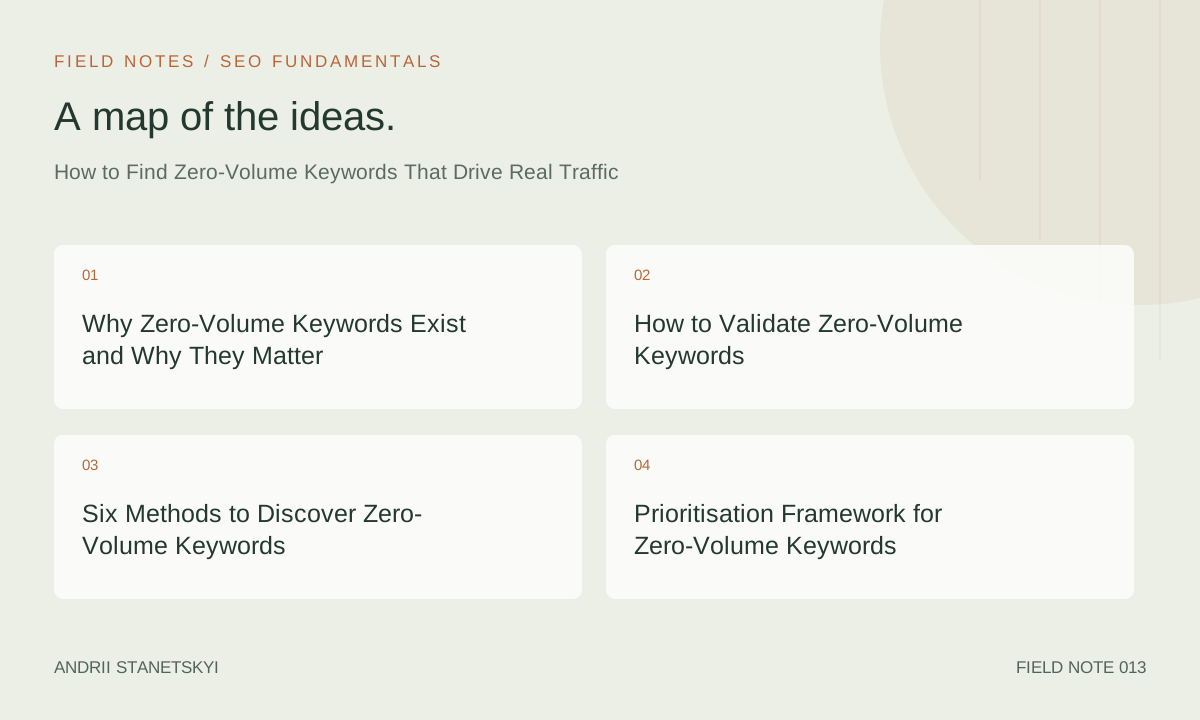
Why Zero-Volume Keywords Exist and Why They Matter
Keyword volume tools report estimates, not measurements. The major tools — Ahrefs, Semrush, Keyword Planner — all use different methodologies, but they share a common limitation: their data panels skew toward consumer queries in high-volume markets. B2B enterprise queries, ultra-niche technical queries, and highly localised queries are systematically underrepresented.
The Data Gap Categories
Understanding why a keyword shows zero volume helps you decide whether the zero is real or artificial:
- B2B enterprise queries: "Salesforce CPQ integration with NetSuite ERP" — this query fires from procurement teams at Fortune 500 companies. The user base is tiny (maybe 200 companies globally need this), the panel data has no signal. Yet this query leads directly to six-figure software deals.
- Emerging technology queries: Terms coined in the last 6–12 months that haven't been searched enough to register in tool databases. The window between a concept emerging and tools detecting its volume is your competitive advantage.
- Hyper-local queries: "[Service] in [small city]" — if the city has under 100,000 residents, most tools show zero even when there's genuine local search demand.
- Product-specific queries: "[Your product name] + [feature]" — brand-new products or features don't have search volume in third-party tools, but your existing customers are searching for support and documentation.
- Verbatim long-tail questions: The exact phrasing a searcher uses in a conversational query. "How do I configure X to work with Y when Z happens" — tools will have volume for approximations but not the exact verbatim.
The Commercial Value of Zero-Volume Keywords
Zero-volume keywords are disproportionately valuable in B2B because B2B search behaviour concentrates decision-makers into small, high-value query pools. A query that fires 30 times per month, with 10% of searchers being VP-level procurement managers, is worth more than a 10,000 volume consumer query with a 0.5% purchase rate.
How to Validate Zero-Volume Keywords
Before investing content resources in a zero-volume keyword, validate that demand actually exists. Use this multi-signal validation approach:
Signal 1: Google Search Console Impression Data
GSC reports on actual Google Search impressions, not panel estimates. If a keyword you're targeting shows zero in Ahrefs but your GSC shows impressions for queries in the same semantic neighbourhood, real demand exists. Export GSC queries filtered to "contains [core term]" and look for zero-volume variants that are registering impressions.
Signal 2: Google Autocomplete and Related Searches
If Google's autocomplete suggests a query, Google is surfacing it because it's been searched enough to include in its suggestion algorithm. Google Autocomplete is a demand validation signal, not just a keyword discovery tool. The same logic applies to "Related searches" at the bottom of a SERP — those suggestions represent aggregated search patterns Google has observed.
Signal 3: Google Trends Relative Interest
Google Trends shows relative search interest even for queries with low absolute volume. If a zero-volume keyword shows any line on Google Trends (even at index 5–10), there is real, if small, demand. More importantly, Google Trends shows trajectory — a query showing growth from 2 to 10 over 12 months is an early-mover opportunity.
Signal 4: Forum and Community Presence
If a query appears as an actual question in Reddit, LinkedIn groups, Slack communities, or industry forums, real humans are searching for information on that topic. Forum questions are pre-validated demand signals because someone cared enough about the question to post it — that's a stronger intent signal than a passive search.
Signal 5: Competitor Content Existence
If a sophisticated competitor has a dedicated page targeting a zero-volume keyword, they likely have internal data (from their own GSC, from sales queries, from customer support tickets) that validated the demand before creating the content. Competitor content is a proxy demand signal.
Six Methods to Discover Zero-Volume Keywords
Method 1: Customer Support Ticket Mining
Your support tickets are a direct transcript of what your customers are searching for. Mine them systematically:
- Export all support tickets from the past 12 months (Zendesk, Intercom, Freshdesk — most have CSV export)
- Extract the subject line and first paragraph of each ticket
- Run keyword frequency analysis to find recurring phrases
- Cross-reference these phrases in Ahrefs — most will show zero volume
- These zero-volume phrases are exactly what prospects search when they have the same problem
Method 2: Sales Call Transcript Analysis
Sales calls contain the exact language prospects use to describe their problems. If your sales team uses Gong, Chorus, or similar tools, request a transcript export and run the same phrase-frequency analysis. Phrases that appear in multiple sales calls are candidate zero-volume keywords with confirmed commercial intent.
Method 3: Ahrefs "Also rank for" on Niche Competitors
Find 3–5 niche competitors (not category leaders — the second-tier players who serve specific subsegments). Run each through Ahrefs Site Explorer → Organic Keywords, filter KD = 0 and Volume = 0. These are the zero-volume keywords your competitors have already validated with their own content. If they rank for it, demand exists — you just need to outrank them.
Method 4: Programmatic Zero-Volume Keyword Generation
For structured zero-volume opportunities, generate them programmatically using a seed keyword + modifier pattern:
import itertools

seed_terms = ["CRM software", "project management tool", "HR platform"]
industries = ["construction", "healthcare", "nonprofit", "legal", "architecture"]
modifiers = ["for", "used in", "best for", "reviews for", "pricing for"]

zero_volume_candidates = []
for seed, mod, industry in itertools.product(seed_terms, modifiers, industries):
    candidate = f"{seed} {mod} {industry}"
    zero_volume_candidates.append(candidate)

# Output: 90 candidate queries for validation
# e.g., "CRM software for construction", "HR platform pricing for nonprofit"
print(f"Generated {len(zero_volume_candidates)} candidate queries")
for q in zero_volume_candidates[:10]:
    print(q)
Run the generated list through Ahrefs in bulk (Keywords Explorer accepts bulk input up to 10,000 keywords). Filter to volume = 0 and check SERP results for each — queries returning <10 results in Google are weakly contested.
Method 5: Internal Search Analytics
If your site has internal search functionality, your site search analytics are a goldmine of zero-volume keywords. Users who can't find what they want on your site are telling you exactly what they searched for. These queries represent both content gaps and zero-volume keyword opportunities with confirmed intent from your audience.
Method 6: Reddit and Quora Scraping
Questions posted on Reddit and Quora in your niche represent real demand with zero curation by keyword tools. Use the Reddit search API or a tool like Semrush's Topic Research (which pulls from Reddit) to extract frequently-asked questions in relevant subreddits. Questions with 10+ upvotes and multiple comments in a niche subreddit represent demand that keyword tools won't detect.
Prioritisation Framework for Zero-Volume Keywords
With zero-volume keywords, standard volume-based prioritisation doesn't work. Use this alternative framework:
| Signal | Weight | How to Score |
|---|---|---|
| Commercial intent strength | 35% | CPC proxy or presence of commercial modifiers; score 1–5 |
| Validation signal count | 25% | Number of validation signals (GSC, Trends, forums, competitor content): 1 signal = 1 point, max 5 |
| Content gap (no existing page) | 20% | Does a dedicated, optimised page exist for this query? No = 5, Partial = 3, Yes = 1 |
| Strategic alignment | 20% | Does ranking for this support a business goal (product page, trial signup, demo)? Score 1–5 |
Score each zero-volume keyword candidate on a 0–5 scale per criterion, apply weights, and sort descending. Top 20% of scores get standalone pages; remainder get incorporated into relevant existing content.
Content Strategy for Zero-Volume Keywords
FAQ Pages as Zero-Volume Aggregators
A single FAQ page can target 20–50 zero-volume keywords simultaneously. Each FAQ question targets a specific zero-volume query; the page builds topical authority for the broader theme. This approach is resource-efficient: one URL, one internal link target, but dozens of potential ranking opportunities.
Glossary Pages for Niche Terminology
Technical and industry-specific glossary pages target zero-volume niche terminology that experts search for and that AI Overviews rarely satisfy (because they require specific technical accuracy rather than general knowledge). A glossary page for "NetSuite accounting terms" or "Kubernetes networking terminology" targets dozens of zero-volume queries per page with minimal ongoing maintenance.
Documentation and How-To Guides
Product-specific zero-volume keywords ("how to set up X in [your product]") are best served by documentation-style content that answers the exact question. These pages also serve customer retention goals — existing users who find answers to their product questions are more likely to renew.
Case Study: B2B SaaS Zero-Volume Strategy
A legal technology company selling contract management software had a DR of 28 and was struggling to rank for any high-volume keywords in their category. We conducted a zero-volume keyword audit using the six discovery methods above.
The support ticket mining surfaced 47 unique phrases their clients used when asking how to do specific tasks. The sales call analysis (using Gong transcripts from 6 months of demos) added 31 more. Competitor analysis of three niche legal-tech competitors in Ahrefs added 82 zero-volume keywords those competitors were ranking for, primarily in the KD 0 range.
We created 28 content assets targeting the highest-priority zero-volume clusters:
- 12 how-to guides targeting support-ticket queries
- 8 FAQ pages targeting sales-call question clusters
- 8 comparison/use-case pages targeting competitor-ranked zero-volume terms
At month 8, GSC was reporting 3,400 impressions per month across these 28 pages, with 290 clicks. The conversion rate from these pages — 6.2% to demo request — was 3.1x the site average. Revenue attribution: 18 demo requests over 8 months, with a 40% close rate and $24,000 ACV = $172,800 in influenced pipeline from zero-volume keywords.
See our framework for mapping these keywords to specific buyer journey stages for how we structured the content to drive demo conversions.
FAQ
If a keyword has zero volume, can it realistically drive traffic?
Yes. The zero is a data gap, not a demand absence. Validated zero-volume keywords — confirmed via GSC impressions, Google Trends, forum presence, or competitor content — drive real, measurable traffic. B2B clients consistently see that their highest-converting pages target queries that show zero or near-zero volume in third-party tools.
How many zero-volume keywords should I include in my keyword strategy?
For B2B SaaS and enterprise software: 30–50% of your total keyword target list should be zero-volume or very-low-volume (under 50/month). For e-commerce: 15–25%. For consumer informational sites: 5–15%. The right ratio depends on how niche your audience is and how poor third-party panel data is for your vertical.
Do zero-volume keywords still need on-page optimisation?
Yes — arguably more so than high-volume keywords. For zero-volume keywords, there are often zero or very few competing pages. Thin content can rank, but if a qualified buyer lands and the content doesn't fully answer their specific question, you've wasted the acquisition. Zero-volume pages should be thorough and specific.
Can I use AI to generate zero-volume keyword lists?
AI tools are excellent at generating candidate zero-volume keywords in the programmatic category — pattern combinations of seed terms + modifiers + qualifiers. What AI cannot do is validate demand. Always follow up AI-generated lists with the validation workflow: GSC, Trends, forum cross-reference, competitor content check. Generation and validation are separate steps.
What tool is best for finding zero-volume keywords?
No single tool. The most effective sources are: your own GSC data, customer support tickets, sales call transcripts, and forum/community analysis. Third-party tools like Ahrefs and Semrush can confirm zero-volume status and reveal competitor rankings for these terms, but they're validation tools for zero-volume research, not discovery tools.
How do I measure ROI on zero-volume keyword content?
Track in GSC by URL: impressions, clicks, and average position. Combine with your analytics platform to measure on-page conversion events (form fills, demo requests, product signups). Attribution model: last-click and first-click. For B2B, connect GSC clicks to CRM entries via UTM parameters or IP-based attribution. Revenue per GSC click is the metric that justifies the investment.
Key Takeaways
- Zero-volume in a keyword tool means data gap, not zero demand. B2B enterprise, emerging technology, hyper-local, and product-specific queries are systematically underrepresented in tool databases.
- The five most reliable validation signals: GSC impression data, Google Autocomplete presence, Google Trends interest, forum/community question presence, and competitor content existence.
- Customer support tickets and sales call transcripts are the highest-intent zero-volume keyword discovery sources available — they represent queries from people with confirmed commercial intent.
- Programmatic zero-volume keyword generation (seed × modifier × qualifier) produces hundreds of candidate queries for bulk validation in Ahrefs.
- For prioritisation without volume data, score on commercial intent strength, validation signal count, content gap existence, and strategic alignment.
- FAQ pages and glossary pages are the most resource-efficient content formats for zero-volume keywords — one URL targets dozens of queries simultaneously.
- In B2B, zero-volume keywords often deliver the highest conversion rates in the entire keyword portfolio because they represent the most specific, bottom-funnel intent signals.
Conclusion
Zero-volume keyword research is counter-intuitive — it requires you to trust validation signals over tool-reported numbers, and it demands deeper research than pulling a keyword list from Ahrefs. But for B2B SEO in particular, the return on that research investment is consistently higher than chasing high-volume keywords where competition is dominated by category leaders with 10x your domain authority.
The practitioners who build zero-volume keyword programs into their standard workflow have a consistent advantage: they're creating content for demand that competitors haven't detected yet. By the time the volume shows up in tools, you're already ranking. Start with support tickets and sales call transcripts — that's where zero-volume keywords with confirmed commercial intent live.
For related strategy, see our long-tail keyword guide and the buyer journey keyword mapping framework to understand where zero-volume keywords fit in the full funnel.
Reference: Google's documentation on how Search works explains the indexing and ranking signals that determine whether a low-volume query earns a result — useful for understanding why some zero-volume queries return competitive SERPs.