Most content strategies fail at the attribution layer, not the execution layer. Teams produce technically sound, well-optimised content and then wonder why their keyword rankings don't translate into pipeline. The root cause is almost always the same: keywords were assigned to content types based on keyword metrics, not buyer psychology. The result is informational content targeting commercial intent keywords, landing pages targeting awareness-stage queries, and comparison guides published where product pages belong.
This is the framework I use to map keywords to buyer journey stages systematically — with specific decision criteria, content format rules, and attribution logic that connects organic traffic to revenue.
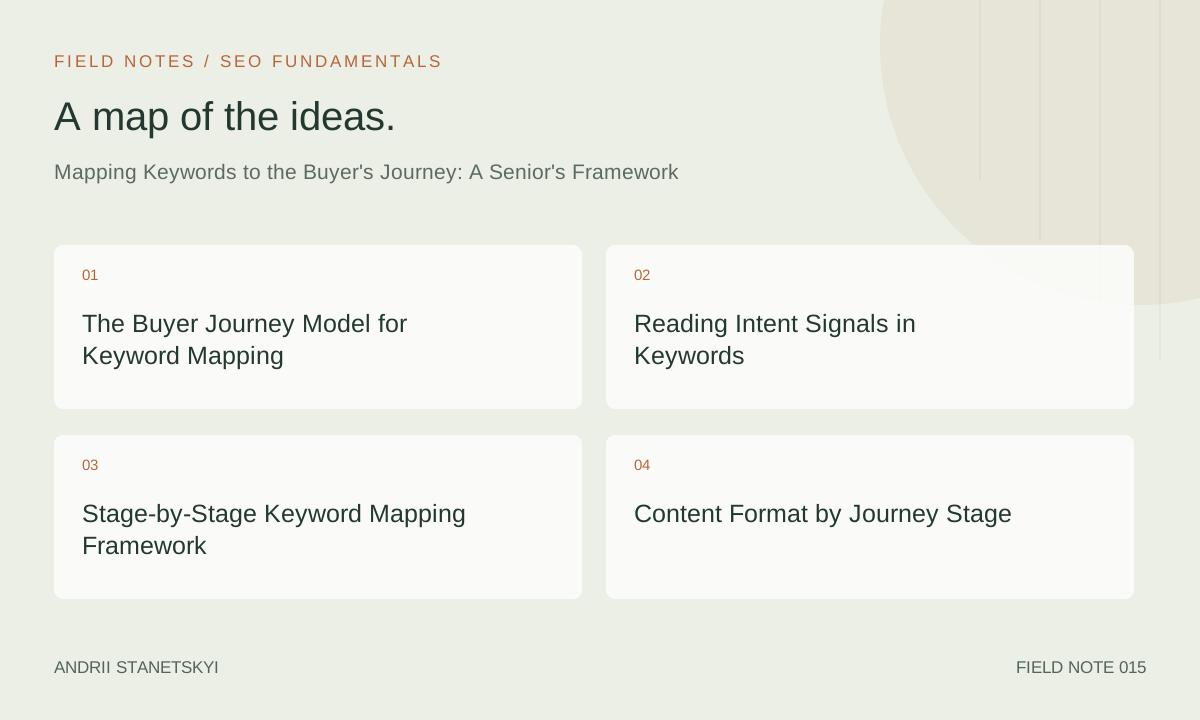
The Buyer Journey Model for Keyword Mapping
I don't use the classic three-stage TOFU/MOFU/BOFU model for keyword mapping. It collapses too many distinct intent states into single buckets, which produces imprecise content briefs and misaligned CTAs. The model I use has five stages, each with a distinct psychological state, keyword pattern, and conversion goal:
- Problem-Unaware: The buyer has a problem but doesn't know it has a name or a solution. Searches are symptom-based. ("why is my team missing deadlines," "how to reduce employee turnover")
- Problem-Aware: The buyer recognises the problem and is searching for context, causes, and solutions categories. ("project management challenges," "employee retention strategies")
- Solution-Aware: The buyer knows solution categories exist and is researching which type fits their situation. ("project management software vs spreadsheets," "best ways to manage remote teams")
- Product-Aware: The buyer is evaluating specific vendors. ("best project management software 2026," "Asana vs Monday vs ClickUp")
- Most Aware / Ready to Act: The buyer is ready to purchase or start a trial. ("Asana pricing," "Monday.com free trial," "ClickUp enterprise plan")
The key insight: Google's SERP composition reflects this model accurately. Search "project management challenges" and you get blog posts about causes and solutions — Problem-Aware content. Search "Asana pricing" and you get Asana's own pricing page and competitor comparison tables — Most Aware content. The SERP is your primary mapping tool.
Reading Intent Signals in Keywords
Specific modifier words and query structures reliably signal journey stage. The table below is the lookup reference I use during keyword audits:
| Journey Stage | Keyword Patterns | Example Queries | SERP Composition |
|---|---|---|---|
| Problem-Unaware | Symptom phrases, "why is," "how to fix," "reasons for" | "why is our project always late," "reasons employees quit" | Blog posts, guides, listicles |
| Problem-Aware | Challenge + topic, "issues with," "problems with," "strategies" | "project management challenges," "team communication problems" | Thought leadership, research, guides |
| Solution-Aware | "vs spreadsheet," "software vs," "how to choose," "best way to" | "project management software vs spreadsheets" | Comparison posts, buyer guides |
| Product-Aware | "best [category]," "top [category]," "[product] vs [product]," "reviews" | "best project management software 2026," "Asana vs Monday" | Review sites, comparison pages, G2/Capterra |
| Most Aware | "[brand] pricing," "free trial," "sign up," "[brand] coupon," "enterprise plan" | "Asana pricing," "Monday.com free trial" | Brand pages, affiliate comparison tables |
When Intent Signals Are Mixed
Some keywords contain signals from multiple stages. "Best CRM software for real estate" contains a "best" Product-Aware signal but also a strong use-case qualifier that narrows the audience to a Solution-Aware state — they know they want CRM software, they're evaluating options for their specific context. When signals are mixed, the SERP composition overrides the modifier analysis. Check the actual top-10 results. If they're comparison pages and review aggregators, it's Product-Aware. If they're use-case guides and "how to choose" articles, it's Solution-Aware.
Stage-by-Stage Keyword Mapping Framework
For each keyword in your research database, the mapping process follows four steps:
- Modifier classification: Scan the keyword for the signal modifiers in the table above. Assign a provisional stage.
- SERP validation: Open the keyword SERP incognito. Does the composition confirm the provisional stage? If yes, confirm. If no, override with SERP-based assignment.
- CPC verification: CPC from Keyword Planner is a commercial intent proxy. If CPC is >$5 (B2B) or >$1.50 (B2C), bias toward Solution-Aware or Product-Aware even if modifiers suggest earlier stage.
- Funnel gap check: Does your site currently have content at this stage for this topic? If yes, map keyword to that existing URL (update candidate). If no, flag as new content requirement.
The Mapping Spreadsheet Structure
For the operational output, I use a spreadsheet with these columns:
- Keyword
- Monthly Volume
- KD (Ahrefs)
- CPC
- Journey Stage (1–5)
- Validation Method (modifier / SERP / CPC)
- Existing URL (if content exists)
- Recommended Content Type
- Primary CTA
- Priority Score
The "Primary CTA" column is critical — it's what connects the keyword to a revenue outcome. A Stage 2 (Problem-Aware) keyword mapped to a guide about "project management challenges" should have a CTA to a free resource or email capture, not a "Start Free Trial" button. Mismatched CTAs destroy conversion rates even when content and ranking are correct.
Content Format by Journey Stage
Journey stage dictates not just CTA but content format, depth, and internal linking strategy:
Stage 1–2: Problem-Unaware to Problem-Aware
Format: Long-form educational content. Thought leadership. Research-backed guides. Data-driven posts. The goal is to establish that the problem is real and solvable, and to introduce your category as the solution class — not your specific product yet.
Internal linking: From these pages, link to Stage 3 content (solution category comparison). Do not link to product pages or pricing — it's too early and creates cognitive dissonance that increases bounce rate.
CTA: Email capture with high-value lead magnet (benchmark report, template, calculator). Primary goal is to build a retargeting audience, not to drive direct trial signups.
Stage 3: Solution-Aware
Format: Comparison guides ("software vs spreadsheets"), buyer guides ("how to choose [category] software"), use-case specific content. These pages establish your solution category's superiority over alternatives.
Internal linking: Link to Stage 4 content (specific product comparisons and reviews) and to your product feature pages. This is the bridge layer between educational content and commercial content.
CTA: "Download the Buyer's Guide" or "Compare [Category] Software" — softer commercial CTAs that acknowledge the searcher is in evaluation mode, not purchase mode.
Stage 4: Product-Aware
Format: Comparison pages ("[Your Product] vs [Competitor]"), review-style content, best-of lists where you control the narrative. These pages need third-party validation signals — customer quotes, review scores from G2/Capterra, specific feature comparisons.
Internal linking: Direct links to trial signup, pricing page, and demo request form. Also link to Stage 5 content (pricing, specific plan pages).
CTA: "Start Free Trial" or "Request Demo" — direct conversion CTAs are appropriate here.
Stage 5: Most Aware
Format: Pricing pages, feature pages, demo request pages, landing pages for specific use cases. Minimal educational content — the searcher knows what they want, reduce friction to conversion.
CTA: Singular, prominent conversion CTA. No competing CTAs. No email capture alternatives that dilute the primary conversion path.
Attribution: Connecting Keywords to Revenue
The attribution model you choose changes how you perceive keyword performance. Most analytics platforms default to last-click attribution, which massively undervalues Stage 1–3 content (it rarely gets last-click credit) and overvalues Stage 5 content (it almost always gets last-click credit).
The Data-Driven Attribution Approach
Google Analytics 4's data-driven attribution model uses machine learning to distribute conversion credit across all touchpoints in the buyer journey. For keyword-level attribution:
- Connect GSC to GA4 via the "Search Console" link in GA4 → Admin → Property Settings
- Set up a custom Exploration in GA4 filtering by "First user medium = organic" and "Session source = google"
- Add "Landing page + query string" and "First user campaign / source" as dimensions
- Add "Conversions" and "Revenue" as metrics
- Compare last-click vs. data-driven attribution for the same keyword set to see Stage 1–3 content's actual revenue influence
In virtually every audit I've run, data-driven attribution reveals that Stage 2–3 content (informational and solution-aware) influences 30–50% more revenue than last-click attribution suggests. This is the data you need to justify investment in top-of-funnel keyword content to stakeholders who only look at direct conversion metrics.
Case Study: SaaS Funnel Keyword Audit
A B2B project management SaaS with 200+ published blog posts came to us with a common problem: high organic traffic, low trial signups from organic. Their keyword portfolio had been built entirely on Stage 2 (Problem-Aware) content — they had dozens of posts about "project management challenges," "how to improve team communication," and "project planning tips." Almost nothing in Stage 4 (Product-Aware) or Stage 5 (Most Aware).
The audit revealed the funnel gap: 78% of their keyword portfolio was Stage 1–3, 8% was Stage 4, and 14% was Stage 5 (most of which were product pages with minimal SEO optimisation). Their competitors had inverted this ratio for their commercially-oriented content, with 40–50% of their blog content at Stage 4.
We built a 6-month keyword and content plan with:
- 16 Stage 4 comparison and "best of" pages targeting "best [PM software] for [use case]" keywords (KD 10–30, volume 200–1,200)
- 8 Stage 4 "vs" pages targeting direct competitor comparison keywords
- Optimised internal linking from existing Stage 2–3 content to new Stage 4 content
- Updated CTAs on high-traffic Stage 2–3 posts to include a contextually relevant Stage 4 link ("Compare PM software options →")
At month 6: trial signups from organic increased 47%. The Stage 4 pages alone were driving 380 trial signups per month at a 4.1% conversion rate, compared to 120/month from organic overall before the intervention. See the modern keyword research methodology that underpinned this audit, and the SERP feature analysis that shaped our content format decisions.
FAQ
What do I do when a keyword fits multiple journey stages?
Use SERP composition as the tiebreaker. Run the keyword incognito and examine the top 5 results. The majority content type determines your stage assignment. If results are genuinely mixed (40% informational, 40% commercial), consider a hybrid content format: a guide that includes a decision tool or comparison table, transitioning from educational to commercial within the same piece.
How do I handle keywords where my content is at the wrong stage?
Two options: content update or content split. If an existing Stage 3 page is ranking for Stage 4 keywords, update the page to include more commercial content — direct comparisons, review data, product-specific CTAs. If the ranking keyword volume justifies a new URL, create a dedicated Stage 4 page and use a canonical or internal redirect flow to consolidate signals. Avoid competing internal pages targeting the same keyword at different stages — this causes cannibalization.
Does journey stage mapping work for e-commerce?
Yes, with adjustments. E-commerce journey stages are compressed compared to B2B — the cycle from Problem-Aware to purchase can happen in a single session for low-consideration purchases. But the framework still applies: category pages are Product-Aware, brand + product specific searches are Most Aware, "gift ideas for X" is Problem-Aware, "best [product type] for [use case]" is Solution-Aware. The CTA and content format logic holds across verticals.
How often should I re-audit keyword-to-stage mappings?
Every 6 months for established keyword portfolios. SERP composition changes as competitors publish new content and Google's algorithm updates shift what satisfies a given query. A keyword that was dominated by informational content 12 months ago may now show commercial content in the top 3, signalling a stage shift that requires a content update to match.
What's the most common journey-stage mapping mistake?
Publishing comparison content ("X vs Y") at Stage 5 pricing pages instead of Stage 4. Searchers comparing "Asana vs Monday" are in evaluation mode — they need a comprehensive, balanced comparison. Redirecting that intent to a pricing page creates cognitive mismatch and high bounce rates. Build the comparison as a standalone Stage 4 page with clear CTAs, not as a section of your pricing page.
How do I convince stakeholders to invest in top-of-funnel (Stage 1–2) content?
Show attribution data from GA4's data-driven model, which surfaces the revenue influence of Stage 1–2 content that last-click attribution hides. If you don't have that data yet, build a new top-of-funnel page with email capture, measure email-to-trial conversion rates from that lead segment, and use that as a proxy for the indirect conversion path value. Numbers win stakeholder debates — build the measurement before the argument.
Should branded keywords be assigned to a specific journey stage?
Branded keywords span all stages but skew heavily toward Stage 4–5 for branded + modifier queries. "Asana" (navigational) is a special case — it's not a journey stage, it's a known-destination query. "[Brand] reviews" is Stage 4. "[Brand] pricing" is Stage 5. "[Brand] + [feature]" can be Stage 4 or 5 depending on whether it's feature discovery or feature-specific usage. Map branded keywords by modifier, not by brand presence. Read our guide on branded vs non-branded keyword strategy for a dedicated framework.
Key Takeaways
- The five-stage buyer journey model (Problem-Unaware → Problem-Aware → Solution-Aware → Product-Aware → Most Aware) is more precise for keyword mapping than TOFU/MOFU/BOFU and produces more targeted content briefs.
- Modifier words in keywords are provisional stage signals; SERP composition is the authoritative tiebreaker.
- CPC from Keyword Planner is a commercial intent proxy: CPC >$5 (B2B) biases toward Stage 3–5 regardless of modifier signals.
- CTA mismatch is the most common conversion failure: Stage 2 content with "Start Free Trial" CTAs dramatically underperforms the same content with email capture CTAs.
- Most SaaS content strategies have a Stage 4 gap — too much informational content, insufficient comparison and "best of" content targeting product-aware searchers.
- Data-driven attribution in GA4 typically reveals that Stage 2–3 content influences 30–50% more revenue than last-click attribution reports.
- Internal linking from Stage 2–3 content to Stage 4 content is the highest-leverage technical action for improving organic conversion rates — it costs nothing and accelerates the buyer journey.
Conclusion
Keyword-to-journey-stage mapping transforms a keyword list into a strategic content architecture. The discipline isn't complicated — it's a combination of modifier analysis, SERP validation, and structured output formatting — but it requires consistency and a willingness to let SERP data override intuition when the two conflict.
The biggest operational impact from implementing this framework is almost always the same: discovery of a specific journey-stage gap (usually Stage 4) that, when filled, unlocks a significant improvement in organic conversion rates. Build the mapping, find the gap, fill it — that's the sequence.
Reference: HubSpot's research on content marketing and the buyer's journey provides supporting data for the content-type and CTA recommendations at each stage.