Most SEO teams treat branded and non-branded keywords as separate universes. Branded gets handed to the paid team; non-branded becomes "our SEO strategy." That split is operationally convenient and strategically wrong. In 2026, with AI Overviews cannibalizing top-of-funnel traffic and branded search becoming an explicit signal of entity authority, the two keyword types are more interdependent than ever. This guide is about understanding that interdependence and exploiting it deliberately.
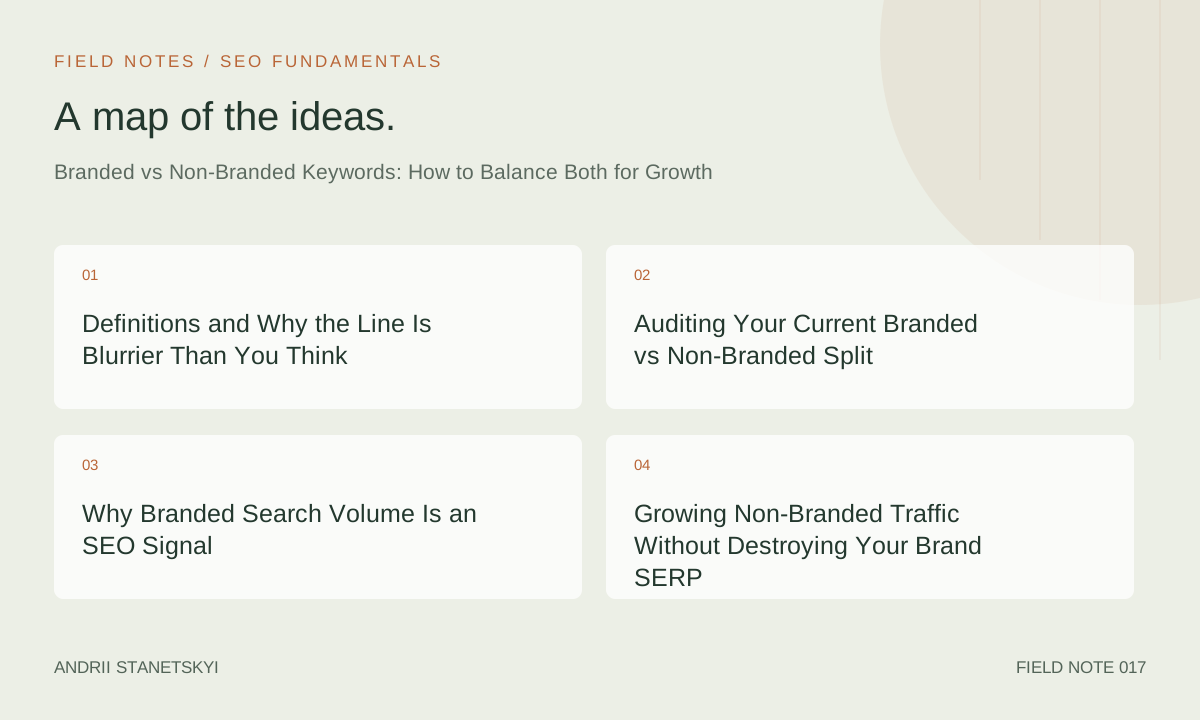
Definitions and Why the Line Is Blurrier Than You Think
A branded keyword contains your brand name, product name, or a distinctive brand term: "Ahrefs backlink checker," "Semrush pricing," "Nike Air Max 95." A non-branded keyword is anything a user types without knowing—or caring—who answers it: "backlink checker," "SEO tool pricing," "white running shoes."
The blur starts at the edges. Consider:
- Branded modifiers on competitor terms: "Ahrefs vs Semrush" is branded for both companies simultaneously.
- Genericized brands: "Jacuzzi," "Kleenex," "Hoover"—some brands own the category term entirely.
- Semi-branded navigational queries: "Shopify login" is branded but fulfills a navigational intent that you'd never write content for.
- Model/product line names without the parent brand: "GPT-4o review" may or may not count as branded depending on your competitive strategy.
For practical SEO purposes, segment in Google Search Console by filtering queries containing your brand name variants (including common misspellings) using regex. In GSC's search analytics, apply a custom regex filter like ^(yourbrand|your brand|youbrand).* to isolate branded impressions cleanly.
Auditing Your Current Branded vs Non-Branded Split
Before you can balance anything, you need accurate numbers. GSC is the canonical source; Semrush and Ahrefs organic traffic estimates are directionally useful but systematically undercount branded traffic because users often don't click results for their own navigational queries.
Pulling the Split in GSC
# Python: GSC API branded/non-branded segmentation
import re
from google.oauth2 import service_account
from googleapiclient.discovery import build

BRAND_REGEX = re.compile(r'\b(yourbrand|yourbrandvariant)\b', re.IGNORECASE)

def classify_query(query):
    return 'branded' if BRAND_REGEX.search(query) else 'non_branded'

# After fetching GSC rows:
for row in response['rows']:
    query = row['keys'][0]
    category = classify_query(query)
    clicks = row['clicks']
    impressions = row['impressions']
    # aggregate by category
Run this across a rolling 90-day window. Export two aggregates: clicks and impressions by category. Then compute your branded traffic ratio (BTR):
BTR = Branded Clicks / Total Organic Clicks
A BTR above 0.60 (60% of organic clicks are branded) means your SEO is effectively functioning as a brand defense operation, not a customer acquisition channel. A BTR below 0.10 in a market where you've been operating for 3+ years suggests brand awareness problems that content alone won't fix.
Benchmarks by Category
| Business Type | Expected BTR | Red Flag BTR | Notes |
|---|---|---|---|
| Early-stage SaaS (<3 years) | 5–20% | >40% | High branded = low distribution reach |
| Established SaaS (5+ years) | 25–45% | <15% | Below 15% means brand isn't sticking |
| Enterprise brand / Fortune 500 | 50–75% | <30% | Brand equity should dominate |
| E-commerce (competitive niche) | 15–35% | >60% | High branded = no category visibility |
| Local service business | 10–30% | <5% | Local pack dominates non-branded |
Why Branded Search Volume Is an SEO Signal
Branded search volume is not just a vanity metric. Google's systems—and increasingly Bing's—treat brand search demand as a proxy for entity authority. When your brand name generates consistent, growing search volume, it contributes to:
- E-E-A-T reinforcement: Google's Quality Rater Guidelines explicitly reference brand recognition as a signal of trustworthiness. A brand with zero direct search interest is harder to validate as authoritative.
- Knowledge Panel eligibility: Google grants Knowledge Panels to entities with sufficient search interest. More branded volume = higher likelihood of panel qualification and SERP real estate control.
- AI Overview citation preference: Brands that appear frequently in branded searches are more likely to be cited in AI Overviews as "recognized" sources. Anecdotally and from early 2025 studies, branded search volume correlates with AIO mention frequency for informational queries in the same niche.
This means non-branded SEO work—getting traffic from category keywords—has a secondary flywheel effect. Users who discover you through non-branded queries and subsequently search your brand directly are increasing your branded search volume, which strengthens your overall entity authority. See how entity optimization connects to this in our guide on BERT, MUM, and LLM ranking signals.
Tracking Branded Search Trend
Use Google Trends (not GSC) to normalize branded search interest against your competitors. In Ahrefs Site Explorer, check "Organic keywords" filtered by your brand name—the estimated monthly volume fluctuations correlate with PR, product launches, and content virality. A well-run content program should produce a slow, steady upward slope on branded search volume. Spikes without retention mean campaigns are not converting to memorable brand experiences.
Growing Non-Branded Traffic Without Destroying Your Brand SERP
Non-branded growth carries a specific risk that most SEO guides ignore: if your non-branded content ranks for transactional keywords, Google may begin understanding your site as a transactional resource—which can suppress brand-adjacent informational content that you depend on for authority coverage. This is not common, but it is real in aggressive niches like finance, health, and legal.
The Cluster-First Approach
Rather than chasing individual non-branded keywords, map them to topic clusters where your brand already has authority signals. If you've published branded content about "project management for remote teams" (i.e., content that ranks partly on brand strength), use that as the hub and build non-branded spokes: "remote team productivity metrics," "async communication frameworks," "distributed team onboarding checklist."
The cluster approach ensures that non-branded traffic flowing into spoke pages has a natural pathway to branded hub pages. This internal linking pattern means Google sees your non-branded content as part of a coherent branded knowledge graph, not a disconnected money-grab. Our topic clusters and pillar pages guide covers cluster architecture in depth.
Content Formats That Earn Non-Branded Traffic
- Comparison pages (non-self-referential): "Top 5 project management tools for engineering teams"—yes, include yourself, but make it genuinely useful, not a rigged list.
- Data studies and original research: These earn non-branded links and direct search traffic ("remote work statistics 2026") while building brand authority.
- Tool/calculator pages: High intent, low branded dependency. A "customer churn rate calculator" attracts non-branded traffic and converts it into brand-aware users.
- Definition and explainer content: "What is [industry term]" queries have low KD (typically 5–25 in Ahrefs) and high relevance if the topic aligns with your product.
The Balancing Framework: Ratios, Thresholds, and Triggers
Balance is not a static target—it shifts with company stage, market conditions, and search landscape changes. Here is a trigger-based framework rather than a fixed ratio prescription:
When to Prioritize Non-Branded Growth
- BTR > 55% for 3+ consecutive months (over-indexed on brand, missing category demand)
- Category keyword positions dropping without corresponding brand search decline (competitors are winning category visibility)
- Pipeline attribution shows <30% of new MQLs entered through organic non-branded (brand is a retention tool, not an acquisition tool)
- New market or product line launch where brand recognition is near zero
When to Prioritize Branded Defense
- Competitor content ranking in positions 1–5 for your brand name queries
- Negative reviews or brand-damage content surfacing in branded SERPs
- BTR dropping rapidly (>15 percentage points in 60 days) without a clear cause
- M&A or rebrand scenario where old brand equity needs to be migrated or protected
Operational Cadence
Review your BTR monthly. Set a target corridor—say, 25–45% for a mature SaaS—and treat movement outside the corridor as a trigger for strategy review. Do not react to a single month's data. Use a 3-month rolling average to smooth seasonal effects (branded searches often spike in January and dip in August for B2B, for example).
Paid + Organic Interplay on Branded Terms
This is where most SEO specialists should push back harder on their paid counterparts. Running paid ads on your own brand terms when you already rank #1 organically has a specific, limited set of valid use cases:
- Competitor ads are active on your brand terms — bidding defensively protects impression share and controls the message
- You need specific landing page control — organic results may serve the homepage; a campaign-specific landing page requires paid
- Resellers or affiliates are bidding on your brand — defensive bidding keeps channel attribution clean
Outside these scenarios, branded paid ads cannibalize organic clicks, inflate reported conversion rates (branded intent converts at 8–15x non-branded), and waste budget that could grow non-branded reach. Google's own data on incrementality for branded paid search is worth reviewing when having this conversation with paid teams.
For non-branded keywords, paid and organic should run in parallel during testing phases. A keyword that converts well in paid before it ranks organically is a signal to accelerate organic content production for that term. This is a legitimate use of paid data to inform SEO prioritization. See our keyword research methodology for incorporating paid conversion data into SEO prioritization.
Case Study: Rebalancing at a SaaS Company
A project management SaaS with $40M ARR came to SEO review with an 68% BTR. Almost all their organic traffic was branded—existing users navigating back, and people who already knew the product name. Their non-branded visibility was essentially zero outside a handful of long-tail accidental rankings.
Situation: 68% BTR. Non-branded clicks: ~3,200/month from ~850 organic keywords. Branded clicks: ~6,800/month.
12-month intervention:
- Identified 40 cluster-relevant non-branded keywords with KD < 30 in Ahrefs, monthly volume 500–3,000, strong commercial intent alignment
- Built 8 pillar pages (one per product use case) with 4–6 supporting cluster posts each
- Migrated 12 existing branded blog posts to non-branded URLs while preserving internal linking
- Launched a data study ("State of Remote Project Management 2025") that earned 340 linking domains, primarily non-branded
Result at month 12: BTR dropped to 44%. Total organic clicks grew from ~10,000 to ~24,500/month. Branded clicks held at ~10,800 (absolute growth, not decline). Non-branded clicks grew from 3,200 to ~13,700. Pipeline from organic non-branded grew from 22% to 41% of total organic pipeline.
The key insight: fixing the BTR did not hurt branded search—it grew alongside non-branded because the non-branded content created new users who subsequently searched the brand directly.
FAQ
Should I exclude branded keywords from my SEO reporting?
You should report both, separately, and together. Combining them gives a misleading picture of SEO's role in customer acquisition—branded traffic is largely driven by advertising, product quality, and word of mouth, not SEO skill. Excluding them entirely means you miss important brand health signals. Segment them and make the BTR a standing metric in your SEO dashboard.
How do I find branded keywords I don't know about?
Run a broad Semrush or Ahrefs organic keywords report filtered to your domain. Look for queries you don't recognize as intentionally targeted—these are often branded variants, product feature names, or employee names that have become searchable. Also check "Queries" in GSC without any filter and sort by impressions; branded long-tails often appear in positions 3–10 where you'd expect #1.
What's a realistic non-branded traffic growth rate?
In a competitive SaaS niche (KD 30–60 on primary category terms), expect 8–15% month-over-month non-branded traffic growth during an active content program. Below 5% suggests execution problems or a highly saturated SERP. Above 25% is possible in emerging categories or with significant link-building investment, but often plateaus after 6 months.
Can non-branded SEO hurt my branded SERP?
Rarely, and only in specific scenarios: if non-branded pages outrank branded pages for queries that should surface branded content, or if aggressive non-branded anchor text dilutes internal equity from brand-name pages. Monitor your SERP for brand queries monthly using a rank tracker. If non-branded content appears in your brand SERP, adjust internal linking to reinforce your branded hub pages' authority.
How should I handle branded vs non-branded in Google Ads bidding strategy?
Keep branded and non-branded in completely separate campaigns with separate budgets, separate conversion tracking, and separate ROAS targets. Branded campaigns typically have CPC $0.30–$1.50 and conversion rates 15–30%. Non-branded campaigns have CPC $3–$25+ and conversion rates 1–5%. Blending them produces misleading performance averages and leads to budget misallocation in automated bidding strategies.
Does branded search volume affect domain authority or DR?
Not directly—DR and DA are link-based metrics. But branded search volume correlates with brand mentions, which correlates with editorial link acquisition, which does affect those metrics. The relationship is indirect and operates over quarters, not weeks.
At what company stage should branded keywords become a priority?
Branded SERP management (owning the first page for your brand name) should begin at Series A or the equivalent revenue stage—around $3–10M ARR for SaaS. Before that, virtually all effort should go to non-branded acquisition. After Series B ($25M+ ARR), branded search defense typically becomes a quarterly standing agenda item in SEO planning.
Key Takeaways
- Calculate your Branded Traffic Ratio monthly and set a corridor target based on your company stage and market position
- Branded search volume is an entity authority signal—growing non-branded traffic has a secondary flywheel that increases branded search demand
- Non-branded content should be organized into clusters anchored to branded hub pages, not created as standalone articles
- Paid branded ads are only justified in three specific scenarios; outside them they cannibalize organic and inflate conversion metrics
- A rebalancing toward non-branded does not require sacrificing branded clicks—both can grow simultaneously with the right content architecture
- BTR thresholds are directional, not absolute—context (industry, company age, competitive density) matters more than hitting a specific number
Conclusion
The branded vs non-branded question is ultimately a question about what job your SEO program is doing. Defense or acquisition. Retention or growth. The answer for almost every growing business should be: both, in a managed ratio that evolves with your stage. The framework here gives you the metrics to know when you're out of balance and the levers to pull to correct it. Stop treating the split as an accounting exercise and start treating it as a growth instrument.