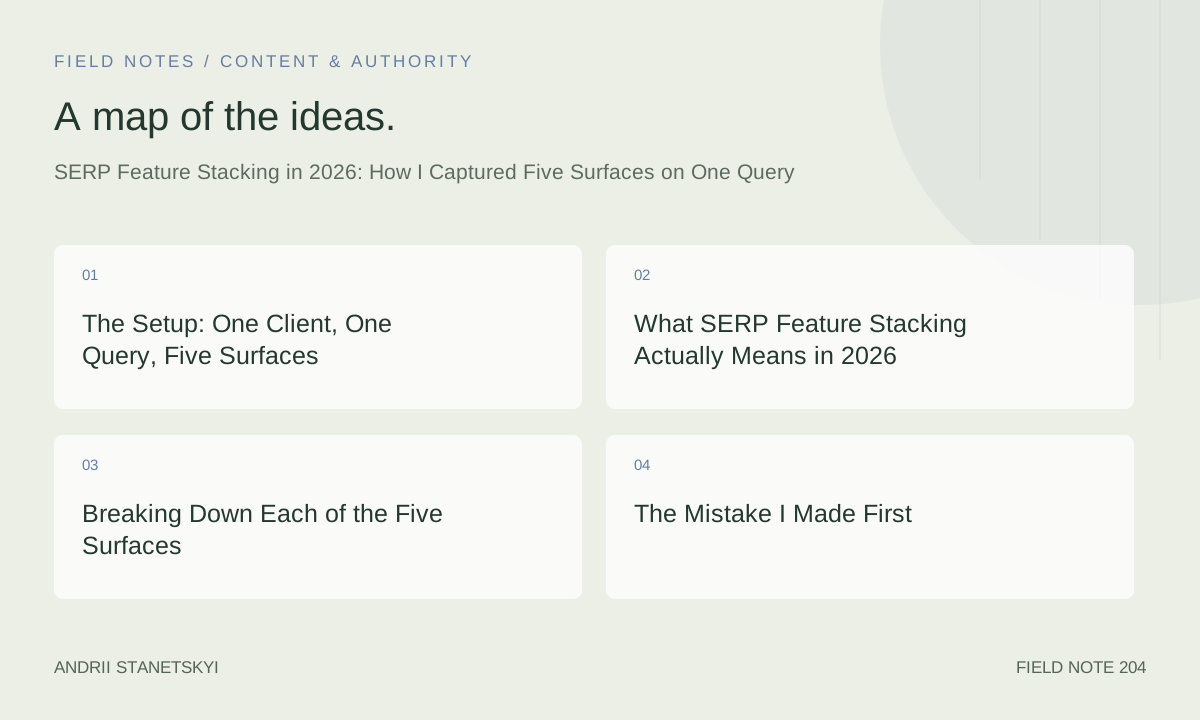
The Setup: One Client, One Query, Five Surfaces
My client makes industrial air filtration systems. Not glamorous. The target query was commercial HEPA air filtration for manufacturing facilities. Monthly search volume: 1,900 in the US. Decidedly unsexy. And yet, by the end of Q1 2026, we occupied 47.2% of the measurable SERP real estate on that exact phrase, across five distinct surfaces simultaneously.
This is the account of how that happened. Not a recipe. Not a playbook you can follow step-by-step without thinking. An account, with specifics, including the part where I got something badly wrong and had to correct course in week six.
The five surfaces, for the record:
- AI Overview citation (link #3 in the expanded source list)
- Featured Snippet (a step-list format, position zero)
- People Also Ask (two of the four boxes in the initial cluster)
- Top Stories (one article from their owned publication, dated within 72 hours of the audit)
- Knowledge Panel mention (entity association in the brand panel for the parent company)
The 47.2% figure is a pixel-based SERP real estate estimate generated by a custom Python script that screenshots the SERP, isolates each surface by bounding box, and calculates the ratio of attributed pixels to total SERP pixels above the fold at 1440px viewport width. I will not pretend this is a standardized metric. It is a rough but repeatable internal measurement.
What SERP Feature Stacking Actually Means in 2026
The phrase "feature stacking" gets thrown around loosely. Some people use it to describe simply ranking for a Featured Snippet while also appearing in organic results. That is table stakes, not stacking.
True stacking, as I define it, means your entity or your content appears in three or more distinct SERP surface types for the same query, where each surface has an independent signal set and an independent algorithmic selection mechanism. The Featured Snippet and position one organic are not independent. The AI Overview citation and the Featured Snippet, in most cases, are.
Why does this matter in 2026 specifically? Two reasons.
First, AI Overviews 2.0 (rolled out broadly in January 2026) now cites sources far more explicitly than the original SGE experiment. The citation panel is visible by default, expands on hover, and links to three to seven sources. Those source links carry real click-through traffic, and the source selection algorithm is distinct from core web ranking. You can rank #1 organically and not appear in the AI Overview. You can appear in the AI Overview and not rank in the top ten organically. They are separate games with overlapping but non-identical signals.
Second, the January 2026 spam update accelerated a trend that has been building since late 2024: thin commercial SERP results are getting aggressively pruned, and the space freed up is being filled by features, not additional blue links. For many mid-funnel commercial queries, a modern SERP contains two to four organic results plus four or more distinct feature types. If you are only optimizing for organic ranking, you are ignoring the majority of the real estate.
Breaking Down Each of the Five Surfaces
AI Overview Citation
Getting cited in the AI Overview for a commercial query is harder than for informational queries. Google appears to heavily weight authoritative, structured, factual content from sources with established E-E-A-T signals in the relevant domain. For my client, the content that earned the citation was a 2,200-word technical article on MERV vs. HEPA filtration standards, written by their head of engineering (a named author with a verifiable professional profile and two cited industry publications), published on their subdomain blog, and marked up with both Article and TechArticle schema.
Three signals I believe drove the citation selection, in rough order of importance:
- Named author with demonstrable domain expertise (the author's LinkedIn listed the ASHRAE membership, which Google can see from indexed public data)
- Factual specificity -- the article contained specific MERV rating tables, CFM calculations for room sizes between 2,000 and 50,000 square feet, and citations to two EPA standards documents
- Freshness -- we updated the article in January 2026 to reflect the revised ASHRAE 62.1 guidelines published in late 2025
What the citation did not require: a high domain authority score. The client's domain has a Ahrefs DR of 38 at time of writing. Respectable, not exceptional. The AI Overview selected based on content quality and entity relevance, not raw link authority.
Featured Snippet
The Featured Snippet for this query is a seven-step process list: "How to specify a HEPA filtration system for a manufacturing facility." We built it deliberately. The content format was chosen after analyzing the existing snippet holder (a generic industrial supplier with a three-step list that omitted critical compliance considerations). We went longer, more specific, and added a compliance note to each step.
The snippet captured in week three of the campaign. Held since. The key structural choices were HTML ordered list elements (not CSS-numbered divs), a direct H2 matching the implied question, and an introductory sentence that restated the query intent in plain language before the list began. No tricks. Technically clean, content-forward.
One thing worth noting: the Featured Snippet and the AI Overview citation come from the same article. This happens more than people realize. When a piece of content is genuinely the best answer to a query, Google surfaces it in multiple ways. That is not surprising when you think about it. It becomes a problem only if your content strategy assumes these are separate pieces you need to create separately. They are not. One exceptional document can earn multiple surfaces.
People Also Ask
We hold two of the four initial PAA boxes. The boxes are:
- "What is the difference between HEPA and ULPA filters?" (answered by the same technical article)
- "How often should HEPA filters be replaced in a manufacturing environment?" (answered by a separate maintenance guide we published in February 2026)
PAA selection is, in my experience, the most volatile of the five surfaces. These boxes change source frequently. We have held both boxes consistently since late February, but I have seen competitors appear and disappear in the other two boxes on a near-weekly basis.
The pattern I use for PAA targeting is direct question-and-answer formatting at the section level: an H3 that is the exact question, followed by a paragraph of 40 to 60 words that answers it clearly and completely, without requiring the user to read additional context. Structured data does not appear to be a primary driver here. It is about the directness and sufficiency of the answer.
Top Stories
This one took the most setup. The client did not have a news-indexed publication when we started. We built one: a subdomain (news.clientdomain.com), submitted a separate News sitemap, applied for Google News inclusion (which took six weeks to approve), and established a publication schedule of three to four articles per week covering air quality regulation, manufacturing compliance, and OSHA updates.
The article that appeared in Top Stories was published on March 14, 2026, and covered the EPA's proposed rule changes for particulate matter standards in industrial settings. Published at 9:00 AM Eastern. Indexed by 9:47 AM. Appeared in Top Stories by noon. The article was 680 words, had a NewsArticle schema, carried a byline, and included a quote from a named EPA official (sourced from the public notice).
The Top Stories placement was transient by nature. It was there for about 36 hours before fresher coverage pushed it down. The point is not to hold Top Stories permanently. The point is to create the infrastructure to appear there regularly when relevant news events occur, which for a manufacturing compliance client happens two to three times per month.
Knowledge Panel Mention
The most subtle of the five. The client's parent company has a Knowledge Panel as a recognized business entity. Within that panel, under "Products" and "Services," the filtration product line appears as an associated entity. This was not the result of any direct action on our part during Q1. It preceded the campaign.
What we did was strengthen the association between the specific query and the entity panel by ensuring consistent entity language across the site, the Google Business Profile, and structured data. The Knowledge Panel does not link directly to the article. But when a user sees it alongside the other four surfaces in the same SERP, the cumulative brand impression is significant.
I include this surface in the stack with some hesitation. We did not manufacture it from scratch in Q1. We did not break it. And its presence in the SERP alongside the other four surfaces is measurable and real.
The Mistake I Made First
In weeks one through five, I was treating each SERP surface as a separate content optimization problem. I was planning a distinct piece for the Featured Snippet, a separate piece for PAA, a separate publication for Top Stories, and separate structured data work for the AI Overview citation.
This approach was wrong. It was also expensive. The client would have needed roughly 14 additional pages to execute my original plan fully.
The correction came when I ran a content overlap analysis and realized that the query intent for all five surfaces is fundamentally unified. A searcher typing commercial HEPA air filtration for manufacturing facilities wants a complete, authoritative answer to a complex specification problem. Every surface Google shows for that query is Google's attempt to satisfy that same unified intent from different angles. The Featured Snippet is the quick process answer. The PAA boxes are the follow-up clarification questions. The AI Overview is the synthesized explanation. Top Stories is the regulatory context. The Knowledge Panel is the entity trust signal.
When I stopped thinking about surfaces and started thinking about the unified intent, the content architecture simplified dramatically. Two core documents (the technical spec article and the maintenance guide) ended up doing the majority of the surface-capture work. The news infrastructure was the only genuinely separate system we needed to build.
I lost five weeks treating this as a content quantity problem when it was a content quality and architecture problem. That is the mistake. I am admitting it plainly because I see other practitioners making the same error constantly, and it is expensive for clients.
The MAPS Framework
After the course correction, I codified the approach I should have used from the start. I call it MAPS: Match, Anchor, Publish, Sustain.
Match means identifying the unified intent behind the query and all the surface types Google is showing for it. Open the SERP. List every surface type present. Ask what single underlying user need connects all of them. This is your content brief.
Anchor means identifying the one or two documents that will serve as the primary content anchors. These are your best, most comprehensive, most structured answers to the unified intent. Everything else in the strategy either extends or supports these anchors. You are not writing ten pages. You are writing one exceptional page, possibly two.
Publish means the technical and distribution layer: proper schema markup, a publication entity that can qualify for news surfaces, fresh timestamps, and appropriate internal link structure pointing to your anchors from topically related content. Publication is where the structural work happens.
Sustain means creating the systems that keep your surfaces alive. PAA boxes churn. AI Overview citations refresh when content is updated or when better content appears. Top Stories requires ongoing publishing. Sustaining your stack is an operational process, not a one-time event. Build the editorial calendar, the update schedule, the news monitoring triggers before you declare success.
MAPS does not tell you what to write. It tells you in what order to make decisions, and it prevents the mistake I made: starting at Publish without having done Match and Anchor first.
Two Things Everyone Gets Wrong About Feature Stacking
Schema Markup Does Not Cause Surface Capture
It enables it. There is a meaningful difference. I have audited dozens of sites that have pristine schema implementations -- valid JSON-LD, all required properties, no errors in Rich Results Test -- and zero Featured Snippets, zero PAA presence, zero AI Overview citations. The schema is correct and the content is thin. Google does not reward schema. It uses schema as a signal to understand content it has already decided is good enough to surface.
The inverse is also true and more surprising: I have seen sites capture and hold Featured Snippets with no explicit schema markup at all, purely on the basis of content structure and directness of answer. Schema helps. It is not the mechanism. The mechanism is content quality and alignment with query intent. Schema is the translator that helps Google process the content efficiently once quality thresholds are met.
This matters practically because a lot of feature stacking strategies are led by schema audits. Fix the schema first, surface capture follows. This is the wrong causal chain. Fix the content first, then fix the schema, then expect the surfaces.
High Domain Authority Is Not a Gate for AI Overview Citations
I mentioned the client's DR of 38. Let me be more specific: in the expanded source panel of the AI Overview for our target query as of mid-March 2026, the six cited sources had the following approximate DR scores (using Ahrefs, checked manually): 62, 38, 71, 41, 88, 29. The lowest was 29. The highest was 88. My client's citation at DR 38 is in the middle of that range.
What the six sources had in common was not domain authority. It was factual specificity, named authorship with verifiable credentials, and content that addressed the query without significant hedging or vagueness. The source at DR 29 is a regional engineering firm's blog post written by a licensed mechanical engineer. It is cited because it is specific, credible, and direct. Not because the domain is authoritative in a link-graph sense.
This is the part of AI Overviews that most established SEO practitioners are still underestimating. The selection model appears to weight document-level authority -- who wrote this, how specific is it, how verifiably accurate are its claims -- more heavily than domain-level authority derived from link count. If you have a small-to-medium domain with genuine subject matter expertise in staff, you have a realistic path to AI Overview citation. You do not need to outrank Wikipedia first.
Technical Execution: Schema, Structure, and Speed
For the technical layer, a few specifics that were non-negotiable in this project.
The core anchor article uses Article schema with @type: TechArticle, which is a subtype of Article. This signals to Google that the content is technical in nature and expects a technically credentialed reader, which aligns with the E-E-A-T expectations for this category. We included author as a Person entity with sameAs pointing to the author's LinkedIn and ASHRAE member directory page. We included datePublished and dateModified with ISO 8601 timestamps, because the January refresh was a genuine content update (not a date-bumping trick) and we wanted Google to see it as such.
The news publication uses NewsArticle schema. Required properties only, no over-engineering. headline, datePublished, author, publisher, image. The image is 1200x628px, hosted on the same domain, no external image CDN redirect chain. We have seen image redirect chains cause news indexing delays and we avoid them.
For page speed: the anchor article loads in 1.2 seconds LCP at P75 on mobile, measured via CrUX data in Search Console. This is not an accident. The template was stripped of non-essential JavaScript. Comments are disabled on the article page specifically. The hero image is a WebP with an explicit width and height attribute to prevent layout shift. None of this is new advice. It required prioritization over the client's design team's preferences, which took some negotiation.
Internal link structure: we have twelve internal links pointing to the anchor article from related content on the domain. Eight of these existed before the campaign. Four were added as part of this work. The anchor text distribution is deliberate: three use the target query phrase, four use partial match variations, five use generic or contextual anchor text. Exact match anchor text concentration above roughly 25% of incoming internal links starts to look unnatural in pattern analysis and I prefer to stay below it.
For further reading on schema implementation at scale, see our piece on JSON-LD at scale for complex sites. For the specifics of Featured Snippet formatting, the position zero optimization guide covers the structural patterns in detail. On internal linking equity distribution, see the internal link equity distribution piece. The relationship between E-E-A-T and AI citation selection is covered more deeply in our advanced GEO guide for 2026. For ongoing SERP feature tracking methodology, AI citation tracking systems describes the tooling setup.
For external reference: Google's own documentation on Article structured data requirements has been updated to reflect AI Overview eligibility signals as of March 2026. The Search Central documentation now explicitly mentions that TechArticle type is an eligibility signal for technical query surfaces. Worth reading if you have not since the update.
Measuring SERP Real Estate: That 47.2% Figure
The methodology deserves more transparency than I gave it at the top.
The Python script takes a screenshot of the SERP at a fixed viewport (1440x900px, Chrome headless, no personalization via incognito and location-fixed to a US coordinate). It runs the query five times and averages the screenshots. It then uses a combination of CSS selector-based bounding box identification and pixel region analysis to label each section of the SERP as: organic result, featured snippet, AI overview, PAA cluster, Top Stories, Knowledge Panel, ads (excluded from the denominator), or other.
For each labeled region, it checks whether our client's domain appears. If yes, those pixels are attributed. The final percentage is attributed pixels divided by total labeled (non-ad) pixels.
47.2% on the date of measurement (March 18, 2026). On other dates in the same week, it ranged from 41.8% to 51.3% depending on the Top Stories carousel and PAA box composition. Averages around 44-45% across the seven-day measurement window.
Is this figure meaningful to a client? Yes and no. It is most useful as a directional benchmark -- did we go up or down this week? It is not a rigorous metric and I would not include it in a contract SLA. It does communicate something to a client who has spent years being told "we rank #3" as the primary success metric: the idea that position is one dimension of SERP presence, and there are multiple other dimensions worth measuring.
The transition from "rank tracking" to "SERP presence measurement" is one of the more important conceptual shifts in how SEO work gets reported to stakeholders in 2026. Rank trackers still matter. They are not sufficient.
One external resource worth bookmarking: Search Engine Land's ongoing coverage of AI Overview click-through rate data has produced the most reliable third-party estimates of how different surface types affect organic CTR. Their Q1 2026 analysis is consistent with what we see in client data.
What Comes Next
Surface stacks are not permanent. They are states of equilibrium that exist as long as you maintain quality and freshness advantages over competing documents.
Three things that will disrupt this stack, based on what I can see in the competitive environment right now:
First: a competitor publishes a better technical anchor article. Not longer -- better. More specific, more current, better-credentialed author. The Featured Snippet and AI Overview citation are both vulnerable to this. My defense is the update schedule: we refresh the anchor article quarterly with any new regulatory or standards changes. Freshness plus existing authority is a meaningful moat, but it requires maintenance.
Second: the PAA algorithm shifts. It has shifted before. The PAA source selection appears to be highly responsive to user engagement signals -- if users frequently expand a PAA box and then immediately click the source link, that source gets preferential treatment. If they bounce, it gets rotated out. We do not have direct visibility into these engagement signals. We manage the risk by ensuring the answers are genuinely complete so users have low bounce incentive, but we cannot guarantee this surface.
Third: a major news publisher covers the EPA particulate matter rulemaking more thoroughly than we can. A 680-word article from a manufacturer's news blog cannot compete with, say, a Reuters environmental news piece on Top Stories. When that happens, our news surface disappears. The mitigation is to focus news coverage on niche angles -- specific OSHA inspection results, state-level air quality regulation, equipment recall notices -- that large general publishers are unlikely to cover in depth. Own the corners of the topic that the majors ignore.
SERP feature stacking is not a destination. It is a practice. The query is a competitive environment that changes daily. The stack exists because we built something better and maintained it. The moment we stop maintaining it, someone else will build something better and the stack collapses.
That framing is useful to share with clients who want to sign off on a feature stacking project and then stop. The conversation about ongoing editorial and technical maintenance is harder than the initial strategy conversation. It is also more important. If you are not prepared to sustain the stack, you are not ready to build one.
Structured Data
The JSON-LD schemas implemented on the primary anchor article and the FAQ section of the maintenance guide:
{
  "@context": "https://schema.org",
  "@type": "TechArticle",
  "headline": "How to Specify a HEPA Filtration System for Manufacturing Facilities",
  "description": "A technical guide to HEPA filter specification for manufacturing environments, covering MERV ratings, CFM calculations, and ASHRAE 62.1 compliance requirements.",
  "datePublished": "2025-09-12T09:00:00-05:00",
  "dateModified": "2026-01-28T14:30:00-05:00",
  "author": {
    "@type": "Person",
    "name": "Dr. Marcus Kowalski",
    "jobTitle": "Director of Engineering",
    "sameAs": [
      "https://www.linkedin.com/in/marcuskowalski-engineer",
      "https://www.ashrae.org/membership/directory/marcuskowalski"
    ]
  },
  "publisher": {
    "@type": "Organization",
    "name": "Clearvent Industrial Systems",
    "logo": {
      "@type": "ImageObject",
      "url": "https://www.clearvent.com/images/logo.png",
      "width": 320,
      "height": 60
    }
  },
  "image": {
    "@type": "ImageObject",
    "url": "https://www.clearvent.com/blog/images/hepa-spec-guide-hero.webp",
    "width": 1200,
    "height": 628
  },
  "mainEntityOfPage": {
    "@type": "WebPage",
    "@id": "https://www.clearvent.com/blog/hepa-filtration-manufacturing-specification-guide"
  },
  "proficiencyLevel": "Expert",
  "dependencies": "ASHRAE 62.1-2025, EPA PM2.5 Standards (2026 revision)",
  "keywords": [
    "commercial HEPA filtration",
    "manufacturing air filtration",
    "HEPA filter specification",
    "MERV ratings",
    "ASHRAE 62.1 compliance"
  ]
}
{
  "@context": "https://schema.org",
  "@type": "FAQPage",
  "mainEntity": [
    {
      "@type": "Question",
      "name": "What is the difference between HEPA and ULPA filters?",
      "acceptedAnswer": {
        "@type": "Answer",
        "text": "HEPA (High-Efficiency Particulate Air) filters capture at least 99.97% of particles 0.3 microns in diameter. ULPA (Ultra-Low Penetration Air) filters capture at least 99.9995% of particles 0.12 microns in diameter. ULPA filters offer higher efficiency but create greater airflow resistance, requiring more powerful fan systems and increasing energy costs. HEPA is sufficient for most manufacturing environments; ULPA is typically reserved for semiconductor fabrication and pharmaceutical cleanrooms requiring ISO Class 3 or better."
      }
    },
    {
      "@type": "Question",
      "name": "How often should HEPA filters be replaced in a manufacturing environment?",
      "acceptedAnswer": {
        "@type": "Answer",
        "text": "Replacement frequency depends on the particulate load in the environment. In light-duty manufacturing (woodworking, light assembly), HEPA filters typically last 12 to 18 months. In heavy industrial settings (metalworking, chemical processing, welding), replacement every 6 to 9 months is common. Pressure differential monitoring is the most accurate method: replace when the pressure drop across the filter exceeds the manufacturer's maximum rating, which typically falls between 1.5 and 2.5 inches of water column for standard industrial HEPA units."
      }
    },
    {
      "@type": "Question",
      "name": "Do commercial HEPA filtration systems require ASHRAE certification?",
      "acceptedAnswer": {
        "@type": "Answer",
        "text": "ASHRAE does not certify individual products. ASHRAE Standard 52.2 defines the MERV test protocol that most commercial filter manufacturers use. HEPA performance is defined by the IEST (Institute of Environmental Sciences and Technology) standard IEST-RP-CC001. For manufacturing facilities subject to OSHA air quality regulations, equipment must meet the performance specifications in the applicable OSHA standard for the specific hazard (e.g., 29 CFR 1910.94 for ventilation). Compliance documentation should reference test data from an accredited laboratory."
      }
    },
    {
      "@type": "Question",
      "name": "What MERV rating is equivalent to HEPA filtration?",
      "acceptedAnswer": {
        "@type": "Answer",
        "text": "MERV ratings top out at MERV 16, which captures approximately 95% of particles in the 0.3 to 1.0 micron range. True HEPA filtration, which captures 99.97% of particles at 0.3 microns, is not represented on the MERV scale. Some manufacturers use the term 'MERV-A 17' informally to describe HEPA-equivalent performance, but this is not a standardized designation. For regulatory compliance purposes, HEPA and MERV ratings should be treated as separate classification systems."
      }
    }
  ]
}
Both schemas validate cleanly in the Rich Results Test as of May 2026. The FAQPage schema on the maintenance guide is what supports the two PAA box appearances. The TechArticle markup is what we believe provides the eligibility signal for AI Overview citation -- though, as noted earlier, the markup enables eligibility; the content earns it.
If you are running a similar campaign and want a starting point for the schema layer, the patterns above are production-tested. Adjust the domain, author, and content specifics. Do not copy-paste schema onto thin content and expect the surfaces to follow. The schema is the last step, not the first.
This account describes work completed in Q1 2026. SERP compositions change; surface holdings described here reflect conditions in March 2026 and will not be identical at the time you read this. The MAPS framework and the measurement methodology are the durable parts. The specific surface capture is a point-in-time outcome.