Most content teams operate a one-way pipeline: write article, publish, move on. The article then sits, accumulating a slow drip of organic traffic while the team sprints to produce the next piece. This is one of the most expensive inefficiencies in modern content marketing — not because the articles aren't good, but because the value extraction is catastrophically shallow.
A well-researched 3,000-word pillar article contains enough intellectual raw material to fuel content across a dozen distribution channels. Each channel reaches a different audience segment, in a different context, with different consumption preferences. Failing to repurpose is not just a missed opportunity — it's leaving most of your content investment on the table.
This article provides a complete, channel-by-channel repurposing playbook for a single pillar article, including production templates, quality criteria, and the sequencing logic that makes the system work at scale. This is not a tactical overview; it's an operational framework a content team can deploy on Monday morning.
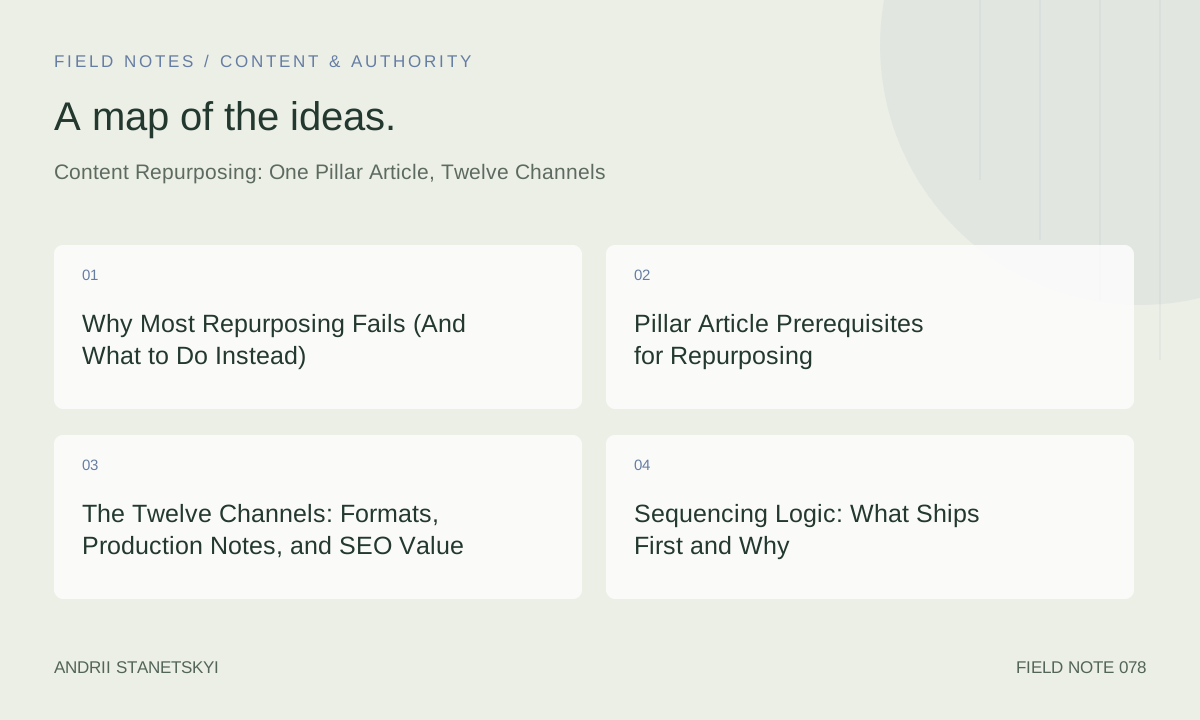
Why Most Repurposing Fails (And What to Do Instead)
Content repurposing fails for predictable reasons. The most common: treating repurposing as a copy-paste exercise rather than a format translation problem. Copying three paragraphs from a blog post and publishing them as a LinkedIn post is not repurposing — it's lazy replication that performs badly across every platform that values native content behavior.
Genuine repurposing means understanding what each channel rewards: the hook mechanics of LinkedIn, the visual compression requirements of infographics, the conversational register of podcast scripts, the specificity demands of YouTube tutorials. Each format needs the core insight from your pillar article translated into the native language of its channel.
The second failure mode is attempting to repurpose weak source material. Repurposing amplifies the quality of the original. A pillar article full of generic advice produces a mediocre LinkedIn carousel, a forgettable email, and a thin YouTube script. The twelve-channel system only works when the source pillar is genuinely excellent — original data, specific frameworks, counterintuitive positions, or step-by-step depth that competitors haven't matched.
Pillar Article Prerequisites for Repurposing
Not every article is repurposing-worthy. Before committing a piece to the twelve-channel workflow, it should meet these criteria:
- Minimum word count: 2,500 words with genuine depth (not padding)
- Contains at least one proprietary element: original data, a named framework, a step-by-step process, or a contrarian position backed by evidence
- Targets a keyword with >1,000 monthly searches and has a realistic path to top-10 ranking
- Evergreen or semi-evergreen: the core content stays relevant for 12+ months
- Structured with clear H2/H3 sections: each section should be extractable as a standalone asset
Articles that don't meet these criteria can still be repurposed, but into a reduced channel set — not the full twelve. Investing the full repurposing workflow in thin content is a losing trade.
The Twelve Channels: Formats, Production Notes, and SEO Value
Channel 1: Long-Form LinkedIn Article
Format: 1,200–2,000 words native LinkedIn article. Not a summary — a parallel argument using 2–3 key insights from the pillar, adapted to LinkedIn's professional register and narrative style. LinkedIn articles receive indexed ranking signals in Google; they are genuinely SEO-adjacent distribution.
Production time: 2–3 hours | SEO value: Medium (domain authority of LinkedIn + internal referral traffic)
Channel 2: LinkedIn Carousel (PDF Slide Deck)
Format: 8–12 slides. Each slide = one insight, compressed to a headline + 2-sentence elaboration. The hook slide must be strong enough to generate a "see more" click. Carousel posts consistently outperform static image posts in LinkedIn feed algorithms.
Production time: 3–4 hours (design included) | SEO value: Low (no crawl value) but high distribution value for audience-building
Channel 3: Email Newsletter
Format: 600–900 words. The opening should reference why this topic matters to the subscriber right now, contextualize it within a trend, then present 3–4 extracted insights from the pillar with a clear CTA to read the full article. Do not summarize — tease with specificity.
Production time: 1.5–2 hours | SEO value: Indirect (traffic signal to pillar page)
Channel 4: Twitter/X Thread
Format: 10–15 tweets. Tweet 1 = the counterintuitive hook. Tweets 2–12 = one insight or data point each. Tweet 13 = the framework summary. Tweet 14 = link to pillar. Threads with strong hook tweets are the primary traffic driver from X to long-form content.
Production time: 1 hour | SEO value: Low direct, high referral potential
Channel 5: YouTube Tutorial or Explainer
Format: 8–15 minute video. The pillar's step-by-step sections translate directly into tutorial segments. Script from the pillar's H2/H3 structure. YouTube is the second largest search engine; optimizing video titles and descriptions for pillar keywords earns dual-channel SERP presence.
Production time: 6–10 hours (scripting, filming, editing) | SEO value: High (YouTube SERP + Google Video results)
YouTube description template:
[Hook sentence referencing core problem]

In this video, you'll learn:
→ [Insight 1 from pillar]
→ [Insight 2 from pillar]
→ [Framework name and what it solves]

Read the full article: [pillar URL]

Timestamps:
0:00 Intro
2:15 [Section 1]
5:30 [Section 2]
9:00 [Framework explanation]
12:40 Summary
Channel 6: Podcast Episode or Audio Essay
Format: 15–25 minutes. Audio works best as a conversational elaboration, not a verbatim reading. Use the pillar's structure as a chapter outline, add personal anecdotes or listener-relevant examples, and expand on the "why" behind each recommendation. Show notes should include the pillar URL and a keyword-rich description.
Production time: 3–5 hours (scripting + recording + light editing) | SEO value: Medium (show notes indexed; branded search lift)
Channel 7: Infographic
Format: Vertical infographic (800×2000px minimum) visualizing the pillar's framework, process steps, or data. Infographics earn backlinks when published as embeddable assets on the pillar page itself. Include a embed code block beneath the infographic to facilitate link acquisition.
Production time: 4–6 hours (design) | SEO value: Medium-high (backlink acquisition potential)
Channel 8: Slide Deck (SlideShare / Speaker Deck)
Format: 20–30 slides designed as a conference presentation. SlideShare pages rank in Google image and document search. Include the pillar URL in the slide deck footer and in the SlideShare description. This format also doubles as sales enablement material.
Production time: 3–4 hours | SEO value: Low-medium (SlideShare domain authority)
Channel 9: Short-Form Video (Reels / TikTok / YouTube Shorts)
Format: 60–90 seconds. Extract one counter-intuitive insight from the pillar and build a short-form video around it. The hook must land in the first 3 seconds. Short-form video has minimal direct SEO value but drives top-of-funnel brand awareness that feeds branded search volume over time.
Production time: 2–3 hours | SEO value: Low direct, long-term brand lift
Channel 10: Quora / Reddit Answers
Format: 400–600 word answers to specific questions on Quora or relevant subreddits that the pillar addresses. Not promotional — genuinely answer the question, then reference the pillar as additional reading where it adds value. Quora answers rank in Google for long-tail question queries.
Production time: 45 minutes | SEO value: Medium (Quora pages rank; referral traffic)
Channel 11: Guest Post Derivative
Format: 1,200–1,800 word guest article for a high-DR publication in your niche. Pitch a related angle that lets you reference the pillar as source material. The guest post earns a topically relevant backlink to the pillar, directly strengthening its authority.
Production time: 4–6 hours (pitch + writing + outreach) | SEO value: High (backlink acquisition)
Channel 12: Interactive Tool or Template
Format: If the pillar contains a framework, scoring model, or checklist, translate it into a downloadable Google Sheets template, an interactive calculator, or a printable PDF checklist. Tools generate inbound links, have high sharing rates, and create a recurring traffic asset separate from the pillar page itself.
Production time: 3–6 hours | SEO value: High (link magnet; SERP visibility for "template" keyword variations)
See our guide to building SEO-optimized content templates and toolsSequencing Logic: What Ships First and Why
Sequencing matters. The goal is to concentrate engagement signals on the pillar page as quickly as possible after publication, then sustain distribution over a 4–6 week window rather than front-loading everything on day one.
| Week | Channels | Rationale |
|---|---|---|
| Week 1 (publication day) | LinkedIn Article, Email Newsletter, Twitter/X Thread | Drive immediate traffic to new pillar for early engagement signals |
| Week 1 (days 3–5) | LinkedIn Carousel, Quora/Reddit Answers | Second wave of social distribution; question-based referral traffic |
| Week 2 | YouTube Tutorial, Infographic published on pillar page | Durable video asset; infographic embed code activates link acquisition |
| Week 3 | Podcast Episode, Short-Form Video (2–3 pieces) | Audio distribution; short-form for brand reach |
| Week 4 | Slide Deck (SlideShare), Guest Post Outreach | Document search SEO; link building campaign launch |
| Week 5–6 | Interactive Tool launch, Guest Post publication | Link magnet activation; guest post backlink secured |
Production Workflow and Team Roles
A realistic repurposing system for a 3–5 person content team looks like this:
- Content Strategist (you): selects repurposing-worthy pillar candidates, owns the content brief for each derivative, sets channel priorities
- Writer/Editor: produces Channel 1 (LinkedIn Article), Channel 3 (Email), Channel 4 (Thread), Channel 10 (Quora answers), Channel 11 (Guest Post)
- Video Producer: owns Channels 5, 9 (YouTube + Short-Form)
- Designer: owns Channels 2, 7, 8 (Carousel, Infographic, SlideShare)
- Developer/Ops (part-time): builds Channel 12 (Interactive Tool) in Google Sheets or Webflow
For solo operators or small teams: prioritize the channels with highest SEO leverage (Channels 5, 7, 11, 12) and highest audience-building ROI (Channels 1, 2, 3) and defer the rest until resources allow.
Mini Case Study: Repurposing a Cybersecurity Pillar
A B2B cybersecurity firm published a 3,400-word pillar: "Zero Trust Architecture: Implementation Guide for Enterprise Teams." The article contained original survey data (n=127 IT security managers), a 5-stage implementation framework, and a cost/benefit comparison table. It met every prerequisite for the full twelve-channel system.
What They Did
Week 1: LinkedIn article + email to 4,200 subscribers + Twitter thread (43 tweets, later consolidated into 12 key insights). The email drove 1,840 clicks to the pillar on day one — enough to establish early engagement signals.
Week 2: YouTube tutorial (11 minutes, walkthrough of the 5-stage framework) hit 3,200 views in 30 days. The infographic with embed code was picked up by 4 industry publications, earning 4 DA-50+ backlinks.
Week 4: Guest post in a cybersecurity trade publication referenced the survey data and linked to the pillar. The Google Sheets implementation checklist (Channel 12) was downloaded 890 times in its first month.
Results at 90 Days
- Pillar page: position 4 for "zero trust architecture implementation" (up from position 22 at publication)
- Total multi-channel reach: estimated 47,000 unique content impressions across all formats
- Inbound links to pillar: 11 new referring domains (7 organic, 4 from infographic embeds)
- Email list growth attributable to checklist lead magnet: +312 subscribers
Tracking Framework: Measuring Multi-Channel ROI
# Google Sheets formula to calculate Content ROI by channel
# Assumes columns: Channel | Production Hours | Traffic to Pillar | Leads Generated | Backlinks Earned

# In Google Sheets: ROI Score (weighted composite)
# =((B2*0.2)+(C2*0.3)+(D2*0.3)+(E2*0.2))/SUM(B2:E2)

# Python equivalent for batch channel scoring
channels = {
    "LinkedIn Article": {"hours": 3, "traffic": 420, "leads": 4, "links": 0},
    "Email Newsletter": {"hours": 2, "traffic": 1840, "leads": 12, "links": 0},
    "YouTube Tutorial": {"hours": 8, "traffic": 280, "leads": 6, "links": 1},
    "Infographic": {"hours": 5, "traffic": 90, "leads": 0, "links": 4},
    "Guest Post": {"hours": 6, "traffic": 160, "leads": 3, "links": 1},
}

weights = {"traffic": 0.35, "leads": 0.40, "links": 0.25}

for channel, data in channels.items():
    max_t, max_l, max_lk = 1840, 12, 4
    score = (
        (data["traffic"] / max_t) * weights["traffic"] +
        (data["leads"] / max_l) * weights["leads"] +
        (data["links"] / max_lk) * weights["links"]
    )
    efficiency = score / data["hours"]
    print(f"{channel}: Score={score:.2f}, Efficiency per hour={efficiency:.3f}")
FAQ
How do I know which pillar articles deserve the full twelve-channel treatment?
Use a simple scoring matrix: keyword traffic potential (1–5) + content uniqueness (1–5) + business alignment (1–5). Articles scoring 12+ are candidates for the full twelve channels. Articles scoring 8–11 get a reduced channel set (6–8 channels). Below 8, standard promotion only. This keeps the highest-investment workflow reserved for your strongest content.
Does repurposing create duplicate content issues?
Only if you republish verbatim content on your own domain without canonicalization. Derivative content on external platforms (LinkedIn, YouTube, Quora, podcast hosts) is expected to be different in format and is not a duplicate content risk for your site. For any derivative content published on a domain you control, use a canonical tag pointing to the original pillar.
How long should I wait after publishing the pillar before starting repurposing?
Start immediately. Day-one distribution through email and social drives the early traffic signals that help Google assess the pillar's engagement quality. The common mistake is waiting for the article to "rank first" before promoting it — the traffic from promotion is part of what helps it rank.
How do I repurpose pillar content that's been live for 12+ months?
First, update the pillar (refresh data, add new sections, update examples). Republish with a new timestamp. Then run the repurposing sequence as if it's new — the content refresh is itself a newsworthy signal worth distributing. Frame it as "What's changed in [topic] in 2026" rather than re-promoting the original.
Can I repurpose content that contains licensed third-party data?
Check your data license terms carefully. Most third-party data licenses restrict republication of raw data but allow you to reference findings, create your own charts from the data, and cite the source. When in doubt, reframe the insight as your own analysis of publicly available information rather than reproducing the underlying dataset.
What's the biggest repurposing mistake senior content teams make?
Treating repurposing as a junior task. The highest-value derivations — the LinkedIn article, the podcast script, the YouTube tutorial — require the same strategic thinking as the original pillar. Delegating these to junior writers without a quality brief produces mediocre derivatives that perform poorly and reflect badly on the source content. Set the brief; don't outsource the thinking.
Key Takeaways
- Content repurposing is a format translation problem, not a copy-paste exercise. Each channel has a native content language; fluency in that language determines derivative performance.
- Only invest in the full twelve-channel system for pillar articles that meet strict quality prerequisites: depth, originality, keyword relevance, and evergreen value.
- The twelve channels break into four value categories: SEO-direct (YouTube, infographic, guest post, tool), audience-building (LinkedIn, email, carousel), referral traffic (Quora, Twitter thread), and brand reach (short-form video, podcast).
- Sequence matters: front-load social and email distribution on publication day to drive early engagement signals to the pillar, then sustain distribution over 4–6 weeks.
- The highest-ROI channels by efficiency (output per production hour) are consistently email newsletters, LinkedIn articles, and Quora answers — all relatively low-effort, high-referral formats.
- Track multi-channel ROI with a weighted composite score covering traffic to pillar, leads generated, and backlinks earned — then use this data to refine channel prioritization quarterly.
Conclusion
The content teams that win in 2026 are not the ones that publish most frequently — they're the ones that extract the most value from every piece they publish. Twelve-channel repurposing is the operational answer to content efficiency: one research investment, one rigorous pillar, twelve distribution surfaces, and a compounding asset that earns traffic, links, and audience attention long after the initial publication sprint ends.
Build the pillar well. Then go wide.
Next: How to build topic clusters that earn backlinks passively