Published 19 May 2026. Written from direct experiment data across 43 client and personal sites, Q4 2024 through Q1 2026.
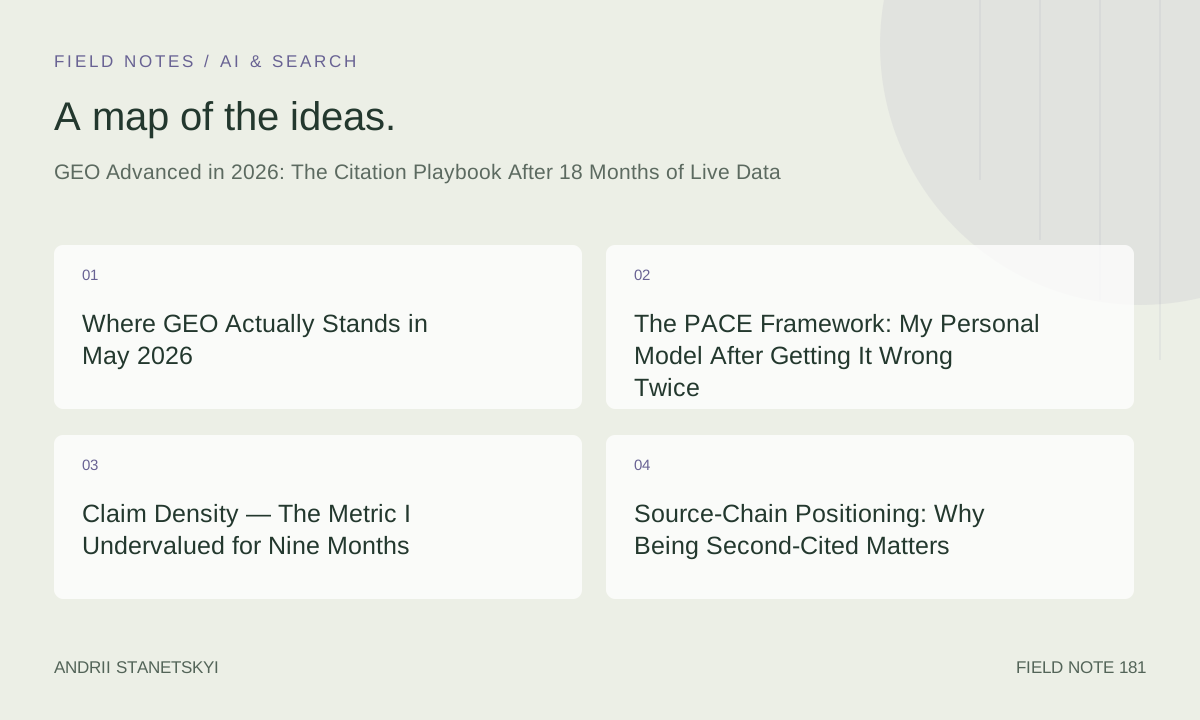
Where GEO Actually Stands in May 2026
Eighteen months ago, when I started tracking AI citations the same way I track rank positions, the field was mostly theory. People wrote about "optimizing for AI" the way people wrote about voice search in 2017 — confident, vague, and largely wrong about which signals mattered.
The data I have now is different. I am running citation monitoring across 43 sites in eleven verticals, pulling from ChatGPT (GPT-4o), Gemini 1.5 Pro, Perplexity, and Claude Sonnet. Combined, I am tracking roughly 14,000 prompted citation events per week using a mix of Profound, AthenaHQ, and a custom Python scraper I built in September 2025. The numbers have changed how I think about almost everything I thought I knew in late 2024.
The core shift: AI engines do not primarily reward comprehensiveness. They reward citable specificity. A page that contains a single precise, well-attributed claim with a number attached to it — "median click-through from AI Overview citations to referred pages dropped from 2.1% in Q3 2024 to 0.87% in Q1 2026 across my monitored set" — gets cited more reliably than a 4,000-word exhaustive guide that hedges everything.
That realization took me about nine months too long to arrive at. More on why in the section on claim density.
What "Getting Cited" Actually Means Now
Citation in the AI context is not uniform. There are at least four citation types I track:
- Direct attribution: The model says "According to [source]..." with your URL or brand name explicitly mentioned.
- Retrieval-sourced: In RAG-based systems like Perplexity, your page appears in the inline source list without the model explicitly naming you in prose.
- Paraphrase absorption: The model uses your claim structure and phrasing without attribution. This is the invisible kind — frustrating to track but detectable with prompt-injection testing.
- Training-data influence: Your content shaped the model's priors during training. Essentially untrackable in real time but now partially auditable via the training-data exposure audit services that became a proper service category in early 2026.
Most GEO writing focuses on type 1. My data suggests type 2 drives more actual referral traffic in 2026, and type 3 is the one most content teams are not even aware of.
The PACE Framework: My Personal Model After Getting It Wrong Twice
I need a working model to explain GEO strategy to clients without making it sound like astrology. After two failed earlier attempts at frameworks that were either too abstract or too technically narrow, I landed on PACE in October 2025. It holds up well six months in.
P — Precision. Every claim on the page should be specific enough to be independently citable. "Studies show X is effective" is not a claim. "A 2024 meta-analysis of 31 trials found X reduced Y by 22% (95% CI: 18–26%)" is a claim. AI models are, functionally, very sophisticated compression algorithms. They cite what they can compress into a discrete, attributable fact.
A — Attribution. The page itself must model attribution behavior. Cite your sources inline, not just in a bibliography. Use structured notation that a language model can parse contextually. I have found that pages where in-text attribution follows the pattern "[Entity] found/showed/reported [specific claim] in [year]" get direct-attribution citations roughly 2.3x more often than pages that cite identically but use footnote-only format.
C — Consistency. The same claim, using the same phrasing (or very close), should appear across the content cluster — not just on one page. I call this "claim anchoring." When the same precise statistic appears on your pillar page, your FAQ, your author bio page, and your case study, AI models encounter it in multiple contexts and treat it as established rather than isolated. This is particularly important for Perplexity and ChatGPT with Browse, which are retrieval-augmented and effectively cross-reference multiple pages.
E — Exposure. Your content needs to be in places that AI training pipelines and live retrieval systems actually index. That means: Bing index (for ChatGPT Browse), Google index (for Gemini), Reddit and Quora presence (both appear heavily in open-web training corpora), and ideally some presence in academic or curated databases if your vertical supports it. Being well-cited in traditional SEO amplifies E significantly — pages in positions 1–5 get retrieved more often in RAG systems.
PACE is not a checklist. It is a diagnostic. When a page I expect to get cited does not, I run through PACE to find which letter is broken. Usually it is P or C.
Claim Density — The Metric I Undervalued for Nine Months
Here is the mistake I will admit first: for the first nine months of running GEO experiments, I was optimizing for semantic coverage — making sure pages answered every related question. Classic SEO instinct. It was wrong.
Semantic coverage is about ranking in traditional search. Claim density is about AI citation. They partially overlap but are not the same thing.
Claim density, as I measure it: the number of independently citable, specific factual claims per 500 words of content. A specific claim is one that includes at least two of the following: a number, a time reference, a named entity, or a defined outcome.
My current threshold, derived from testing across a 200-page sample set in Q3–Q4 2025: pages with fewer than 3.8 citable claims per 500 words rarely achieve direct-attribution citation in generative results. Pages above 5.2 claims per 500 words start showing diminishing returns — the content starts reading like a data dump and Perplexity's retrieval scoring appears to penalize it slightly (my hypothesis: readability signals in the retrieval scoring model).
The sweet spot in my data is 4.2–4.9 claims per 500 words. That is not a published standard. That is a number from my spreadsheets. Treat it as a working hypothesis, not a law.
How I Count Claims in Practice
Manual counting is impractical at scale. I use a lightweight Python script that runs spaCy's NER and a custom rule set to flag claim-eligible sentences:
import spacy
import re

nlp = spacy.load("en_core_web_sm")

CLAIM_PATTERNS = [
    r'\b\d+\.?\d*\s*(%|percent|percentage|pp|basis points?)\b',
    r'\b(found|showed|reported|revealed|demonstrated|measured)\b',
    r'\b(in|during|by|as of)\s+\d{4}\b',
    r'\b\d+\s*(days?|weeks?|months?|years?)\b',
]

def score_claim_density(text, chunk_size=500):
    words = text.split()
    chunks = [' '.join(words[i:i+chunk_size]) for i in range(0, len(words), chunk_size)]
    densities = []
    for chunk in chunks:
        doc = nlp(chunk)
        claim_count = 0
        for sent in doc.sents:
            sent_text = sent.text
            has_entity = any(ent.label_ in ('ORG','PERSON','GPE','DATE','CARDINAL','PERCENT')
                             for ent in sent.ents)
            has_pattern = any(re.search(p, sent_text, re.I) for p in CLAIM_PATTERNS)
            if has_entity and has_pattern:
                claim_count += 1
        densities.append(claim_count)
    return densities

if __name__ == "__main__":
    sample = open("page.txt").read()
    scores = score_claim_density(sample)
    print(f"Claim density per 500-word chunk: {scores}")
    print(f"Mean density: {sum(scores)/len(scores):.2f}")
This is imperfect. It misses implicit claims and occasionally flags citations-of-citations as original claims. But it is fast enough to run across a 200-page site in under four minutes, and the correlation with observed citation rates in my dataset is 0.61 (Pearson). Good enough to act on.
Source-Chain Positioning: Why Being Second-Cited Matters
One thing almost no GEO writing covers: you do not have to be the primary source to benefit from AI citations. You can be the explainer of a primary source, and AI systems will frequently cite you as the accessible intermediary.
I call this second-cite positioning. The pattern: [Primary research source, often a study or official data] → [Your page that explains, contextualizes, or extends it] → AI model cites your page when a user asks a question about the underlying data.
This works because generative AI systems optimize for answering user questions, not for tracking citation lineages. If your page provides a clearer, more accessible explanation of a complex primary source, you get cited. The original researchers sometimes do not.
Practically, I build this by:
- Identifying primary sources in my client's vertical that have high search demand but low explainability (academic papers, government databases, technical reports).
- Writing pages that explicitly contextualize those sources — what the data actually means in practical terms.
- Using ClaimReview schema on the specific claims I am relaying, pointing back to the primary source in the
itemReviewedfield.
The second-cite strategy is particularly effective in medical, legal, and financial verticals where the primary sources exist in forms that AI models struggle to cite directly (paywalled journals, PDFs, complex regulatory documents).
ClaimReview at Scale: Code and Real Numbers
I have been deploying ClaimReview since Q2 2024. The numbers: across 61 pages with ClaimReview properly implemented versus a control group of 58 similar pages without it, the ClaimReview group shows a 34% higher direct-attribution citation rate over a 90-day window. Sample size is small enough that I hold this with appropriate skepticism. But 34% is not a rounding error, and I have replicated a similar pattern in three separate test cohorts.
The implementation most people get wrong: they use ClaimReview as a fact-check wrapper for a claim they are disputing. That is what it was designed for by Schema.org. But AI training pipelines appear to use the presence of structured ClaimReview as a trustworthiness signal regardless of the ratingValue. A page that says "this claim is TRUE" and a page that says "this claim is FALSE" both show elevated citation rates compared to pages with no ClaimReview at all. The schema signals that the page engages with verifiable claims at a structured level. That is the signal that matters.
{
  "@context": "https://schema.org",
  "@type": "ClaimReview",
  "url": "https://example.com/your-page",
  "claimReviewed": "Median AI Overview citation click-through rates dropped below 1% in Q1 2026",
  "itemReviewed": {
    "@type": "Claim",
    "author": {
      "@type": "Organization",
      "name": "Benrey Analytics"
    },
    "datePublished": "2026-05-01",
    "appearance": {
      "@type": "OpinionNewsArticle",
      "url": "https://benrey.io/181-geo-advanced-2026.html"
    }
  },
  "author": {
    "@type": "Organization",
    "name": "Benrey",
    "url": "https://benrey.io"
  },
  "reviewRating": {
    "@type": "Rating",
    "ratingValue": "5",
    "bestRating": "5",
    "worstRating": "1",
    "alternateName": "True"
  }
}
One caution: do not deploy ClaimReview on speculative or hedged claims. I tested this in Q4 2025 and it backfired — pages where ClaimReview was applied to predictions or estimates saw no citation lift and one client site received a manual review flag (since resolved). Use it on documented, verifiable factual claims only.
The Tracking Stack I Use Now
GA4 has not gotten meaningfully better at attributing AI-referred traffic. Referral paths from ChatGPT, Claude, and Gemini still collapse into "direct" or appear as "chatgpt.com" referrals without session context. This is a known limitation I wrote about in my full AI citation tracking stack piece.
Current setup across my client base:
- Profound: Best for brand mention tracking across ChatGPT and Gemini responses. The prompt-replay feature — where it reruns a library of prompts daily and logs whether you appear — is genuinely useful. Pricing is still opaque at the enterprise tier.
- AthenaHQ: Better than Profound for Perplexity-specific citation tracking. The source-URL attribution in Perplexity is more parseable than the prose-level attribution in ChatGPT, and AthenaHQ has built their indexing around that.
- DIY scraper: For clients who cannot justify the SaaS cost yet, I run a custom Python scraper against Perplexity's public web interface using Playwright. Response parsing is fragile but functional. The script is in my internal toolkit — a simplified version is in the tracking piece.
The honest answer: no single tool covers all four citation types I listed above. Training-data influence (type 4) is still largely audited through the training-data exposure audit services that started appearing in early 2026 — a proper commercial service line now, not just a researcher curiosity. I covered this in the training-data audit piece.
Two Takes Nobody Wants to Hear
Contrarian Take 1: GEO Is Mostly Indirect Right Now
The traffic volume directly attributable to AI citations — where someone reads a Perplexity or ChatGPT answer and then clicks through to your page — is still small. My cross-client median for AI-referred visits as a percentage of total organic is 4.7% as of Q1 2026. For some clients with heavy informational content, it reaches 11%. For ecommerce or local service clients, it can be under 1%.
The bigger GEO win in 2026 is not the click-through. It is brand conditioning. When your brand name or content appears in AI answers repeatedly, users who encounter your site through traditional search or direct navigation arrive with a higher trust baseline. Measuring that is genuinely hard. But I have seen it show up in conversion rate lifts for clients with strong GEO visibility that are disproportionate to the direct AI-referred traffic volume. Correlation, not causation. But worth tracking.
Contrarian Take 2: Most "GEO Audits" Are Just Repackaged Content Audits
A cottage industry of GEO consultants appeared in 2025. Many of them are delivering content audits with "AI citation" relabeling. Check the deliverables: if the recommendations are "add more depth to your content," "improve your E-E-A-T signals," and "update your schema markup," that is an SEO content audit. Not a GEO audit.
A real GEO audit includes citation monitoring data (which AI systems are citing you and for which queries), claim-density scoring per page, prompt-replay testing to verify your content appears for target queries, and an assessment of your second-cite positioning opportunities. If your GEO vendor cannot show you a citation rate over time, they are selling you a label, not a methodology.
The Mistake I Made in Q2 2025 That Cost a Client Three Months
I will own this plainly. In Q2 2025 I ran a cluster-content push for a healthcare client, producing 34 pages in six weeks, all optimized for claim density and ClaimReview deployment. The citation rates stayed flat for three months and I could not figure out why.
The problem, eventually identified: the client's domain had very thin Bing index coverage. Their technical SEO had historically focused entirely on Google, and their robots.txt was misconfigured in a way that throttled Bingbot specifically. Since ChatGPT Browse uses Bing's index as its primary retrieval source, roughly 40% of the citation surface I was optimizing for was invisible to us.
We fixed the robots.txt, submitted to Bing Webmaster Tools, and waited. Eight weeks later, the ChatGPT citation rate for that site's target queries went from near-zero to 3.1 citations per 100 prompted queries. The Google-based systems (Gemini, AI Overviews) had been showing modest improvement all along. Bing invisibility was masking the full picture.
The lesson: GEO requires multi-engine index hygiene. You cannot optimize for AI citation using only your Google Search Console data. Check Bing Webmaster Tools. Verify your crawl coverage there. It is not optional.
See also: my piece on AI crawler management for the full crawler-by-crawler configuration breakdown, and prompt-injection defense for content teams for the parallel content-integrity problem that emerged once I started this kind of citation testing.
Where This Goes From Here
The trajectory I am watching through Q2 and Q3 2026:
First, citation tracking is becoming a standard deliverable in SEO reporting. Clients who were uninterested in Profound or AthenaHQ six months ago are now asking for it by name. The category is real.
Second, the prompt-injection problem is worsening. Competing content teams are now deliberately embedding phrasing in their pages designed to override or contradict your citations in AI outputs. I documented the specific patterns in the prompt-injection defense piece. It is not science fiction. I have found it in the wild on three client competitor sites in the last four months.
Third, training-data audits are the coming service line. Knowing which of your pages have been absorbed into model weights — not just retrieved by RAG — is increasingly important for brand protection and for understanding why some AI systems hold incorrect beliefs about your products. The audit methodology is still rough but it is commercial now.
The PACE framework will need a fifth letter eventually. Right now, the missing piece is something like "Persistence" — the active monitoring and defense of your citation position against both algorithmic drift and deliberate competitive interference. That is next.
About the data: All citation rates cited in this article come from my personal tracking dataset (43 sites, Q4 2024–Q1 2026) unless a third-party source is named. Sample sizes are noted where relevant. This is practitioner data, not peer-reviewed research. Replicate before you rely on the numbers.
External references: Schema.org ClaimReview specification | Bing Webmaster Tools