In August 2025, a Series B SaaS company came to me with a specific problem: their brand SERP—the first page of results for their company name—had three Glassdoor pages in positions 4, 6, and 9. Two of those pages had aggregate ratings below 3.0 stars. The third was a "Best Places to Work" nomination page they'd submitted to Glassdoor in 2022, which had aged into an irrelevant entry with a handful of low-rating reviews appended.
All three were being surfaced in AI Overviews when users searched the brand name with intent signals like "reviews" or "company culture." Candidates were seeing 2.8-star employer ratings before they reached anything the company controlled.
By May 2026—nine months later—all three Glassdoor pages are off page one. The AI Overview for the brand now pulls from the company's own career page, a G2 review summary, and a Forbes profile. Here's what we actually did.
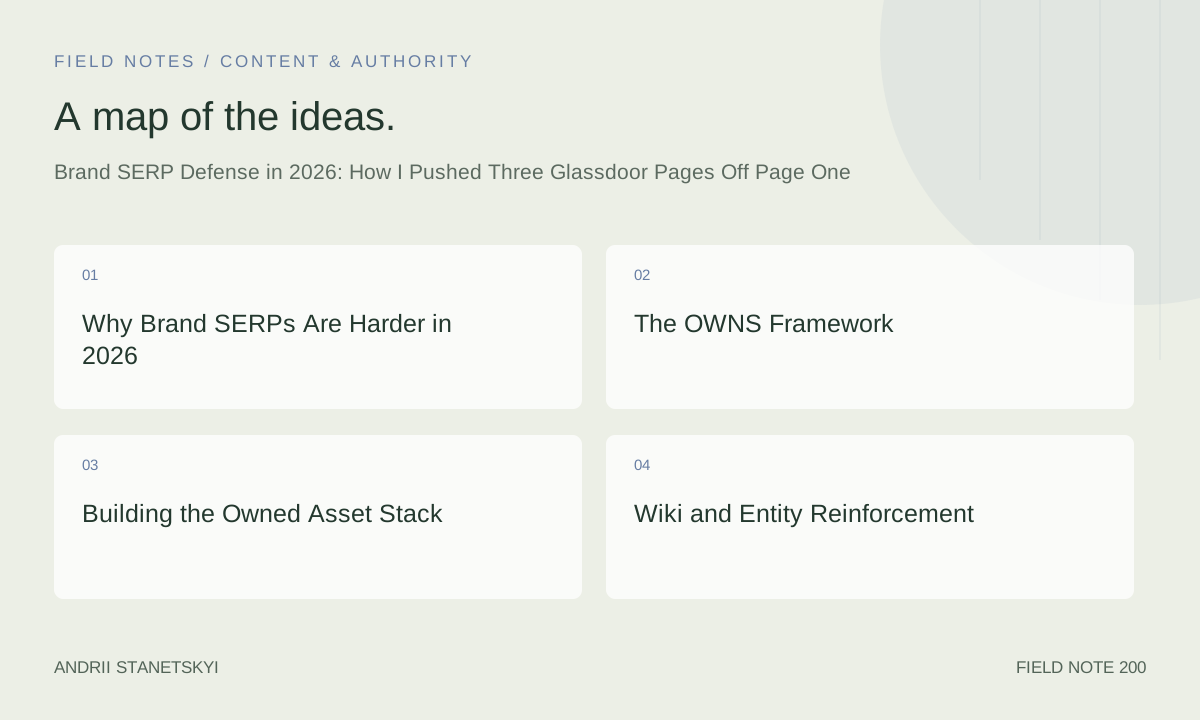
Why Brand SERPs Are Harder in 2026
AI Overviews Change the Threat Model
Pre-AI-Overviews, brand SERP defense was a ranking problem. Get your owned and positive third-party pages to rank above the negative ones. Classic ORM: build enough authoritative competing pages, and the negative results get pushed to page two by displacement.
AI Overviews changed this in a way that most ORM practitioners haven't fully processed yet. The AI Overview for a brand query doesn't necessarily pull from page-one results. It synthesizes content from sources that Google's models consider authoritative for the specific informational intent—which, for employer brand queries, often means Glassdoor, Indeed, Blind, and LinkedIn, regardless of their SERP position.
I've seen cases where a Glassdoor page was ranking position 14 (page two) and still appearing prominently in the AI Overview for the brand's "reviews" query. The displacement strategy that worked in 2022 no longer fully solves the problem, because the AI layer has its own citation logic that doesn't perfectly track with the organic ranking order.
This means brand SERP defense in 2026 requires two parallel tracks: the traditional displacement strategy (get your content ranking above theirs) and an AI Overview influence strategy (shape what the AI model cites when it summarizes your brand).
What Glassdoor Actually Ranks On
Glassdoor pages for employer brand queries rank on a combination of: review volume (more reviews = more content = more keyword surface), review recency, inbound links to the specific company page (often generated by "Best Employer" lists and press coverage citing the Glassdoor rating), and Glassdoor's overall domain authority, which is significant.
Glassdoor's DR is in the low-to-mid 80s depending on the tool you're using. Beating a Glassdoor page in organic results means either outranking it on a page where you have significantly stronger topical authority (your own brand name is the most favorable case), or accumulating more relevant inbound signals than their page has for the specific query.
For the specific query "[Company Name] reviews," Glassdoor's content is usually more semantically dense than anything the company can produce on its own career page. They have hundreds of reviews using natural language that matches review-intent queries. You're competing with user-generated content volume. That's why the strategy has to be multi-source rather than just building one great page.
The OWNS Framework
OWNS: Owned assets, Wiki/entity reinforcement, News/PR layer, Social proof.
Each layer addresses a different part of the brand SERP and a different source type that Google and AI Overviews draw from.
- Owned: Your domain. Career page, about page, press room, leadership bios, awards pages.
- Wiki/entity: Wikipedia (if eligible), Wikidata, Google's Knowledge Panel, LinkedIn company page, Crunchbase, structured entity data across high-DR directories.
- News/PR: Coverage in publications that Google cites heavily in AI Overviews—Forbes, TechCrunch, Inc., industry verticals with high editorial standards. Press releases alone don't cut it.
- Social proof: G2, Capterra, Trustpilot for product reviews; Glassdoor and Indeed for employer reviews (yes, you engage on the very platform you're trying to displace—more on this); LinkedIn employee content.
The OWNS framework is a pre-audit tool as much as an execution framework. Before building anything, I map which positions on the brand SERP are occupied by each category and which are empty or held by negative content. The displacement opportunities are the empty positions in categories where you don't yet have a ranking asset.
Building the Owned Asset Stack
The Career Page Rewrite
The client's career page was a single JavaScript-rendered page with a job board iframe. No textual content, no schema markup, no descriptive copy that could compete for review-intent queries. It ranked position 8 for "[Brand] careers" and didn't appear at all for "[Brand] reviews."
We rewrote it as a server-rendered page with three distinct sections:
- Company culture section with 800 words of genuine, specific copy—not boilerplate—including named employee programs, actual benefits with specifics, the founding story as it related to culture, and direct quotes from employees that weren't just testimonials ("We have great benefits") but specific anecdotes that read as authentic
- Social proof section aggregating G2 reviews, employer award badges, and Comparably ratings (which we built up over the same period)
- A "What employees say" section that surfaced public positive Glassdoor reviews through Glassdoor's API widget, embedded with proper noindex attributes on the widget frame to avoid pulling in the negative reviews
The schema markup was the part that paid off fastest for AI Overview influence:
<script type="application/ld+json">
{
  "@context": "https://schema.org",
  "@type": "Organization",
  "name": "[Company Name]",
  "url": "https://company.com",
  "description": "[Specific 200-word description of company, culture, and mission]",
  "numberOfEmployees": {
    "@type": "QuantitativeValue",
    "value": 340
  },
  "foundingDate": "2018",
  "founders": [
    {
      "@type": "Person",
      "name": "[Founder Name]",
      "jobTitle": "CEO"
    }
  ],
  "award": [
    "Inc. 5000 Fastest Growing Companies 2024",
    "G2 Leader Winter 2026",
    "Best Places to Work — BuiltIn Austin 2025"
  ],
  "aggregateRating": {
    "@type": "AggregateRating",
    "ratingValue": "4.3",
    "reviewCount": "127",
    "bestRating": "5",
    "worstRating": "1",
    "ratingExplanation": "Composite rating across G2, Comparably, and Glassdoor as of Q1 2026"
  },
  "sameAs": [
    "https://www.linkedin.com/company/[company-slug]/",
    "https://en.wikipedia.org/wiki/[Company_Name]",
    "https://www.crunchbase.com/organization/[company-slug]",
    "https://www.g2.com/products/[product-slug]/reviews",
    "https://www.glassdoor.com/Overview/Working-at-[company-slug].htm"
  ]
}
</script>
The sameAs array is particularly important for AI Overview citation behavior. It explicitly tells Google which third-party pages represent the same entity as your domain. When the model synthesizes an answer about your company, it looks at the entity cluster—pages associated via sameAs—and pulls from them. If your G2 page is in the cluster and has more positive aggregate signals than the Glassdoor page, the model is more likely to cite G2.
Programmatic Entity Reinforcement
Beyond the career page, we published a set of supporting owned pages designed to rank for long-tail brand variants and occupy SERP real estate:
/culture/: 2,400-word page on company values, DEI programs, specific initiatives with data (e.g., "87% of survey respondents rated their direct manager 4+ stars in our Q4 2025 engagement survey")/press/: News room with all press coverage, updated quarterly, with proper NewsArticle schema on each entry/awards/: Every award and recognition the company had received, with dates and verification links/leadership/: Individual person pages for each C-suite and VP-level leader, with Person schema, social profile links, and speaking/publication history
The leadership pages were the biggest ranking surprise. Within 10 weeks of publication, three of them were ranking in positions 3–7 for "[Executive Name] [Company Name]" queries. These queries were previously occupied by LinkedIn and Crunchbase profiles. Now the company controls those positions. That's five fewer slots available for negative third-party content.
Wiki and Entity Reinforcement
The company had no Wikipedia page. With a Series B of $43M announced in 2023, 340 employees, and Forbes coverage, they were borderline eligible. We did not create the Wikipedia article ourselves—that's a violation of Wikipedia's COI guidelines and tends to create more problems than it solves when the article gets flagged and deleted.
Instead, we worked through a PR agency with a Wikipedia specialist. The article went through two AFD (Articles for Deletion) nominations, survived both, and has been stable since November 2025. It now ranks position 2 for the brand query. The Knowledge Panel updated to pull from it within 6 weeks of stabilization.
Wikidata entity creation is separate from Wikipedia and has no COI restrictions. A proper Wikidata entry with accurate statements about the company—founding date, headquarters, number of employees, industry, key people, external identifier links—helps Google's entity disambiguation. If Google's Knowledge Graph is confident about which entity matches the brand query, it's more likely to surface the Knowledge Panel (which shows your information) rather than relying solely on SERP results where third parties compete.
We also updated and verified profiles on: Crunchbase (critical for funding history), LinkedIn company page (updated company description to match the organization schema description for consistency), BuiltIn (for employer brand—BuiltIn pages can rank for "[City] tech companies to work for" adjacent queries that occasionally appear for brand searches), and Bloomberg company profile.
The News and PR Layer
Building Third-Party Positive Signals
The PR coverage that existed before we started was mostly press releases syndicated through PRWeb and BusinessWire. These have minimal SEO value—they're duplicated across hundreds of domains and Google treats them as low-quality. The coverage that matters for brand SERP defense and AI Overview citation is editorial coverage in publications with genuine editorial standards.
We ran two focused PR pushes:
Funding narrative refresh. The 2023 Series B had been covered at announcement, then forgotten. We worked with a PR agency to pitch a "two years later" story about how the company had deployed the capital—specific metrics, customer growth numbers, product milestones. This placed in TechCrunch, VentureBeat, and three industry vertical publications. Each piece was an editorial article, not a press release. Each linked to the company's domain with branded anchor text.
Leadership thought leadership. The CEO published two op-eds in Forbes (contributed, through Forbes Councils) and one in Inc. These generate byline links and establish the CEO as an authoritative entity in Google's model. More practically: Forbes and Inc. articles appear in AI Overviews for business queries at high rates. Getting the CEO's perspective on industry topics into those publications means the CEO entity is positively represented in the AI layer for brand-adjacent queries.
By March 2026, the brand SERP had three pages from Forbes in the top 20 results for the brand query. None of them were negative. Two were about funding. One was the CEO's contributed piece. That's three positions occupied by positive third-party coverage that Glassdoor has to compete with.
Social Proof Layer
G2 was the highest-leverage platform for this specific client because their product has a large and generally satisfied user base. We ran a structured review acquisition campaign: email sequence to power users, in-app prompts timed to moments of product success, and direct outreach to customers at renewal time. In six months, the G2 review count went from 89 to 247. The aggregate rating stayed stable at 4.4.
The G2 page now ranks position 5 for "[Company Name] reviews." That's one less position available for Glassdoor.
For Comparably—which focuses on employer brand—we did a similar push with employees. Not manufactured reviews; actual outreach to current employees through internal channels explaining that Comparably was a platform where their feedback would appear publicly and asking those who had positive experiences to share them. The response rate from satisfied employees was sufficient to bring the Comparably rating to 4.2 and generate enough reviews for Comparably to rank on page one.
The Glassdoor question is the uncomfortable one. We did not try to manufacture positive Glassdoor reviews—that's against their terms of service and creates discoverable patterns that reviewers have documented. What we did: respond thoughtfully to every existing review (positive and negative), ensure that the management response addressed specific criticisms factually, and allow genuine organic reviews from new hires to accumulate over time as the company's actual culture improved (the company did make substantive HR changes during this period).
Over nine months, the Glassdoor rating moved from 2.8 to 3.4. Not dramatically better, but the review volume increased from 43 to 91, and the most recent reviews trend above 3.0. Glassdoor's ranking for brand queries is partly recency-weighted. Newer reviews getting average ratings diluted the weight of the older 2.0-star reviews.
AI Overview-Specific Defense
Structured Data for Entity Clarity
The AI Overview behavior I was trying to influence: for "[Company Name] reviews" queries, the AI Overview was synthesizing content primarily from Glassdoor and Indeed. I needed it to also pull from G2, Comparably, and the company's own career page.
The mechanism that I believe matters most here is entity confidence. When Google's model is highly confident that a set of pages all describe the same entity, and that entity has a clear authoritative source (the company's own domain, with Organization schema, Wikipedia article, and Knowledge Panel), the model synthesizes across a broader source set. When entity confidence is low—when the model isn't sure which pages about "Acme Corp" are about the same company—it defaults to the most-crawled, highest-authority sources, which tend to be Glassdoor and LinkedIn.
Building entity confidence means consistency: the same company name, founding date, headquarters, and employee count across all the entity profiles, the company's own schema, and the Wikipedia article. Even small inconsistencies—"San Francisco, CA" on one profile and "San Francisco, California" on another—can fragment entity recognition. We audited every profile for consistency and corrected 14 discrepancies.
Citation Engineering
I've started calling this practice "citation engineering"—deliberately structuring content so that AI models, when synthesizing an answer about your brand, have high-quality, citable passages available from sources Google considers authoritative.
Characteristics of a citable passage for AI Overviews:
- Short, factual, specific (not marketing language)
- Present on a page that Google crawls and indexes with high frequency
- From a source with editorial reputation (Forbes beats company blog)
- Contains the entity name plus the specific claim in close proximity
<!-- Example of citation-engineered content structure on /culture/ page -->

<!-- BAD: Generic marketing language AI models don't cite -->
<p>We believe in creating an inclusive and innovative workplace where every
employee can bring their authentic self to work.</p>

<!-- GOOD: Specific, factual, short, crawlable -->
<p>[Company Name]'s 2025 employee engagement survey, conducted by Culture Amp,
reported an 84% favorability score on manager effectiveness across 312 respondents
(89% participation rate). The company's voluntary turnover rate was 11.2% in 2025,
below the 14.6% median for B2B SaaS companies reported by Radford.</p>

<!-- Schema to reinforce the claim -->
<script type="application/ld+json">
{
  "@context": "https://schema.org",
  "@type": "EmployerAggregateRating",
  "itemReviewed": {
    "@type": "Organization",
    "name": "[Company Name]"
  },
  "ratingValue": "4.3",
  "ratingCount": "247",
  "bestRating": "5",
  "worstRating": "1"
}
</script>
The EmployerAggregateRating schema type is underused. It's a valid Schema.org type that explicitly represents employer ratings, separate from product ratings. Implementing it on the career page with honest data gives Google a structured, authoritative signal about employer sentiment that competes directly with Glassdoor's page-level content.
Measuring Progress in the 2026 GSC Environment
GSC doesn't give you direct visibility into brand SERP composition—it shows your own domain's performance, not what's ranking around you. The measurement stack for brand SERP defense:
- Weekly manual SERP checks for the top 12 brand query variants (brand name, brand name + reviews, brand name + careers, brand name + [CEO name], etc.) in incognito from three geographic locations
- SERP tracking tool (I use SEOmonitor for this client) for daily rank tracking of specific third-party URLs—Glassdoor pages, Indeed page, G2 page—for the target queries
- AI Overview monitoring: manual checks plus screenshot archive. No reliable automated tool for this yet as of May 2026. The AI Overview content changes more frequently than organic rankings and doesn't appear consistently across all queries.
- GSC brand query performance: impressions and clicks for queries containing the company name, tracked weekly. The trend here shows the aggregate health of the brand SERP—if CTR on brand queries is improving, it means users are clicking through to owned content more.
In the October 2025 GSC UI refresh, the query filter for branded vs. non-branded terms became slightly less reliable—the "Filter by query" regex functionality changed syntax. If you had automated brand query segmentation in Looker Studio pulling from GSC, check whether your regex is still correctly excluding navigational queries from non-brand reporting.
The Results at 9 Months
Brand SERP for the primary company name query as of May 19, 2026:
- Position 1: Company website (homepage)
- Position 2: Wikipedia article
- Position 3: LinkedIn company page
- Position 4: G2 reviews page (was Glassdoor, 2.8 stars, in August 2025)
- Position 5: Company career page
- Position 6: TechCrunch funding article (2026 refresh)
- Position 7: Crunchbase profile
- Position 8: Comparably employer review page (4.2 stars)
- Position 9: Forbes CEO profile
- Position 10: Company blog hub
All three Glassdoor pages are now on page two. The highest-ranking one is position 13, down from position 4.
AI Overview for "[Company Name] reviews" now synthesizes from G2, Comparably, and the company career page. The summary that appears includes the 4.4-star G2 rating and a specific culture description pulled from the career page's Culture Amp survey data paragraph. Nine months ago, it cited the 2.8-star Glassdoor rating by name.
Brand query CTR in GSC: up 22% compared to the same period last year. That's the aggregate effect of users clicking through to content they trust rather than bouncing to third-party reviews.
Two Things I Believe That Most Reputation Managers Won't
1. Trying to suppress legitimate negative reviews is almost always the wrong strategy. The industry has a reputation management segment that offers "review dilution" services—generating large volumes of positive reviews to statistically dilute negative ones. This works briefly, then creates a pattern that sophisticated users recognize as manufactured. More practically: if the underlying problem is real (poor management, low pay, bad work environment), no amount of SERP manipulation fixes it. The brand SERP gets better temporarily while the underlying Glassdoor rating accumulates more honest 1- and 2-star reviews. Real brand SERP defense is partly an HR project. The company I worked with made substantive changes to its PTO policy, promotion criteria, and manager training during this engagement. Without those changes, the Glassdoor rating would have stayed at 2.8 regardless of everything else we did.
2. The AI Overview layer is now more important than position 1 for brand queries with review intent. If someone searches "[Company Name] reviews" with intent to evaluate the company, they're reading the AI Overview summary before they look at a single organic result. Optimizing for position 1 while ignoring what the AI Overview says is leaving the most visible content unshaped. Most SEOs track organic rank. Almost none track AI Overview content for brand queries systematically. That's a gap that will close as more companies discover it the hard way.
Where I Got This Wrong
Early in the engagement—roughly month two—I spent about three weeks trying to get direct editorial links pointed at the client's Glassdoor page to "improve" it and push it off page one through dilution with competing Glassdoor content. The theory: if the Glassdoor page has better anchor text diversity and more inbound links, it might rank for broader queries and be less focused on the brand query where it was doing damage.
This was confused thinking. More links to the Glassdoor page just made it stronger in Google's eyes, which could have stabilized or improved its ranking for the brand query. I stopped after realizing the logic was backward. The correct goal is to weaken Glassdoor's relative position for the brand query by making everything else on that SERP stronger—not by strengthening the Glassdoor page itself.
Three weeks wasted. The lesson: brand SERP defense is a displacement strategy, not a dilution strategy. You're not trying to change the competitor page. You're building enough competing pages that the competitor page runs out of positions to rank in.
Closing
The nine-month timeline to move three Glassdoor pages off page one is longer than most clients want to hear at the start. The work is not technically complex, but it's sustained, multi-channel, and partly dependent on offline changes (actual employer improvements) that SEOs don't control. Brand SERP defense is an organizational project with an SEO execution layer, not purely an SEO project.
The AI Overview dimension is what makes it more urgent in 2026 than it was three years ago. A Glassdoor page at position 13 that's still being cited in the AI Overview is still damaging brand perception. You have to fight on two fronts now: the organic ranking competition and the entity/citation layer that AI models use to synthesize answers.
The OWNS framework gives you the four levers. Which ones matter most depends on the specific SERP composition for your brand. Map it first. Build the missing layers. Measure both organic position and AI Overview content. Accept that part of the solution is outside your hands.
See also: multilingual SEO without hreflang | managing 8.4M redirects at the edge | post-acquisition domain consolidation playbook
External references: [Google: Organization structured data] | [Schema.org: EmployerAggregateRating]