Internal linking is the most underinvested lever in technical SEO. While teams spend thousands of dollars and months of effort acquiring external backlinks, they leave enormous link equity stranded in orphaned pages, buried in navigation menus, or diluted across hundreds of low-priority pages that don't need it. A senior practitioner's approach to internal links is systematic, data-driven, and treats every crawl budget credit and PageRank flow as a scarce resource to be allocated deliberately. This guide covers the complete framework: site architecture design, equity flow analysis, crawl efficiency, and the specific configurations that produce measurable ranking improvements.
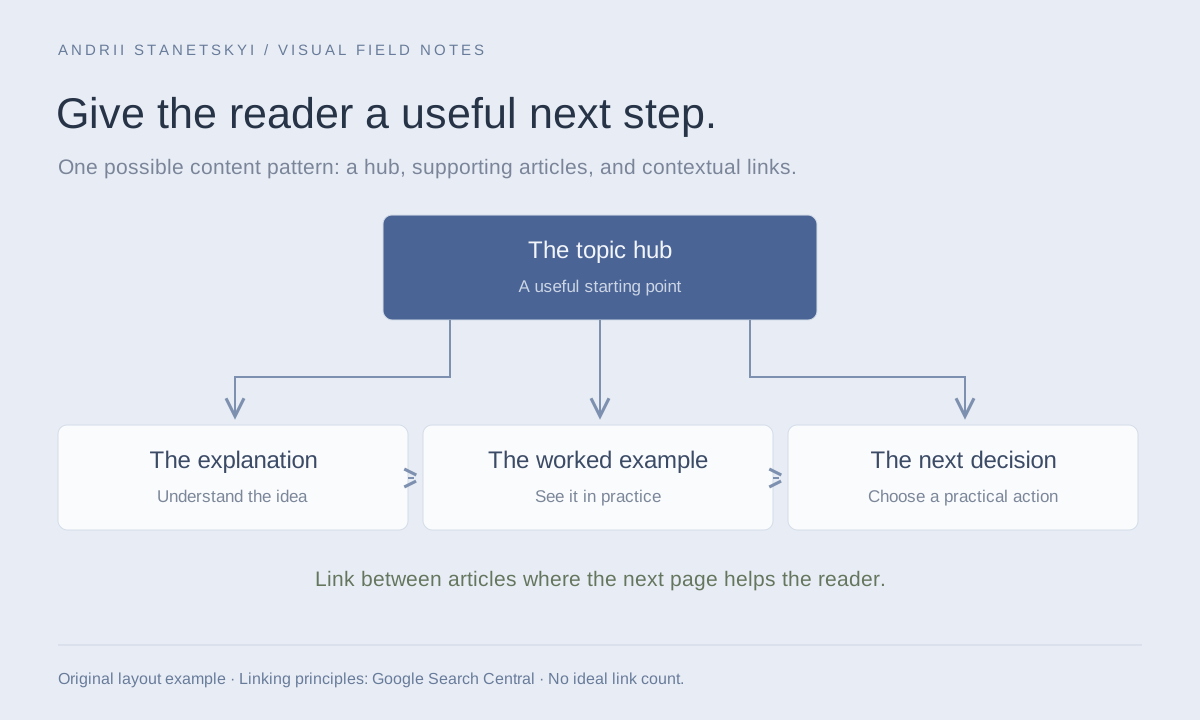
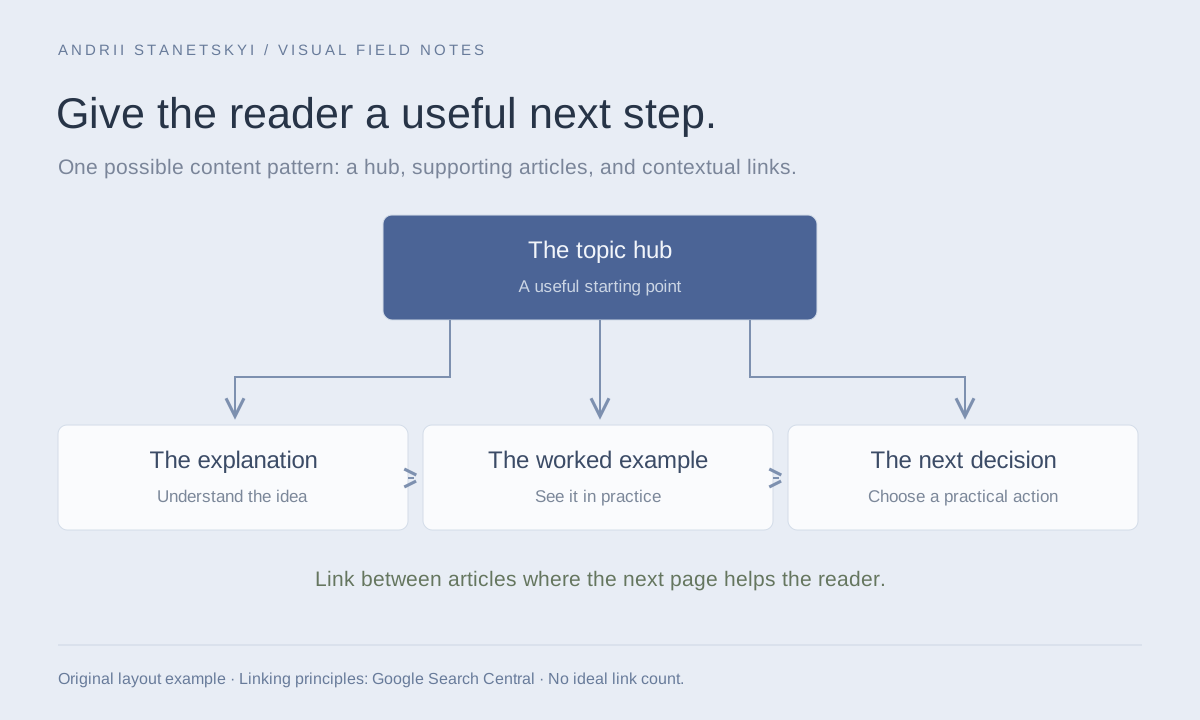
A topic hub connects an explanation, a worked example, and a next decision. Supporting articles link to each other where relevant.
Why Internal Links Are Underestimated
The reason internal links are perpetually neglected is that their impact is diffuse and delayed. An external link acquisition produces a discrete, attributable event in Ahrefs' backlink history. An internal link optimization is structural — it changes the flow of equity across the whole site, and the ranking improvements emerge weeks later across multiple pages simultaneously.
But the impact is real. Google has stated repeatedly that internal links are one of the primary mechanisms by which it discovers pages and evaluates their importance within a site. John Mueller has confirmed in multiple Search Central conversations that a page receiving no internal links will be harder to rank, even if it has strong external backlinks, because Google has limited signals about its topical context and importance within the site's hierarchy.
The practical implication: every external link you build is worth more if the page receiving it distributes equity efficiently to connected pages via strong internal links. And every money page on your site can be boosted by redirecting equity from low-priority pages that currently receive more internal links than they need.
How Link Equity Flows Internally
PageRank flows through internal links according to the same principles as external links, with some important site-specific behaviors:
- Nofollow internal links block equity flow. Some CMS platforms add nofollow to pagination, category filters, or user-generated content. Audit these with Screaming Frog to confirm they're intentional.
- JavaScript-rendered links may not pass equity. Tabs, accordions, and dynamically loaded navigation links may not be crawled consistently. Always verify in GSC's URL Inspection tool.
- Link position on page affects equity weight. Google has disclosed that links appearing higher in the HTML source are weighted differently from footer links. Navigation and early-body links pass more equity than footer links.
- Number of links on a page dilutes equity per link. A page with 300 links passes less equity per individual link than a page with 30. This is why link-heavy category pages with hundreds of product links dilute equity across thousands of product pages rather than concentrating it on priority pages.
Architecture Principles for Equity Distribution
The Inverted Pyramid Model
Most sites that perform well in competitive search have an implicit or explicit pyramid structure: the homepage receives the most external links and distributes equity down to primary category/hub pages, which distribute to subcategory and pillar pages, which distribute to individual articles and product pages.
The failure mode in most sites is that this pyramid collapses: the homepage links to 150+ pages (too diluted), category pages link to 2,000 products without prioritization, and the 20% of pages that drive 80% of revenue receive no special internal link treatment.
The Pillar-Cluster Architecture
For content-heavy sites, the pillar-cluster model is the most equity-efficient architecture available:
- Pillar pages cover broad topics (e.g., "project management") comprehensively. They receive internal links from multiple cluster pages and link back to clusters.
- Cluster pages cover specific subtopics ("agile project management," "project management software for remote teams"). Each links to the pillar and to one or two sibling clusters.
- Supporting content (case studies, news, supplementary guides) links to the nearest relevant cluster or pillar but is not linked back to heavily.
This structure concentrates equity on pillar pages (your highest-value, broadest-intent targets) while ensuring cluster pages are well-connected and receive sufficient equity to rank for long-tail terms.
Auditing Your Current Internal Link Structure
Step 1: Crawl with Screaming Frog
Screaming Frog Configuration for Internal Link Audit:
Mode: Spider
Configuration → Spider → Crawl:
  - Follow internal links: YES
  - Follow external links: NO
  - Maximum URL path length: unlimited

Reports to generate:
  - Internal → All internal links (shows all links, source, target, anchor)
  - Response Codes → 3xx Redirects (chains eating equity)
  - Response Codes → 4xx Client Errors (internal links pointing to 404)
  - Page Titles → All (for URL-to-title mapping)

Export: Full bulk export for analysis in Google Sheets or Python
Step 2: PageRank Flow Analysis
Use the InLinks report in Ahrefs for your own domain to see which pages receive the most internal links. Cross-reference with your priority page list. Misalignment — high-priority pages with few internal links, low-priority pages with many — is your optimization target.
Ahrefs Site Explorer → Pages → Best by Links
Filter: Internal links
Sort by: Inlinks (desc)

Compare against your priority page mapping:
Pages receiving 50+ internal links but classified as low-priority:
  → equity leak — reduce internal links to these pages

Pages receiving <5 internal links but classified as high-priority:
  → opportunity — systematically add internal links to these pages
Step 3: Crawl Depth Analysis
Pages that are more than 3 clicks from the homepage are at risk of being crawled infrequently and indexed unreliably. Screaming Frog's crawl depth visualization maps this. Any priority page at depth 4+ needs to be brought into the primary navigation or linked from a high-equity shallow page.
| Crawl Depth | Indexation Reliability | Equity Received | Ranking Potential | Recommendation |
|---|---|---|---|---|
| Depth 1 (Homepage links) | Near 100% | Very High | Maximum | Reserve for top 5 priority pages |
| Depth 2 | 99%+ | High | High | Primary category / pillar pages |
| Depth 3 | 95–99% | Medium-High | Good | Cluster pages, key product pages |
| Depth 4 | 85–95% | Medium | Moderate | Review; critical pages must move shallower |
| Depth 5+ | <80% | Low | Limited | High risk; likely orphaned in practice |
Anchor Text Strategy for Internal Links
Unlike external link anchor text (where over-optimization is a clear risk signal), internal anchor text can and should be more deliberately keyword-optimized. Google uses internal anchor text to understand the topical context of target pages. However, the anchor still needs to read naturally in context — keyword stuffing into anchor text is detectable and discouraged.
Internal Anchor Text Framework
- Primary target keyword as anchor: Use this for the most important 2–3 internal links pointing to a priority page. The first mention of the target keyword in a relevant piece of content should link to the target page.
- Semantic variant anchors: Subsequent internal links to the same page should use related terms, partial matches, or descriptive anchors.
- Avoid generic anchors: "Click here," "read more," and "learn more" waste the anchor text signal. Use descriptive anchors that name the destination.
- Never repeat the same exact anchor for every internal link to a page: Variety within a semantic family is natural; identical repetition is not.
Fixing Orphaned Pages and Equity Leaks
Identifying Orphaned Pages
An orphaned page exists in your sitemap but receives no internal links (or only one: from the sitemap itself). These pages receive minimal equity and are crawled infrequently. Identify them by comparing your XML sitemap URLs against Screaming Frog's internal links report — URLs in the sitemap with zero inlinks are orphaned.
# Python snippet for orphan page detection
# Compare sitemap URLs to pages with internal inlinks

import pandas as pd

sitemap_urls = set(pd.read_csv('sitemap_urls.csv')['url'])
inlinked_urls = set(pd.read_csv('screaming_frog_inlinks.csv')['Destination'].unique())

orphaned = sitemap_urls - inlinked_urls
print(f"Orphaned pages: {len(orphaned)}")
for url in sorted(orphaned):
    print(url)
Equity Leak: Pages That Absorb Links But Don't Need Them
Common equity leaks on most sites:
- Privacy policy, terms of service, cookie policy: Linked from sitewide footer. These pages don't need equity. Add
rel="nofollow"to footer links for these pages. - Tag and category archive pages: On WordPress and similar CMS, tag pages can accumulate large numbers of internal links. If they're not ranking targets, noindex them and/or reduce internal links.
- Author archive pages on multi-author blogs: Same issue. Decide whether author pages serve a ranking purpose; if not, reduce their link equity intake.
- Pagination pages: /page/2, /page/3, etc. should generally not receive priority equity. Use rel="next"/"prev" pattern and limit internal link depth to paginated series.
Step-by-Step Implementation Process
- Crawl and baseline: Full Screaming Frog crawl, export internal links report, map crawl depth for all pages.
- Priority page mapping: List your top 20 pages by revenue potential / strategic importance. This is your equity target list.
- Gap analysis: For each priority page, count current internal inlinks and identify which high-equity pages don't yet link to it.
- Content audit for link insertion opportunities: Find existing published pages that cover related topics and could naturally include a contextual internal link to each priority page.
- Internal link insertion: Add contextual links systematically — not more than 2–3 new internal links per existing page to avoid looking like a retroactive linking binge.
- Orphan page resolution: For every identified orphaned page, either delete/consolidate it, add it to a relevant hub page's navigation, or redirect it to a canonical alternative.
- Equity leak mitigation: Apply nofollow to footer links for legal pages, tag pages, and author archives that are not ranking targets.
- Re-crawl and measure: Re-crawl with Screaming Frog 4 weeks after implementation. Compare inlink counts per priority page. Monitor ranking changes in GSC.
Mini Case Study: E-commerce Site, 34% Ranking Improvement
Client: Mid-size e-commerce retailer (15,000 SKUs), DR 55. Primary issue: category pages for high-value product lines (power tools, outdoor equipment) ranking positions 8–20 despite strong external link profiles. Homepage had 380+ outgoing links in navigation and footer — extreme equity dilution.
Audit findings:
- Homepage navigation linked to 14 top-level categories and 180+ subcategories directly — severe dilution
- Top 10 revenue-generating category pages averaged 3.2 internal inlinks per page from non-navigation sources
- 1,247 orphaned pages (mostly old out-of-stock product pages still in sitemap)
- Footer contained 64 links to legal pages, blog tags, and low-value content — all dofollow
Changes made:
- Restructured homepage navigation to link only to 8 primary categories (not 180+ subcategories)
- Created 8 hub/pillar pages for top product categories with comprehensive internal linking to subcategories and key products
- Added contextual internal links from 85 blog articles to their corresponding high-priority category pages
- Applied nofollow to all footer links for legal/policy pages (47 links)
- Removed/redirected 1,247 orphaned out-of-stock product pages to category pages
Results at 90 days:
- Average ranking improvement for top 20 priority category pages: 34% better position (average move from position 14.2 to 9.4)
- 6 previously position 11–20 pages moved into top 10
- Organic traffic to category pages: +41%
- Crawl budget efficiency (as measured by GSC crawl stats): improved by 28% (more pages crawled per day with same budget)
Key insight: None of the external backlink profile changed during this period. Every ranking improvement was attributable to internal link restructuring. This is the clearest demonstration of internal links as a ranking lever independent of external link acquisition. See our backlink audit guide for combining internal and external link analysis.
FAQ
How many internal links should a page have?
There's no hard maximum, but the practical ceiling for an article or landing page is 50–100 internal links before dilution becomes significant. For homepage navigation, aim for fewer than 100 total outgoing links including navigation and footer. Category pages linking to thousands of products should use pagination and rely on secondary navigation rather than listing every product with a link on a single page.
Does Google treat internal links differently from external links in terms of PageRank?
The PageRank algorithm applies to both. The practical difference is that internal links can be controlled entirely by the site owner, whereas external links are controlled by third parties. Internal links also don't carry the same topical authority signal that an external link from a high-DR domain carries — they primarily pass equity and provide crawling pathways.
Should I use nofollow on internal links to pages I don't want to rank?
Google deprecated the PageRank sculpting use of nofollow on internal links around 2009, but it remains useful for blocking equity to purely administrative pages (legal notices, login pages, user account pages). For low-priority content pages, a better solution is consolidating or removing the content rather than simply blocking equity with nofollow. See our disavow and canonical strategy guide for related decisions.
How often should I audit internal links?
Quarterly for large sites (10,000+ pages), semi-annually for medium sites. Sites that publish new content frequently (daily or weekly) should run monthly orphan checks — new content is the most common source of new orphaned pages. Use Ahrefs' site audit or Semrush's site audit on a schedule to automate this.
What is the biggest mistake sites make with internal linking?
Treating internal linking as a copyediting decision ("does this link make sense here?") rather than a strategic equity allocation decision ("does this link serve my site's traffic goals?"). Both questions should be asked, but the strategic one must be primary. Content that reads naturally but points internal equity at low-value pages is a systemic leak that compounds over years.
How do JavaScript-based navigation menus affect internal link equity?
JavaScript navigation (hamburger menus, mega menus rendered via JS) may not be crawled as reliably as static HTML links. Google has improved JavaScript rendering but still crawls JS-rendered content on a two-phase basis, meaning some JS navigation links may not be followed on every crawl. Critical internal links — particularly those pointing to your top-priority pages — should exist in crawlable HTML, not exclusively in JavaScript. Google's developer documentation on JavaScript SEO covers rendering behavior in detail.
Key Takeaways
- Internal links are an equity allocation system. Treat them strategically, not as a copyediting afterthought.
- The pillar-cluster architecture is the most efficient structure for distributing equity in content-heavy sites.
- Priority pages should receive the most internal links from the highest-equity pages. Audit this alignment quarterly.
- Orphaned pages are an equity vacuum — resolve them by deleting, consolidating, or connecting them.
- Footer links to legal pages and archives are common equity leaks. Apply nofollow to these.
- Internal link anchor text should be keyword-informed but contextually natural — more room for optimization than external links, but still requires editorial judgment.
Conclusion
Internal link equity distribution is the unsexy foundation that most link building conversations ignore, but it determines how much value every external link you acquire actually delivers. Fix the structure before scaling acquisition, and you'll find that the external links you already have produce significantly better results. Ignore it, and every new link you build is working against an inefficient system that wastes much of the equity it receives.