The link building playbook that worked in 2019 will get you penalized in 2026. Google's Helpful Content updates, the SpamBrain classifier, and a maturing link graph have collectively killed the spray-and-pray era. What remains is a discipline that looks less like SEO and more like relationship-based PR combined with rigorous data analysis. This guide is for practitioners who already know the basics and want a clear-eyed view of what actually moves rankings today.
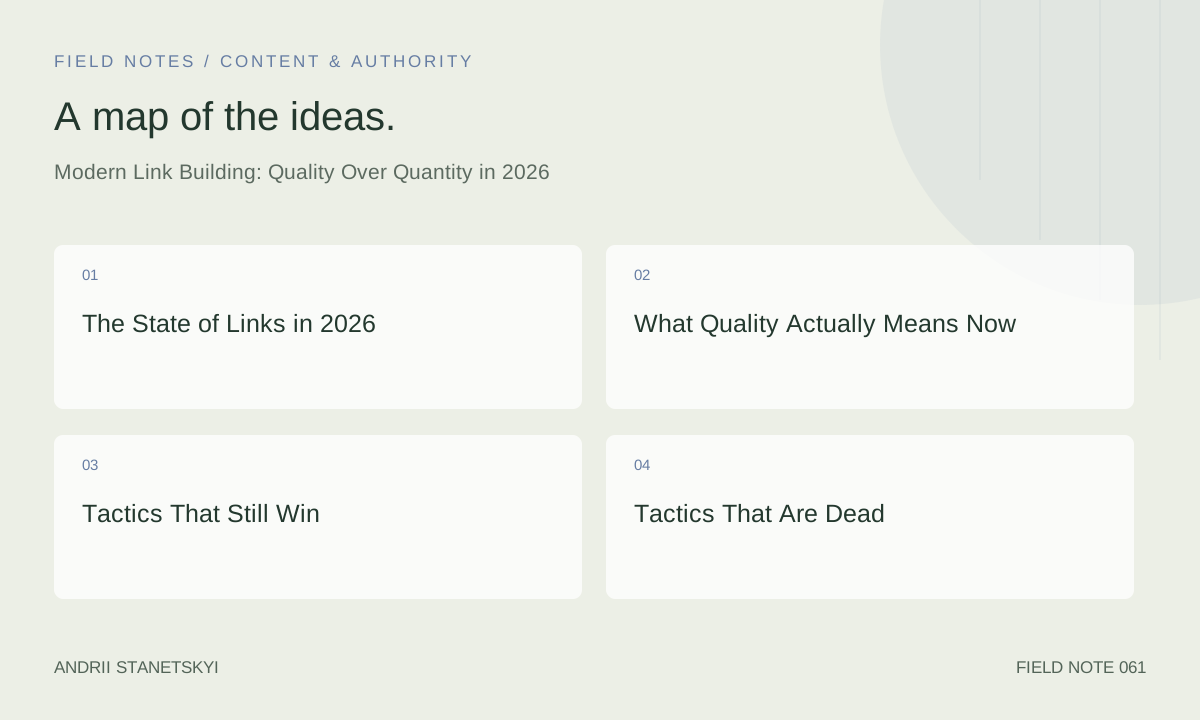
The State of Links in 2026
Links remain a top-three ranking factor. Google's own engineers have confirmed this repeatedly, and every large-scale correlation study from Ahrefs' ranking factors research to Semrush's 2025 ranking report backs it up. But the signal has become dramatically more nuanced. A single DR 80 link from a topically relevant publication now outperforms 50 DR 40 links from generic directories. The algorithm has grown sophisticated enough to weight editorial context, topical authority, and link placement — not just raw domain metrics.
SpamBrain, Google's AI-based spam detection system, has been running link quality assessments at scale since 2022. By 2026 it has accumulated enough training data to identify link scheme patterns with high confidence. This means that what looks "natural" to a human reviewer often isn't natural enough for the classifier. Velocity anomalies, anchor text clustering, and IP subnet concentrations are all detectable signals.
What Quality Actually Means Now
Quality is not a single metric. It's a composite of at least six signals that experienced practitioners track:
Topical Relevance
A DR 55 link from a site that covers your exact niche is worth more than a DR 75 link from a general news portal. Use Ahrefs' Site Explorer to check the topical distribution of linking domains before pitching. Look for sites where your subject matter represents at least 30% of their content. Majestic's Topical Trust Flow categories are a quick proxy for this — filter for TF categories that match your industry.
Traffic Reality Check
Links from sites with zero organic traffic are nearly worthless. A page that Google doesn't trust enough to send traffic to is unlikely to pass significant link equity. In Ahrefs, filter prospective link targets by organic traffic > 500/month at the page level, not just the domain level. The specific page linking to you matters as much as the domain.
Link Placement and Context
Editorial placement in the body of an article beats footer links, sidebar links, and sitewide links every time. Contextual links surrounded by relevant text carry more weight. Avoid placements that appear in templated sections — Google's classifier recognizes these patterns.
Anchor Text Distribution
Exact-match anchors above 5% of your total backlink profile is a risk signal in 2026. Natural profiles are dominated by branded, URL, and partial-match anchors. When you control anchor text (as in guest posts), default to brand or generic anchors unless the page is severely under-optimized for a target term.
Tactics That Still Win
Digital PR and Data-Driven Content
Original research, proprietary surveys, and data studies earn links passively at scale. A single well-executed study can generate 50–200 links in its first three months. The key is a genuine data angle that journalists haven't covered. See our Digital PR guide for the full workflow.
HARO / Connectively and Expert Commentary
Journalists still need expert quotes. Responding to queries with genuinely insightful, specific answers (not generic platitudes) earns DR 50–90 links from major publications. The success rate for well-crafted responses is 15–25%. Our HARO guide covers response frameworks in detail.
Strategic Guest Posting
Guest posting isn't dead — low-quality, mass-produced guest posting is. Targeting 3–5 high-authority publications in your niche per quarter, writing genuinely useful long-form content, and building an ongoing contributor relationship is a sustainable strategy. Expect to invest 8–12 hours per placement for tier-1 publications.
Broken Link Building
Still one of the highest ROI tactics when executed with real content assets. The 2026 version requires better content matching and faster outreach. Full framework in our broken link building article.
Unlinked Brand Mentions
If your brand is being mentioned without a link, conversion rates on outreach are 40–60% higher than cold prospecting. These are warm leads by definition. See the unlinked mentions guide for the full workflow.
Tactics That Are Dead
- Private Blog Networks (PBNs): SpamBrain identifies PBN footprints at scale. The risk-to-reward ratio is negative for any legitimate business.
- Comment spam and profile links: These provide zero PageRank and trigger spam classifiers.
- Reciprocal link schemes: Systematic A-links-to-B, B-links-to-A arrangements are detectable and penalized.
- Mass directory submissions: Generic directories with no editorial standards provide no value.
- Exact-match anchor text campaigns: Artificially inflating exact-match anchors remains a manual action trigger.
- Parasite SEO link insertions: Publishing on high-DA third-party platforms to pass equity has largely been neutralized.
The 2026 Tool Stack
A senior practitioner's link building stack in 2026 typically includes:
- Ahrefs: Backlink analysis, link intersect, content gap, prospecting via Site Explorer and Content Explorer
- Majestic: Trust Flow / Citation Flow ratio analysis, topical trust flow categorization
- Semrush: Backlink audit, toxic score assessment, authority score benchmarking
- Pitchbox: Prospecting automation, outreach CRM, follow-up sequences, response tracking
- BuzzStream: Relationship management, contact research, campaign tracking
- Hunter.io / Snov.io: Email discovery and verification
- Google Search Console: Link acquisition monitoring, manual action alerts
Key Metrics and Benchmarks
| Tier | Ahrefs DR | Ahrefs UR (linking page) | Majestic TF | Organic Traffic (domain) | Realistic Acquisition Method |
|---|---|---|---|---|---|
| Tier 1 (Elite) | 80+ | 30+ | 50+ | 500k+/mo | Digital PR, HARO, exclusive data |
| Tier 2 (Strong) | 60–79 | 20–29 | 35–49 | 50k–500k/mo | Guest posts, broken link, partnerships |
| Tier 3 (Solid) | 40–59 | 10–19 | 20–34 | 5k–50k/mo | Resource pages, niche directories, outreach |
| Tier 4 (Marginal) | 20–39 | 5–9 | 10–19 | <5k/mo | Low-priority; use sparingly |
| Avoid | <20 | <5 | <10 | Near zero | Do not pursue; disavow if acquired |
Mini Case Study: B2B SaaS in 90 Days
Client: B2B project management SaaS, DR 38 at start, targeting competitive "project management software" cluster.
Problem: 200+ backlinks but 80% from irrelevant directories and low-TF sites. Link velocity was flat. Ranking positions stagnant between 15–30 for primary terms.
Strategy implemented:
- Conducted a full backlink audit using Semrush's Backlink Audit tool. Disavowed 47 toxic domains (spam score 60+, zero organic traffic).
- Produced an original "State of Remote Work 2026" survey with 500 respondents. Used this as a PR asset.
- Pitched the survey data to 85 technology and HR publications via Pitchbox. Response rate: 22%. Link acquisition: 18 links (DR 45–78 range).
- Executed broken link campaign on competitor resource pages. Found 34 dead links using Ahrefs' broken links report. Converted 9 into placements.
- Responded to 40 HARO queries over 90 days. 8 successful placements (DR 52–91).
Results after 90 days: DR increased from 38 to 49. Primary target keyword moved from position 18 to position 6. Organic traffic up 67%.
Key insight: The quality of the 35 new links outweighed the 200+ existing low-quality links. This is the clearest evidence of quality over quantity in practice.
FAQ
Is link building still necessary in 2026?
Yes. Despite years of predictions that links would be deprecated, they remain a primary ranking signal. What has changed is the threshold: you need fewer, better links. For competitive queries, a strong topically relevant backlink profile is non-negotiable.
How many links per month is a "natural" velocity for a new site?
There is no universal answer, but as a rough benchmark: 0–5 links/month for a new site, scaling to 10–30/month as the site matures and gains traction. Sudden spikes of 100+ links in a single month without a corresponding PR event are a pattern SpamBrain flags. See our link velocity article for detailed benchmarks.
Should I use a link building agency or hire in-house?
For sites above DR 40 targeting competitive queries, in-house or a deeply vetted specialist agency is better. Generic link building agencies sell volume over quality. If an agency promises 20+ links per month for under $2,000, ask where those links come from — the answer will usually disqualify them.
What is an acceptable ratio of dofollow to nofollow links?
Natural profiles typically run 65–80% dofollow. A profile that is 100% dofollow looks manufactured. Similarly, a profile that is 90%+ nofollow suggests a pattern of low-quality directory submissions. Aim for a mix that reflects genuine editorial behavior.
How do I measure the ROI of link building?
Track: (1) DR/authority score trajectory, (2) keyword ranking movement for target terms, (3) estimated organic traffic value (Ahrefs' "Traffic Value" metric), (4) referring domain growth rate. Direct revenue attribution is difficult; use traffic value as a proxy for link building ROI.
Is paying for links always a bad idea?
Paying for links violates Google's guidelines. The practical risk depends on scale and detectability. One-off placements on highly relevant, genuinely editorial sites are low risk. Systematic paid link campaigns are high risk. Most experienced practitioners draw a hard line at any form of payment for links and instead invest in content assets that earn links naturally.
How important is anchor text diversity in 2026?
Extremely important. A well-optimized anchor profile in 2026 looks like: 40–50% branded, 20–30% URL/naked, 15–20% partial match, 5–10% generic ("click here", "read more"), and no more than 3–5% exact match. Deviation from this pattern in either direction is a risk signal.
Key Takeaways
- Quality beats quantity: 10 links from DR 60+ topically relevant sites outperform 100 links from generic DR 30 sites.
- SpamBrain has made link scheme detection highly automated. Manual action risk is real and recovery is painful.
- The highest ROI link building tactics in 2026 are: original data/research, HARO/Connectively responses, strategic broken link building, and unlinked brand mention conversion.
- Always filter prospects by organic traffic (page-level), topical relevance, and DR/TF before outreach.
- Anchor text distribution is a managed metric, not an afterthought. Plan it at the campaign level.
- Link building is relationship-based PR at its core. Invest in relationships, not transactions.
Conclusion
Modern link building in 2026 demands the same rigor you would apply to any data-driven marketing discipline. The practitioners who win are those who treat every link placement as a mini editorial partnership — one that serves the reader, fits the context, and passes a quality threshold most competitors won't reach. Build fewer links, build better links, and measure everything.