Of all the link building tactics available to a senior SEO practitioner, unlinked brand mention conversion has the best effort-to-outcome ratio. You're not pitching a stranger to link to content they've never seen. You're asking someone who already mentioned you — who already has a positive enough association with your brand to reference it in their content — to add a link that makes their reference more useful to their readers. The conversion rate is dramatically higher than cold outreach, the links earned are genuinely editorial, and the signal quality is excellent because the mention is organic.
Most practitioners under-invest in this tactic because the setup requires some initial infrastructure investment and the manual review component is time-consuming. This guide covers the full end-to-end process: discovery methodology, qualification filtering, outreach templates, automation with Pitchbox and BuzzStream, and realistic conversion benchmarks.
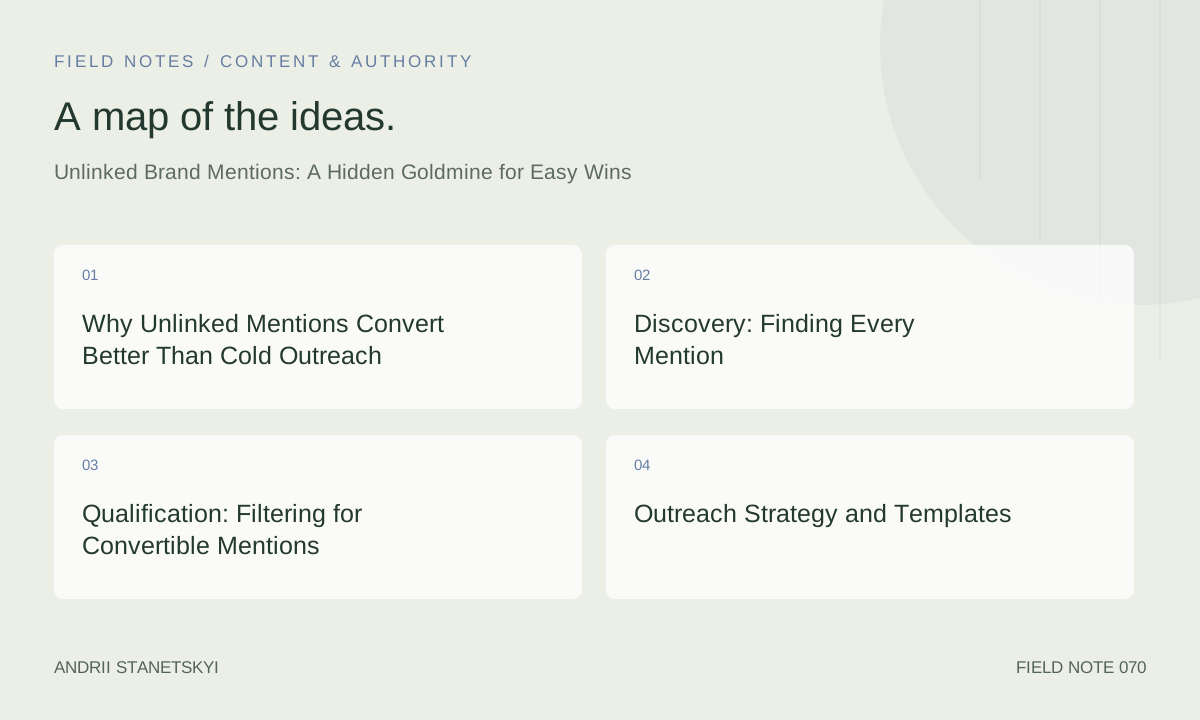
Why Unlinked Mentions Convert Better Than Cold Outreach
Standard cold link building outreach — reaching out to sites that have never mentioned you, asking them to link to a piece of content — converts at roughly 1–5% in most niches. Practitioners who optimize their outreach heavily and have strong content can push this to 8–12% on their best campaigns. Unlinked mention conversion, in practice, converts at 15–35% depending on the niche, the strength of the relationship, and the quality of the mention context.
The reason is simple: the psychological distance from "stranger asking for a link" to "known entity asking for a technical correction" is enormous. When you reach out about an unlinked mention, you're not asking the author to do something for you — you're pointing out that they referenced something without giving their readers a way to follow up on it. Framed correctly, you're doing them a favor.
There's also a quality signal advantage. A site that mentioned your brand organically — without prompting, without payment — is a site whose editorial team has some familiarity with what you do. The resulting link reflects genuine editorial judgment, which is exactly what Google's systems are designed to reward.
Discovery: Finding Every Mention
The discovery phase is where thoroughness matters most. Missed mentions are missed opportunities. Use all of the following methods in combination:
Google Search Operators
Start with manual Google searches using advanced operators. These are imperfect (Google personalizes results and not everything is indexed) but capture a substantial portion of mentions:
# Google search operator queries for unlinked mention discovery

# Basic brand mention excluding your own site
"[Brand Name]" -site:yourdomain.com

# Brand mention with nofollow or unlinked context (harder to filter)
"[Brand Name]" -site:yourdomain.com -inurl:yourdomain.com

# Mentions in specific content types
"[Brand Name]" site:reddit.com OR site:quora.com
"[Brand Name]" filetype:pdf (academic/report mentions)
"[Brand Name]" inurl:blog OR inurl:article

# Variations — catch misspellings, abbreviations
"[Brand Variant]" -site:yourdomain.com
"[Product Name]" -site:yourdomain.com

# Exclude social platforms (usually nofollow anyway)
"[Brand Name]" -site:twitter.com -site:facebook.com
  -site:linkedin.com -site:instagram.com
Ahrefs Content Explorer
Ahrefs Content Explorer is purpose-built for this use case. Search for your brand name, filter by "One page per domain," set a DR minimum (e.g., DR 20+), and sort by "Referring domains" to prioritize high-authority mentions. Export the results and cross-reference against your existing backlink profile to identify which are unlinked.
# Ahrefs Content Explorer filter configuration
Search query: "[Brand Name]"
Filters:
  - Published: Last 2 years (or custom range)
  - DR: 20 to 100 (adjust based on site's authority)
  - Organic traffic: > 100 (filters dead/no-traffic pages)
  - Exclude homepages: YES
  - One page per domain: YES
  - Language: [your target language]

Export: Title, URL, DR, Organic Traffic, Referring Domains, Date Published

Then cross-reference exported domains against your
Ahrefs backlink export to flag unlinked ones.
Semrush Brand Monitoring
Semrush's Brand Monitoring tool (under .Trends) tracks new mentions in near real-time. Set up monitoring for your brand name, key product names, and common variants. Configure email alerts for new mentions above a traffic threshold. This serves as the ongoing monitoring component rather than the initial discovery sweep.
Google Alerts
Free and imperfect, but useful for ongoing monitoring of new mentions. Set up alerts for:
- Exact brand name in quotes
- Key product names
- CEO/founder name (for personal brand mentions)
- Common branded phrases or slogans
Google Alerts has significant coverage gaps — it doesn't catch everything and has become less reliable over the years. Treat it as a supplementary signal, not a primary discovery tool.
HARO/Connectively Response Tracking
If you or your clients respond to journalist queries on HARO/Connectively or similar services (Featured, Qwoted, ProfNet), maintain a log of all responses sent. Many journalists use your quote without linking to your site. Tracking your response history enables proactive follow-up for attribution links when your quotes are used.
Qualification: Filtering for Convertible Mentions
Not every unlinked mention is worth pursuing. The qualification process filters your discovery list down to the opportunities with realistic conversion potential and meaningful link value.
Primary Qualification Criteria
| Criterion | Minimum Threshold | Target | Priority Multiplier |
|---|---|---|---|
| Ahrefs DR of linking page's domain | DR 20 | DR 40+ | +1 for DR 60+ |
| Estimated organic traffic (page level) | >100/month | >500/month | +1 for >2,000/month |
| Mention context (positive/neutral) | Neutral | Positive | -1 for negative context |
| Link request difficulty (editor reachable?) | Contact form available | Named author with email | +1 for direct editor contact |
| Topical relevance of linking page | Adjacent topic | Direct niche match | +1 for exact match |
| Content recency | Published within 3 years | Published within 1 year | +1 for within 6 months |
Eliminate immediately: negative mentions (conversion probability near zero and approaching a negative-context author with a link request typically makes the situation worse), social media posts (almost always nofollow), and mentions on domains where you already have links (no conversion value).
Secondary: Contact Findability
Before adding a mention to your outreach queue, verify that you can find a credible contact. In order of preference:
- Named author on the page with a linked author bio that includes contact info
- Named author searchable via LinkedIn or professional site
- Editorial email found via Hunter.io, Snov.io, or similar tools
- General contact form (lowest priority — lowest conversion rate)
Use Hunter.io domain search to find email patterns and verify specific addresses. For high-value targets (DR 60+), spend more time on contact discovery — a hand-found direct email converts 3–5x better than a contact form submission.
# Hunter.io API query for contact discovery
# Find email pattern for a domain
GET https://api.hunter.io/v2/domain-search?domain=targetsite.com&api_key=YOUR_KEY

# Verify a specific email address
GET https://api.hunter.io/v2/[email protected]&api_key=YOUR_KEY

# Find person by name and domain
GET https://api.hunter.io/v2/email-finder?domain=targetsite.com&first_name=John&last_name=Smith&api_key=YOUR_KEY
Outreach Strategy and Templates
The tone and framing of unlinked mention outreach differs fundamentally from cold link building outreach. You're not pitching — you're following up on an existing connection. This distinction should be explicit in every email.
Template 1: Standard Mention Conversion (Author Contact)
Subject: Quick note about your [article title] piece

Hi [First Name],

Came across your piece on [topic] — great overview of [specific
aspect you genuinely liked].

Quick note: you mentioned [Brand Name] in the section on
[specific context of mention]. Would it be possible to link that
mention to [specific page URL]? It would give your readers an
easy way to explore [what the page covers] if they're curious.

No worries if it's outside your editorial process — just wanted
to flag it.

[Your name]
[Title] at [Brand Name]
Template 2: Product Review / Comparison Mention (No Link to Product Page)
Subject: Re: [Brand Name] in your [article title]

Hi [First Name],

Thank you for including [Brand Name] in your [comparison/review]
of [topic]. Really appreciate the thorough coverage.

One small thing: the mention of [Brand Name] isn't currently
linked — if you'd like to add a link, our [product page / homepage]
is [URL]. Totally optional, but it would let readers jump directly
to us if they're interested.

If you have any questions about [Brand Name] for a future update
to the piece, happy to help.

[Your name]
Template 3: HARO/Connectively Quote Attribution Follow-Up
Subject: Quick thank you — and one small request

Hi [First Name],

Just saw the piece at [URL] — thank you for including my
perspective on [topic]. Really glad it was useful for the article.

One quick ask: my quote is attributed to [Brand Name] but isn't
linked back to our site. If it's easy to add a link to
[yourdomain.com], that would be much appreciated. Completely
understand if your editorial guidelines don't allow it.

Either way, great piece — bookmarking it.

[Your name]
Follow-Up Strategy
Send one follow-up email 5–7 business days after the initial message if there's no response. Keep it brief — a single sentence referencing the original email. Do not send more than two emails total. Aggressive follow-up sequences appropriate for cold outreach are inappropriate here and will damage your brand's relationship with the publication.
# Follow-up template (one time only)
Subject: Re: [original subject]

Hi [First Name],

Just following up on the note below in case it got buried.
No pressure at all — if it's not possible, completely
understood.

[Your name]
Scaling with Pitchbox and BuzzStream
For brands with substantial mention volume, manual outreach doesn't scale. Pitchbox and BuzzStream both support unlinked mention campaigns, though the setup requires careful configuration to maintain the personalization that drives conversion rates.
Pitchbox Configuration for Mention Campaigns
In Pitchbox, create a custom campaign type using the "Custom Outreach" workflow. Import your qualified mention list with these custom fields mapped:
{{mention_page_url}}— the specific page containing the mention{{mention_context}}— manually summarized context of the mention (5–10 words){{article_title}}— title of the article mentioning you{{target_link_url}}— the URL you want them to link to
The {{mention_context}} field requires manual population — this is the variable that prevents the outreach from reading as templated. Do not automate this field.
BuzzStream for Relationship Management
BuzzStream excels at managing the relationship history across a campaign. Set up tags for mention type (product comparison, industry roundup, quote attribution, news mention) and source (Ahrefs Content Explorer, Google Alerts, HARO follow-up). Track response rates by tag to identify which mention types convert best for your brand.
For brands actively investing in link building, integrate your digital PR campaign tracking with mention monitoring so that earned PR mentions are automatically flagged for link-back follow-up.
Ongoing Monitoring Setup
Unlinked mention outreach isn't a one-time project — it's an ongoing acquisition channel. Set up a monitoring stack that surfaces new mentions as they appear:
- Semrush Brand Monitoring: Daily digest, threshold-based alerts for high-traffic mentions
- Ahrefs Alerts — Web mentions: Weekly digest (note: this monitors content, not backlinks)
- Google Alerts: As-they-happen delivery for exact brand name in quotes
- Mention.com or Brand24: Real-time monitoring with sentiment filtering — useful for high-volume brands to auto-filter positive/neutral mentions
The monitoring output feeds a weekly review process: new mentions are assessed against the qualification matrix, qualified mentions are added to the outreach queue, and outreach is deployed on a rolling basis rather than in batches. This keeps velocity natural and prevents sudden spikes in link acquisition from mention conversion campaigns.
Advanced Tactics: Product Reviews, Comparisons, and Lists
Beyond standard mentions, several specific content formats deserve specialized tactics:
Product Comparison Pages
"Best [your category] tools" and "[Tool A] vs [Tool B]" pages are extremely high-value targets. If your product is included in a comparison but not linked, the traffic to that comparison page may be in active buying intent. Prioritize these above all other mention types. When reaching out, offer to provide updated screenshots, pricing information, or any other asset that makes the comparison author's job easier — this converts at much higher rates than simply asking for a link.
Industry Roundups and Lists
"Top 10 [your category] companies" and similar list posts often include brands without linking them. These are typically easy conversions because the author structured the post as a directory and linking is expected behavior in that format. Frame your outreach as helping complete the author's intent for the piece.
Award and Recognition Pages
Industry award lists, vendor directories, and "companies to watch" features frequently mention brands without links. These pages often have high editorial standards and established contact processes — response rates from direct editorial contact can exceed 40%.
Academic and Research Citations
If your brand, product, or content has been cited in academic papers, industry reports, or research publications, these are extremely high-authority mentions. PDFs typically can't link, but many research publications also have web versions with reference sections that can include links. Target the web version authors specifically. A link from a .edu or .gov publication citing your research is among the highest-value links attainable through any outreach method.
Mini Case Study: SaaS Brand — 90 Days of Mention Conversion
A mid-market B2B SaaS company (project management category, DR 48 at the time) ran a structured 90-day unlinked mention campaign as the primary link building activity during a period where new content production was limited.
Discovery phase (Week 1–2):
- Ahrefs Content Explorer: 847 pages containing brand name
- Google search operator sweep: 312 additional results (some overlap)
- Semrush Brand Monitoring backlog: 156 mentions from prior 6 months
- HARO response log: 43 quotes used in articles, reviewed for attribution
- Total raw mentions identified: approximately 1,100
Qualification filtering:
- Already linking: 287 removed (cross-reference with Ahrefs backlinks)
- Social media / nofollow platforms: 198 removed
- DR below 20: 143 removed
- Negative context: 12 removed
- Contact unfindable: 67 removed
- Final qualified outreach queue: 393 mentions
Outreach execution (Weeks 3–14): Deployed through BuzzStream at approximately 30 contacts per week. Personalization field (mention_context) completed manually for all contacts. Three email templates used, rotated by mention type.
Results at 90 days:
- Emails sent: 393 (one follow-up sent to 281 non-responders)
- Response rate: 38% (149 responses)
- Links secured: 87 (22% conversion on total queue; 58% conversion on responders)
- Average DR of secured links: 44
- DR 60+ links secured: 11
- Time investment: approximately 2 hours setup + 45 minutes per week ongoing
The 87 links represented a DR 44 average — significantly above what most guest post campaigns produce for equivalent effort. The 11 DR 60+ links from high-authority publications were the highlight and would have been extremely difficult to secure through cold outreach.
At the end of 90 days, ongoing monitoring was configured so that new mentions feed into the outreach queue automatically, making mention conversion a permanent channel rather than a one-time project. See the methodology for scaling outreach campaigns without velocity risk for how to pace ongoing mention outreach.
FAQ
How do I find unlinked mentions without paid tools?
Google search operators are free and effective for initial discovery: "[Brand Name]" -site:yourdomain.com combined with Google Alerts for ongoing monitoring. Google Alerts has coverage gaps and doesn't give you DR or traffic data, so you'll spend more time manually assessing the value of each mention. For occasional campaigns on a budget, this works. For sustained programs, the Ahrefs Content Explorer investment pays for itself quickly in time saved during qualification.
What's a realistic conversion rate for unlinked mention outreach?
In practice: 15–35% of qualified outreach contacts convert to links, with higher rates for direct author contact versus editorial forms. Variables that significantly affect conversion: strength of the mention context (a detailed positive review converts better than a passing reference), recency (content published in the last year converts better than older articles), and contact quality (named author with direct email versus generic contact form). DR of the target site has less impact on conversion rate than practitioners expect — high-authority sites often have responsive editorial teams.
Should I offer anything in exchange for adding a link?
Be careful here. You can legitimately offer to provide helpful assets — updated screenshots, current pricing data, a quote from a spokesperson — that make adding the link easier or improve the quality of the content. What you should not do is offer payment, reciprocal links, or any transactional exchange. That converts the editorial link into a paid link, which Google's guidelines prohibit and which changes the nature of the signal. The framing that works is "here's how to make this easier for you," not "here's what you get."
What if the mention is in a negative context — a complaint or criticism?
Do not reach out to request a link. Approaching an author who has written critically about your brand asking them to link to you will almost certainly make the situation worse — it signals that you monitor every mention and are primarily concerned with SEO rather than the substance of their criticism. If the criticism is valid, address it through the appropriate channels. If it's inaccurate, consider a polite factual correction request, but keep link building entirely out of that conversation.
How long after a mention appears should I reach out?
Within 30–60 days is ideal. Mentioning an article that was published 3 years ago and asking for a link retroactively is considerably harder — the author may not remember writing it, the content may have been updated, and editorial processes have changed. For new mentions identified through monitoring, a 2–4 week outreach window after publication hits the sweet spot between "not yet indexed and evaluated by the author" and "forgotten."
Can I use unlinked mention conversion for a brand that's just starting out?
Yes, but the volume will be lower for newer or less well-known brands. The tactic scales with brand awareness — the more content that references you, the more opportunities exist. For early-stage brands, combine mention monitoring with active PR work to generate the mentions that future conversion campaigns can harvest. HARO/Connectively responses are particularly valuable here: they generate mentions in authoritative publications that you can then convert to links through attribution follow-up.
How do I handle a site that uses JavaScript rendering and my mention isn't visible to Ahrefs?
JavaScript-rendered content is a known gap in Ahrefs' crawl. Google Search Console may catch these links since Googlebot renders JavaScript. For discovery, use Google search operators and Semrush Brand Monitoring (which also renders JavaScript for some sites) as supplementary sources. Manual Google searches are the most reliable fallback for mentions on heavily JavaScript-dependent sites like modern web apps and SPAs.
Key Takeaways
- Unlinked mention conversion consistently outperforms cold outreach in conversion rate (15–35% vs 1–12%) because the relationship and editorial intent already exist.
- Discovery requires multiple tools in combination: Ahrefs Content Explorer for bulk discovery, Google Alerts for ongoing monitoring, Google search operators for gaps, and HARO/Connectively tracking for quote attribution.
- Qualify ruthlessly before outreach: existing backlinks, social/nofollow platforms, negative context, and unfindable contacts should all be filtered out first.
- Personalization in the mention context field is the single most impactful variable in conversion rate. Do not automate this field.
- Product comparison pages, industry roundup lists, and HARO quote attributions are the highest-priority mention types by conversion rate and link value.
- Set up ongoing monitoring so mention conversion becomes a permanent acquisition channel, not a one-time project.
- Offer assets (screenshots, data, quotes) to make link addition easy — never offer payment or reciprocal links, which transforms the editorial link into a paid link.
Conclusion
Unlinked brand mention conversion is the closest thing to low-hanging fruit that actually exists in link building — and it's one of the most consistently underutilized tactics in senior practitioners' arsenals. The setup investment is real but bounded; the ongoing returns are disproportionate to the effort required.
For any brand with meaningful search presence, the first 90-day mention conversion campaign typically surfaces enough opportunities to materially improve the link profile's quality distribution. The DR 40–60 editorial links earned through this process are categorically better signals than anything purchased through link building services, and they carry none of the risk associated with velocity manipulation concerns.
Pair mention conversion with a proactive content strategy that generates mentions — original research, strong opinions, useful data — and you create a compounding loop: better content generates more organic mentions, which generate more conversion opportunities, which generate more editorial links, which improve rankings, which drive more visibility for your content. That's a sustainable link acquisition system, not a campaign.
For practitioners managing multiple clients, the operational infrastructure — monitoring stack, BuzzStream/Pitchbox workflows, email templates — is reusable across accounts. Build it once, replicate the setup for each new client, and ongoing maintenance is minimal. This is one of the few link building tactics where the time investment genuinely amortizes over months rather than being reset with each campaign.
Reference: Ahrefs' Content Explorer documentation provides guidance on advanced search filters for brand mention discovery at scale.