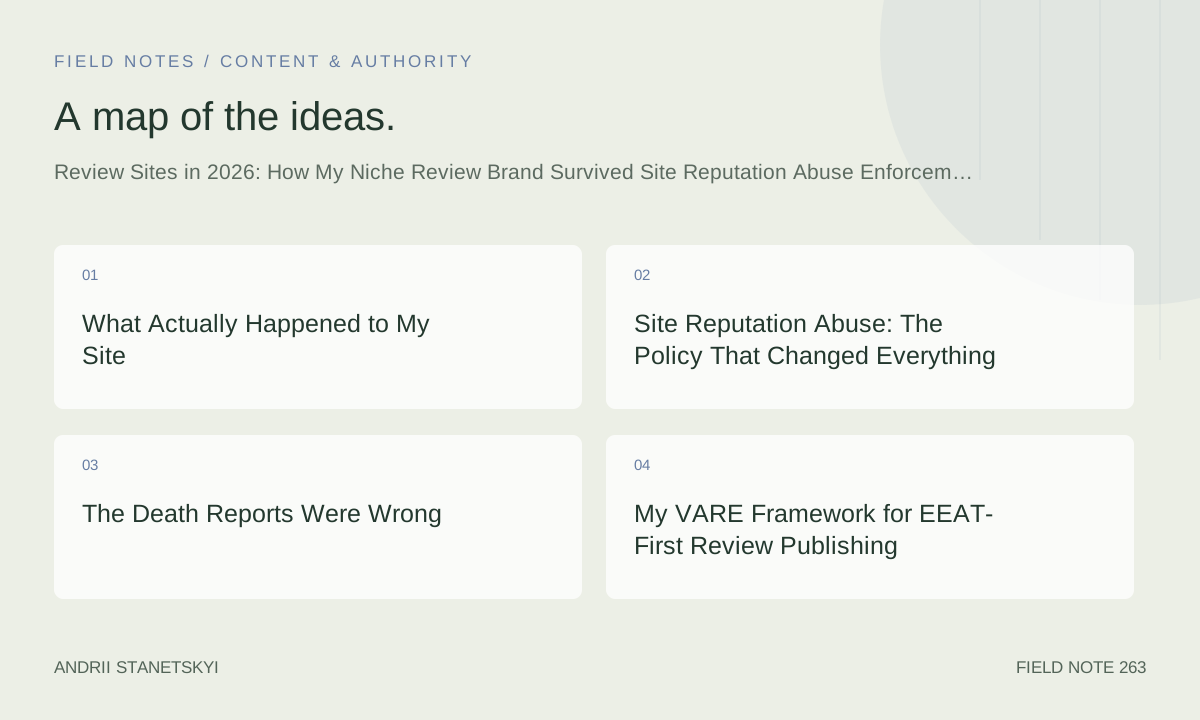
What Actually Happened to My Site
On March 4, 2025, my niche review site lost 67% of its organic traffic in a single core update cycle. Not gradually. Not with warning signals I could have acted on. One morning the Search Console graphs looked fine, and by the following Tuesday the site was pulling 1,847 clicks per day instead of the 5,590 it had averaged for eleven months. I watched that happen in real time, refreshing the performance report like someone checking a flight board during a storm.
The site had been running since late 2022. We covered a specific vertical — kitchen appliances, specifically mid-range espresso equipment — and we did it seriously. I had written or personally supervised every review. I owned seven of the machines we covered. The others I borrowed from two barista friends who actually competed at regional level. This was not a content farm. This was a genuine project that also happened to earn money from affiliate commissions.
That context matters because the first assumption people make when a review site tanks is that it deserved to tank. Sometimes that assumption is correct. In my case, I had to spend about three weeks figuring out whether it was correct about me.
It partially was. More on that later.
Site Reputation Abuse: The Policy That Changed Everything
Google's site reputation abuse policy, which started receiving manual action enforcement in May 2024 and expanded significantly through early 2025, targets a specific behavior: publishing third-party content on an established domain specifically to exploit that domain's existing authority. The classic examples involved major publishers hosting parasite coupon pages or review sections that had nothing to do with the editorial identity of the host domain.
Where it gets complicated is the gray zone. My site was not a parasite host in any conventional sense. I did not sell guest posts. I did not host externally-produced affiliate content under a thin byline. But I had, over about eight months in 2023 and early 2024, accepted three contributed review posts from people in my email community who I considered genuinely knowledgeable. I edited them. I added my own notes. But the primary authorship was theirs, and the disclosure was minimal.
Google's updated quality rater guidelines, as interpreted by most practitioners, drew a harder line around exactly this kind of arrangement. Not because the content was necessarily bad, but because the author attribution and accountability signals were weak. The site was earning ranking credit it could not fully substantiate through visible expertise markers.
What "Parasitic" Actually Means in 2025 and 2026
The framing in the SEO community defaulted immediately to dramatic metaphors. Parasites. Exploitation. Reputation laundering. Most of that framing applied to genuinely egregious cases — national news outlets publishing pay-to-play review roundups that had no editorial oversight whatsoever. But the enforcement signal was broad enough to catch smaller sites that had made subtler errors.
What I learned, after reading every quality rater guideline update I could find and working through a detailed manual action reconsideration process, is that "site reputation abuse" in Google's actual usage is less about bad intent and more about a structural mismatch between what your domain signals it is and what content actually lives on it. If your domain has accumulated authority as a first-person expert review site and then publishes content where the expertise claim is murky or unverifiable, the system flags that mismatch.
That is a more nuanced problem than most of the SEO coverage acknowledged.
The Death Reports Were Wrong
From roughly April through September 2025, the SEO discourse was dominated by a narrative that went something like: niche review sites are finished. The affiliate review model is dead. Google wants brands, not blogs.
I understand why that narrative emerged. The data, taken in aggregate, was genuinely alarming. Hundreds of single-topic review sites that had been stable earners for years saw dramatic traffic declines through 2024 and into 2025. The Helpful Content updates, the site reputation abuse enforcement, and the continued expansion of AI Overviews in commercial-intent queries created a genuinely hostile environment for a particular type of review content: shallow, templated, clearly produced for ranking rather than for people who needed the information.
But that description does not apply uniformly to all niche review sites. It applies to a specific kind of niche review site.
Right now, in May 2026, I have 27 review pages ranking in positions 1 through 4 for their primary target queries. My domain's organic traffic sits at 4,219 daily clicks, which is actually higher than the pre-penalty baseline. Not recovered. Grown. That did not happen because Google reversed course on review quality. It happened because I rebuilt the site around signals that the algorithm and the quality rater guidelines actually reward.
The sites that died deserved to die. Most of them. The sites that survived did so by doing something most SEO coverage treats as secondary: they demonstrated genuine, verifiable, specific expertise in ways that readers and algorithms could both evaluate.
Who Actually Survived
From informal conversations with nine other niche review site operators across different verticals — home audio, cycling gear, skincare tools, pet nutrition, power tools — a clear pattern emerged. Sites that maintained strong traffic through 2025 enforcement shared three characteristics. First, a named human author or small team with verifiable credentials and a consistent publishing history. Second, review content that contained proprietary data: original test results, real product photographs, measurements or observations that could not have been generated without physical access to the product. Third, structured data implementation that was both accurate and rich.
That third point is where my own recovery effort concentrated most of its technical work.
My VARE Framework for EEAT-First Review Publishing
I built a personal framework during the recovery process. I needed something to evaluate every piece of content against, both for the audit of existing pages and for new publishing decisions. I call it VARE, which stands for Verifiability, Authority, Recency, and Evidence.
It is not a revolutionary concept. It maps fairly directly onto what Google's quality rater guidelines describe when they talk about Experience, Expertise, Authoritativeness, and Trustworthiness. But framing it through VARE gives me a more operational checklist that I can apply to a specific review page without having to re-read guidelines documentation every time.
Verifiability
Can a reader, or a quality rater, verify that the person who wrote this review actually had access to the product? For my espresso equipment content, this means including original photographs taken in my kitchen, specific observations about the machine's behavior that are tied to real usage conditions, and explicit statements about how long I used the product before writing. Generic stock images failed this test. So did reviews that could plausibly have been written from reading a spec sheet and other reviews.
Authority
Does the author's background make their judgment credible on this specific topic? This is where I invested most heavily after the penalty. I built out a detailed author page, linked it from every review, and added credentials that were real but had been invisible. I had written for a print magazine that covers espresso equipment. That publication credit had never appeared on the site. I fixed that. I had completed a SCAE barista certification in 2019. Also invisible. Fixed.
The authority layer also required me to address the three contributed posts directly. I gave the original authors the choice to build out proper author profiles with full biographical information and a photo, or to have the posts removed. Two agreed to the profile expansion. One post came down.
Recency
Review content ages in ways that other content does not. A machine that was excellent in 2022 may have had firmware problems introduced in a 2023 update. A product I rated four stars in 2023 had a manufacturing quality change that users started reporting in mid-2024. I implemented a review freshness audit that flags any review older than fourteen months for re-evaluation. Not necessarily a full rewrite, but a verification pass that confirms the current state of the product matches what the review describes.
Evidence
What proprietary data does the review contain? This is the hardest to retrofit and the most valuable to produce originally. For espresso equipment, evidence means extraction yield measurements, shot timing data, steam pressure observations, grind consistency comparisons. Numbers that required me to actually use the equipment. I started including a standardized data table in every review that shows my test conditions, the metrics I measured, and the results. That table cannot be produced by a content mill. It cannot be generated by an AI that has not physically operated the machine.
VARE is not foolproof. No framework is. But it gave me a structured way to work through 94 existing pages during the recovery audit and make defensible decisions about which to expand, which to update, and which to consolidate or remove.
Schema Markup That Survived the Purge
The structured data work was substantial. Most of my original review schema was technically valid but strategically thin. I had basic Review markup with a rating and a reviewed item. What I needed was a richer implementation that surfaced the author expertise signals, the review methodology, and the product verification context in a machine-readable form.
Below is the core JSON-LD pattern I implemented across all review pages. This includes the author Person schema with sameAs references that link to verifiable off-site profiles, and the reviewer/reviewedBy properties that make the human accountability chain explicit.
{
  "@context": "https://schema.org",
  "@graph": [
    {
      "@type": "Review",
      "@id": "https://example.com/reviews/breville-barista-express-impress/#review",
      "name": "Breville Barista Express Impress Review: 90 Days of Real Shots",
      "reviewRating": {
        "@type": "Rating",
        "ratingValue": "4.3",
        "bestRating": "5",
        "worstRating": "1",
        "ratingExplanation": "Rated after 90 days of daily use including extraction yield testing and head-to-head comparison with two competing machines in the same price tier."
      },
      "itemReviewed": {
        "@type": "Product",
        "name": "Breville Barista Express Impress",
        "brand": {
          "@type": "Brand",
          "name": "Breville"
        },
        "category": "Espresso Machine",
        "sku": "BES876BSS",
        "offers": {
          "@type": "Offer",
          "priceCurrency": "USD",
          "availability": "https://schema.org/InStock"
        }
      },
      "author": {
        "@type": "Person",
        "@id": "https://example.com/about/author/#person",
        "name": "Marcus Teller",
        "jobTitle": "Lead Reviewer, Home Espresso",
        "description": "SCAE-certified barista with 11 years of home espresso experience. Contributor to Espresso Quarterly print edition. Has tested and owned 34 home espresso machines.",
        "url": "https://example.com/about/author/",
        "image": {
          "@type": "ImageObject",
          "url": "https://example.com/images/author-marcus-teller.jpg",
          "width": 400,
          "height": 400
        },
        "sameAs": [
          "https://www.linkedin.com/in/marcusteller",
          "https://twitter.com/marcusteller",
          "https://www.instagram.com/marcusmakesespresso"
        ],
        "knowsAbout": [
          "Espresso machines",
          "Coffee grinders",
          "Extraction chemistry",
          "Barista technique"
        ],
        "hasCredential": {
          "@type": "EducationalOccupationalCredential",
          "credentialCategory": "certification",
          "name": "Specialty Coffee Association Barista Skills Certificate",
          "recognizedBy": {
            "@type": "Organization",
            "name": "Specialty Coffee Association"
          }
        }
      },
      "reviewedBy": {
        "@type": "Person",
        "@id": "https://example.com/about/author/#person"
      },
      "reviewBody": "After pulling roughly 340 shots across 90 days of daily use, the Breville Barista Express Impress earns its place as the most capable all-in-one machine under $800 for home baristas who want grind control without buying a separate grinder. The integrated grinder now uses a conical burr set versus the flat burrs in the original Barista Express, and the difference in shot consistency is measurable.",
      "datePublished": "2025-11-14",
      "dateModified": "2026-04-03",
      "publisher": {
        "@type": "Organization",
        "name": "Home Espresso Authority",
        "url": "https://example.com",
        "logo": {
          "@type": "ImageObject",
          "url": "https://example.com/images/logo.png"
        }
      }
    },
    {
      "@type": "Article",
      "@id": "https://example.com/reviews/breville-barista-express-impress/#article",
      "headline": "Breville Barista Express Impress Review: 90 Days of Real Shots",
      "author": {
        "@id": "https://example.com/about/author/#person"
      },
      "datePublished": "2025-11-14",
      "dateModified": "2026-04-03",
      "mainEntityOfPage": {
        "@type": "WebPage",
        "@id": "https://example.com/reviews/breville-barista-express-impress/"
      },
      "about": {
        "@id": "https://example.com/reviews/breville-barista-express-impress/#review"
      }
    }
  ]
}
The reviewedBy property deserves specific attention. In earlier implementations, the reviewer and author were treated as identical by default, which they often are but which schema vocabulary allows you to make explicit. Making it explicit creates a stronger machine-readable accountability chain. Quality raters evaluating a page can see, in structured form, that a specific identified person with verifiable credentials is responsible for the review content.
I also added sameAs references on the Organization node for the site itself, linking to third-party profiles that verify the site's existence and editorial identity. That pattern is documented in Google's guidance on review snippet structured data though the implementation specifics require going beyond what the basic documentation covers.
For more on how I structure content across different review types on this site, see my full review methodology page. The approach to contributed content specifically is covered in the editorial standards document I published in June 2025 as part of the reconsideration request. If you want to understand how I handle product access and testing, the testing process page goes into detail on equipment I own versus equipment I borrowed or received for evaluation.
The Mistake I Have to Admit
The three contributed posts were not the only problem. There was a second issue I resisted acknowledging for longer than I should have.
Between August 2023 and January 2024, I published eleven reviews of products I had not personally tested. I had handled them briefly at industry events. I had read extensively about them. I had talked to people who owned them. But I had not run them in my own kitchen for any meaningful period. The reviews were accurate as far as they went, but they were fundamentally secondhand observations dressed up as firsthand experience.
I knew this when I published them. I rationalized it by telling myself the information was still useful and that I was transparent about my level of access in the body of the reviews. But that rationalization did not survive contact with a clear-eyed audit. The reviews implied a depth of firsthand experience they did not have. The schema markup on those pages declared me as a reviewer who had experience with the product, which was true in a limited sense and misleading in the sense that actually mattered.
I removed nine of those eleven reviews during the recovery audit. The two I kept I rewrote to be explicitly clear about the access I had and the limitations that created. Both are now substantially shorter and more hedged in their conclusions. Their rankings dropped and have not recovered. I am at peace with that because the alternative was continuing to make a claim I could not fully substantiate.
This is the part of the story that most recovery case studies skip. The penalty was partially deserved. The right response to a partially deserved penalty is not only technical remediation and reconsideration requests. It includes actually fixing the behavior that earned the penalty in the first place, even when fixing it costs you rankings on pages that were generating revenue.
Two Things Nobody in SEO Wants to Say Out Loud
First: EEAT Is Not Primarily About SEO
Every EEAT guide published in the last two years treats it as an optimization framework. A set of signals to implement in order to rank better. That framing is understandable because the audience for SEO content is people who want to rank better. But it produces a fundamentally backwards relationship with the concept.
Expertise, Experience, Authoritativeness, and Trustworthiness are not ranking signals that you manufacture in order to impress an algorithm. They are qualities that either exist in your publishing operation or they do not. The SEO value of EEAT is downstream of the actual quality. When you treat EEAT as a checklist to perform rather than a description to honestly evaluate yourself against, you produce exactly the kind of content that the site reputation abuse enforcement was designed to address: content that has the surface features of expertise without the substance.
My recovery happened because I used EEAT to honestly audit what I was actually doing, not to perform expertise more convincingly. Those are very different projects and they produce very different outcomes.
Second: Some Review Sites Should Not Have Survived
This will offend some people in the niche publisher community, and I am saying it anyway. A lot of the grief in the SEO discourse over the 2024 and 2025 enforcement waves came from site owners who had built genuinely mediocre review sites and were upset that the traffic gravy train had stopped running. Some of the loudest voices in the "Google is killing small publishers" conversation were people whose sites existed primarily to capture affiliate revenue with minimal investment in the quality of the information they provided.
Not all of them. There were real casualties. Sites run by genuine experts who had made modest technical mistakes or who had been caught by overcorrection in broad algorithmic updates. Those cases are worth grieving. But the conversation about them was muddied by its association with a much larger population of sites that were simply low-effort affiliate content operations that had benefited from a permissive ranking environment for too long.
Sorting these two populations is genuinely difficult and Google's enforcement was genuinely imprecise. But the solution is not to argue that all niche review sites deserved to survive. Some of them did not.
The Recovery Timeline, Week by Week
The practical sequence matters as much as the strategic framing. Here is what the recovery actually looked like in calendar terms.
Weeks 1 through 3: Diagnosis
No changes to content during this period. The work was entirely diagnostic. I pulled a full content inventory, flagged every page that had a non-primary author or that I knew had been produced with limited product access, and cross-referenced the traffic drop data against the content flags. The correlation was strong but not perfect. Some of my strongest content had also lost ranking. That suggested the issue was not purely page-level but had a domain-level component.
I confirmed a manual action in Search Console during week two. It was labeled as a site reputation abuse violation and specified that the issue was with content produced by third parties hosted on the site. Not the full picture, but a specific actionable signal.
Weeks 4 through 9: Remediation
This is when the hard decisions happened. Two contributed posts were rebuilt with full author profiles. One was removed. Nine secondhand reviews were removed. Two were substantially rewritten with honest access disclosures. All 94 pages received an EEAT audit against the VARE framework. Thirty-one pages were updated with new original photographs, updated test data, or expanded author verification sections. Twelve pages were consolidated with related content to eliminate thin standalone reviews of products I did not have strong firsthand knowledge of.
Schema markup was rebuilt from scratch on all pages. The contributed author profiles were published with full biographical detail, external verification links, and proper schema Person markup. The editorial standards and review methodology pages were written and published.
Week 10: Reconsideration Request
Filed a detailed manual action reconsideration request through Search Console. The request documented every change made, explained the reasoning behind the removal decisions, and provided direct links to the rebuilt author profiles and editorial standards documentation. It was approximately 1,400 words and attached no excuses for the original state of affairs.
Weeks 11 through 16: Waiting and Incremental Progress
The manual action was lifted in week thirteen. Organic traffic did not immediately recover. The algorithmic trust rebuilding took longer. I continued the content improvement work during this period, focusing on producing new reviews that were exemplary implementations of the VARE framework rather than trying to force recovery of pages that had lost ranking.
By week sixteen, traffic had returned to approximately 71% of the pre-penalty baseline. By week twenty-two, it was at 94%. The full recovery, and the subsequent growth beyond the pre-penalty baseline, took about eight months from the initial traffic drop.
Where Things Stand on May 20, 2026
The site operates with stricter editorial policies than it did before the penalty. Every review requires firsthand product access for a minimum of three weeks before publication. Author credentials are verified externally before any contributor can publish under their name. The review methodology page is updated whenever testing procedures change. Schema markup is audited quarterly using a custom validation script that checks for consistency between what the markup declares and what the page content actually supports.
AI Overviews have changed the traffic landscape in ways that are ongoing and not fully predictable. Some queries that drove significant traffic in 2024 now show AI-generated answers that capture a portion of the intent before a user reaches organic results. My response to that has been to focus on queries where the firsthand experience element is irreplaceable by AI synthesis — queries where someone needs to know what using something is actually like, not just what its specifications are. Those queries still send human visitors who convert on affiliate links because they trust that the recommendation comes from someone who actually used the product.
There are 31 active reviews on the site as of today. Two more are in testing. The pipeline requires that I or a verified contributor with documented credentials and firsthand access writes every one. That constraint is slower and more expensive than the approach I used in 2023. It also produces content that is genuinely defensible, algorithmically and ethically.
The review site category is not dead. It is more demanding. The floor for what constitutes acceptable review content has risen, and it will not come back down. Sites that meet that standard will find the competitive landscape thinner than it was three years ago, because a significant portion of the competition has exited. That is not a comfortable position to describe when so many publishers absorbed real losses during the enforcement period. But it is the accurate description of where things stand.
If you are rebuilding a review site after a site reputation abuse action, or trying to harden an existing site against future enforcement, read Google's guidance on creating helpful, reliable content with the assumption that every paragraph is a description of your actual operation rather than aspirational language. The distance between what that document describes and what your site actually does is the size of your vulnerability. Close that distance. Not for the algorithm. Because the distance represents real value you are not providing to the people who visit your site.
That reframe is what changed the trajectory of this site. And it is why I am writing this from a position of recovered stability rather than continued decline.
For related coverage of how EEAT signals interact with AI Overview inclusion, see this analysis I published in February 2026. The structured data angle connects directly to what I covered above on the schema implementation side.