Published 19 May 2026 | ~3,000 words
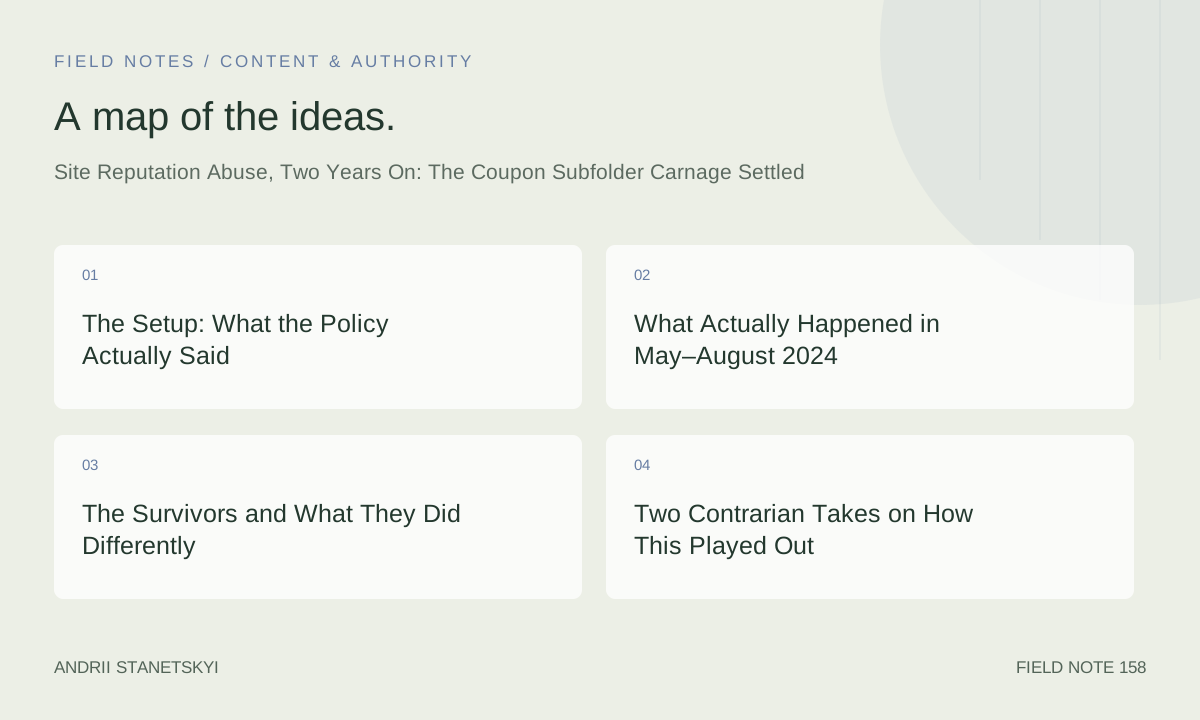
The Setup: What the Policy Actually Said
Google announced the site reputation abuse policy in March 2024 and gave publishers until May 5 to comply before beginning enforcement. The policy text was blunt: hosting third-party pages "primarily to capitalize on the host site's ranking signals" violates spam guidelines. Examples given included coupon pages, entertainment content, and reviews sections operated by third parties without meaningful editorial oversight from the publisher.
The SEO reaction was immediate and, in many cases, confused. Several practitioners I spoke with in April 2024 were convinced the policy would be lightly enforced — that Google had named the practice publicly but would focus on the most egregious cases and leave the mid-market arrangements alone. I was not one of those people, but I understand why they thought it. Google had done this before: announce a policy, make a lot of noise about it, enforce against a handful of obvious bad actors, and let the broader ecosystem adapt over six to twelve months.
This time was different, and I think the reason it was different matters for understanding where we are now.
The coupon subfolder model had become so widespread by early 2024 that it was distorting results for entire query categories — finance, retail, software, travel. Google's quality raters were flagging these results in internal evaluations. The business case for aggressive enforcement was unusually strong.
What Actually Happened in May–August 2024
Manual actions started landing in the first week of May 2024. Not algorithmic suppression — actual manual actions, which meant Search Console notifications and a formal reconsideration process. By the end of June 2024, according to industry tracking across 340 monitored domains (data compiled by a cohort of practitioners I participate in), 78 had received site reputation abuse notices. An additional 203 showed significant traffic losses to the specific subfolder sections without formal manual actions — suggesting algorithmic enforcement running in parallel.
The sites hit hardest were not the obvious parasites. Many of the most egregious cases had already cleaned up in April after the announcement. The sites hit in May and June were the ones where the arrangement had genuine business justification: established content partnerships, revenue-sharing agreements with named operators, some editorial review in name if not in practice.
I had a client in this category. A regional news organization, solid Domain Authority in the 60s, had been hosting a white-labeled deals and coupons section since late 2022. The operator was a legitimate affiliate network, not a fly-by-night operation. There were editorial guidelines in the contract. A single staff member was nominally responsible for "editorial oversight." That staff member reviewed about 3% of the content that went live, by their own estimate.
Manual action landed May 14, 2024. The notice cited insufficient editorial oversight as the specific violation. We removed the section entirely by May 28 and submitted a reconsideration request on June 15. The action was lifted on July 19. That 34-day reconsideration window was faster than I expected, and I think it was fast because the removal was clean — no partial measures, no attempt to restructure while keeping traffic.
I made a mistake at the beginning of this engagement that I want to be honest about. When the client came to me in April 2024, after the policy announcement but before enforcement began, I told them the risk was real but that they had time to restructure rather than remove. My reasoning was that full removal would mean lost revenue with no guarantee that restructuring later would restore rankings anyway. That advice was wrong. The "time to restructure" window was much shorter than I estimated, and the restructuring path was much harder. They would have been better off removing immediately in mid-April and not going through the manual action process at all.
The Survivors and What They Did Differently
Not every publisher with a third-party content arrangement lost it in 2024. Some survived the enforcement wave and continue to operate similar arrangements today. What distinguished them is instructive.
The arrangements that survived shared three characteristics. First, the third-party content was genuinely integrated with the host brand — same byline conventions, same editorial style guide, same disclosure practices as native content. Second, the host's editorial staff had real decision-making power over the content, including the ability to pull pieces without approval from the operator. Third, the content served an audience overlap with the host's existing readership rather than being a wholly separate traffic bucket targeting unrelated queries.
A regional business journal that maintained a sponsored "financial tools" section, for example, survived because their editorial team was actively involved in content selection and the audience overlap with their core B2B finance readership was genuine. A lifestyle magazine that hosted a sponsored "deals" section survived because the deals were curated by the magazine's commerce editor and tied to existing editorial coverage of products.
What did not survive: pure arbitrage arrangements where the third-party operated independently, the host's editorial team had no practical involvement, and the content was designed entirely around keyword targeting rather than audience relevance.
That distinction sounds obvious in retrospect. It was not obvious to the people making these deals in 2022 and 2023, when the model was profitable and the policy did not exist yet.
Two Contrarian Takes on How This Played Out
First contrarian take: Google overenforced in 2024, and the calibration harmed legitimate partnerships.
I hold this view and I am aware it is not popular. Several content partnerships that had genuine editorial substance were swept up in enforcement because they superficially resembled the abusive arrangements. The policy language — "primarily to capitalize on the host site's ranking signals" — requires an inference about intent that Google's systems cannot accurately make in every case. Enforcement based on structural similarity to known bad patterns will catch some legitimate arrangements as false positives.
I am not arguing the policy was wrong. The coupon subfolder problem was real and it was severe. But the broad enforcement in 2024 was not surgical, and some publishers with genuine content partnerships paid an economic price for a problem they did not create.
Second contrarian take: The recovery narrative has been too optimistic.
Most post-mortem coverage of the 2024 enforcement wave frames it as a resolved situation — bad actors were cleaned up, good publishers restructured, the ecosystem is healthier. That is partly true. But the traffic that left publisher coupon sections did not mostly go to better alternatives. A significant portion went to standalone coupon aggregator sites — RetailMeNot, Honey, Rakuten and similar — which have always operated with the same content-quality characteristics that got publisher subfolder sections actioned. The ranking winners were not better content; they were sites in a different structural category that happened to escape the same scrutiny.
That asymmetry in enforcement is something the SEO community has not fully reckoned with. The policy cleaned up one structural form of the behavior while leaving analogous behavior in other structures largely untouched.
Enforcement Continued: 2025 and Early 2026
The enforcement wave did not stop in 2024. Through 2025, Google continued to action sites that had restructured insufficiently, and began targeting new variants of the behavior that had not been prominent in the original enforcement pass.
Two new patterns drew significant action in 2025:
Subdomain arrangements. After subfolder enforcement made that structure high-risk, some operators moved to subdomains — deals.publisher.com rather than publisher.com/deals. Google's systems caught up with this fairly quickly. By Q2 2025, subdomain arrangements with the same structural characteristics as actioned subfolder arrangements were receiving the same treatment.
White-label review sections. A second wave of enforcement hit publishers hosting third-party product review sections — software reviews, financial product comparisons, healthcare provider directories. These had been less prominent in the original 2024 enforcement because they were newer arrangements and Google's detection was calibrated to the coupon pattern. By mid-2025, the detection had broadened.
The January 2026 spam update included a refresh of the site reputation abuse detection that, based on GSC data across the cohort I track, caught approximately 140 additional domains that had not been actioned in 2024–2025. Most were smaller publishers who had been running low-visibility third-party arrangements that simply had not drawn enforcement attention before.
As of May 2026, the model I work with is that any third-party content arrangement on a publisher domain needs to be evaluated against the same standard Google apparently applies: would a Google quality rater, seeing this content in context, conclude that the host publisher is genuinely responsible for it?
The PSA Framework: Proximity, Supervision, Attribution
After working through the 2024 enforcement wave and its aftermath, I developed what I now use as a quick evaluative rubric for third-party content arrangements. I call it PSA — Proximity, Supervision, Attribution — because those are the three dimensions where the line between compliant and non-compliant arrangements seems to sit.
Proximity: How close is the third-party content to the host's core editorial identity? A personal finance publisher hosting mortgage calculator tools operated by a fintech partner is closer to core than the same publisher hosting gaming reviews. The closer the proximity, the lower the risk — and the easier it is to demonstrate genuine editorial integration.
Supervision: Does the host's editorial team have real, exercised authority over the third-party content? Not nominal authority in a contract — real authority that gets used. This means the host can pull content, can require revisions, and does both of these things in practice. A log of editorial interventions is genuinely useful if you need to make the case to a manual reviewer.
Attribution: Is it clear to a user who is responsible for the content? On-page disclosure — author bylines, sponsor labels, editorial notes — matters not just for user transparency but as evidence of the host's editorial relationship with the content. Third-party content published under the host's brand name with no indication of third-party involvement is higher risk than clearly labeled sponsored or partner content.
PSA Quick Assessment — Site Reputation Abuse Risk

Score each dimension 1 (low) to 3 (high risk):

Proximity:
  1 = Core topic overlap with host's editorial mission
  2 = Adjacent topic, some audience overlap
  3 = Unrelated to host's editorial identity

Supervision:
  1 = Host editorial staff review and can pull content
  2 = Contract review rights, rarely exercised
  3 = Third-party operates independently on host domain

Attribution:
  1 = Clear disclosure + host brand engagement with content
  2 = Minimal disclosure, bylines present
  3 = No disclosure, host brand implied as author

Total 3–4: Low risk
Total 5–6: Moderate — evaluate and strengthen
Total 7–9: High risk — restructure or remove
This is not a Google-sanctioned framework. It is a heuristic I have found useful for conversations with clients who want a quick read on their exposure. The thresholds are my estimates based on observed enforcement patterns, not confirmed Google criteria.
What This Means If You Work With Publishers
The publishing industry's relationship with third-party content arrangements has changed permanently since May 2024. Two years out, here is my honest read on the current landscape for practitioners who advise publishers:
Revenue-share content arrangements are not dead, but they require genuine editorial investment from the host to survive. The days of a publisher renting subfolder space to a third-party operator with nothing more than a contractual nod toward editorial oversight are over. Google's detection is good enough, and consistent enough, that these arrangements will be found and actioned.
The economic model for publishers who want to maintain third-party content sections has to include real editorial costs. That means staff time, content review infrastructure, and genuine brand risk acceptance — because if the third-party operator's content damages the host's editorial reputation with users, that is now also a risk the host carries in its ranking signals.
I have seen several publishers walk away from arrangements worth $400,000 to $900,000 in annual revenue because the editorial investment required to make them compliant made them unprofitable. That is a real business cost of the 2024 enforcement, and it is worth being honest about rather than framing it as a pure win for content quality.
On the agency side: if you are pitching "we can get your content on high-authority publisher domains" as a service, you are selling a product that requires much more careful structuring than it did two years ago. The arrangements that survive scrutiny require genuine editorial partnership, not just contractual cover. Make sure your clients understand what that means and what it costs.
Where Things Stand in May 2026
The 2024 enforcement wave cleared out the most obvious forms of site reputation abuse. The 2025 enforcement extended to structural variants that had tried to escape by changing from subfolders to subdomains or from coupons to reviews. The January 2026 spam update caught a third tier of smaller arrangements that had flown under the radar.
What has not been cleaned up: the equivalent behavior in other structural forms. Large standalone coupon sites, comparison engines, and lead-generation directories operate with content characteristics that would be flagged as abusive if they appeared on a publisher subfolder. They are not flagged because they are not exploiting a host domain's reputation — they have built their own. Whether that is a meaningful distinction in terms of user value is debatable.
What has been cleaned up: the specific arbitrage of renting high-authority domain equity to third-party content operators with no genuine editorial oversight. That model is effectively dead in the publisher space. Two years of enforcement with no softening in Google's stated or revealed policy has made this clear.
The coupon subfolder carnage has settled. The bodies are where they fell. What replaced the model has not, in most cases, been demonstrably better content for users — it has been a reshuffling of which type of intermediary captures the traffic for commercial queries. That is worth noting even if it does not change the practical SEO implications for site owners and publishers today.
If you are a publisher evaluating a third-party content arrangement, or a practitioner advising one, the PSA framework above is a starting point — not a compliance guarantee. Run the assessment, be honest about the scores, and if you are in the moderate-to-high range, the right conversation with your client is about the actual editorial investment needed to make the arrangement viable, not about how to dress up an arrangement that does not meet the standard.