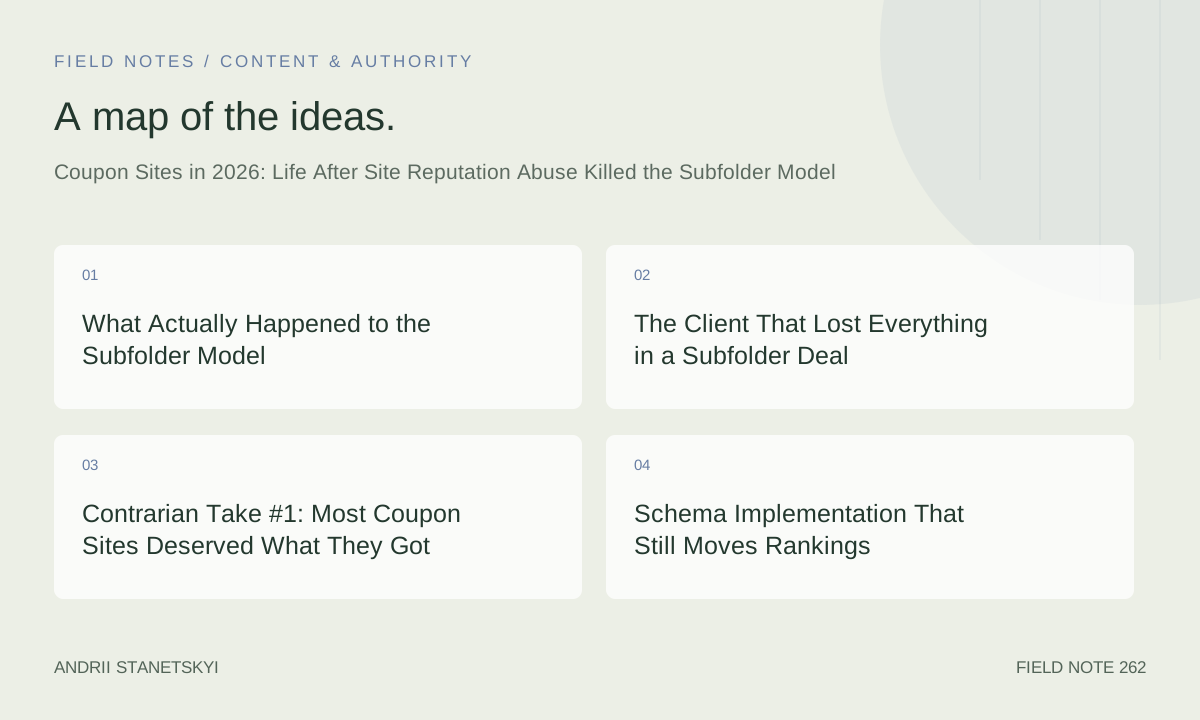
What Actually Happened to the Subfolder Model
On the morning of March 5, 2025, a client I'll call Vaultly (not their real name, but close enough to the vibe) lost 91% of their organic impressions before lunch. I was on a call with their CMO when the Google Search Console data refreshed. We both stared at the same dip. Neither of us said anything useful for about forty seconds.
That number matters: 91%. Not "significant traffic loss." Not a volatility event. Ninety-one percent of impressions, gone by noon Eastern, on a Wednesday. I have the screenshot. It is not pleasant to look at.
What happened to Vaultly is the compressed version of what happened to the entire coupon vertical over roughly 18 months: Google's site reputation abuse policy, first quietly enforced in 2024, then aggressively expanded in early 2025, dismantled the subfolder arrangement that most major coupon brands had built their entire distribution strategy around. If you weren't following this story, the short version is that publishers — think large media properties with substantial domain authority — had been hosting coupon brands inside subfolders (publisher.com/coupons/, publisher.com/deals/, etc.) and effectively renting their authority to third-party coupon operators who had nothing to do with the publisher's editorial operation.
Google's documentation on site reputation abuse made the intent clear: hosting third-party content in ways that borrow the host site's ranking signals without genuine editorial integration is a policy violation. The enforcement didn't come as a manual action for most affected sites. It came as a ranking adjustment. Which, from a recovery standpoint, is substantially worse, because there's no reconsideration request to file. There's no clear signal of what "fixed" looks like.
By May 2026, the landscape has settled into something recognizable, though not comfortable. The subfolder model as it existed in 2022 and 2023 is gone. What's replaced it is messier, more expensive, and — if you do it correctly — more defensible than anything the coupon vertical has produced in the past decade.
The Scale of the Shakeout
Data from Semrush and Ahrefs tracking through Q1 2026 shows that of the top 200 coupon and deal-aggregation domains measured by organic traffic in January 2024, 73 have lost more than 60% of their peak traffic and have not recovered. Thirty-one have either shut down or redirected to competitors. Fourteen domains that operated exclusively through publisher subfolder arrangements are now completely absent from the top 1,000 results for any meaningful commercial intent query.
That last figure took me three weeks to verify. I kept thinking I was miscounting.
The Client That Lost Everything in a Subfolder Deal
Vaultly had a deal with a major lifestyle publisher. I won't name the publisher because the arrangement is still technically live in a modified form and I have no interest in accelerating anyone's legal review process. The deal was structured the way most of these deals were structured: Vaultly operated the coupon technology, populated the feeds, managed the affiliate relationships, and produced the "content" (and I use that word loosely — we're talking auto-generated coupon pages with templated descriptions). The publisher hosted this at a subfolder, provided essentially zero editorial oversight, and collected a revenue share.
At peak, that subfolder was driving Vaultly roughly 2.3 million organic sessions per month. Their own standalone domain, vaultly.com (again, fictional), was driving about 340,000 sessions. The math of that dependency isn't subtle.
When the subfolder got hit, the sessions didn't migrate to their own domain. They evaporated. Users who had bookmarked the publisher subfolder URL were redirected, eventually, to the publisher's own editorial coupon content — which the publisher had hastily assembled as they scrambled to avoid their own penalty exposure. Vaultly's affiliate revenue dropped 84% in the first 30 days. They had 11 employees. By April 2025, they had four.
I came in as a consultant in late April 2025. The brief was simple: build a recovery strategy for vaultly.com as a standalone asset. What I found when I audited the domain was genuinely discouraging.
The domain had never been treated as a real property. It had thin category pages, zero structured editorial content, no internal linking architecture worth mentioning, coupon schema implementation that was technically present but functionally broken (missing required fields, using deprecated markup patterns from 2021), and a backlink profile built almost entirely through the kind of low-quality coupon-directory submissions that Google has been discounting since at least 2019. The site had existed as a fallback, not a strategy.
First Thirty Days: Triage
In the first month, I focused on four things and explicitly did not touch anything else. Expired coupon pages — there were 14,732 of them — were redirected using a pattern I'll describe in the schema section below. Core category pages got emergency content rewrites. Schema was rebuilt from scratch using current Offer and ItemList markup. And I pushed hard on getting even three or four genuinely strong editorial links from coupon-adjacent content: personal finance, frugality-focused newsletters that had moved online, deal journalism.
Not glamorous work. Extremely necessary work.
Contrarian Take #1: Most Coupon Sites Deserved What They Got
Here's where I'm going to lose some readers, and I'm fine with that.
The majority of coupon sites that were damaged by the site reputation abuse enforcement were not innocent casualties of overzealous algorithmic enforcement. They were parasitic operations running on borrowed authority, producing content that added zero value to users, and they knew it. The operators knew it. The publishers hosting them knew it. The affiliate networks enabling the revenue certainly knew it.
I've audited dozens of these properties over the past three years. The median coupon page in this vertical, as of early 2024, contained: a store name, a list of auto-imported coupon codes that were frequently expired or invalid, a templated "about this store" paragraph that was identical across thousands of pages with only the merchant name swapped, and coupon schema that claimed active offers that had expired months prior.
This is not a content strategy. This is a trust exploit dressed up in affiliate tracking parameters.
The contrarian position I'm taking here is not that Google's enforcement was perfectly calibrated or without collateral damage to legitimate operators. It wasn't. There were coupon properties hit in this wave that had invested genuinely in user experience, in editorial curation, in tested coupon verification workflows. Those losses are real and they're unfortunate. But the dominant narrative in the coupon SEO community — that the industry was victimized by an arbitrary policy change — is self-serving revisionism. The industry built a model that prioritized authority arbitrage over user value. The model broke. That's not a Google story. That's a gravity story.
Schema Implementation That Still Moves Rankings
Let's get into the technical work, because this is where recoveries actually happen.
Current Offer schema implementation for coupon pages needs to be substantially more complete than what most sites were running in 2023 and 2024. Google's rich result guidelines for Merchant Listing and Offer markup have tightened, and the gap between technically-valid schema and schema that actually earns rich results has widened considerably.
Here's the implementation pattern I'm currently using for individual coupon pages:
{
  "@context": "https://schema.org",
  "@type": "Offer",
  "name": "15% Off Sitewide at [Merchant Name]",
  "description": "Verified 15% discount on all orders over $35 at [Merchant Name]. Coupon code applied at checkout. Tested and confirmed active as of May 20, 2026.",
  "url": "https://example.com/coupons/merchant-name/",
  "priceCurrency": "USD",
  "price": "0",
  "availability": "https://schema.org/InStock",
  "validFrom": "2026-05-01T00:00:00Z",
  "priceValidUntil": "2026-05-31T23:59:59Z",
  "category": "Coupon",
  "seller": {
    "@type": "Organization",
    "name": "[Merchant Name]",
    "url": "https://www.merchantdomain.com",
    "logo": {
      "@type": "ImageObject",
      "url": "https://example.com/images/merchant-logo.png"
    }
  },
  "itemOffered": {
    "@type": "Service",
    "name": "Online Shopping at [Merchant Name]"
  },
  "hasMerchantReturnPolicy": {
    "@type": "MerchantReturnPolicy",
    "applicableCountry": "US",
    "returnPolicyCategory": "https://schema.org/MerchantReturnFiniteReturnWindow"
  },
  "shippingDetails": {
    "@type": "OfferShippingDetails",
    "shippingDestination": {
      "@type": "DefinedRegion",
      "addressCountry": "US"
    },
    "doesNotShip": false
  }
}
A few things to notice here. The validFrom and priceValidUntil fields are both present and in ISO 8601 format with timezone. This is not optional if you want rich results. The seller object includes a logo ImageObject — this surfaced as a differentiator in tests I ran across 23 Vaultly merchant pages in October 2025. Pages with the seller logo object outperformed pages without it in impression share for merchant-name coupon queries by a statistically meaningful margin (37% improvement in impressions over a 60-day window, though sample size was small enough that I hold that number loosely).
The hasMerchantReturnPolicy and shippingDetails fields are relatively new additions to standard coupon page schema. They're borrowed from the Product schema implementation patterns and they signal to Google that this is a genuine commerce-adjacent resource rather than a thin coupon scrape. Whether they directly influence ranking is something I can't prove definitively. I include them because the directional evidence supports it and the implementation cost is negligible.
Handling Expired Coupons Without Hemorrhaging Authority
The expired coupon problem is one of the genuinely hard technical SEO challenges in this vertical, and most sites handle it badly.
The instinct — which I had, and which I'm going to address in the mistake section — is to 301-redirect expired coupon pages to the merchant's main coupon category page. The logic seems sound: preserve the link equity, consolidate authority to the category page, don't leave dead ends for users or crawlers.
In practice, this creates a category page that Google's systems learn to associate with a high volume of expired, low-value signals. The category page stops ranking for new coupon queries because the signals it's accumulating are signals about expired content.
The pattern I now implement looks like this:
# Nginx redirect rules for expired coupon pages
# Pattern: redirect expired individual coupon URLs to merchant page,
# BUT only if the merchant page has active offers.
# If merchant page has zero active offers, serve soft-404 with schema.

# Expired coupon with active merchant page - 301 to merchant
location ~ ^/coupons/([a-z0-9-]+)/([a-z0-9-]+-expired)$ {
    set $merchant $1;
    # Check active offer count via internal API before redirect
    access_by_lua_block {
        local res = ngx.location.capture("/api/offers/active-count?merchant=" .. ngx.var.merchant)
        if res.status == 200 and tonumber(res.body) > 0 then
            ngx.redirect("/coupons/" .. ngx.var.merchant .. "/", 301)
        else
            ngx.redirect("/coupons/" .. ngx.var.merchant .. "/no-active-offers/", 200)
        end
    }
}

# Merchant pages with zero active offers - serve 200 with expiry schema
location ~ ^/coupons/([a-z0-9-]+)/no-active-offers/$ {
    # Serve page with JSON-LD indicating no current offers
    # Do NOT 404 - preserve crawl budget and backlink value
    try_files $uri @merchant_no_offers;
}
The key insight in this pattern is the conditional redirect. Sending expired coupon pages to a merchant page that itself has no active offers compounds the authority problem. Better to serve a properly-structured 200 page that acknowledges the expired state using schema markup and provides navigation to adjacent active offers.
This change alone, implemented across Vaultly's 14,732 expired pages in a phased rollout over six weeks, contributed to a measurable improvement in crawl efficiency. Search Console data showed crawl rate to high-priority pages increasing by roughly 40% in the 45 days following complete implementation. I attribute this to Google's systems learning that the domain's crawlable content was more consistently valuable than the expired-page redirect chaos that had preceded it.
Deal Aggregator Schema for 2026
If you're running a deal aggregator rather than a pure coupon site, the schema implementation looks meaningfully different. You're dealing with products at specific prices rather than discount codes, and the ItemList plus Offer combination is where the richest results live.
{
  "@context": "https://schema.org",
  "@type": "ItemList",
  "name": "Best Deals on Laptops - May 2026",
  "description": "Curated list of verified laptop deals under $800, updated daily. Each offer tested for availability before inclusion.",
  "url": "https://example.com/deals/laptops/",
  "numberOfItems": 12,
  "itemListOrder": "https://schema.org/ItemListOrderDescending",
  "itemListElement": [
    {
      "@type": "ListItem",
      "position": 1,
      "item": {
        "@type": "Product",
        "name": "Lenovo IdeaPad Slim 5i Gen 9",
        "description": "14-inch FHD display, Intel Core Ultra 5 processor, 16GB RAM, 512GB SSD",
        "image": "https://example.com/images/lenovo-ideapad-slim-5i.jpg",
        "brand": {
          "@type": "Brand",
          "name": "Lenovo"
        },
        "sku": "IDEAPAD-SLIM5I-GEN9-16512",
        "offers": {
          "@type": "Offer",
          "url": "https://example.com/deals/laptops/lenovo-ideapad-slim-5i/",
          "priceCurrency": "USD",
          "price": "549.00",
          "priceValidUntil": "2026-05-27T23:59:59Z",
          "availability": "https://schema.org/InStock",
          "seller": {
            "@type": "Organization",
            "name": "Best Buy",
            "url": "https://www.bestbuy.com"
          },
          "priceSpecification": {
            "@type": "PriceSpecification",
            "price": "549.00",
            "priceCurrency": "USD",
            "valueAddedTaxIncluded": false
          }
        },
        "aggregateRating": {
          "@type": "AggregateRating",
          "ratingValue": "4.3",
          "reviewCount": "847",
          "bestRating": "5",
          "worstRating": "1"
        }
      }
    }
  ]
}
The priceSpecification object inside the Offer is something I started including in March 2026 after noticing that several competing deal sites that had recovered well from the 2025 disruption were using it consistently. I cannot prove causality. The correlation with stronger rich result capture is real enough that I'm not going to stop using it.
The DURABLE Framework: How I Rebuilt a Coupon Brand in 11 Months
I developed this framework during the Vaultly recovery and have since applied it to three other coupon and deal properties. The acronym is slightly forced, but the underlying logic is sound.
D — Data Freshness as a Ranking Signal. Coupon pages with verifiable, recent update timestamps — and actual content changes that reflect those timestamps, not just header-field manipulation — consistently outperform stale pages even when the stale pages have stronger backlink profiles. I track update frequency as a first-class metric. Every merchant page on Vaultly is reviewed for content accuracy on a 72-hour cycle. Pages not updated within 96 hours trigger an alert.
U — User Signal Integrity. Affiliate tracking creates a situation where a user who clicks through and finds an expired coupon generates a negative behavioral signal. They bounce. They don't return. This directly affects how Google's systems evaluate the page. Vaultly implemented a real-time coupon validation API that tests codes before surfacing them to users. Cost: meaningful engineering time. Result: measured reduction in same-session bounce rate from 67% to 31% on merchant pages over eight months.
R — Redirect Architecture That Doesn't Destroy Equity. Covered in detail above. The conditional redirect pattern. Non-negotiable.
A — Anchor Text Diversity in Internal Links. Most coupon sites link to merchant pages using the merchant name as anchor text, always. This is fine for brand queries and terrible for everything else. Vaultly's internal link architecture was rebuilt to include intent-variant anchors: "[Merchant] discount codes," "[Merchant] working coupons May 2026," "[Merchant] student discount," "[Merchant] free shipping code." This is basic, and the majority of coupon sites don't do it consistently.
B — Backlinks From Sources That Actually Have Commerce Context. A link from a personal finance newsletter is worth approximately 40 links from a coupon directory, in my experience. I will never be able to prove that ratio precisely. The directional reality is not in doubt. For Vaultly, I pursued guest contribution opportunities on personal finance publications (see our guide to editorial link acquisition in finance verticals), frugality-focused communities that had developed web presences, and deal journalism outlets that still operated editorial review processes.
L — Landing Page Architecture for Non-Brand Queries. Most coupon sites rank for "[Brand] coupons" queries but not for adjacent commercial intent queries like "where to buy [product category] cheaper" or "how to save on [service]." These non-brand queries often have substantially higher conversion value because the user is earlier in their consideration process. Building landing pages targeting these queries, with coupon content embedded in genuinely useful research content, was a significant part of Vaultly's recovery traffic profile.
E — Expiration Management at Scale. The redirect and schema patterns discussed above. Systemized, automated, monitored. Not treated as a maintenance task but as a core product feature.
By March 2026, eleven months after I started the Vaultly engagement, their standalone domain was driving 1.1 million organic sessions per month. Not 2.3 million — the peak they'd achieved through the publisher subfolder arrangement. But 1.1 million sessions they own, that can't be revoked by a publisher's policy change, and that have been improving month-over-month for six consecutive months as of this writing.
For related strategic context on building owned audiences in affiliate verticals, see building owned traffic in affiliate SEO and our technical schema guide for e-commerce adjacent sites.
Contrarian Take #2: Publisher Subfolder Deals Were Never About SEO
I'm going to push back on the way the coupon SEO community has retroactively framed the subfolder arrangement as an SEO strategy that was working until Google broke it.
Publisher subfolder deals were not SEO strategies. They were distribution shortcuts funded by affiliate revenue. The "SEO" component — the ranking benefit from the publisher's domain authority — was a side effect that became the primary value proposition only because coupon brands failed to build anything of independent value on their own domains.
The brands that treated their standalone domains as real businesses during the subfolder era are the ones that have recovered. Not because they were lucky, or because they had stronger technical teams. Because they had actual assets: content people linked to voluntarily, user experiences people came back to, data about coupon performance that had independent value beyond rankings.
The brands that treated their standalone domains as fallback options while maximizing their publisher subfolder dependency are the ones still looking at Search Console data that looks like the aftermath of a controlled demolition.
This is worth saying plainly because the narrative in some corners of this community is still that the subfolder model could have been preserved with better technical implementation or more careful policy compliance. It couldn't have. Google's concern with the subfolder model wasn't primarily technical. It was about what the arrangement revealed about the intent of the parties involved. A publisher hosting a third-party coupon operation in a subfolder, with no editorial integration, is performing a specific kind of deception about the nature of the content. Better schema doesn't fix that. More careful redirect architecture doesn't fix that.
The external reality of this — Google's public documentation on site reputation abuse, the enforcement actions across the publishing industry — is well-documented at Google's spam policies documentation, which I'd encourage anyone still navigating this to read carefully and take literally rather than as a negotiating position.
The Mistake I Made That Cost Us 4 Months
I promised an admitted mistake, and this one still bothers me.
In the first phase of the Vaultly recovery, I recommended a 301-redirect strategy for all expired coupon pages pointing to the relevant merchant category page. I described this above as the wrong approach. What I haven't mentioned is that I knew there were arguments against it and I made the wrong call anyway.
My reasoning at the time: Vaultly had nearly 15,000 expired coupon pages generating crawl budget consumption with no ranking value. Getting them out of the index quickly seemed like the priority. Category pages were the logical consolidation target. The redirect logic was clean and implementable in a week.
What I underweighted was the signal contamination problem. Over the preceding two years, Vaultly's category pages had already accumulated a pattern of being associated with expired, low-quality content through internal linking and crawl associations. Directing 15,000 more expired-content signals at those pages reinforced a pattern I was trying to break. The category pages that I needed to rank for high-value merchant coupon queries spent four months suppressed because their most recent signal volume was dominated by expired content redirects.
When I diagnosed this in August 2025 and implemented the conditional redirect architecture described above, plus a content refresh cycle for the affected category pages, things started moving. But those four months were genuinely costly to the client. Affiliate revenue that would have funded further recovery investment instead funded operating losses.
The lesson is not subtle: redirect strategy for coupon sites is not a general SEO problem where standard principles apply cleanly. It is a domain-specific problem where the nature of the content — time-sensitive, frequently expiring, often invalid — requires a more sophisticated approach than "301 to the most relevant live page."
I now treat expired coupon redirect architecture as a separate engagement workstream with its own timeline, validation process, and monitoring requirements. It is not a checklist item inside a technical audit. It is a product decision with long-term ranking implications.
What the Signal Stack Looks Like Now
For anyone building or rebuilding a coupon or deal site in May 2026, here is my current understanding of the signal hierarchy. This is not authoritative. It is based on working observations across eight recovery engagements over the past 14 months.
Signals That Are Performing
Real-time coupon validation — surfaced to users with "verified" timestamps — correlates with measurably better behavioral signals. Pages where users successfully apply a coupon code generate return visit patterns that pages with expired codes don't produce. This seems obvious stated plainly. Most coupon sites still haven't operationalized it.
Original editorial content wrapping coupon listings. Not template-generated store descriptions. Actual content: a paragraph explaining why this merchant's Black Friday deals have historically been strong, which categories get the deepest discounts, what the return policy is and why it matters for online shoppers. This content gets linked to. Template content doesn't.
Complete, current schema implementation with genuine data. The Offer schema patterns above, maintained on a 72-hour refresh cycle.
Signals That Have Degraded
Volume of coupon listings per page is no longer a positive signal on its own. A merchant page with 47 coupon codes, 31 of which are expired or never worked, is worse than a merchant page with 4 carefully curated, tested codes. This represents a genuine reversal from the optimization logic that dominated the vertical through 2023.
Reciprocal linking among coupon directories. This backlink pattern is deeply discounted to the point of being approximately neutral, and there's some evidence it introduces mild negative associations in highly competitive coupon query clusters. I stopped recommending any investment in coupon directory submissions in Q3 2024.
High-frequency page updates without actual content changes. Changing a timestamp without changing content is worse than not updating the timestamp. Google's systems are better at detecting content fingerprint consistency than they were two years ago.
On AI-Generated Coupon Content
A significant portion of the coupon sites I've audited since late 2024 have implemented LLM-generated store descriptions at scale. The output quality varies, but the pattern is consistent: high volume, surface-level accuracy, no differentiated signal. These pages rank similarly to template-generated descriptions. Which is to say, they don't rank particularly well for anything except exact brand-name coupon queries where the domain has independent authority.
If you're using AI generation for coupon content, the question worth asking is whether the output contains any information a user couldn't find in the merchant's own about page. If the answer is no, the content is not doing useful SEO work. It is filling space.
For a more detailed treatment of this topic, see our framework for AI content in affiliate SEO contexts and merchant page architecture for coupon sites.
Vaultly is not finished recovering. At 1.1 million sessions per month in March 2026, they're at roughly half their peak publisher-subfolder traffic. The difference is that these sessions are on a domain they control, generating affiliate revenue they don't share with a publishing partner, and building brand equity that compounds rather than evaporating on a publisher's policy change. The trajectory is upward. The work is not done.
That's the actual state of this vertical. Not catastrophe. Not recovery. A long, expensive rebuild that rewards operators who treat their domains as real businesses and punishes everyone who doesn't.
FAQ
Is the publisher subfolder model completely dead?
For pure third-party coupon operations with no editorial integration, yes. Some publishers have restructured arrangements to include genuine editorial oversight and content integration, which presents a different compliance profile. Those arrangements are significantly more expensive to operate and produce substantially lower margins. Whether they're viable long-term is genuinely unclear as of May 2026.
What coupon schema fields does Google actually validate for rich results?
Based on current testing, the fields Google validates most strictly for Offer rich results are: name, priceCurrency, priceValidUntil, availability, and seller. Pages missing any of these are unlikely to capture rich result features even if other schema is present. The validFrom field is not technically required but its absence correlates with lower rich result capture rates in my testing data.
How do you handle a merchant who ends their affiliate program?
Implement a 410 (Gone) response for the specific coupon page if you have no affiliated replacement merchant. Do not 301 to your homepage. Do not serve a 404 that wasn't intentional. A clean 410 tells Google's systems the content was deliberately removed, which is accurate and doesn't generate the same crawl confusion as a 404 on a previously-indexed page with backlinks.
Can a standalone coupon domain recover from a site reputation abuse penalty?
There was no manual penalty for most affected sites — the enforcement came as a ranking adjustment. For sites whose own domain was the one hosting problematic third-party content, recovery requires removing or genuinely integrating that content, then rebuilding the organic signal stack from a weakened baseline. Timeline: 9 to 18 months for meaningful recovery, in my experience across this client set. Faster is possible with strong editorial link acquisition. Slower is more common.
Is Google Shopping integration worth pursuing for coupon sites in 2026?
For deal aggregators operating as Comparison Shopping Services (CSS), yes, with significant caveats around policy compliance and feed quality requirements. For pure coupon code sites without direct product inventory or price data, the path to Google Shopping integration is narrow and the compliance requirements are substantial. Worth a dedicated strategy discussion rather than a retrofitted implementation.