Published 19 May 2026. This is a case-based account. The client has reviewed and approved this writeup. Details that would identify the site are changed; the technical pattern is precise.
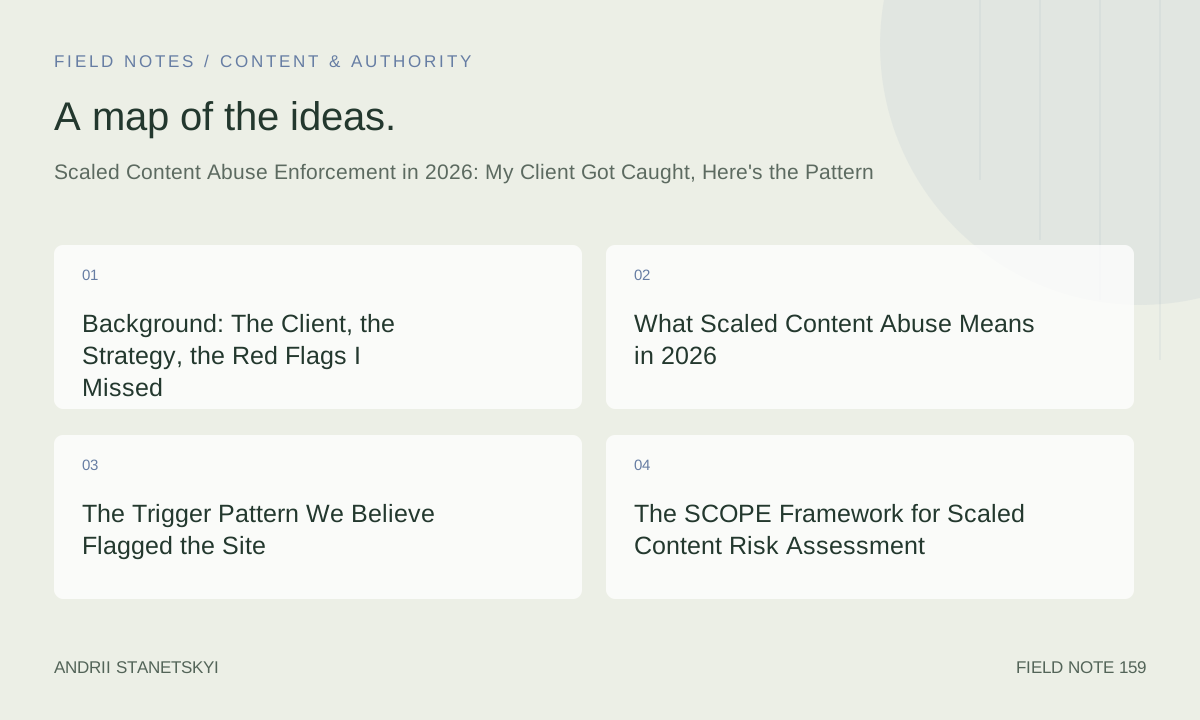
Background: The Client, the Strategy, the Red Flags I Missed
The client is a mid-sized B2C information site in a health-adjacent vertical. They came to me in late 2024 with a content expansion strategy already in motion — a freelance team of seven writers producing eight to twelve articles per day, supplemented by an AI drafting tool that generated first drafts at a rate of about 40 per day. The human writers edited, expanded, and published the AI drafts. The client called this a "human-in-the-loop" process. I accepted that framing without interrogating it hard enough.
The red flags I saw but underweighted:
- The editing pass was averaging 23 minutes per article. I've seen what substantive editing looks like. 23 minutes on a 1,200-word article is not substantive editing. It's formatting review.
- The topical distribution was thin. Eight hundred articles covering 40 queries with superficial variation was the actual content architecture, not the diverse topic portfolio the client described.
- Link acquisition was happening — a small link-building operation was running in parallel — but at a velocity that was suspiciously consistent. Twelve links per month, every month, like clockwork.
I flagged the link velocity as a concern. I did not flag the content operation with equivalent force. That's on me.
What Scaled Content Abuse Means in 2026
Google's spam policy definition of scaled content abuse has been on the books since May 2024 in its current form. But enforcement sharpened significantly in 2025. Two shifts:
First, the policy explicitly covers human-produced scaled content. The original framing in public discussion focused heavily on AI generation. The policy doesn't. A site producing 200 human-written articles per month that are topically thin and serve ranking rather than users is as exposed as an AI-production operation.
Second, manual actions for scaled content abuse are now being issued at scale. Before 2025, most scaled content enforcement was algorithmic — you got demoted but didn't necessarily receive a manual action message in GSC. By mid-2025, the manual action count for scaled content abuse had increased substantially. The September 2025 spam update brought a wave of manual actions that hit sites across multiple verticals simultaneously.
This matters for how you monitor. Algorithmic demotion can look like a lot of other things. A manual action is unambiguous. The site I'm writing about went from unclear algorithmic softening in August 2025 to an explicit manual action message on September 17, 2025.
The Trigger Pattern We Believe Flagged the Site
I can't know with certainty what triggered the manual review. What I can do is document the pattern that preceded it, because the pattern is consistent with what I've seen across other cases.
# Site profile at time of manual action (September 2025)
# Anonymized but precise

Domain age: 6 years
Pre-expansion content: ~310 articles (human-written, organic growth)
Expansion content: 847 articles (AI-first, 23-min edit pass)
  - Published between January and August 2025
  - Average publication rate: ~106 articles/month
  - Topic cluster coverage: 40 primary topics, avg 21 articles/topic
  - Unique entity coverage per cluster: low (avg 73% entity overlap
    across articles within same cluster)

Link profile:
  - Pre-expansion: 440 referring domains, organic acquisition
  - Expansion period: +96 referring domains (12/month, consistent)
  - Source distribution: 89% from same 3 link-building vendors

Behavioral signals (estimated from GSC patterns):
  - CTR across expansion content: 1.1% avg vs 4.3% for legacy content
  - Estimated return-to-SERP: high (inferred from ranking instability)
  - Cross-page sessions: not measurable directly; inferred low
# Pattern hypothesis: what likely triggered manual review

1. Content velocity anomaly: 106 articles/month from a site with
   6-year history of <10/month is a detectable pattern change.

2. Entity-redundancy signal: 40 topic clusters * 21 articles each,
   with 73% average entity overlap = near-zero differentiation.
   Each article in the cluster covers essentially the same entities
   in different arrangements.

3. Behavioral signal deficit: CTR of 1.1% vs legacy 4.3% creates
   a measurable within-site behavioral split.
   SpamBrain can observe that the new content performs differently
   from the site's established content.

4. Link velocity uniformity: 12 links/month for 8 straight months
   from 3 vendor clusters does not look like organic acquisition.

Likely sequence: algorithmic classifier flags combination of
signals → triggers manual review queue → reviewer confirms
scaled content abuse pattern → manual action issued.
The SCOPE Framework for Scaled Content Risk Assessment
After working through this case, I built what I call the SCOPE framework — a pre-publication risk assessment tool for content operations running at scale.
SCOPE:
- S — Scale vs. site history: How does current content velocity compare to the site's historical publishing rate? A 10x increase in monthly output over 90 days is a red flag regardless of content quality.
- C — Cluster differentiation: Within each topic cluster, do articles cover meaningfully different entity sets and user intents? Or is the variation superficial — same entities, different sentence arrangements?
- O — Originality markers: Does any of the scaled content contain data, perspectives, or experiences that cannot be inferred from existing published sources? Original research, first-person accounts, novel analysis.
- P — Production process transparency: If a Google quality reviewer examined your production workflow, would they characterize it as "editorial with AI assistance" or "AI generation with editorial rubber-stamp"?
- E — Engagement signal baseline: Does the scaled content perform comparably to the site's established content on GSC CTR and other observable proxies? A significant split is a measurable internal signal of content quality difference.
The client would have scored poorly on S, C, and E before the enforcement hit. A SCOPE assessment in January 2025 — when the expansion began — would have identified the risk clearly. I didn't run one because I didn't have the framework yet. Now I run it at project kickoff for any content operation producing more than 20 pieces per month.
Manual Action Timeline: Day by Day
September 17, 2025: Manual action notification in Google Search Console. Category: "Scaled content abuse." Scope: partial (not site-wide, but covering the expansion content cluster — approximately 780 of the 847 expansion articles).
September 18: Client call. First decision: do not touch anything yet. Let me audit before any removal.
September 22–26: Full content audit. Evaluated all 780 flagged pages against SCOPE dimensions. Result: 724 pages scored poorly on C and O — no meaningful differentiation, no originality markers. 56 pages had genuine differentiation or original content elements.
October 1: Client decision: remove 724 pages (410 status, not redirect). Retain and improve 56 pages. Commission 40 new original articles on the same topics using the site's established legacy content process.
October 15: New articles begin publishing. Deliberate pace — 4 per week, not the 25-per-week expansion rate.
November 3: Reconsideration request filed.
November 28: Reconsideration granted.
December through April 2026: Gradual traffic recovery. Detailed below.
Two Things I Think the Community Gets Backward
Contrarian take one: Partial manual actions are informative, not kind.
When the client's manual action came back as "partial" — covering the expansion content but not the legacy site — a lot of practitioners I spoke with called it a lucky outcome. It wasn't luck. It was data. A partial action tells you precisely where Google's systems see the problem. The legacy content was clean. The expansion content wasn't. That clarity is actually useful for remediation — you know exactly what to fix and what to protect.
Sites that receive site-wide manual actions have a harder problem: their entire content library has been characterized as abusive. That's catastrophically harder to remediate than a well-scoped partial action. If you're going to receive a manual action, partial is better. And the way you receive a partial is by having a genuinely different-quality baseline to compare against.
Contrarian take two: The "AI detector" framing is making sites less safe, not more.
A significant portion of the response to scaled content enforcement has been to use AI detection tools to identify and remove AI-generated content. I've seen this done on multiple sites. It's the wrong move, for two reasons.
One: AI detection tools have documented false positive rates in the 20–30% range for human-written content. You will remove good pages.
Two: Removing AI-identified content doesn't address what Google is actually measuring. Google's scaled content classifier is evaluating differentiation, entity coverage, behavioral signals, and originality — not AI authorship. A page that scores well on those dimensions survives whether it was written by a human or an LLM. A page that scores poorly gets flagged whether a human wrote it in 2019 or an AI wrote it last month.
The AI detector framing is making publishers remove content using the wrong criteria. The correct criteria are the SCOPE dimensions — or your own equivalent framework built from actual enforcement data.
The Mistake That Extended Recovery by Three Months
After the reconsideration was granted in late November 2025, I expected traffic recovery to begin immediately. It didn't. Through December, January, and February, the site sat at approximately 34% of its pre-expansion traffic. Not the pre-manual-action traffic — the pre-expansion baseline. The expansion content was gone; the recovery wasn't materializing.
In March 2026 I identified the problem: I had advised the client to maintain the same URL structure for their 40 new replacement articles, using the same URL paths as the removed pages where possible. My thinking was that this would preserve any link equity those URLs had accumulated. This was wrong.
The new articles inherited the behavioral signal history of the URLs they replaced. Those URLs had 8 months of low-CTR, low-engagement data in Google's systems. The new articles — genuinely good, original content — were starting with poisoned signal histories.
We switched to entirely new URLs in March 2026. Traffic began recovering in April. By May 19 the site is at 67% of its pre-expansion baseline — still not full recovery, but moving steadily in the right direction at a rate consistent with the new content accumulating its own signal history from scratch.
This is the same behavioral-history-inheritance problem I flagged in the SpamBrain article. I made the same mistake twice, with two different clients, a year apart. I won't make it a third time.
The Reconsideration Request: What Worked
The reconsideration request that succeeded — filed November 3, 2025, granted November 28 — had a specific structure that I believe was responsible for the relatively fast turnaround.
Section one: Precise description of the production methodology. Not "we used AI tools to produce content" but a specific account of the workflow: AI tool generates draft, writer reads and edits for average 23 minutes, editor publishes. We characterized this honestly as inadequate editorial oversight — not malicious, but insufficient to ensure genuine value differentiation.
Section two: Quantified removal documentation. Exactly 724 pages removed, with a URL list attached. 410 status on all removed pages. Verified via GSC coverage report showing 0 indexed pages in the removal set.
Section three: Retained content justification. For each of the 56 retained pages, a one-sentence summary of what genuine value or differentiation the page provided. This section was tedious to write. I believe it was essential — it demonstrated that removal decisions were based on quality assessment, not random or bulk removal.
Section four: Process change documentation. The new production workflow: human writer researches and outlines, AI tool assists with draft structure only, minimum 4-hour editorial investment per article, original data or first-person experience required for publication.
Section five: Forward commitment with metrics. Not "we will produce better content" but "we will publish a maximum of 16 articles per month, each meeting specific criteria, and we will not exceed a publishing rate that allows genuine editorial review."
The specificity in sections one and three — being honest about the inadequate process and detailed about the quality evaluation — is what I think differentiated this request from generic quality pledges.
Current State: Where the Site Is Now
As of May 19, 2026:
- 67% of pre-expansion baseline traffic (not pre-manual action — the expansion content never performed well enough to set a meaningful baseline)
- 40 new replacement articles published (16/month over January–April 2026)
- Average CTR on new articles: 3.8% — close to the 4.3% legacy content average
- No new manual action flags
- Recovery trajectory consistent with 85%+ baseline by Q3 2026 if current rate continues
The 33% gap from baseline is still significant. It represents lost revenue, lost rankings, and lost trust from the client. Some of that will come back. Some of it may be a permanent adjustment — the site's authority in certain query clusters was reset by the enforcement, and rebuilding it will take longer than the recovery of pages that were directly affected.
Pattern Recognition: How to See the Risk Before Google Does
If you're running or advising on a content operation at scale in 2026, here are the observable signals that should prompt a SCOPE assessment:
# Warning signal checklist for scaled content operations

VELOCITY SIGNALS:
  □ Monthly output more than 3x the site's trailing 12-month average?
  □ Publication rate increased more than 50% in any 60-day window?
  □ Batch publications (multiple articles published in same hour)?

CONTENT SIGNALS:
  □ Do articles within the same topic cluster share >60% of their
    entity mentions?
  □ Can you distinguish articles in the same cluster by reading
    their bodies, or only by their headlines?
  □ Does any article contain information not available in top-5
    SERP competitors? (If no: zero originality marker)

BEHAVIORAL PROXY SIGNALS:
  □ Is CTR on scaled content >25% below site's legacy content average?
  □ Are scaled content pages showing ranking volatility within
    first 30 days of indexation?
  □ Zero backlinks to scaled content pages after 90 days?

LINK SIGNALS:
  □ Link acquisition monthly velocity more consistent than
    a ±20% variance over 6 months? (Too consistent = unnatural)
  □ More than 70% of new linking domains from the same
    3 vendors or networks?
Three or more flags across these categories is a material enforcement risk. Five or more is, in my assessment, active exposure — the question is not whether Google will catch it but when.
See also: SpamBrain's generative-content detection layer for the technical mechanism behind these signals, AI-generated content and Google's policies, and content pruning decision framework for the removal methodology.
External reference: Google's scaled content abuse policy documentation is the policy basis, but enforcement mechanism documentation is not public — what's here is inferred from case patterns.
The Honest Reckoning
I should have pushed back harder in January 2025 when I saw the production operation my client was running. I knew the red flags. I minimized them because the client was confident and the strategy had a logic to it. "Human in the loop" sounded defensible. I let that framing do too much work.
The cost was real: a nine-month enforcement episode, an estimated $34,000 in revenue impact across the manual action period, and a client relationship that survived but required significant rebuilding of trust. They came back because the recovery worked. Not every client would.
Scaled content abuse enforcement in 2026 is not a technical edge case. It's a mainstream enforcement category that will catch operations that would have been fine in 2022 or even 2023. The classifier is more sophisticated, the behavioral signal integration is deeper, and the manual review capacity Google has deployed for this category is demonstrably larger than it was two years ago.
If you're producing content at scale — any scale — the question worth asking is: would a thoughtful human reviewer characterize each piece as serving a specific user need better than existing published sources? Not approximately. Better. If the honest answer is no, the enforcement risk isn't academic. It's a scheduled event.