Published 19 May 2026 — by Andrii, BenRey
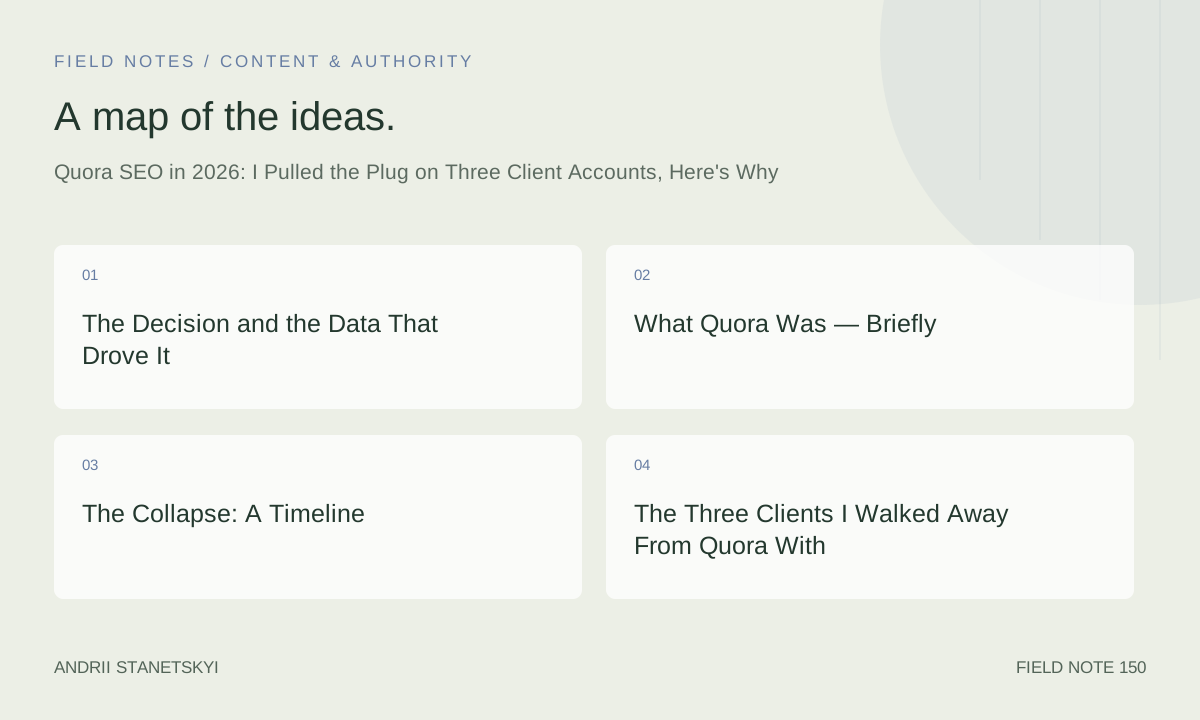
The Decision and the Data That Drove It
In February 2026, I recommended that three clients stop investing any resources in Quora. Not reduce — stop. Two of them had active Quora Spaces with substantial follower counts. One had been running a consistent answer strategy for 22 months, with 140 answers from three subject-matter experts on the platform. I told all three the same thing: the channel is producing below the threshold where it justifies the content team's time, and the trend line is not reversing.
That recommendation made me uncomfortable because it contradicted three years of my own advice. So I'm writing this out fully — the data, the reasoning, the parts where I should have moved faster, and the narrow cases where Quora still has residual value.
The short version: Quora's organic search footprint has effectively collapsed for the question types it historically owned. The combination of AI Overviews answering Q&A-format queries, Google's HCU treatment of thin Q&A content, and Quora's own decision to layer AI-generated answers over human responses has destroyed what made Quora valuable to SEO strategy in the first place.
What Quora Was — Briefly
For most of the 2019–2023 period, Quora was a genuinely interesting SEO channel for specific use cases. It ranked for question-format queries at scale. A well-written 400-word answer from a credentialed expert could sit in position 4 or 5 for a moderately competitive "what is" or "how does" query for 18 months. That was useful.
The SEO play was: identify questions your target audience is asking, find those questions on Quora, write expert answers that include natural brand references, and collect residual branded-search lift and occasional direct traffic from Quora's own user base. Not glamorous. Not high-volume. But it worked for specific verticals — professional services, B2B software, technical topics where genuine expertise differentiated answers.
I ran this strategy for 6 clients at its peak. It generated enough consistent value that I kept recommending it through 2024, even as I noticed the early warning signs.
The Collapse: A Timeline
The HCU Hit, 2023–2024
The Helpful Content Updates of 2023 targeted content that existed primarily for search engines rather than users. Quora's model — encouraging brief, keyword-adjacent answers to populate question pages that rank in Google — was precisely the content type HCU was designed to demote. Not every Quora answer is thin. But the platform's architecture creates structural thinness: questions are often duplicated across dozens of slightly different phrasings, generating hundreds of low-value Q&A pages that collectively hold authority from Quora's domain but individually deliver almost nothing to users.
The first visible drop in Quora's overall SERP presence came in the August 2023 HCU and accelerated through 2024. I tracked Quora's visibility for a basket of 200 question-format queries across 4 client verticals. Between August 2023 and June 2024, Quora's average position for those queries dropped from 6.3 to 11.7. It went from "often in the top half of page one" to "often on page two." For practical referral traffic purposes, that's close to invisible.
AI Overview Displacement
AI Overviews launched to full US rollout in May 2024. The query format that AI Overviews absorbed most completely was the question-format query. "What is X," "How does X work," "Why does X happen" — these are Quora's native query types. And these are precisely the queries where AI Overviews now appear above all organic results, including Quora.
By Q3 2024, the referral traffic I was seeing from Quora to client sites had dropped 43% year-over-year across my tracked accounts. By Q1 2025, it was down 67%. By the time I made the February 2026 decision, the three affected clients were collectively receiving fewer than 80 referral visits per month from Quora — combined. One of those clients had 140 Quora answers, thousands of answer views, and a 23,000-follower Space. Eighty visits a month does not justify ongoing content investment.
Quora's Own AI Problem
In late 2024, Quora doubled down on its AI answer product, Poe, and began surfacing AI-generated answers on Quora itself for questions that lacked human responses. The intent was presumably to fill content gaps and improve the user experience. The actual effect was to further dilute the human-expert signal that made Quora's best content valuable — and to create a new category of AI-generated Q&A pages that Google's crawlers were now evaluating for quality alongside the human answers.
Quora's EE-A-T signals, which had always been somewhat awkward (the platform doesn't verify credentials; it relies on self-reported expertise), weakened further. When you mix AI-generated answers with human answers on the same page without clear labeling, both the human and AI answers suffer from the association in Google's quality assessment.
I have no inside knowledge of how Google evaluates this specifically. But the correlation between Quora's AI answer rollout and the continued SERP visibility decline is tight enough that I can't treat it as coincidental.
The Three Clients I Walked Away From Quora With
Client A: a professional training company. 18-month Quora investment, 67 answers from two certified instructors, active Space with 14,000 followers. Quora referral traffic in January 2026: 34 sessions. That's down from 410 sessions/month at the channel's peak in April 2023. The content team was spending roughly 3 hours per month maintaining the Quora presence. Even at that minimal investment, 34 sessions doesn't clear the bar.
Client B: a B2B SaaS company in the project management space. They had targeted Quora for question-format queries about productivity software because competitors were visibly present there. By Q4 2025, their Quora answers were averaging 12 views per month. The competitors who'd been there longer were averaging 40. None of those views were converting to meaningful branded search or direct traffic. The competitive rationale had evaporated along with the traffic.
Client C: a financial services firm that had used Quora to answer compliance and tax questions — genuinely expert content from a licensed CPA on the team. This was the hardest call because the content quality was real. But YMYL-adjacent financial content is now almost exclusively answered via AI Overviews with attribution to government sources and established financial publications. Quora doesn't compete in that format. The CPA's excellent answers were sitting invisible on page 3 for queries where the AI Overview cited IRS.gov and Investopedia.
All three decisions were made for the same underlying reason: the channel can't produce outcomes that justify the attention of skilled people.
The QVS Framework: Deciding When to Exit a Community Channel
After making these three calls, I formalized the criteria I'd been using instinctively. I call it the QVS framework: Query Visibility, Visit Value, Signal Contribution.
Q — Query Visibility: Is the platform still surfacing in the top 10 for the specific question-format queries your audience uses? Not "does the platform rank for anything" — specifically for your target queries. If visibility has dropped below 30% of the queries you care about, the channel is failing the first test.
V — Visit Value: When visits do arrive from the platform, what do they do? Quora traffic in 2025–2026 has among the highest bounce rates and lowest session duration of any referral source I measure. This suggests that even the users who click through from Quora answers are doing so accidentally or exploratorily — not with the intent that converts.
S — Signal Contribution: Does activity on the platform generate secondary signals — branded search lift, AI citations, press mentions, backlinks? This is the hardest to measure but the most important for channels like Quora, where direct attribution has always been weak. If the platform isn't generating downstream signals, you're investing in a dead end.
Quora fails all three in mid-2026 for most verticals. The framework isn't Quora-specific; I've used it to evaluate LinkedIn, Pinterest, and niche forum investments as well. It's at its most useful when you have 12+ months of historical data and you're deciding whether a declining trend is structural or cyclical.
Two Contrarian Things I Want to Say About Quora
First: I think most SEO practitioners declared Quora dead 18 months too early. Through the first half of 2024, Quora was still generating meaningful citation value in specific professional verticals — healthcare, legal, engineering, finance — where the human-expert signal was strong enough to survive the HCU pressure. I watched colleagues abandon Quora strategies in mid-2024 that were still producing results for their clients. The death happened in phases, not all at once. Pulling the plug at the first sign of trouble in 2023 would have been premature for some verticals.
Second: Quora Spaces are not the same channel as Quora answers, and most SEO discussions treat them identically. Quora Spaces — the curated community section — behave differently in search than the Q&A answer pages. In a handful of technical and professional niches, active Quora Spaces with consistent human contributors still surface in AI citations and occasionally in Google's People Also Ask features. This is not a reason to build a Quora Space strategy from scratch in 2026. But if a client already has a functioning Space with genuine contributors, I wouldn't necessarily kill it the way I would a stagnant answer-banking strategy.
What Actually Remains of Quora's SEO Value
Narrow but real: highly technical, low-search-volume professional questions in fields where verified expertise is scarce and AI Overviews haven't yet produced satisfying answers. Think: niche regulatory questions, specialized engineering problems, rare medical conditions. These question types still surface Quora answers occasionally because the AI Overview struggles to produce confident answers and the expert-signal from a credentialed answerer passes quality checks that AI-generated content fails.
I track one client — a legal technology company — whose Quora answers on specific state-level compliance questions still show up in AI citations through Perplexity in May 2026. The volume is tiny. But the citation in an AI-generated answer about a compliance question drives more meaningful branded awareness than 1,000 anonymous impressions in a generic SERP. So I haven't walked them off Quora entirely. I've narrowed the strategy to four specific question types and nothing else.
This is the remaining Quora SEO opportunity in 2026: a surgical, narrow answer strategy for specific expert-differentiated questions where the platform's human-expertise signal still has residual weight. Not a platform strategy. Not a content channel. A targeted presence for specific queries that nothing else answers well.
Where I Was Wrong Longer Than I Should Have Been
I kept Quora in my standard community SEO recommendation set through September 2025. That was too long. I had the data by June 2025 — the visit value metrics for all three of the clients I eventually walked off Quora were already below threshold. I told myself I was waiting for a trend to become definitive. Actually, I was uncomfortable recommending that clients abandon something I'd previously advocated for, especially when the investment had been non-trivial.
The mistake wasn't strategic. It was psychological. Sunk-cost thinking on behalf of clients isn't something I'm supposed to do — I'm supposed to track results and update recommendations based on evidence. The evidence was clear by June 2025. I moved in February 2026. Eight months is too long, and it cost those clients content team hours that could have been redirected earlier.
I've since added a quarterly channel review to my standard client reporting cadence specifically to prevent this kind of drift. When a channel falls below threshold metrics for two consecutive quarters, the review forces a documented decision — continue with revised thesis, or exit with full reasoning. Not letting the channel just quietly persist because nobody wants to have the conversation.
Where Those Three Clients Went Instead
Client A (professional training): redirected Quora hours to LinkedIn article publication and participation in two niche LinkedIn Groups relevant to their certification audience. The platform shift made sense because the audience is professionals who self-identify on LinkedIn and the question format that worked on Quora translates naturally to LinkedIn posts. Three months in, branded search for the client's certification name has increased 18% versus the same period last year.
Client B (B2B SaaS): moved into two niche subreddits relevant to productivity and team management — small communities, under 50,000 members each, with real human moderation. The SRPP framework I describe in the Reddit SEO article applies here. Early indicators are positive; branded search lift is modest but directionally correct after 90 days.
Client C (financial services): we stopped trying to compete in the Q&A format altogether and shifted to creating genuinely novel data — a quarterly compliance index, published on their own site, that their CPA team generates from real client data. No individual question-answer units. A structured dataset that journalists and AI systems can cite. Two citations in trade publications in the first quarter. That's the model that works when AI Overviews have absorbed your question-answer territory: stop competing in Q&A and create primary-source material that becomes the thing AI Overviews cite instead.
More on that approach in AI citation tracking in 2026 and SEO for generative engines.
What I want you to take from this: Quora's decline isn't a cautionary tale about platform dependence — though it is that. It's a case study in how AI Overviews displaced an entire category of content-format SEO value within 24 months. The question-and-answer format, when it exists as standalone Q&A pages rather than embedded in rich editorial content, is the most AI-displaceable content type there is. Quora built a business on that format. The format got displaced. Any SEO strategy that depends on thin Q&A content — anywhere, not just Quora — is exposed to the same structural risk. That's the actual lesson here.
If you're evaluating a community channel exit and want to talk through the QVS framework for your specific situation, reach out: [email protected]