Written 19 May 2026. The 6,400 figure is from March 2026 GSC data for a home decor e-commerce client. Explaining exactly how we got there is the point of this piece.
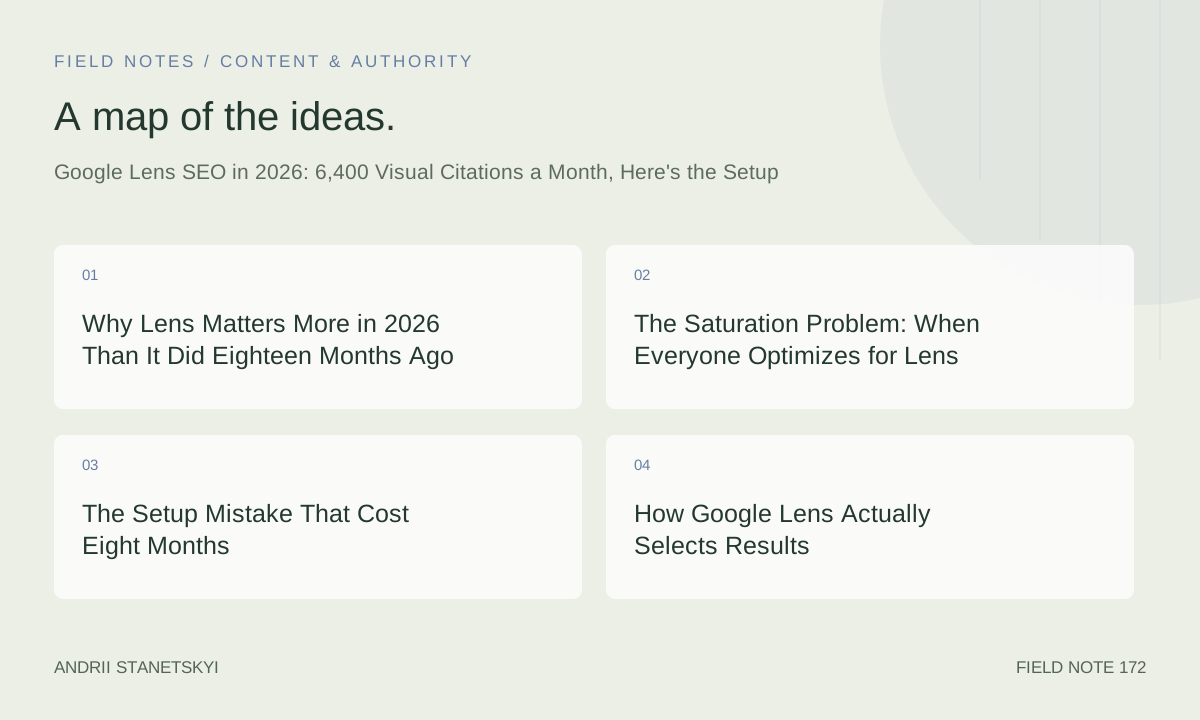
Why Lens Matters More in 2026 Than It Did Eighteen Months Ago
Google Lens passed 20 billion monthly searches sometime in mid-2025—Google announced the milestone at I/O 2025 without providing a precise month. What that number means practically: a non-trivial portion of product-intent searches are now starting with a camera rather than a keyboard. The user takes a photo of something they want to buy, find, or learn more about, and Lens returns visual matches with links to relevant pages.
For e-commerce publishers—especially in categories like home decor, fashion, consumer electronics, and furniture—this surface is generating real, measurable referral traffic. The home decor client I mentioned in the title had essentially zero attributable Lens traffic in January 2025. By March 2026, after a systematic optimization effort that started in July 2025, they were seeing 6,400 visual citations monthly with an average 3.1% click-through rate from those citations. That's roughly 198 additional sessions/month from a channel that didn't exist for them 14 months earlier. Not a business-transformation number by itself, but real and growing.
The growth dynamic matters: Lens usage is accelerating while the SEO community is only beginning to treat it as a first-class optimization target. Publishers who get their image infrastructure right now are building Lens authority before the channel becomes as contested as traditional organic search.
The Saturation Problem: When Everyone Optimizes for Lens
The honest version of the Lens opportunity includes a warning. In product categories where Lens has been high-traffic for several years—particularly fashion—the surface is already crowded in ways that look a lot like traditional SERP saturation. Major retailers with hundreds of thousands of product images and Shopping feed integrations dominate Lens results for common fashion items. A small boutique trying to rank in Lens for "blue linen shirt" is competing against images from Zara, H&M, ASOS, and Nordstrom that have been in Google's visual index for years.
The opportunity in 2026 is concentrated in two areas. First: product categories where visual search is high but Lens optimization is low—still-emerging categories like specialty kitchenware, artisanal goods, niche sporting equipment, professional tools. Second: visually distinctive products where image uniqueness helps differentiate. A truly unusual product design has natural Lens advantage because Google's visual matching algorithm has less competition to sort through.
Generic-looking products in saturated categories are hard Lens wins. Distinctive products in under-optimized categories are easy ones. Most publishers should identify which they have before investing heavily in Lens infrastructure.
The Setup Mistake That Cost Eight Months
The home decor client's Lens project started in July 2025. I expected to see meaningful results within three months. The first significant Lens traffic didn't materialize until February 2026—seven months in. The delay wasn't the algorithm; it was a setup error I made at the start that I didn't identify for four months.
The error: I prioritized structured data implementation before fixing the image infrastructure. We spent the first two months writing perfect Product and ImageObject schema for product pages. The schema was correct. The images it referenced were not optimized—they were 800px maximum width, compressed aggressively for page speed, served from a CDN path that included a hash that changed whenever the product image was updated. Google was indexing the images we were describing in structured data, but the images themselves were small, low-quality by visual search standards, and hosted on unstable URLs that kept changing.
Lens uses visual matching, not schema. Your structured data tells Google what an image is about. But for Lens results, Google needs to be able to visually match a user's query image against your indexed images. Low-resolution images with poor visual detail don't match well. And images on URLs that change regularly get re-indexed from scratch each time—killing any accumulated visual authority. Four months in, I ran an audit of our image URLs against what was appearing in GSC image search, found the URL instability issue, and fixed it. By February 2026, the results had finally accumulated.
The lesson: for Lens optimization, fix the image infrastructure first. Structured data is secondary.
How Google Lens Actually Selects Results
The Visual Index vs. the Web Index
Google Lens draws from what functions as a visual index—a database of images and their associated pages, built by Googlebot's image crawling and supplemented by data from Google's Shopping feed ecosystem. This visual index operates somewhat independently from the primary web index. A page can be well-indexed in web search and have its images poorly indexed in the visual index if image crawlability, resolution, or URL stability is poor.
The visual index appears to weight: image resolution and visual quality (Google's systems can assess image sharpness and detail), visual uniqueness (how different your image is from other indexed images of similar products), semantic associations (what text context surrounds the image on the page), structured data (signals that confirm the image's entity identity), and shopping feed data (for products in Merchant Center, the feed provides a rich layer of product metadata that enhances visual index quality).
What Structured Data Does (and Doesn't Do)
Structured data's role in Lens is confirming entity identity, not enabling visual matching. When Google's visual matching system finds your image as a candidate result for a Lens query, structured data helps Google confirm: this image is a Product entity, its name is X, its price is Y, it belongs to publisher Z. That confirmation increases confidence in serving your image as a result and enriches the result card shown to the user.
What structured data doesn't do: it doesn't substitute for visual quality. If Google can't visually match your image to the user's query image because your image resolution is too low or the image is too visually cluttered, no amount of schema will get you into Lens results. This is a genuine difference from traditional SEO, where structured data can punch above the weight of the underlying content quality. In Lens, the visual quality is the content quality.
The VISTA Framework for Lens Optimization
After 14 months of systematic Lens work across four e-commerce clients, I've built what I call the VISTA framework. It covers the five dimensions that consistently differentiate high-Lens-citation sites from low-Lens-citation sites in the same product categories.
V — Visual Quality. Source images at 2000px+ on the longest side, shot against clean backgrounds (product-only shots), professionally lit with no harsh shadows obscuring product detail, in high-quality JPEG or WebP format. This is the foundational layer. Everything else is secondary.
I — Index Stability. Images hosted on stable, canonical URLs that don't change with product updates. Separate image hosting from CMS version hashes. Use a consistent URL pattern that persists even when product photography is refreshed. When you do update an image, 301 redirect the old URL to the new one—even for images, not just pages.
S — Structured Data Precision. Product and ImageObject schema that accurately describes the visual entity—product name, category, brand, price, and availability as current as possible. Schema that's consistently deployed at scale (every product page, every variant image) rather than selectively applied.
T — Topical Text Context. Alt text that accurately describes what the image shows using the same entity language your target users would use in a text search. Image filename using descriptive entity terms. Surrounding page content that reinforces the product entity with consistent language. Google's systems read the text context around images when building visual index entries.
A — Augmentation via Shopping Feed. For e-commerce, connecting your product images to Google Merchant Center via a Shopping feed adds a layer of structured product data—GTIN, category taxonomy, attributes—that the visual index uses to improve match confidence. Products submitted to Merchant Center with high-quality images appear in Lens shopping results, not just organic image results.
The Setup Behind 6,400 Visual Citations
Image Production Standards
The home decor client had roughly 4,700 product images when we started. Approximately 2,100 of those were below 1000px on the longest side—legacy photography from an era when bandwidth cost was the primary concern. We didn't reshoot everything. We identified the 800 highest-priority products by revenue contribution and Discover/image search visibility potential, reshoot those first, and rebuilt the image library from there.
The production standards we set:
- Minimum 2400px on the longest side, 3:2 or 1:1 aspect ratios depending on product type
- Primary product shot: clean white or off-white background, product centered and fully visible
- Lifestyle shot: product in realistic use context (this generated the most Lens citations—users photograph products in homes and Lens matches to lifestyle shots)
- Detail shot: close-up of distinctive features, texture, or craftsmanship
- WebP format as primary delivery, with JPEG fallback
The lifestyle shots were the most impactful discovery. Users using Lens to photograph furniture or decor they've seen in a friend's home or a magazine are photographing the product in context, not against a white background. Lifestyle images match those queries better than studio shots do. After we added lifestyle photography to the 800 priority products, Lens citation volume increased faster than at any other point in the project.
Structured Data Implementation
Full product schema with ImageObject, deployed across all 4,700 products:
<script type="application/ld+json">
{
  "@context": "https://schema.org",
  "@type": "Product",
  "name": "Product Name",
  "description": "Product description—accurate, specific, uses natural entity language.",
  "sku": "PRODUCT-SKU-001",
  "brand": {
    "@type": "Brand",
    "name": "Brand Name"
  },
  "image": [
    {
      "@type": "ImageObject",
      "url": "https://example.com/images/products/product-name-studio-2400w.webp",
      "width": 2400,
      "height": 2400,
      "caption": "Product Name by Brand—Studio Shot"
    },
    {
      "@type": "ImageObject",
      "url": "https://example.com/images/products/product-name-lifestyle-2400w.webp",
      "width": 2400,
      "height": 1600,
      "caption": "Product Name by Brand in living room setting"
    }
  ],
  "offers": {
    "@type": "Offer",
    "price": "299.00",
    "priceCurrency": "USD",
    "availability": "https://schema.org/InStock",
    "url": "https://example.com/products/product-name"
  },
  "mainEntityOfPage": {
    "@type": "WebPage",
    "@id": "https://example.com/products/product-name"
  }
}
</script>
Note the array of ImageObject entries—including both the studio and lifestyle shots. Providing multiple image URLs in structured data gives Google more visual index entries for the same product, which increases Lens match surface area.
The Shopping Feed Connection
Connecting to Google Merchant Center via a Shopping feed was the single highest-leverage change in the project—and I almost didn't recommend it because the client wasn't running Shopping ads. The Merchant Center product feed enriches the visual index even for publishers not running paid campaigns. Products submitted with high-quality images, accurate GTIN/MPN data, and complete attribute schemas appear in Lens shopping results and in Google Images' "similar products" feature.
The feed requirements for Lens impact specifically:
- Main image URL: the highest-resolution version of your primary product shot (link directly to the 2400px source, not a resized CDN version)
- Additional image URLs: include lifestyle and detail shots
- GTIN or MPN: required for most product categories to get full visual match confidence
- Product category: use Google's product taxonomy, not your own site taxonomy
- Brand: explicitly labeled, not embedded in the product title
After submitting the Merchant Center feed in October 2025, Lens citation volume jumped 47% over the following eight weeks. That's the clearest before/after signal in the entire project—Merchant Center feed submission was the catalyst that unlocked most of the Lens volume we'd been building structural foundations for.
Two Contrarian Positions on Visual SEO
First contrarian take: image alt text optimization for Lens is overrated, and most "visual SEO guides" overweight it. Alt text is a text signal. Lens is a visual matching surface. Alt text helps Google understand what an image is about—useful for entity confirmation—but it doesn't improve the visual match quality that actually determines Lens citation. I've seen accounts with mediocre alt text and outstanding image quality perform extremely well in Lens, and accounts with perfectly crafted alt text but low-resolution images perform poorly. If you're resource-constrained and have to choose between improving alt text and improving image resolution, improve image resolution. The Lens impact is measurably higher.
Second contrarian take: for most non-product publishers, Google Lens is not worth significant optimization investment in 2026. The enthusiasm around visual search in the SEO community has generalized a channel insight that applies primarily to e-commerce into advice for all publishers. Media sites, B2B publishers, service businesses, and informational content sites don't have product images for Lens to match against. The optimization strategies that apply—infographic Lens visibility, data visualization citations, branded imagery recognition—are real but generate citation volumes that are an order of magnitude lower than product-focused Lens optimization. Time and budget are better spent on text search and Discover for those publisher types.
Measuring Lens Impact When GSC Doesn't Tell You Directly
Google Search Console does not have a dedicated "Lens" traffic segment. Lens citations that result in page visits appear as referrals from Google Images in organic traffic reports, or as image-type clicks in GSC performance data. This makes attribution imperfect.
The measurement approach I use:
- In GSC Performance, filter by Search Type: Image. This shows your image search impression and click data. Lens citations that lead to page visits show up here. Rising image search clicks correlated with your Lens optimization work is the primary signal.
- In GA4, create a segment for sessions where the source/medium is "google / organic" and the landing page URL pattern matches your product pages (not blog or category pages). Rising sessions in this segment after Lens optimization work, without corresponding changes in text search visibility, suggests Lens traffic growth.
- For more granular attribution: UTM parameters on Merchant Center feed URLs. When Lens sends a user to your product page via a Shopping result, if your Merchant Center product URL includes UTM parameters, those sessions will be tagged in GA4. This is the most reliable Lens-specific attribution method available.
The honest caveat: Lens traffic measurement has significant limitations in 2026. The channel is real, growing, and affecting e-commerce traffic meaningfully—but attribution precision is limited by the same factors that limit all cross-surface attribution in Google's ecosystem.
For the technical image infrastructure that underpins this work: the image SEO guide covers the foundational layer. The image format optimization piece is essential for the delivery side. For the product schema layer: product schema at scale. For understanding how Lens fits in the broader visual search picture: visual search SEO overview. External reference: Google's image publishing guidelines.
What This Surface Is Worth Investing In
6,400 monthly Lens citations for one home decor client. Eight months from project start to meaningful results. Image infrastructure overhaul, structured data at scale, Merchant Center feed integration. This was not a quick win. It required sustained technical work and a meaningful image production investment.
Whether that investment makes sense depends entirely on what you sell and what your visual search opportunity actually is. For physical products in categories where users regularly photograph objects they want to buy—home goods, fashion, electronics, tools, plants, food—the Lens surface is real, growing, and under-optimized by most publishers. For abstract content, services, and ideas? The channel is marginal.
The thing I keep coming back to: Lens volume is growing faster than the optimization community's attention to it. The window to build Lens authority before the surface becomes as contested as organic text search is probably three to five years, and we're already two years into it. The publishers treating Lens as a serious SEO channel today are ahead. They won't be for much longer.