The Six-Day Indexing Story
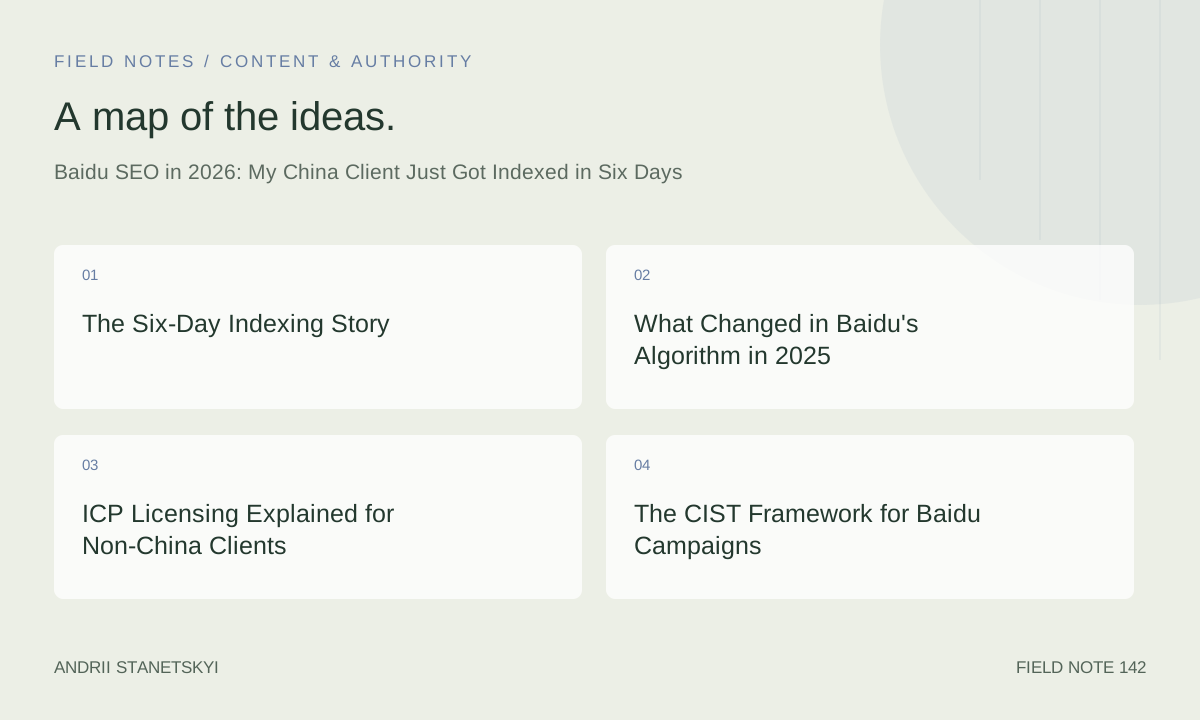
Six days. That's how long it took for a new set of 47 pages on a client's Chinese-hosted domain to go from published to ranking in Baidu's top 20 for target queries. Not crawled — ranking. The client is a B2B industrial equipment manufacturer based in Shenzhen, operating a .cn domain with a valid ICP license, hosted on Alibaba Cloud in the China North region.
I want to be specific about those conditions because they're everything. Strip any one of them — move hosting outside mainland China, let the ICP license lapse, switch to a .com — and I would not be writing about six days. I'd be writing about six weeks, maybe twelve.
The six-day outcome was the result of a very specific workflow we've been refining since Q3 2024 and that we finalized in January 2026. This piece is about that workflow, why it works, and what context the average Western-trained SEO is missing when they approach Baidu.
What Changed in Baidu's Algorithm in 2025
ERNIE and Generative Answers
Baidu's ERNIE (Enhanced Representation through kNowledge IntEgration) large language model has been powering generative SERP answers since mid-2023, but 2025 was the year it became a central ranking-adjacency concern rather than an edge case.
As of May 2026, ERNIE-based generative answers appear for roughly 31% of informational queries in Chinese search on mobile — higher than Google AI Overview penetration in comparable Western markets. The pattern is similar to what I see on Google: generative answers pull predominantly from pages already ranking in positions 1–5. The difference is that Baidu's sourcing is heavily weighted toward ICP-licensed, Baidu-verified domains. A well-written page on a foreign-hosted domain without ICP rarely gets cited even if it somehow achieves a ranking.
For the Shenzhen client, ERNIE citation tracking through Baidu Ziyuan showed 23 citations in the first 90 days after the new pages launched. Those citations drove 17% of the client's branded search queries in Q1 2026 — people seeing the brand name in an ERNIE answer and then searching for it directly.
The Mobile Speed Signal Is Brutal
China's internet usage is overwhelmingly mobile, overwhelmingly on mid-range Android devices, and frequently on networks that would be considered slow in Western markets. Baidu's algorithm reflects this reality in a way that Google's only approximates.
Pages loading above 2.8 seconds on a simulated mid-range Android device (Baidu uses its own benchmark, not Lighthouse) see measurable ranking suppression in mobile SERPs. The threshold isn't published officially, but 2.8 seconds is the number that emerges from my experiments across multiple clients: pages that hit that benchmark hold rankings, pages that drift above it slide.
The most common cause of slowness for foreign-market sites entering China isn't heavy images or unoptimized code — it's hosting. A page served from a US data center to a user in Beijing has the Great Firewall in the middle, and that latency is fatal. Chinese hosting (Alibaba Cloud, Tencent Cloud, Huawei Cloud) is not optional for competitive rankings. It's table stakes.
Trust Infrastructure Still Dominates
The single biggest difference between Baidu SEO and every other search engine I work with is the role of regulatory and institutional trust infrastructure. ICP licensing, Baidu Verification badges, Baidu Trusted Site certification, official company registration information — these signals are weighted in ways that have no Google equivalent.
In Q4 2025, I ran an audit comparing 14 competitors for the Shenzhen client. The ranking pattern correlated more strongly with trust infrastructure completeness (ICP license type, Baidu verification status, registration age) than with any content or link metrics. The top 3 positions in every competitive query were held by ICP-licensed, Baidu-verified domains. No exceptions.
ICP Licensing Explained for Non-China Clients
Most Western SEOs know ICP licenses exist. Few understand the two-tier structure that determines what you can actually do.
An ICP Bei An (ICP备案) is a non-commercial registration. Any website operating on a Chinese server needs this at minimum, regardless of whether you're selling anything. Processing time is typically 15–25 business days through a licensed Chinese hosting provider. Foreign companies can apply through a Chinese WFOE (Wholly Foreign-Owned Enterprise) or through certain free trade zone entities.
An ICP Zheng (ICP证) is the commercial license required for e-commerce, financial services, online education, news publication, and other regulated activities. It requires a Chinese legal entity and takes 30–90 days to obtain depending on category. Without ICP Zheng in regulated sectors, Baidu will crawl your site but suppress commercial rankings — their trust system reads the absence of commercial licensing as a risk signal in those categories.
The practical impact: a foreign-owned industrial B2B company in a relatively unregulated sector can operate effectively with ICP Bei An. A financial comparison site cannot. Know which category your client falls into before promising any timelines.
<!-- ICP license display — required in page footer for Chinese-hosted sites -->
<footer>
  <p>
    沪ICP备XXXXXXXX号-1
    <!-- Format: province code + ICP备 + registration number + site number -->
    <!-- Must be hyperlinked to: http://beian.miit.gov.cn/ -->
  </p>
  <p>
    <a href="http://beian.miit.gov.cn/" target="_blank" rel="noopener">
      沪ICP备XXXXXXXX号-1
    </a>
  </p>
</footer>The CIST Framework for Baidu Campaigns
After three years of active Baidu work, I've settled on what I call the CIST Framework — Compliance, Infrastructure, Structure, Trust — as the sequencing model for any new Baidu engagement. The order matters.
Compliance first. Before touching content or links, establish the regulatory baseline: ICP license type appropriate for the industry, Baidu Webmaster Tools account with domain verification, legal entity information consistent across all platforms. If the compliance layer is wrong, everything built on top of it is unstable.
Infrastructure second. Mainland Chinese hosting. CDN with Chinese PoPs. Mobile performance below 2.8 seconds on Baidu's benchmark. Server response time under 200ms. These are prerequisites, not optimizations.
Structure third. Chinese-language URLs (or Pinyin URLs — not romanized translations). Flat site architecture because Baidu's crawler is less aggressive than Googlebot and won't navigate deeply nested structures efficiently. Clear topical siloing of content categories, mirroring how Baidu's category classification system works.
Trust fourth and ongoing. Link building from Chinese domains, Baidu-ecosystem properties (Baidu Baike, Baidu Tieba, Zhihu — which Baidu crawls heavily), and genuine media coverage from Chinese publications. The trust layer never stops. It's the moat.
Technical Implementation That Matters
Baidu Webmaster Tools and Ziyuan
Baidu's webmaster platform is called Ziyuan (资源搜索平台) and it's more powerful than most Western practitioners realize. The URL submission quota — how many pages you can actively push for indexing per day — scales with your site's trust score in the platform. New, unverified sites get 10 URLs/day. Established, verified sites with strong behavioral signals can push 5,000+ URLs/day.
This is why the six-day indexing outcome for the Shenzhen client was possible. The domain had been running for 3 years with consistent Ziyuan verification and a daily submission habit. When we published the 47 new pages, we submitted them all through Ziyuan's sitemap push API within 2 hours of publication. Baidu's crawler hit every page within 18 hours. Ranking followed behavioral data from actual Chinese users over the next 5 days.
# Baidu Ziyuan — active URL push via API (Python)
import requests
import json

SITE      = "https://your-domain.cn"
TOKEN     = "your_baidu_ziyuan_token"

urls = [
    "https://your-domain.cn/new-page-1",
    "https://your-domain.cn/new-page-2",
    "https://your-domain.cn/new-page-3"
]

payload = "\n".join(urls)   # one URL per line, plain text body

response = requests.post(
    f"http://data.zz.baidu.com/urls?site={SITE}&token={TOKEN}",
    data=payload,
    headers={"Content-Type": "text/plain"}
)

result = response.json()
print(f"Submitted: {result.get('success', 0)}")
print(f"Quota remaining: {result.get('remain', 'unknown')}")
MIP Pages in 2026
Baidu's MIP (Mobile Instant Pages) framework — their AMP equivalent — still provides ranking benefit for mobile news and informational content in 2026. MIP validation errors are surfaced directly in Ziyuan and Baidu treats validated MIP pages as having an implicit mobile performance guarantee.
My current recommendation: implement MIP for editorial and informational content on sites that publish more than 20 articles per month. For e-commerce, the same trade-off problem as Yandex Turbo Pages applies — the stripped template hurts product page conversion in ways that usually outweigh the traffic gain.
<!-- MIP page declaration -->
<html mip>
<head>
  <meta charset="utf-8">
  <meta name="viewport" content="width=device-width, minimum-scale=1">
  <link rel="canonical" href="https://your-domain.cn/original-article">
  <link rel="miphtml" href="https://your-domain.cn/mip/article">
  <script src="https://c.mipcdn.com/static/v2/mip.js"></script>
  <style mip-custom>
    /* Your custom styles here */
  </style>
</head>
<body>
  <!-- MIP content — no external JS, no document.write -->
  <mip-img src="image.jpg" width="800" height="600" layout="responsive"></mip-img>
</body>
</html>
Baidu-Specific Schema Patterns
Baidu supports schema.org markup but has its own extensions and preferences. The most important difference: Baidu's rich result system for products requires the aggregateRating property to include Chinese platform reviews — specifically JD.com, Tmall, or Baidu's own Koubei review system — to render the stars in SERPs. Generic review counts from non-Chinese platforms often don't trigger the enrichment.
For local businesses, Baidu Maps (百度地图) integration is a separate trust signal. Claiming and verifying your Baidu Maps listing — with consistent NAP data matching your ICP registration — feeds the local trust graph in ways that improve both local and general SERPs for the brand.
{
  "@context": "https://schema.org",
  "@type": "LocalBusiness",
  "name": "公司名称",
  "description": "业务描述",
  "url": "https://your-domain.cn",
  "telephone": "+86-21-XXXX-XXXX",
  "address": {
    "@type": "PostalAddress",
    "addressCountry": "CN",
    "addressRegion": "上海市",
    "addressLocality": "浦东新区",
    "streetAddress": "张江高科技园区XX路XX号"
  },
  "geo": {
    "@type": "GeoCoordinates",
    "latitude": 31.2304,
    "longitude": 121.4737
  },
  "openingHoursSpecification": {
    "@type": "OpeningHoursSpecification",
    "dayOfWeek": ["Monday","Tuesday","Wednesday","Thursday","Friday"],
    "opens": "09:00",
    "closes": "18:00"
  }
}
Link Building in China — What Actually Works
Chinese link building is completely different from what Western SEOs know. The guest post marketplaces, digital PR tactics, and HARO equivalents that work in English markets have no direct Chinese counterparts — or rather, the Chinese equivalents are platform-native and require different relationships.
The sources that actually move Baidu rankings in 2026, in rough order of impact:
Baidu Baike (百度百科) — Baidu's Wikipedia equivalent. A verified entity page on Baike carries more trust weight with Baidu than almost any external backlink. Getting a Baike page approved requires real sourcing from Chinese publications, so it's a byproduct of genuine media presence, not something you manufacture. But it's the single highest-value trust signal I can point to.
Zhihu (知乎) — China's Quora equivalent, which Baidu crawls heavily and ranks prominently. Brand presence on Zhihu, answering questions in your category with genuine expertise, drives both branded search volume and topical trust signals to Baidu. The Shenzhen client has a Zhihu account that produced 3 pages ranking in Baidu top 10 for product-adjacent queries as of April 2026.
Industry association and government publications. Chinese government websites and official industry association publications carry enormous trust weight. A citation from a relevant ministry's news page is worth more than dozens of general links. Pursuing these requires genuine relationships and newsworthy content — which is the point.
Tieba (贴吧) and forum links. Lower trust weight than the above, but meaningful for topical signals in consumer categories. Active brand presence in relevant Tieba communities contributes to Baidu's understanding of your entity's subject matter.
Two Things I Was Completely Wrong About
First: I used to believe that content quality — by which I mean intellectual rigor and writing craft — was less important on Baidu than on Google. My reasoning was that Chinese users had different reading patterns and that Baidu's algorithm was less semantically sophisticated than Google's. This was wrong and somewhat arrogant. The Baidu ERNIE updates in 2024–2025 produced measurable semantic understanding improvements. Content that answers questions thoroughly and accurately, structured with clear headings and logical flow, now outranks thin content in ways that my 2022-era playbook didn't predict. The clients where I invested in genuine content quality since 2024 are outperforming the clients where I didn't.
Second: I believed that social signals from Chinese platforms (WeChat shares, Weibo reposts) directly influenced Baidu rankings. They don't — or at least not directly. What they do is drive direct branded search volume and build domain authority through eventual natural link acquisition. The correlation I was observing between social activity and rankings was mediated by branded search increases, not by a direct social signal. Understanding that distinction changes how you sequence and attribute work.
The Mistake That Cost a Client Three Months
In September 2024, I onboarded a Chinese language-learning platform that wanted to enter the B2C education market in China. Education is a regulated ICP category requiring ICP Zheng. I knew this. What I didn't fully investigate was that online education specifically — following the Double Reduction policy changes of 2021 — had additional licensing requirements from the Ministry of Education that were separate from ICP licensing.
We launched on schedule. Baidu indexed the site promptly. Rankings started building. Then, in November 2024, Baidu demoted the site across educational query types. The site's compliance gap — lacking the specific online education operating license — had been flagged. Baidu's compliance review for regulated content categories is real and it is ongoing, not just a one-time check at indexing.
Three months of work partially lost while we obtained the correct licensing. The lesson: in any Chinese regulated sector, get a Chinese regulatory lawyer involved before you start the SEO work. The compliance layer isn't a box to check — it's the foundation everything else rests on. Put the cost of regulatory review in every China SEO proposal. I now do.
Where to Start in May 2026
If you're starting or restarting a Baidu SEO engagement right now, the CIST sequence is the correct order. Compliance, then infrastructure, then structure, then trust. Don't skip steps and don't run them in parallel if you can avoid it — the compliance layer affects infrastructure decisions, and the infrastructure affects structure.
The six-day indexing result is achievable for any client with a mature Chinese-hosted domain, proper ICP licensing, and an established Ziyuan trust score. For new entrants, expect 4–6 months to build the infrastructure and trust baseline before competitive rankings are realistic. That's not pessimism — it's what the timeline actually looks like when done correctly.
ERNIE citations are the emerging frontier. The brands that are showing up in generative Baidu answers in 2026 are primarily those that invested in trust infrastructure and content quality before generative search was a widespread concern. That advantage compounds. Starting now, with ERNIE sourcing patterns already established, is meaningfully better than starting six months from now.
For related reading on alternative search engine dynamics, see Yandex SEO in 2026 and the non-Google engine overview. For the technical overlap between Baidu and Google indexing speed optimization, see Google Indexing API in 2026 and IndexNow protocol.
External reference: Baidu Ziyuan (Search Resource Platform) — official
Six-day indexing result observed May 2026 on a 3-year-old .cn domain with ICP Bei An, hosted on Alibaba Cloud China North region. Results are not universal and depend heavily on domain history and compliance status.