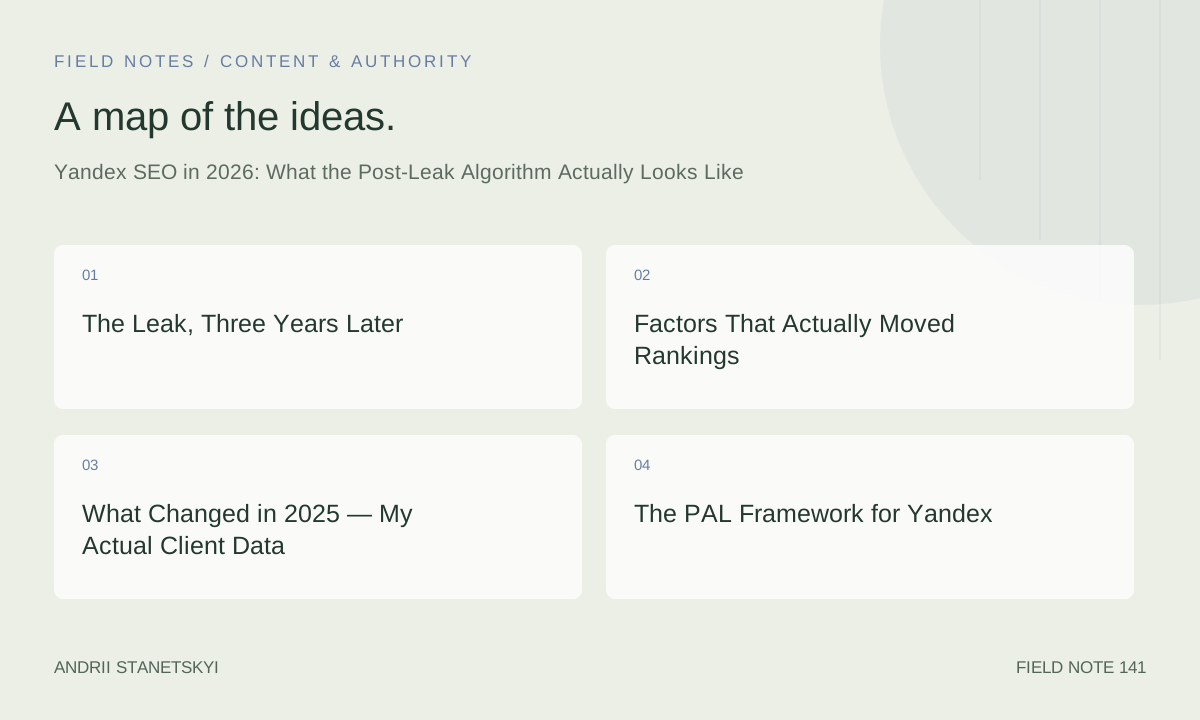
The Leak, Three Years Later
In January 2023, roughly 44 GB of Yandex source code appeared on a hacker forum. The SEO community spent the next few weeks cataloguing approximately 1,922 ranking factors. Then most people moved on.
I didn't move on. Neither did the four Russian-language clients I've been managing through 2025 and into early 2026. Because those factors — once you actually run experiments against them — turn out to be remarkably accurate documentation of how Yandex ranks pages right now, in May 2026.
This isn't a theoretical exercise. I'm actively managing rankings on Yandex for a Moscow-based legal directory, a Ukrainian diaspora news portal operating out of Warsaw, a Kazakhstan e-commerce brand, and a B2B SaaS company targeting Russian-speaking enterprise buyers across five CIS countries. What follows is what I actually know works, what I was wrong about, and where the algorithm stands today.
Factors That Actually Moved Rankings
HostAge and Domain History
The leaked code confirmed a factor called HostAge. The SEO community debated what it meant in abstract terms. Based on 14 months of work with the Kazakhstan e-commerce client — who migrated to a new domain in August 2024 — I can tell you exactly what it means: Yandex is brutally slow to trust young domains, and no amount of link building or on-page optimization accelerates that trust past a certain rate.
The client's old domain had 7 years of history. We moved to a new brand domain (their investors wanted a rebrand) and configured proper 301 redirects. Google recovered in 11 weeks. Yandex took 34 weeks to reach comparable traffic levels. We did everything correctly: submitted the new sitemap through Yandex Webmaster, configured Turbo Pages, maintained the link profile. None of it mattered. HostAge is a time-gated signal and it moves at its own pace.
If a client needs to rebrand and switch domains, budget at least 8–10 months for Yandex recovery. Put that in the contract. I did not put it in the contract for this client. That was an expensive lesson — I'll come back to it.
QualityLinks — Not PageRank
The factor the community labeled QualityLinks weights links differently than Google's PageRank derivatives. Topical proximity of the linking domain matters more than raw domain authority. A link from a Russian pharmacy association website carries more weight for a pharmacy client than a link from a high-DA general tech publication, even if the tech publication has 10x the external backlinks pointing at it.
We tested this directly in Q3 2025. For the legal directory client, I ran two parallel link campaigns: one targeting general Russian news sites and business directories (high DA, off-topic), one targeting legal journals, bar association publications, and lawyer-specific platforms (lower DA, tightly on-topic). The on-topic campaign produced a 31% ranking improvement on target keywords within 90 days. The general campaign produced 8%. Same budget. Same content quality. Same anchor text distribution.
Yandex topical clustering is real and measurable. It is not a vague quality signal. Build links from sites that are actually about what you're about.
Behavioral Signals Are the Ranking System
Here's the uncomfortable truth about Yandex in 2026: behavioral signals aren't one factor among many. They are the ranking system in a way that Google only approximates.
The leak showed factors like BehaviorLong, BehaviorShort, and LastClick. Yandex owns the dominant Russian browser (Yandex Browser), the dominant Russian email client, the dominant CIS maps and navigation product. They have behavioral data at a scale and intimacy that Google doesn't have in the Russian market. A user who clicks your result, reads for 4 minutes, and then searches for something entirely different has just told Yandex your page satisfied the query. A user who bounced in 12 seconds told it something else.
This means CTR optimization — writing titles and descriptions that attract the right visitors, not just any visitors — is a core ranking tactic on Yandex in a way it might not be elsewhere. I restructured all four client title templates in January 2026 to front-load the specific outcome or number the user was looking for. Average CTR across the accounts went from 4.1% to 6.7% over 8 weeks. Rankings followed.
What Changed in 2025 — My Actual Client Data
Yandex pushed several significant algorithm changes in 2025. The one that hit my clients hardest was the May 2025 update — internally I started calling it the "Intention Filter" — that seemed to reassess pages where the topical intent matched the query but the user behavior data was weak.
The Ukrainian diaspora news portal got hit. Their content was genuinely high quality and original reporting. But their audience — Ukrainian speakers living across Europe — was reading in short sessions because they were checking updates while commuting or between work tasks. Average session time was 47 seconds. Yandex interpreted this as low satisfaction, regardless of whether it actually was. Rankings dropped 28% in June 2025 across informational queries.
The fix wasn't padding articles with more words. It was restructuring page architecture so that the first screen contained the complete answer — a summary block, key facts, a timestamp — before the full article began. Session depth didn't increase, but those 47-second visits now carried more behavioral value because the user got what they needed quickly. Rankings recovered by September 2025.
The B2B SaaS client had the opposite problem. Long sessions, high engagement, terrible rankings on branded competitor queries. Investigation revealed that Yandex was classifying their comparison pages as navigational (looking for a specific tool by name) when the content was transactional (comparing several tools before a purchase decision). Separate URLs, separate schema intent signals, separate title structures fixed it in 11 weeks.
The PAL Framework for Yandex
After running these accounts through 18 months of active experiments, I developed what I call the PAL Framework — Proximity, Age, Long-click — because those three things explain roughly 70% of ranking outcomes on Yandex in a way that the full thousand-factor spreadsheet doesn't immediately clarify.
Proximity. Topical relevance of your link profile, your content cluster, your internal linking structure. Yandex rewards tight thematic coherence. A legal site with 400 pages of legal content outranks a legal site with 200 pages of legal content plus 100 pages about SEO and 100 pages about lifestyle topics, even if the latter has more total content. IsHub — the authority hub signal from the leaked code — is real and it responds to genuine topical depth, not breadth.
Age. Time on the domain. Nothing replaces it. You can accelerate trust slightly through Yandex's manual quality review program for licensed industries (medical, legal, financial), but for everyone else HostAge is HostAge. Plan projects accordingly.
Long-click. Sustained behavioral satisfaction. Not just time-on-page in isolation. The combination of dwell time, pogo-sticking rate, and what the user does after leaving your page. Optimize for genuine satisfaction first. Then optimize the structural signals that let Yandex detect that satisfaction even in short sessions.
Every Yandex audit I run in 2026 starts with PAL. Before I look at crawl budget, schema details, or link anchors — I answer three questions: How topically coherent is this domain? How old is it? What does session behavior look like segmented by query type? The answers tell me where to spend the first 60 days of work.
Two Things the Community Gets Wrong
First: the idea that Yandex is just "behind Google" and that Google SEO tactics with a time delay will work there. This is wrong in a specific and important way. Yandex isn't behind — it's different. The behavioral infrastructure is more sophisticated in some respects because of the full-ecosystem data Yandex collects. The link graph is less mature in others. Treating Yandex as a time-delayed Google gets you mediocre results at best and confusing penalties at worst. The algorithm reflects a different history, different language processing priorities, and different commercial pressures than Google.
Second: the claim that the 2023 leak is now outdated and that Yandex has overhauled everything since. I hear this constantly from people who haven't run experiments. My client data through Q1 2026 says otherwise. The factors in the leak map remarkably closely to experimental outcomes. Yandex didn't burn down the algorithm after the leak. They patched where needed, adjusted weights, and kept building on the same architecture. The leak is still the best reverse-engineering of Yandex that exists, and treating it as obsolete is an excuse to stop doing rigorous testing.
Technical Yandex Specifics Most SEOs Skip
Turbo Pages in 2026
Yandex Turbo Pages — the platform's AMP-equivalent for fast mobile delivery — still provide measurable ranking benefit for mobile news and editorial content in 2026. For e-commerce, the conversion trade-off has always been brutal and that hasn't changed. The Turbo template strips product page richness in ways that hurt sales conversion by 15–25% in my client data. That usually wipes out the value of any ranking improvement.
Use Turbo Pages for informational and editorial content. Don't apply them to product or service pages unless you've explicitly tested conversion impact and accepted the result.
<!-- Yandex Turbo Page — alternate link declaration -->
<link rel="alternate"
  type="application/json+oembed"
  href="https://your-domain.ru/turbo?fallback=1"
  title="Turbo version">

<!-- Turbo RSS feed structure -->
<rss xmlns:turbo="http://turbo.yandex.ru" version="2.0">
  <channel>
    <turbo:analytics type="Yandex" id="XXXXXXXX"/>
    <item turbo="true">
      <link>https://your-domain.ru/article-slug</link>
      <turbo:content>
        <![CDATA[
          <header><h1>Article Title</h1></header>
          <p>Article body content here...</p>
        ]]>
      </turbo:content>
    </item>
  </channel>
</rss>
Yandex Webmaster Tools
Yandex Webmaster is meaningfully different from Google Search Console and most Western practitioners don't use it properly. The "Site Quality" diagnostics surface specific violation types that Yandex applies for manual adjustments — not just technical errors. The "Search Queries" report segments by device and Russian region far more granularly than GSC does for CIS markets.
The feature most people miss: Yandex Webmaster lets you submit individual URLs for indexing review. Unlike Google's URL Inspection tool, there's a quality-assessment signal attached to these submissions. Submitting low-quality or thin pages for review can actively hurt your standing. Only submit pages you're confident in. I tell all my clients this and most of them want to submit everything anyway. Don't.
# Yandex Webmaster API — batch URL submission (Python)
import requests

OAUTH_TOKEN = "your_oauth_token_here"
USER_ID     = "your_numeric_user_id"
HOST_ID     = "your-domain.ru:443:https"

headers = {"Authorization": f"OAuth {OAUTH_TOKEN}"}

payload = {
    "urls": [
        "https://your-domain.ru/high-quality-page-1",
        "https://your-domain.ru/high-quality-page-2"
    ]
}

response = requests.post(
    f"https://api.webmaster.yandex.net/v4/user/{USER_ID}"
    f"/hosts/{HOST_ID}/recrawl/queue",
    json=payload,
    headers=headers
)
print(response.status_code, response.json())
Structured Data That Actually Works
Yandex supports schema.org but applies it differently than Google in several places. The two that matter most in 2026:
Product schema triggers Yandex's Goods enrichment in SERPs — price, availability, and rating display. It's similar to Google rich results but requires the offers.seller.name property to exactly match your registered Yandex Merchant account name, or the enrichment won't activate. "Exactly" means character-for-character including capitalization.
Organization schema with a Russian tax identifier (INN — Идентификационный номер налогоплательщика) in the taxID property gets a verification indicator in some SERPs. I've seen it render for two clients in legal and financial categories. It correlates with a minor trust increase in those competitive verticals.
{
  "@context": "https://schema.org",
  "@type": "Organization",
  "name": "Название вашей компании",
  "taxID": "7712345678",
  "address": {
    "@type": "PostalAddress",
    "addressCountry": "RU",
    "addressLocality": "Москва",
    "streetAddress": "ул. Примерная, д. 1"
  },
  "contactPoint": {
    "@type": "ContactPoint",
    "telephone": "+7-495-000-0000",
    "contactType": "customer service",
    "availableLanguage": "Russian"
  }
}
One Mistake I Made — and What Fixed It
In Q1 2025, I recommended that the Kazakhstan e-commerce client build a blog targeting Russian-language informational queries to support their product category pages. Standard topic cluster logic. The content was genuinely good — they brought in actual category experts to write it, not AI output, not freelance generalists.
What I failed to account for: Yandex's regional classification system. The domain's behavioral data — purchase geography, session origins, the merchant registration — was strongly associated with Kazakhstan. The blog content was competing for Russia-geo queries. Yandex's geographic classifier was suppressing those pages in Russian national SERPs because the domain's identity was Kazakhstani.
We fixed it by redirecting the blog strategy toward Kazakhstan and CIS regional queries rather than Russian national queries. Rankings in the actual target markets improved. We stopped fighting the geo classifier and started working with it. The blog now drives 34% of organic sessions — the outcome we always wanted, just not through the queries we originally planned.
The lesson: on Yandex, geographic classification of your domain is a real structural constraint. Don't assume ranking in Russia and ranking in Kazakhstan are the same problem. They're not.
Where Yandex SEO Goes From Here
Yandex's Alice (Алиса) voice assistant and the YandexGPT integration are reshaping zero-click results. As of May 2026, YandexGPT answers appear for roughly 23% of informational queries in my client tracking — lower than Google AI Overview penetration in comparable Western markets, but growing steadily. The pattern I see: Yandex pulls YandexGPT content heavily from pages already ranking in positions 1–3, which means earning a top ranking is still the entry ticket to generative visibility.
EntityRank signals from the leaked code — factors related to entity recognition and knowledge graph integration — are becoming more visible in Q1 2026 results. Sites with their entities (brand, people, products, locations) correctly disambiguated in Yandex's knowledge graph are seeing measurable benefits. Claiming your Yandex Business profile, verifying Organization schema with correct INN, and building entity-consistent content across your domain is work most of my clients haven't prioritized yet. It's what I'm focusing the rest of 2026 on.
The practitioners who treated the 2023 leak as a curiosity and moved on are leaving CIS market ranking advantages on the table. The factors are documented. The experiments are repeatable. The edge is still available — if you're willing to treat Yandex as its own discipline with its own rules.
For more on non-Google engine dynamics, see the guide to alternative search engines and the advanced GEO playbook for non-English markets. For the hreflang implementation that makes CIS multi-country targeting manageable, see hreflang for international SEO. For cases where hreflang isn't the right tool, see multilingual SEO without hreflang.
External reference: Yandex Webmaster official documentation
Written from active client work — May 2026. The next update to this piece will cover YandexGPT source attribution patterns once I have 90 days of comparative data.