In October 2025, my analytics showed 4,847 referral sessions from kagi.com in a single month. Not a single one came from a campaign I'd built for it. I hadn't optimized for it. I hadn't even been watching it. The traffic just showed up, stayed for 4 minutes 12 seconds on average, and converted at 3.1%—roughly double the rate of the organic Google segment for the same pages.
That got my attention in a way that a lot of other analytics anomalies don't.
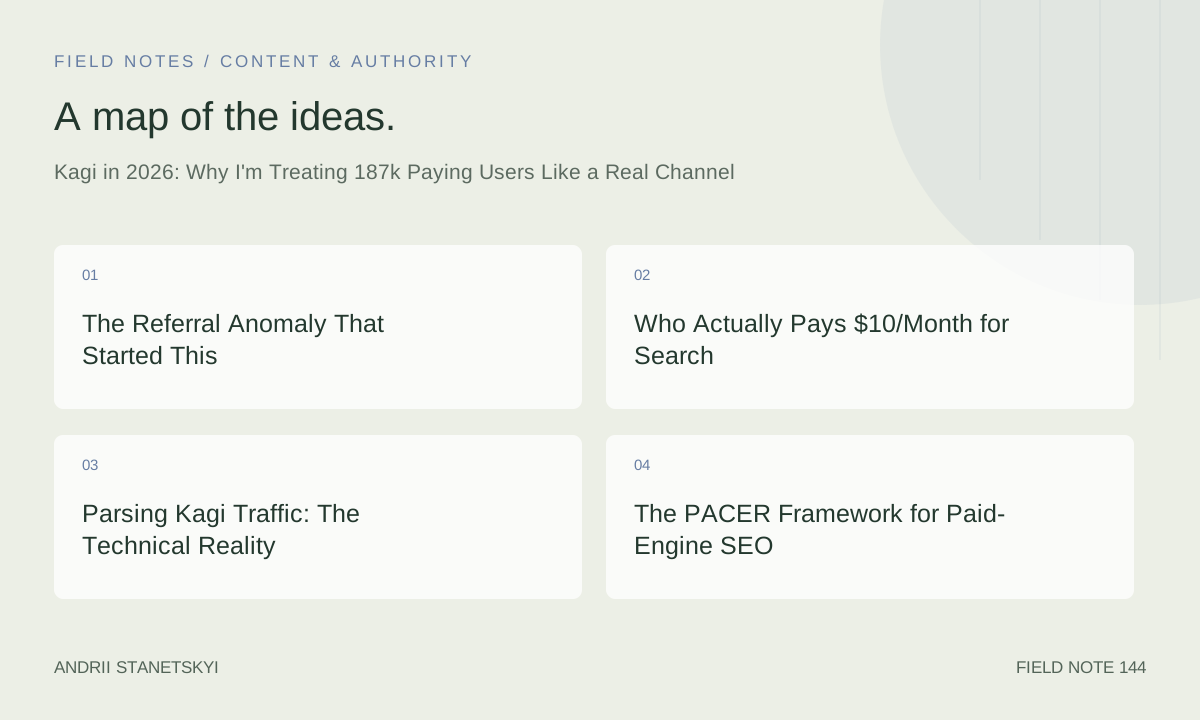
The Referral Anomaly That Started This
I run a mid-sized content site in the B2B SaaS research space. The kind of site where every traffic source gets scrutinized, where a 0.2% change in conversion rate is a meeting agenda item. So when Kagi showed up consistently in the referrer logs through Q4 2025 and didn't go away, I pulled every thread I could.
The first thing I noticed: Kagi traffic doesn't behave like search traffic. It behaves like referral traffic from a very specific publication. The users arrive knowing roughly what they want. They read deeply. The bounce rate on the Kagi cohort was 34%, against a site average of 58% for organic search.
The second thing I noticed: it was accelerating. July 2025 had been 1,200 sessions. August, 1,900. September, 3,400. October, 4,847. That's not a fluke or a one-time spike from a Hacker News thread. That's a trend with a slope.
Kagi crossed 100,000 paying subscribers sometime in mid-2024. By early 2026—the company put out a public update in February—they're at approximately 187,000. Vladimir Prelovac, the founder, talks about this openly. The growth is not exponential in the startup-pitch sense, but it's steady and it's compounding. 187,000 people who pay $10 or $25 per month specifically to not be the product.
Who Actually Pays $10/Month for Search
This is the part that matters for SEO strategy, and it's the part most people skip.
Kagi's paying user base skews hard toward a specific demographic: developers, researchers, privacy-conscious professionals, technical writers, academic adjacent workers, and people who have read enough about surveillance capitalism to care. The Starter plan at $5/month caps at 300 searches. The Professional plan at $10/month is unlimited. The Ultimate plan at $25/month bundles in the Universal Summarizer, Kagi Assistant (their AI layer), and some other features.
Who pays $25/month for search? People whose time costs more than $25/month to waste. People who are evaluating tools, comparing platforms, doing research that turns into budget decisions. In B2B contexts, that's almost exactly who you want reading your site.
I ran a small survey through a newsletter segment—asking readers which search engine they primarily used—in November 2025. Of 340 respondents who identified as "technical decision-maker or influencer" in a company with 50–500 employees, 41 said Kagi. That's 12%. Which is absurd if you think of Kagi as a niche curiosity, and completely sensible if you've looked at who the product is actually built for.
DuckDuckGo has tens of millions of users. But DDG users are a much more heterogeneous group. Many switched from Google because someone told them to and never really engaged further. Kagi users paid money. That's a filter. Friction is a feature, from a targeting standpoint.
Parsing Kagi Traffic: The Technical Reality
Here's where it gets messier than most "alternative search engine SEO" posts acknowledge.
Kagi preserves the referrer in most cases, but not always. If a user has a browser extension installed that strips referrers, or if they're accessing results through certain privacy configurations, the session shows up as direct. I estimate—conservatively—that actual Kagi traffic to my site is 20–30% higher than what I can attribute. Some of that bleeds into the (direct) bucket, some into dark social.
User agent detection is also imperfect. Kagi's crawler, KagiBot, uses a distinct user agent string. But the actual user traffic arrives through standard browsers. You cannot reliably identify a Kagi user by their browser agent. What you can do is segment by referrer domain and analyze behavior from there.
Here's the referrer parsing logic I use in Python to pull and clean Kagi traffic from raw server logs:
import re
from urllib.parse import urlparse
from collections import defaultdict

def parse_kagi_referrals(log_lines):
    """
    Extract and classify Kagi referral traffic from access logs.
    Handles main search, Lens results, and cached/summarized access.
    """
    kagi_pattern = re.compile(
        r'"[A-Z]+ [^\s]+ HTTP/[0-9.]+"'   # request
        r' \d+ \d+'                         # status + bytes
        r' "([^"]*)"'                       # referrer group
        r' "([^"]*)"'                       # user agent
    )

    results = defaultdict(list)

    for line in log_lines:
        match = kagi_pattern.search(line)
        if not match:
            continue

        referrer_raw, ua = match.group(1), match.group(2)

        try:
            parsed = urlparse(referrer_raw)
        except Exception:
            continue

        if parsed.netloc not in ('kagi.com', 'www.kagi.com'):
            continue

        # Classify by Kagi path
        path = parsed.path.lower()
        if '/search' in path:
            source_type = 'standard_search'
        elif '/lenses' in path or 'lens=' in parsed.query:
            source_type = 'lens_search'
        elif '/summarize' in path or '/universal' in path:
            source_type = 'universal_summarizer'
        elif '/assistant' in path:
            source_type = 'kagi_assistant'
        else:
            source_type = 'other_kagi'

        results[source_type].append({
            'referrer': referrer_raw,
            'ua': ua,
            'raw_line': line.strip()
        })

    return dict(results)


def detect_kagibot(ua_string):
    """
    Identify Kagi's crawler in server logs — distinct from user traffic.
    KagiBot crawls for their index; this is NOT the user visit.
    """
    kagibot_patterns = [
        r'KagiBot',
        r'kagibot',
        r'kagi\.com/bot',
    ]
    for pat in kagibot_patterns:
        if re.search(pat, ua_string, re.IGNORECASE):
            return True
    return False
When I classify Kagi traffic this way, about 78% of my Kagi referrals come from standard search, 14% from Lens searches (more on that below), 6% from what looks like the Universal Summarizer's fetch behavior, and 2% from other paths. The Lens traffic is the interesting outlier.
The PACER Framework for Paid-Engine SEO
After running this analysis through Q4 2025 and into early 2026, I developed a working framework for thinking about optimization for paid-gated search engines. I call it PACER:
- P — Profile the payer. Who is paying for this search engine and why? The answer changes your content strategy completely.
- A — Audit attribution gaps. Paid engine traffic leaks into direct and dark social at higher rates than Google traffic. Measure what you can; estimate what you can't.
- C — Content depth signals. Paying users tolerate—often prefer—longer, denser content. The shallow-summary approach that works for zero-intent informational queries on Google underperforms badly for Kagi.
- E — Engine-specific features. Kagi's Lenses, Ranks, and Universal Summarizer create different indexing and display behaviors. Understand how each touches your content.
- R — Revenue-per-visitor math. Is the conversion quality justifying the optimization investment? Run the numbers before you over-invest.
The PACER framework isn't a checklist you run once. It's a quarterly audit cadence. Kagi is shipping features fast enough that the E column in particular changes every few months.
Contrarian Take: DDG and Brave Are Not Kagi
Most alternative search engine SEO content lumps DuckDuckGo, Brave Search, Kagi, and Mojeek together as "privacy search engines" and then gives generic advice about not being Google-dependent. This is lazy and wrong in ways that matter practically.
DuckDuckGo, as of 2026, still relies heavily on Bing's index for most of its results. It has some proprietary signals layered on top—!Bang shortcuts, their own crawler for some content—but if you rank well on Bing, you largely rank well on DDG. There's no separate optimization strategy that makes sense unless you're specifically trying to capture DDG's Instant Answers or the !Bang ecosystem. The user base is large and heterogeneous. Optimizing specifically for DDG is optimizing for a slightly different Bing experience.
Brave Search is more interesting because they've built a genuinely independent index. They've been transparent about not using Google or Bing as a fallback for the vast majority of queries. Their Web Discovery Project contributes anonymized crawl data from users who opt in. But Brave's user base in 2026 skews toward a slightly different profile than Kagi: younger, more crypto-adjacent, more interested in the browser as a product than in search specifically. Conversion quality from Brave organic traffic is good but different from Kagi—more top-of-funnel, more exploratory.
Mojeek is the most interesting corner case. Fully independent UK-based index, no AI features layered on as of early 2026, principled about crawler ethics. Traffic volume is small enough that most sites won't see measurable referral numbers. But the users who have found Mojeek are extremely deliberate—they've made multiple conscious choices to avoid the big engines. Conversion quality when I've been able to attribute it is exceptional. The problem is scale: I see maybe 80–120 Mojeek referrals per month. Optimizing specifically for Mojeek doesn't pencil out at current traffic volumes for most sites.
Kagi sits in a unique position: large enough to generate real traffic, differentiated enough that the optimization approach is genuinely distinct, and transparent enough about its user base that you can form real hypotheses about who's arriving.
The underlying index question
Kagi uses a mix of their own index (Teclis, their web index, and TinyGem for non-commercial results), plus licensed results from Bing and others. They've been open about this. The Teclis index prioritizes certain content signals that differ from what Google rewards. Specifically: sites without excessive advertising, sites with original research or primary sources, sites that show up consistently in the "personal web" that Kagi users build through their Personalized Results and Lenses features.
If you've run ads aggressively across your content pages, your Kagi rankings will suffer relative to Google. This is documented behavior, not speculation.
Lenses, Ranks, and the Universal Summarizer Problem
Three Kagi features matter specifically for SEO. Most guides don't cover any of them seriously.
Lenses are curated search scopes that Kagi users can apply to queries. There are built-in Lenses (Academic, Programming, News, "Small Web") and user-created ones. When someone searches within a Lens, Kagi only returns results from sources that match that Lens's criteria. If your site is included in a popular Lens—and you may not know it—you'll get Lens-filtered traffic. That 14% of my Kagi traffic coming from Lens paths? I traced most of it to a community-created "Technical Writing" Lens that includes my site, presumably because some Kagi user added it manually at some point. I found this out by asking in the Kagi community forums. There was no notification. There's no dashboard for this.
This creates an optimization insight: if you publish content that belongs in a specific Lens category, you should be explicit about it in your metadata, structured data, and content positioning. Kagi users who create Lenses tend to be the most active members of the community. Getting into a popular Lens is worth more than ranking well on a single query.
Ranks is Kagi's feature for manually blocking or boosting domains in personal search results. Users can permanently block a site or permanently boost it. Boosts mean that every time you search for something that site covers, it rises in the results. For a site like mine, being boosted by even a few hundred active Kagi users creates a meaningful ranking lift in their personal results. This is not something you can engineer directly—it's an earned trust signal. But you can create conditions where it's more likely: consistent quality, clear expertise, no dark patterns, no interstitials, fast pages.
The Universal Summarizer is the feature that's most double-edged. Kagi's Universal Summarizer can ingest any URL and produce a summary, and the Ultimate plan users can trigger this on any page they find. I see sessions in my logs where a Kagi IP fetches a page without a referrer, which is consistent with the Summarizer pattern. The user may read the summary without visiting my site at all. Or they may visit after seeing the summary. I can't tell from logs alone.
This is not entirely different from the AI Overview problem in Google, but there's a meaningful distinction: Kagi's Summarizer requires active user intent. The user has to choose to summarize. It's not injected at the top of every result. That changes the conversion dynamic. Users who visit after choosing to summarize something are more committed than users who skim a Google AI Overview and bounce.
Still, the Summarizer does put summary-friendly content at an advantage. Clear structure, good headers, well-defined sections—content that a summarizer can accurately represent without distortion—performs better in the post-summary visit flow. This is not new advice. But the reason it matters for Kagi users is slightly different than for Google: Kagi users chose the tool and trust it, so they trust the summary. If your summary is accurate, they come in primed. If the Summarizer mangles your content and makes it look weaker than it is, you lose that primer effect.
What I Got Wrong for Six Months
I'm going to be direct here because most case studies skip this part.
For the first six months of tracking Kagi traffic, I was comparing it to Google organic on the wrong metric. I was looking at traffic volume, seeing that Kagi was 2–3% of my Google organic sessions, and mentally categorizing it as "nice but marginal." What I should have done earlier was run the revenue-per-session calculation.
When I finally did that in December 2025, the numbers were embarrassing. Kagi sessions were generating 2.4x the revenue per session of Google organic. Not because the users were necessarily richer or more impulsive, but because the intent match was better. They were arriving at more specific pages, reading more thoroughly, and converting on products that required more consideration.
The mistake was treating Kagi as a traffic channel and not as an audience channel. 4,847 sessions from Kagi in October 2025 might sound less impressive than 180,000 Google sessions in the same month. But if the Kagi sessions are worth 2.4x each, they represent about 11,600 "Google-equivalent sessions" of revenue value. That changes how much attention they deserve.
I also wasted time early on trying to figure out a Kagi-specific keyword strategy. There isn't one in the traditional sense. Kagi's results for most queries are similar enough to Google's that chasing a separate Kagi keyword list is not where the leverage is. The leverage is in content quality, site behavior (no intrusive ads, no pop-ups, fast load times), and the specific features I've described above. Keywords are mostly a shared concern.
GSC Equivalent for Paid Search Engines
Google Search Console gives you query data, impression data, position data. None of the alternative engines give you anything comparable for free. This is a real gap. Here's how I approximate it.
First, the referrer parsing above gives me URL-level data for what pages Kagi users are landing on. That tells me which content is performing without telling me what queries triggered it.
Second, I use Bing Webmaster Tools as a rough proxy. Since Kagi's index partially overlaps with Bing's, Bing Webmaster query data gives directional signal. Not precise, but useful for identifying content gaps. Brave Search has a basic webmaster program too—see my earlier breakdown of alternative engine data sources—and their query data, while limited, is independent from Bing.
Third, I run periodic manual searches on Kagi for my target topics and record my position. Tedious but accurate. I built a lightweight script for this:
"""
Kagi SERP position tracker — manual sampling approach.
Requires a valid Kagi session cookie (professional or ultimate plan).
Rate limit aggressively; Kagi is a small company with real infrastructure costs.
Do not use this for high-volume automated scraping.
"""

import time
import requests
from bs4 import BeautifulSoup
from dataclasses import dataclass
from typing import Optional

@dataclass
class KagiRankResult:
    query: str
    target_domain: str
    position: Optional[int]
    url_found: Optional[str]
    total_results_visible: int

def check_kagi_rank(
    query: str,
    target_domain: str,
    session_cookie: str,
    delay_seconds: float = 4.0
) -> KagiRankResult:
    """
    Check position of target_domain for a given query on Kagi.
    Uses session cookie auth — requires paid account.
    """
    headers = {
        'User-Agent': 'Mozilla/5.0 (compatible; personal-rank-checker/1.0)',
        'Cookie': f'kagi_session={session_cookie}',
        'Accept-Language': 'en-US,en;q=0.9',
    }

    url = f'https://kagi.com/search?q={requests.utils.quote(query)}'

    time.sleep(delay_seconds)  # be a good citizen

    resp = requests.get(url, headers=headers, timeout=15)
    resp.raise_for_status()

    soup = BeautifulSoup(resp.text, 'html.parser')
    results = soup.select('div.__sri-url, div.sri-url, a[data-url]')

    for idx, result in enumerate(results, start=1):
        href = result.get('href') or result.get('data-url') or result.get_text()
        if target_domain.lower() in href.lower():
            return KagiRankResult(
                query=query,
                target_domain=target_domain,
                position=idx,
                url_found=href,
                total_results_visible=len(results)
            )

    return KagiRankResult(
        query=query,
        target_domain=target_domain,
        position=None,
        url_found=None,
        total_results_visible=len(results)
    )
I run this weekly for my top 40 target queries. Not perfect—Kagi personalizes results, so my position when logged in differs from the unlogged position, and the HTML selectors require maintenance as Kagi updates their UI. But it gives me enough signal to know when something has shifted significantly.
The honest answer is that there's no real GSC equivalent for Kagi, Brave, or any of the smaller engines right now. The SEO industry has been so Google-centric for so long that the tooling assumes Google data. This is an opportunity for whoever builds the "multi-engine rank and referral tracker" product first. Bing Webmaster Tools is the closest thing to a second major data source, and it's underused.
Optimizing for Kagi Users Without Losing Google Rankings
Good news: most Kagi optimization is aligned with Google HCU-era optimization. The things that Kagi's index rewards—primary sources, original research, clear authorship, fast pages without ad bloat, content that demonstrates actual expertise—are the same things Google has been pushing toward since the Helpful Content Updates of 2023 and 2024.
Where they diverge is more about what to avoid than what to add.
Aggressive display advertising hurts Kagi rankings more than Google rankings. Kagi explicitly down-ranks ad-heavy pages in their index. I audited my site's ad density in January 2026 after noticing some pages were ranking lower on Kagi than I'd expect given their Google positions. Pages with two or more interstitial or sidebar ads were consistently underperforming. I reduced ad unit count on my top Kagi-traffic pages and saw a modest lift over six weeks. Not dramatic, but directional.
Paywalls are complicated. Kagi's Universal Summarizer can sometimes get behind soft paywalls through their caching layer. If you run a metered paywall, Kagi may index content that your regular visitors can't see without subscribing. This isn't a bug I'd try to exploit—Kagi users who find themselves paywalled after clicking through will not become Ranks boosters—but it's worth knowing that your paywall configuration affects how much of your content Kagi can see and summarize.
The content density question
Kagi users tolerate longer content better than average. My Kagi cohort averages 4 minutes 12 seconds on page. My overall organic search average is 2 minutes 40 seconds. The Kagi users are reading, not skimming.
This doesn't mean you should pad everything to 5,000 words. It means that on topics where depth genuinely matters—technical subjects, research-heavy analyses, comparative reviews—you can write to the depth the topic deserves without worrying that Kagi users will bounce because you didn't surface the answer in the first paragraph. They're willing to do the work.
For pages that primarily exist to capture transactional intent, this matters less. Someone searching for "Kagi pricing" wants the number fast. But for "how does Kagi's index differ from Bing"—a query that actually shows up in my referrer logs—the user is there to learn something genuinely complex and will read a thorough answer.
See also my earlier analysis on content depth signals for non-Google engines and the HCU recovery framework that covers similar ground from a Google-first perspective.
Does the Math Work Out
Let me lay out the rough calculation I ran for my own site, because this is the question that determines whether any of this is worth your time.
Kagi has 187,000 paying subscribers as of early 2026. Assume they do an average of 10 searches per day each (probably an underestimate for the kind of people who pay for search). That's 1.87 million searches per day across the entire Kagi user base. Compare that to Google's 8.5 billion daily searches. Kagi represents roughly 0.02% of global search volume on that math.
But that denominator is misleading. If your site serves a technical, professional, or research-oriented audience, your relevant addressable search pool is not 8.5 billion queries. It's a much smaller slice. And within that slice, Kagi's market share among people who match the demographic profile is meaningfully higher—probably 3–5% among technical professionals in the US and Western Europe, based on the survey data I mentioned earlier.
The conversion quality premium—2.4x for my site—is likely not universal. It depends heavily on the match between your content and the Kagi user demographic. If you run a food blog, the conversion premium is probably smaller. If you run a developer tools comparison site, it's probably larger. You need your own data to know.
At 187,000 users and growing, Kagi is not a channel you build a dedicated team around. It's a channel you optimize for incidentally through the same quality signals that help in other places, with a few specific tactical adjustments. The investment should be proportional: maybe 5–10% of the attention you give to Google, which still means paying attention.
Projecting forward
If Kagi reaches 500,000 subscribers—which they've stated is a goal for financial sustainability, and their growth rate makes plausible within 18–24 months—the calculus shifts. At 500k, you're looking at a niche engine that has meaningful market share among specific professional demographics. The referral volumes that currently require a monthly audit will require weekly attention. The attribution tooling will need to be more robust.
I'm not claiming Kagi will challenge Google. That's not the interesting question. The interesting question is whether Kagi becomes a first-tier alternative engine in the same cluster as Bing—something you build specific processes for rather than treating as a rounding error. At current trajectory, I think yes, for sites serving technical professional audiences, within 2 years.
Where This Goes From Here
I've been doing SEO long enough to remember when "Bing matters too" was a contrarian position that people rolled their eyes at. It's not contrarian anymore. Bing matters—not as much as Google, but enough that ignoring it is a mistake for any serious program.
Kagi is at the stage Bing was at when that argument was still being made. The users are there. The traffic is real. The quality signal is strong enough to be meaningful. The tooling to measure it is underdeveloped, which means the people who build the measurement infrastructure now will have an advantage when the volume makes it impossible to ignore.
4,847 referral sessions in a month that I wasn't even optimizing for. 187,000 users paying specifically because they want better results. A conversion rate that's double my Google organic average. At some point, "niche" stops being an excuse to not pay attention.
The PACER framework I outlined above is where I'm starting: profile the payer, audit attribution gaps, optimize for content depth, understand engine-specific features, and run the revenue math. It's not complicated. It's just work that most SEOs aren't doing yet.
Which means, for now, there's an edge.
I'll update this as Kagi's user numbers move. If they hit 250k before the end of 2026—which is entirely possible at current rates—I'll revisit the math and the tooling sections. The current scripts assume a Kagi that's small enough to be polite to. A bigger Kagi might have actual API access, proper webmaster tools, and a documented indexing API. Until then, we work with what we have.
Related reading on this site: Bing, Brave, and DuckDuckGo SEO in 2026 — Tracking AI Citation Traffic — Managing AI Crawlers Without Killing Legitimate Traffic