Most editorial calendars are built backwards. A content lead identifies "trending topics," gets stakeholder buy-in on themes that sound strategically important, assigns articles to writers, and publishes on a schedule optimized for consistency rather than demand timing. The result is a content program that produces consistently but competes for keywords opportunistically — sometimes getting lucky, often wasting production capacity on content that will never rank because the timing, volume, or competitive difficulty was never validated before a word was written.
The alternative is building an editorial calendar from search demand data outward. This guide covers the methodology, the tooling, and the operational systems that turn keyword research into a publishing schedule that compounds rather than exhausts.
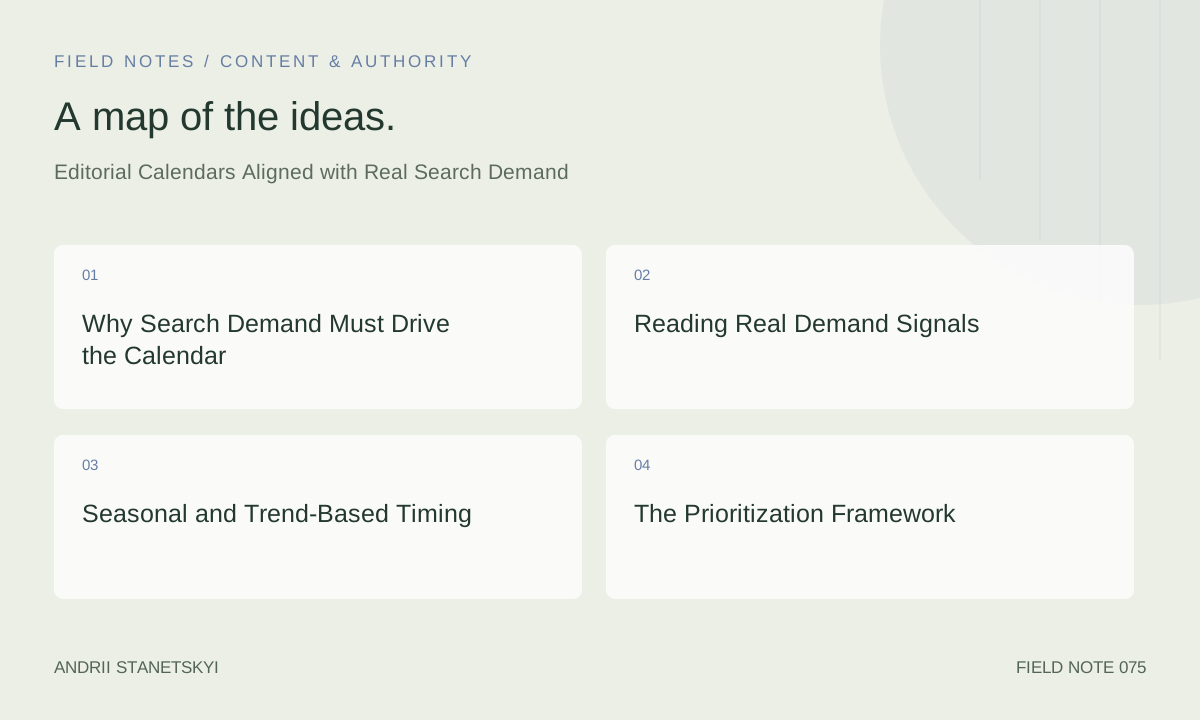
Why Search Demand Must Drive the Calendar
Content without demand is an expensive hobby. A site that publishes 50 articles per month on topics its audience "should" care about is guessing. A site that publishes 20 articles per month on topics validated to have 500–50,000 monthly searches, low-to-moderate keyword difficulty, and identifiable search intent is executing a strategy. The difference in organic traffic outcomes over 24 months is typically 3–8×.
The counterargument — "some of our best content covered topics before they became search terms" — is real but rare. Thought leadership that generates demand where none existed is high-risk, low-predictability content strategy. For most B2B and B2C publishers, the reliable path to compounding organic growth is aligning production with demonstrable demand and winning positions before competitors do. Thought leadership is a complement to SEO-driven editorial calendars, not a replacement.
The honest framing: an SEO-driven editorial calendar is not about creating keyword-stuffed content. It is about directing production capacity toward opportunities where your audience is already searching and your site can realistically rank. The content is still expert, still opinionated, still on-brand — it just targets a keyword that real people type, at a difficulty level you can compete at, published at the time when demand peaks.
Reading Real Demand Signals
Google Search Console: The Ground Truth
GSC's Performance report is your most reliable demand signal because it shows actual search activity for your domain and adjacent queries. Use the Queries tab filtered to your top 50–100 impression-generating terms. Look for:
- High-impression, low-CTR queries (positions 11–20): you have partial relevance for this demand — a stronger article could capture it.
- Queries you rank for that you did not target: opportunistic coverage gaps hiding in your existing content.
- Query clusters around topics you have not addressed: audience signals for net-new articles.
Ahrefs Keyword Explorer: Volume and Difficulty Validation
For every content idea generated from any source — team brainstorm, competitor analysis, GSC discovery — validate it in Ahrefs before it enters the calendar. Required data points:
- Monthly search volume (global and country-specific)
- Keyword Difficulty (KD) score
- Traffic Potential (the sum of traffic the top-ranking page gets for all keywords it ranks for — often 3–5× the head term volume)
- Parent Topic (to confirm you are targeting the right canonical keyword, not a variant)
Semrush Keyword Magic Tool: Gap Discovery
Enter competitor domains into Semrush's Organic Research and export their top keywords by traffic value. Filter out branded terms and keywords you already rank for (use the Keyword Gap tool). The remaining keywords are your opportunity set — demand your competitors are capturing that you are not.
Google Trends: Seasonality and Velocity
Ahrefs and Semrush show average monthly volume, which masks seasonal patterns. A keyword with "1,000 monthly searches" might spike to 8,000 in January and drop to 200 in August. Google Trends shows this curve. For calendar planning, you need to know: when does demand peak, and how far in advance do you need to publish to rank by that peak?
# Python: Pull Google Trends data for seasonal timing
from pytrends.request import TrendReq
import pandas as pd

pytrends = TrendReq(hl='en-US', tz=360)
keywords = ["tax preparation software", "tax filing tips", "estimated tax payments"]
pytrends.build_payload(keywords, timeframe='today 5-y', geo='US')

df = pytrends.interest_over_time()
df = df.drop(columns=["isPartial"])

# Find peak months for each keyword
for kw in keywords:
    peak_month = df[kw].idxmax()
    print(f"{kw}: peak at {peak_month.strftime('%B %Y')}")
Seasonal and Trend-Based Timing
Publishing timing matters because Google needs time to crawl, index, and rank your content. A page published on December 1st targeting "Christmas gift ideas" has approximately zero chance of competing for the December peak. A page published in mid-September, given 10–12 weeks to build impressions and accumulate behavioral signals, has a realistic chance of competing by peak demand in late November.
The Indexing Lag Model
For established sites (DR 50+, regular crawl frequency), new content typically appears in the index within 1–7 days of publication. Ranking competitively for any keyword with KD above 20 typically requires 4–16 weeks of accumulated engagement signals, link equity, and crawl history. Plan your publishing schedule with this lag in mind:
| Keyword Difficulty (Ahrefs) | Minimum Lead Time Before Peak Demand | Recommended Lead Time |
|---|---|---|
| 0–20 (Low) | 2–4 weeks | 4–6 weeks |
| 21–40 (Moderate) | 6–10 weeks | 10–14 weeks |
| 41–60 (Hard) | 12–18 weeks | 20–26 weeks |
| 61–80 (Very Hard) | 6+ months | 12+ months with link building |
| 81–100 (Ultra Competitive) | 18+ months | Only with DR 60+ and active link building |
Trend Capture: Identifying Rising Searches Early
For trend-based content (emerging topics, new regulations, recently launched products), speed matters more than seasonal timing. Monitor Google Trends "Rising" queries in your category weekly. Semrush's Keyword Magic Tool's "Trending" filter surfaces keywords with rapidly increasing volume. Publishing first on a rising topic — even at lower quality than you would achieve with two more weeks — can lock in a top-3 position before demand peaks and before larger competitors respond.
The Prioritization Framework
Every keyword opportunity entering your calendar should be scored. Here is a practical scoring model:
/* Keyword Prioritization Scoring Formula (Sheets) */
/* Score = (Volume_Score * 0.35) + (Difficulty_Score * 0.30) + (Business_Value * 0.25) + (Timing_Score * 0.10) */

/* Volume Score (1-5): */
/* =IF(B2>=10000,5, IF(B2>=5000,4, IF(B2>=1000,3, IF(B2>=500,2, IF(B2>=100,1,0))))) */

/* Difficulty Score (1-5, inverse of KD): */
/* =IF(C2<=20,5, IF(C2<=40,4, IF(C2<=60,3, IF(C2<=75,2, IF(C2<=90,1,0))))) */

/* Business Value (1-5, manual input): */
/* High: directly related to product/service (5) */
/* Medium: related to buyer journey (3) */
/* Low: awareness only, distant from conversion (1) */

/* Timing Score (1-5): */
/* 5 = peak demand in 8-16 weeks */
/* 3 = peak demand in 4-8 weeks or 16-24 weeks */
/* 1 = peak demand >24 weeks or already passed */

=ROUND((IF(B2>=10000,5,IF(B2>=5000,4,IF(B2>=1000,3,IF(B2>=500,2,IF(B2>=100,1,0)))))*0.35 +
IF(C2<=20,5,IF(C2<=40,4,IF(C2<=60,3,IF(C2<=75,2,1))))*0.30 +
D2*0.25 + E2*0.10),1)
Score all keyword opportunities monthly. The top 20 by score become next month's production queue. Lower-scoring opportunities wait in the backlog. This eliminates subjective editorial arguments about what to publish next — the data ranks the queue.
Building the Calendar: Operational System
The Monthly Demand Pull
The first week of each month, run the following process:
- Export GSC Performance data (last 28 days vs. prior 28 days). Flag any new high-impression queries not in the keyword backlog — add them.
- Run Ahrefs Content Gap against the top three competitors using their current top-100 organic keywords. Add any gap keywords not already in the backlog.
- Check Google Trends for rising queries in your category. Add candidates with clear upward trajectory.
- Score all backlog items using the prioritization formula. Sort descending.
- Select the top N items (where N = your team's monthly production capacity). These are committed to the calendar.
Calendar Structure
A demand-driven editorial calendar contains, for each scheduled article:
- Primary keyword + secondary keywords (from Ahrefs Traffic Potential clustering)
- Monthly search volume + KD score
- Target publish date (accounting for indexing lag before peak demand)
- Assigned writer and SME reviewer
- Content format (guide, comparison, listicle, case study, tool page)
- Competing URLs to beat (top 3 current ranking pages)
- Hub assignment (which content hub does this spoke belong to?)
- Priority score
See: Content Hubs — Architecting Pages for Topic Authority for hub assignment logic
Matching Capacity to Opportunity
A common failure mode: the keyword backlog has 200 high-priority opportunities but the team can produce 8 articles per month. This creates decision fatigue and a false sense that any individual article choice is inconsequential because there are always 199 others. The discipline is in deliberately matching your capacity to your highest-value opportunities, month after month, without scope creep.
Capacity planning inputs: how many articles can each writer produce at the quality standard required (not the maximum quantity they can output)? Factor in: research time (often 2–4 hours per article), SERP analysis, brief creation, drafting, SME review, NLP optimization, and publishing. A realistic high-quality article production estimate for an experienced content writer with SEO training is 3–5 articles per month at 1,500–3,000 words each. Pressure to produce more typically reduces quality below the threshold that earns rankings.
Case Study: E-Commerce Content Calendar Redesign
An e-commerce retailer in the home goods category was publishing 24 articles per month with minimal keyword research — topics were chosen by the marketing director based on "what's on trend." After 18 months of publishing, organic traffic was growing at 2–3% per month, well below industry growth rates.
The SEO team conducted a full audit: 62% of published articles had fewer than 100 monthly impressions in GSC. 78% of published articles targeted keywords with insufficient demand to justify production costs. The team presented a proposal to reduce publishing frequency from 24 to 12 articles per month while implementing the demand-driven calendar framework described above.
Results after six months: The 12-article months consistently outperformed the prior 24-article months on every organic metric. Average monthly organic sessions grew from 34,000 to 67,000 over six months. Content production cost was halved. The strategic shift — fewer articles, validated demand, proper lead time before peak seasons — doubled the outcome at half the cost.
Related: Content Decay — How to Identify and Refresh Dying Pages
Templates and Tools
Editorial Calendar Template Fields
| Field               | Example                              |
|---------------------|--------------------------------------|
| Article Title       | Best Stand Mixers for Home Baking    |
| Primary Keyword     | best stand mixer                     |
| Monthly Volume      | 22,000                               |
| KD (Ahrefs)         | 48                                   |
| Traffic Potential   | 67,000                               |
| Priority Score      | 3.9                                  |
| Target Publish Date | 2026-08-15                           |
| Peak Demand Month   | November (Thanksgiving/holiday baking)|
| Assigned Writer     | Sarah K.                             |
| SME Reviewer        | Chef Consultant                      |
| Content Format      | Listicle with comparison table       |
| Hub Assignment      | Kitchen Appliances Hub (Pillar Spoke) |
| Competing URLs      | NYT Wirecutter, Good Housekeeping    |
| Status              | In Brief                             |
FAQ
How far in advance should an editorial calendar be planned?
Plan in rolling 90-day windows with a committed 30-day queue and a softer 60–90-day pipeline. Longer planning horizons (6–12 months) become unreliable because search demand shifts, competitor landscapes change, and algorithmic updates alter priorities. Monthly demand pulls keep the backlog current without forcing the team to plan into uncertainty.
How do I handle stakeholder requests for content that does not have search demand?
Separate your content budget into two buckets: SEO-driven (70–80% of production capacity, governed by the demand-driven calendar) and brand/thought leadership (20–30%, at the team's discretion). Stakeholder requests that fail keyword validation go into the brand bucket. This gives stakeholders a path for their ideas without corrupting the SEO-driven calendar's discipline. Present the two buckets transparently — it is easier to protect the SEO budget when you have a visible alternative for non-SEO content.
Should every article in the calendar target a specific keyword?
Every article should be validated against keyword demand, but not every article targets a single keyword. Topic clusters with multiple related terms (all below the volume threshold individually) may combine into one article targeting the cluster's parent topic. Use Ahrefs Traffic Potential to evaluate the combined opportunity, not just the head term volume.
How do I account for algorithm updates in calendar planning?
You cannot predict algorithm updates, but you can make your calendar more resilient to them: prioritize content that demonstrates E-E-A-T (which consistently performs well after updates), avoid over-indexing on a single category (topic diversity distributes algorithmic risk), and build monthly slack into your calendar (2–3 articles per month that can pivot to refresh existing content if a core update hits).
What is the right publishing frequency for a new site?
For a new site (DR under 20), publishing frequency is less important than content quality and internal link architecture. Eight to twelve excellent, well-linked articles that establish a coherent topic cluster will outperform 40 isolated articles. Build a hub first; scale frequency only after the hub demonstrates traction (5+ articles ranking in top 20). Frequency without authority is noise.
How do I measure editorial calendar effectiveness?
Track three metrics per published article at 90 and 180 days: (1) GSC average position for the target keyword, (2) organic clicks per month, and (3) organic-attributed conversions. Calculate an average "return on content" across all articles published in a given month to identify whether your prioritization model is actually selecting high-performing opportunities. Feed those results back into your scoring model to recalibrate weights quarterly.
Key Takeaways
- Editorial calendars built from brainstorms and brand themes consistently underperform calendars built from search demand data.
- The monthly demand pull — GSC analysis, Ahrefs Content Gap, Google Trends monitoring — keeps the keyword backlog current and prioritized.
- Account for indexing lag in your publishing schedule: for KD 40–60 keywords, publish 10–14 weeks before peak demand.
- Score every keyword opportunity with a weighted formula covering volume, difficulty, business value, and timing before it enters the production queue.
- Fewer, higher-quality articles targeting validated demand consistently outperforms more frequent publishing without demand validation.
- Separate SEO-driven content (70–80% of capacity) from brand/thought leadership (20–30%) to protect the discipline of demand-driven planning from stakeholder scope creep.
- Measure article performance at 90 and 180 days and feed results back into prioritization model calibration.
Conclusion
An editorial calendar is a resource allocation tool. Every article you publish represents a fixed cost in writer time, editorial review, and publishing overhead. A demand-driven calendar ensures that allocation is directed toward opportunities with validated upside rather than toward topics that feel strategically important but lack measurable audience demand. Build the process — monthly demand pull, scoring model, rolling 90-day planning window — and it becomes a compounding machine rather than a recurring argument about what to publish next.
Next: How to Conduct a Content Audit on a 10,000-Page Website