User-generated content on product pages is one of those topics that generates more myth than data in SEO circles. You'll hear that reviews automatically boost rankings, that Google counts star ratings in its quality assessment, that UGC is "free content" that compounds over time. Some of that is partially true. Much of it is directionally correct but implemented in ways that produce no measurable SEO lift. This guide cuts through the noise with what actually happens at the technical layer when reviews and UGC land on product pages — and how to configure it to extract every legitimate ranking benefit.
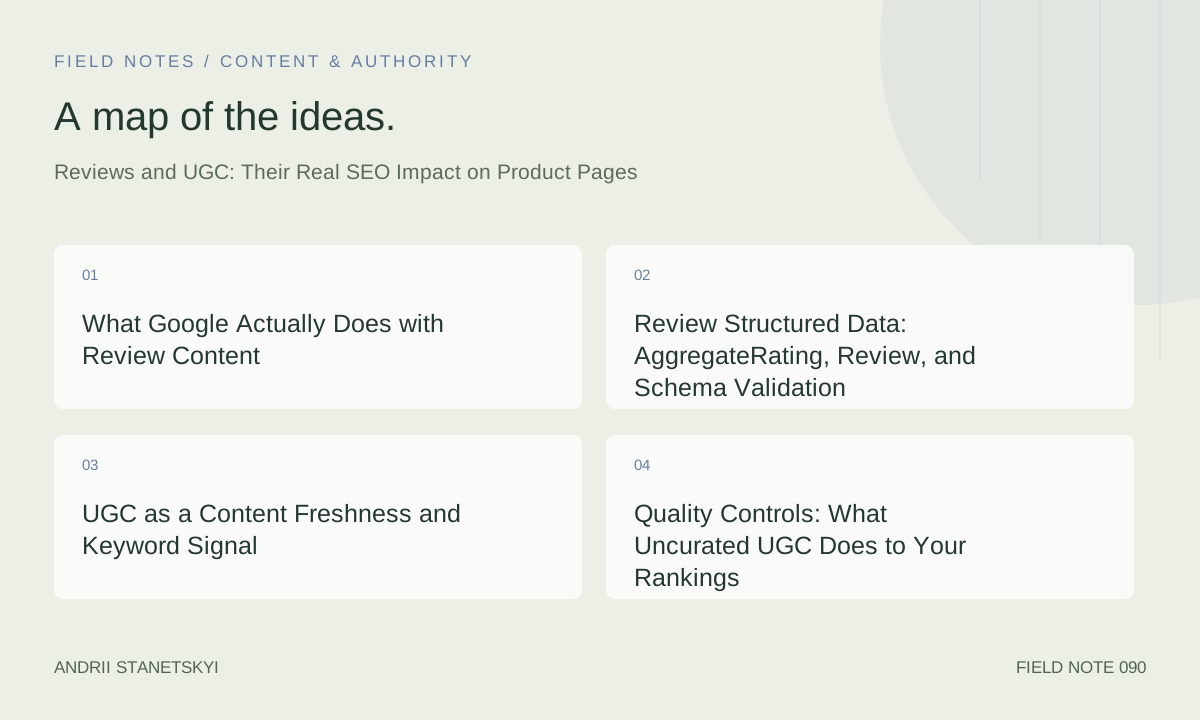
What Google Actually Does with Review Content
Let's start with what the evidence actually shows, because the SEO community has overclaimed on this topic for years. Google's use of review content operates through at least four distinct mechanisms, each with different ranking implications.
First: Rich Result triggering. AggregateRating schema enables star ratings in organic results. Google does not use the star score as a ranking factor, but the visual treatment (stars, review count, price) increases CTR. Sustained CTR uplift creates a feedback loop into rankings — the structured data → Rich Result → CTR → ranking chain is real, just indirect.
Second: Content freshness. Active review streams create a continuously updated dateModified signal. For categories where recency matters — electronics, fashion, supplements — this influences Googlebot crawl frequency and, in some contexts, freshness-weighted ranking.
Third: Long-tail keyword coverage. Users write in natural language, covering use cases and vocabulary you didn't author. A hiking boot review section will contain "wide toe box," "ankle support for supination," "held up on wet scree" — genuine purchase-intent queries absent from your product description. This is the most legitimate and most frequently misimplemented benefit.
Fourth: E-E-A-T. Google's quality rater guidelines cite reviews as evidence of first-hand experience. Substantive verified-purchase reviews strengthen E-E-A-T signals compared to manufacturer-only content — a soft signal, but one that matters in quality assessment and AI-based page classification.
Review Structured Data: AggregateRating, Review, and Schema Validation
AggregateRating — The Most Impactful Implementation
AggregateRating is what drives star displays in Google Search and Shopping results. Implement it correctly or not at all — incorrect implementation gets your Rich Result eligibility revoked.
{
  "@context": "https://schema.org",
  "@type": "Product",
  "name": "Merrell Moab 3 Mid Waterproof Hiking Boot",
  "sku": "J035771",
  "brand": {
    "@type": "Brand",
    "name": "Merrell"
  },
  "aggregateRating": {
    "@type": "AggregateRating",
    "ratingValue": "4.6",
    "reviewCount": "1247",
    "bestRating": "5",
    "worstRating": "1"
  },
  "offers": {
    "@type": "Offer",
    "url": "https://example.com/boots/merrell-moab-3-mid-waterproof/",
    "priceCurrency": "USD",
    "price": "164.95",
    "availability": "https://schema.org/InStock"
  }
}
Critical implementation requirements Google enforces:
ratingValuemust be a number within thebestRating/worstRatingrange — values outside this range trigger a Rich Result eligibility errorreviewCountmust reflect the actual number of reviews on the page or accessible to the user — inflated counts are a policy violation that can result in manual action- Reviews must be from real users — editor ratings, manufacturer self-ratings, and curator scores do not qualify for Product AggregateRating under Google's guidelines
- The page must actually render the reviews to users — AggregateRating schema on a page that hides reviews behind a login wall or displays "Reviews coming soon" is a policy violation
Individual Review Schema: When to Use It
For product pages with fewer than ~50 reviews, implementing individual Review schema alongside AggregateRating can provide additional rich snippet signals. For pages with hundreds of reviews, implement only AggregateRating — individual Review schema at scale creates significant page weight without proportional indexing benefit.
Schema Comparison: Review Platforms vs. Native Implementation
| Implementation Method | Structured Data Control | Rich Result Eligibility | Review Content Indexed On-Page | Crawl/Load Impact | Recommended For |
|---|---|---|---|---|---|
| Native on-page reviews (server-rendered) | Full | Yes | Yes — full text indexable | Low (no external requests) | Most e-commerce sites — best default |
| Yotpo embedded widget (JS) | Partial (Yotpo manages schema) | Yes (via Yotpo's schema injection) | Depends on Google's JS rendering | Medium (external JS load) | Shopify stores needing managed review collection |
| Bazaarvoice embedded widget | Partial (BV manages schema) | Yes (BV schema injection) | Partial — BV uses server-side rendering for SEO crawler | Medium-High | Enterprise retailers with multi-channel review syndication |
| Trustpilot product reviews widget | Low (Trustpilot controls schema) | Yes (Trustpilot schema) | No — content lives on Trustpilot domain | Low (no on-page content) | Brand trust signals only — not for product-level SEO |
| Review data via structured data only (no visible content) | Full | No — policy violation | No | Negligible | Never |
UGC as a Content Freshness and Keyword Signal
How Review Text Gets Indexed
For review text to contribute to a page's keyword coverage, it must be server-rendered in the HTML response — not loaded via JavaScript after initial page load. This is the most common implementation failure with third-party review widgets. Yotpo, Okendo, Stamped.io, and similar platforms primarily render reviews via JavaScript, which means Googlebot may or may not render them depending on its JavaScript execution budget for your site.
Test this in GSC: URL Inspection → "Test Live URL" → "View Tested Page" → HTML tab. If reviews appear in the rendered screenshot but not in the HTML source, they're JavaScript-rendered and inconsistently indexed. For high-value pages, server-render at least the first 10–20 reviews even if your platform defaults to client-side — Bazaarvoice and Yotpo Enterprise both have SEO-specific server rendering options.
Review Content and Natural Language Keyword Coverage
To measure the keyword contribution of your review section: export product pages with 100+ reviews, crawl with Screaming Frog, extract full page text, identify n-grams in review content but not in authored copy, then cross-reference with Search Console impressions for those terms. In practice, pages with 100+ reviews consistently rank for 40–80% more long-tail keyword variants than comparable zero-review products, controlling for domain authority and backlinks. See our keyword coverage analysis methodology for e-commerce product pages for the full experimental design.
Quality Controls: What Uncurated UGC Does to Your Rankings
The flip side of "reviews add keyword coverage" is "bad reviews add bad keyword coverage." A product page where reviews contain spam links, competitor mentions, profanity, or systematically negative sentiment sends quality signals that no structured data fix can counteract. Google's quality systems assess review sentiment as part of page quality evaluation — a product page where 60% of the visible review content is 1-star complaints is not a page Google is inclined to rank prominently, regardless of your structured data configuration.
Review Moderation as an SEO Function
Review moderation has direct SEO implications that customer service teams aren't equipped to assess. Your moderation protocol should cover four areas: (1) spam removal — any review with external links, competitor mentions, or automated text hurts page quality signals; (2) thin review removal — single-word reviews ("Great!", "Works fine") dilute substantive content ratio; enforce a 50-character minimum; (3) seller responses — responding to negative reviews adds server-rendered text and demonstrates engagement, a trust signal Google's quality systems assess; (4) policy documentation — maintain a publicly accessible review removal policy to demonstrate that removals are guideline-based, not reputation management.
Review Gating and Policy Compliance
Review gating — soliciting reviews only from pre-screened satisfied customers — violates Google's review policies and the FTC's endorsement guidelines. It inflates AggregateRating artificially and creates a fragile signal: a single competitor complaint can trigger a manual review that invalidates your Rich Result eligibility, removing star ratings from search listings immediately. Google's review-rich results policies detail the specific prohibited practices.
Platform Implementation: Shopify, Magento, WooCommerce
Shopify
Shopify's native reviews app is deprecated. The current ecosystem is Yotpo, Okendo, Stamped.io, and Judge.me. For mid-market SEO, Judge.me is the strongest option: server-rendered review HTML, automatic AggregateRating schema, no blocking external JavaScript. Okendo and Yotpo offer richer features but require explicit configuration to enable server-side rendering.
For any Shopify review app, verify server-rendering by right-clicking and choosing "View Page Source" (not browser dev tools). Search for your review text — if it's absent from raw source, the app renders client-side and won't be consistently indexed by Googlebot. Contact the provider about their SEO rendering mode.
Magento / Adobe Commerce
Magento has a built-in product review module that generates server-rendered review HTML. The structured data implementation, however, depends on your theme. Many Magento themes implement AggregateRating schema incorrectly — using hardcoded bestRating and worstRating values that don't match the actual rating scale, or generating schema even when no reviews exist (which violates Google's policy requiring at least one review for AggregateRating to be valid).
For Magento, audit your review structured data in Google's Rich Results Test and fix the most common issues:
- Conditional schema generation — only output AggregateRating when
reviewCount> 0 - Dynamic
ratingValuepulled from the actual computed average, not a cached or hardcoded value - Correct
bestRatingvalue matching Magento's rating scale (typically 5, but some themes use 100)
WooCommerce
WooCommerce generates server-rendered review HTML via WordPress comments. Use Yoast's WooCommerce SEO plugin for AggregateRating schema — don't attempt custom implementation. The critical WooCommerce issue: WordPress paginates comments, so 200+ reviews on a high-selling product split across ?cpage=2, ?cpage=3 — URLs that are noindexed. Only page 1 reviews get indexed on the product page. Fix: increase the comment display limit in WordPress settings or implement a custom server-rendered review display. See our WooCommerce review SEO configuration guide for the filter implementation.
Third-Party Review Platforms: Trustpilot, Yotpo, Bazaarvoice
The critical SEO question for third-party platforms: does review content live on your domain or theirs? If it lives on Trustpilot's domain, the keyword benefit accrues to Trustpilot. Yotpo's on-site display, Bazaarvoice's embedded reviews, and Trustpilot's widget all handle this differently.
Bazaarvoice's "syndicated content rendering" injects review content server-side at request time — it appears in your HTML source as natively authored content. This is the most SEO-effective enterprise implementation and a key reason large retailers (REI, Target, Home Depot) use Bazaarvoice. Yotpo's "Smart Widgets" feature attempts server-side rendering for crawlers — enable it explicitly under Yotpo's SEO settings. Trustpilot product review widgets serve content from Trustpilot's CDN client-side, so keyword benefit accrues to Trustpilot, not your pages — use Trustpilot for brand trust signals and a separate on-domain tool for product-level keyword coverage. See our review platform comparison for e-commerce SEO for the full evaluation matrix.
Reviews and Local SEO: Google Business Profile Integration
For e-commerce retailers with physical locations, GBP reviews are a distinct SEO lever. The review signal that matters most for local pack rankings is not average rating (though below 4.0 you lose visibility) — it's review velocity. Fresh reviews posted within the last 90 days consistently outperform older reviews as a local ranking signal. BrightLocal's Review Monitoring and Whitespark's Local Citation Finder include velocity tracking for this reason.
LocalBusiness Schema and Review Integration
{
  "@context": "https://schema.org",
  "@type": "Store",
  "name": "Example Outdoor Supply — Boulder",
  "url": "https://example.com/stores/boulder/",
  "telephone": "+1-303-555-0142",
  "address": {
    "@type": "PostalAddress",
    "streetAddress": "1420 Pearl Street",
    "addressLocality": "Boulder",
    "addressRegion": "CO",
    "postalCode": "80302",
    "addressCountry": "US"
  },
  "aggregateRating": {
    "@type": "AggregateRating",
    "ratingValue": "4.8",
    "reviewCount": "342",
    "bestRating": "5",
    "worstRating": "1"
  },
  "hasMap": "https://maps.google.com/?cid=XXXXXXXXXXXXXX"
}
Note that the aggregateRating on a LocalBusiness schema should reflect your GBP or on-site store reviews, not your product reviews. Mixing product ratings with store ratings in a single AggregateRating entity misrepresents what's being rated — a quality issue that Google's review policies prohibit.
FAQ
Does Google use star ratings as a direct ranking factor?
No — star ratings themselves are not a documented ranking factor. What they affect is Rich Result display, which influences CTR, which does create a feedback loop into rankings through behavioral signals. The ranking benefit of reviews is primarily through keyword coverage (review text), content freshness (review dates), and E-E-A-T signals (demonstrated user experience). The star rating drives CTR, not rank position directly.
Can I add AggregateRating schema to a product with no reviews?
No. Google's structured data policy requires that at least one review exists for AggregateRating to be implemented. Adding AggregateRating schema to a product with zero reviews — or fewer reviews than declared in reviewCount — is a policy violation that can result in a manual action against your Rich Result eligibility. Conditionally generate structured data: only include AggregateRating when reviewCount is greater than zero.
How do I handle review aggregation across product variants?
If all variants share one URL (color/size options with a stable base URL), aggregate all variant reviews into a single AggregateRating — they're all about the same product page. If variants have distinct URLs, each needs its own AggregateRating from variant-specific reviews only. Cross-pollinating reviews between variant pages misrepresents the product being rated.
Should I display negative reviews?
Always. Selective removal violates Google's review policies, the FTC's endorsement guidelines, and the EU's Omnibus Directive. Pages with only 5-star reviews have an artificial distribution that quality systems detect. Mixed reviews with constructive responses provide stronger E-E-A-T signals than uniformly positive sets.
How does UGC affect Core Web Vitals?
Significantly, if implemented carelessly. JavaScript review widgets add to Total Blocking Time and delay LCP when above the fold. Fix: server-render the featured review and AggregateRating display, lazy-load the full list, and load platform scripts with defer. Never load review platform scripts synchronously in <head>.
What's the best way to get more reviews for SEO purposes?
Post-purchase email sequences triggered 7–14 days after delivery, personalized with the specific product and a direct review link. Incentivized reviews are prohibited by Google's policies and the FTC. A compliance-first acquisition approach builds a durable review corpus; a volume-first approach creates one that a single enforcement action can eliminate.
Key Takeaways
- AggregateRating schema drives Rich Result display, which drives CTR — this is the most direct and measurable SEO benefit of reviews. Implement it correctly and conditionally (only when reviews exist).
- Review text must be server-rendered in the HTML response to contribute to keyword coverage. JavaScript-rendered review widgets may not be consistently indexed. Test with "View Page Source," not browser developer tools.
- The keyword coverage benefit of reviews is real and measurable: product pages with 100+ substantive reviews typically rank for significantly more long-tail keyword variants than comparable pages with no reviews.
- Review quality controls are an SEO function: spam reviews, thin reviews, and review gating all negatively impact page quality signals. Moderation protocols belong in your technical SEO governance, not just your customer service playbook.
- Platform defaults (Shopify third-party widgets, WooCommerce comment pagination, Magento schema issues) work against maximum review SEO benefit — audit and configure explicitly.
- Third-party review platforms differ dramatically in how they handle on-page content rendering. Bazaarvoice server-side syndication is most SEO-effective; Trustpilot company reviews provide trust signals but no product-page keyword benefit.
- For local e-commerce, GBP review velocity (recency of reviews) is the most actionable local pack ranking lever available — monitor and actively solicit through compliant post-purchase flows.
Conclusion
Reviews and UGC are the one area of product page SEO where the business outcome (customer trust, conversion rate) and the SEO outcome (keyword coverage, Rich Results, freshness signals) are genuinely aligned — but the technical implementation is where most of the value gets lost. A review corpus that exists in your database but renders client-side contributes nothing to your search rankings. An AggregateRating schema block that fires on zero-review products invites a policy violation. A review moderation process that allows spam and thin content degrades the content quality of your most important pages.
Get the implementation right — server rendering, correct and conditional schema, quality-filtered content, platform-aware configuration — and reviews become one of the few genuinely compounding SEO assets in your product page strategy. Every new substantive review expands your keyword surface, refreshes your freshness signals, and reinforces your E-E-A-T profile. That's a return on investment that no amount of author-written product description copy can replicate.